Articles by Victor Gluck, Editor-in-Chief
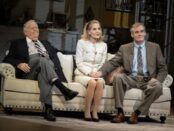
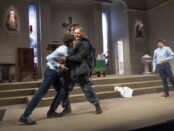
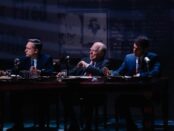
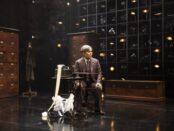
Actress Elizabeth Marvel and director Lee Sunday Evans’ "The Ford/Hill Project," a docudrama first seen in New York in 2024 which uses the verbatim text of the Anita Hill/Clarence Thomas Senate confirmation hearings in 1991 and the Christine Blasey Ford/Brett Kavanagh Senate hearings in 2018, has made a return visit to New York, this time to BAM Fisher’s Fishman Space and the results are riveting. Whether you recall seeing the hearings on television or are witnessing this testimony for the first time, it strikes you this these two cases are among the worse miscarriages of justice in American jurisprudence. The current four-character cast includes Marvel as Doctor Ford, Gabby Beans as Professor Hill, Teagle F. Bougere as Judge Thomas and Josh Hamilton as Judge Kavanaugh. (Marvel and Hamilton have appeared in the play before.) All of the lines that became famous during the hearing are here. [more]

Garry Starr: Classic Penguins
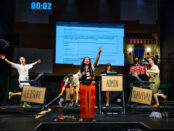
Don’t believe all you hear: Damien Warren-Smith appearing as his alter ego Garry Starr in Classic Penguins is entirely in the nude. However, all the ads say he covers all 1,000+ Penguin paperbacks, when in fact he uses about 50. This inimitable Australian comic is one of the funniest men on the planet and makes this hilarious and at times gross show a madcap and fast review of literature. You do not need to have read the books to enjoy the jokes as in most cases the titles tell it all. When he first appears in a leather armchair, Garry is dressed in an Elizabethan ruff, a top hat, a black tail coat, orange flippers and nothing else, but he quickly loses the coat and hat. The nudity eventually becomes commonplace like the undressed bathers on the beach – you get used it - but he reminds us periodically of his nudity by his antics. The point of the show is to save great literature. Some books get more time than others. There is a great deal of audience participation, always voluntary, and mainly from the first row. The orange and white Penguin paperbacks are revealed by a camera hookup (on top of a small bookcase) which projects each title on to a huge screen above his head. Beginning with Dostoevsky’s The Idiot, he works his way through to R.C. Sherriff’s Journey’s End in 65 minutes. [more]
Becoming Hamlet
Damon Horowitz as Hamlet Guide with Truman Gaudoin as Guildenkranz, Desirée Baxter as Gertrude, [more]
Public Record (Public Works)
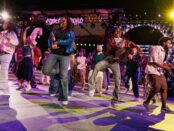
This year’s Public Works’ production of "Public Record" at the Delacorte Theater in Central Park is a tribute and celebration to New York and the people who live in all five boroughs, with 100 cast members singing, dancing and recounting their lives. Originally created by Dan Canham and Emily Lim for the National Theatre, Sunderland, in the United Kingdom, it has now been revised and rewritten to represent New York by Lisa Sanaye Dring. The NY version incorporates the stories of many of its performers, including that of guest artists Louis Cato, Maya Margarita, DJ Papi Juice, Arun Ramamurthy and music supervisor and orchestrator Michael Thurber. At each of the five performances from September 4 - 8, the evening is recorded live and will be preserved by the New York Public Library of the Performing Arts. [more]
Safe House
Not only is L. B. Browne’s play "Safe House" a very accomplished dramatic work, it also manages to be a play for our time including many of the themes of our daily life. Director Benjamin Viertel’s cast of seven brings the play vividly to life so that one recognizes these modern people. If you are interested in the state of new American drama or are just interested in an engrossing night out at the live theater, this is a play not to be missed. [more]
Paranormal Activity
The ability to see all five rooms in the house is par of the fun as you will find yourself constantly looking around to see where the next shock will occur from illusions designer Chris Fisher: the bathroom shower curtain, the dimly lit bedroom, the creepy room designated as the nursery, etc. Of course, lighting designer Anna Watson and sound designer Gareth Fry have a good deal to do with the events that occur: lights go on and off or blackout altogether, unaccountable sounds are heard like the knocks at the door but no one is there. Lights pass through the windows: is it a car or something creepier? [more]
The Real Ivanov (Initiative Productions)
Currently to be seen at the Lynn F. Angelson Theater, adaptor/director Laura Strausfeld has renamed her production "The Real Ivanov," a streamlined version which “preserves almost every line and all of the major characters.” This riveting version performed without intermission reduces the three hour play (with breaks between the acts) to a fast 100 minutes in which the audience sits on all four sides of the playing area, putting us in the arena with Chekhov’s characters. Much of this is due to Jiyoun Chang’s scenic design which uses one item in each of the four acts to set the stage for the different scenes allowing for instant transformations: a bench in Act I, a rug in Act II, a desk and chair for Act III, and a red carpet signifying a hallway for the wedding scene in Act IV. As we have gotten used to a great deal of realistic scenery in recent years, it is amazing how unnecessary it appears to be if the actors create the ambiance and the milieu. [more]
An American Daughter
In "An American Daughter," Wendy Wasserstein approaches a topic still relevant: how American women in public life are expected to be perfect in all things while the men are given a pass for similar behavior. Notice that 29 years after this play appeared on Broadway, the United States has still not had a woman president. Unfortunately, the play is too schematic to be convincing and without enough humor to carry the story to its logical ending. While this production does not make a strong case for this as one of Wasserstein’s better plays, it is still possible that a future staging with a different cast might solve the current problems in this one. [more]
The Winter’s Tale
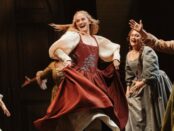
Revivals today tend to come in several similar varieties: rewritten updates by famous contemporary playwrights, director projects that have high concepts, and entirely new plays inspired by the classics, often transposed to the present. It is a pleasure to report that director Daniel Sullivan’s riveting three hour and 20 minutes uncut production of Shakespeare’s The Winter’s Tale for The Public Theater’s Free Shakespeare in the Park is a pure staging, gimmick and update free. Although there is not a weak link in the production, Lily Rabe’s Queen Hermione is so commanding and compelling that she elevates this usually overlooked role to another place in the Shakespeare canon. With a topnotch cast led by Raúl Esparza, Rabe, Chuck Cooper and Steven Skybell, the production features crystal clear sound design by Brian Ronan (sound system design by Mike Tracey) and impeccable diction by vocal and text coach Andrew Wade which makes this easy to follow and understand for both those who are seeing it for the first time and those who know the play. [more]
Hungry Women
Melissa Maney’s "Hungry Women" has a fascinating premise: what would the world be like if there were no men? Obviously, things would be different, but would they be any better? However, the play attempts to be too many things: a critique of Victorian marriage, a sci-fi play set in the future, a socio-political drama, a totalitarian power play. Divided in three parts (“Hungry Women,” “Curious Women” and “Scared Women”), the play seems to be three different one acts as the styles and tones change in each. Daniella Caggiano’s direction is superb except for a great deal of shouting in the third and last scene. However, she does not help unify the play into a coherent whole. [more]
Hershey Felder: The Piano and Me
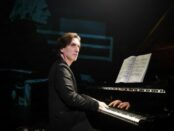
Famous pianist Hershey Felder has toured the world with his many shows about legendary composers from Chopin and Tchaikovsky to Gershwin and Irving Berlin giving over 6,000 performances. Now he has chosen to tell his own story from his upbringing in Montreal to the present and proves himself to be a consummate storyteller both on the piano and in words, incorporating the most famous piano show pieces of the last 250 years. Called "The Piano and Me," the show is riveting for both classical music aficionados as well as those unversed in anything other than pop music of today. Playing 16 people who were instrumental in his career, he brings them all to life for us. [more]
The Saviors
"The Saviors," Bubba Weiler’s second play to be produced in New York in the past year is a coming-of-age play about how to live your life as well as loss of faith. All of its four characters are lost souls and each is trying unsuccessfully to save the other. Tenderly directed by Jack Serio who also directed Weiler’s acclaimed "Well, I’ll Let you Go," the play’s two teen altar boys, acted by Ivan Howe and Julius Rinzel, are actually 13 and 14, giving the play a verisimilitude few productions have. [more]
Giulia: The Poison Queen of Palermo
Feminism did not start in the 20th century. Three-times Grammy winner country singer-songwriter Jennifer Nettles has written an exciting new musical (book, music and lyrics!) inspired by the true story of Giulia Tofana, the 17th century Sicilian woman who is reputed to have poisoned 600 men. Set in 1653, these were the days when the Catholic church forbid divorce and men were kings of their castle with downtrodden wives who were at their beck and call. Brilliantly directed by Mary Zimmerman, "Giulia: The Poison Queen of Palermo" now at the Perelman Performing Arts Center -PAC NYC (which last season gave us "Cats: The Jellicle Ball") is a dynamic show with suitably Broadway pretensions in its elaborate production. [more]
The Whoopi Monologues
Kecia Lewis as Lurleen (foreground) and the cast of Whoopi Goldberg’s “The Whoopi Monologues” [more]
The Tempest (Teatro Grattacielo)
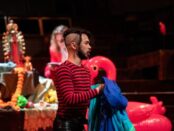
Don’t attend the world premiere of Joseph Summer’s new opera version of William Shakespeare’s "The Tempest" expecting to recognize the text or the characters. Both the libretto by Eve Summer and staging by Teatro Grattacielo’s artistic director Stefanos Koroneos have done their own thing with the original. If you don’t read the program notes before the performance you may be rather confused as to the approach. According to the statement from Koroneos in the program, he imagines Prospero, normally the deposed Duke of Milan, as a film director inside a crumbling 1980s film studio. The enchanted island is filled with inflatable tropical plants, cheap plastic pink flamingos and plastic vines, with a cameraman quietly recording it all. Prospero, previously a magician in thrall to his books, is here seen at an old-fashioned typewriter turning out pages to what one assumes is his latest screenplay. However, if you have not read the notes none of this will be obvious. You may find yourself confused by the typing. [more]
Julius Caesar (Ensemble Shakespeare Company)
In its second producing year, Ensemble Shakespeare Company is offering a fine staging of "Julius Caesar" with some debatable casting choices. As directed by Dylan Diehl, the use of theater in the round focuses the attention center stage for all except Marc Antony’s funeral oration where he climbs up various staircases to give all a vantage to hearing him give his speech. The modern dress production adds a contemporary gloss to an ancient story which still has political relevance. Except for some minor quibbles this is a fine production for both those new to "Julius Caesar" and those very familiar with it. [more]
Are You Now or Have You Ever Been: An American Docudrama
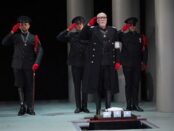
Eric Bentley’s 1972 docudrama "Are You Now or Have You Ever Been" is a powerful play based on the original testimony of the artists, writers and performers who were called to testify before the House Committee on Un-American Activities during the Communist scare of the 1940s and 50s. Originally subtitled “The Investigations of Show-Business by the Un-American Activities Committee 1947 – 1958,” the play remains a reminder of repression and fear tactics so like today’s investigation of so-called enemies of the current administration. Although those times are now called the McCarthy Era, Senator Joseph McCarthy had nothing to do with the House of Representatives Committee that the play depicts as he had his own Senate investigation body. [more]
Henry VI: A Trilogy in Two Parts
Although the three plays have been reduced to two and many of the actors appeared previously in the 2018 production, Henry VI is still challenging for audiences unfamiliar with the Hundred Years War or the War of the Roses. Even with an ensemble of 16, the actors play between three and nine characters each so that you are never entirely sure who anyone is when they appear. With women playing men (mostly to add a few female characters to the play), it is not only often confusing but makes the wrong statement like the Duke of Gloucester played by a female and then his wife being a major character later in the play. Even with 16 cast members some of the court and battle scenes look underpopulated on the large stage. The costuming, a combination of modern and medieval by the collective threeASFour which resembles outfits by Comme des Garçons, does not entirely help even though the English wear black and white in Part I and the French wear black. Due to the number of dukes and earls, it would have been helpful if they wore defining outfits that set them apart from each other. In Part II, the Yorkists wear a white signifier while the Lancastrians wear red but this still does not make it easy to recognize particular characters. [more]
Suddenly Last Summer
In the hands of avant garde director Daniel Fish, the world premiere of Courtney Bryan’s first opera "Suddenly Last Summer" derived from the one-act play by Tennessee Williams is more a performance piece than anything else. In the libretto created by artistic director Gideon Lester and Fish, only the role of Catherine Holly is sung while all the rest are spoken. Catherine does not have any sustained music until the last 23 minutes of the opera which are almost entirely hers. However, as staged at the LUMA Theater of the Fisher Center at Bard College you are most likely to remember the visual aspect of the production which overpowers the musical portions. [more]
Pied À Terre
John S. Anastasi’s "Pied À Terre" is one of those small cast dramas with a lot of secrets to unload. Unfortunately, director Mitch Poulos has staged the play at so slow a pace that it seems to take twice as long as it should. It also has a tricky structure, going back and forth between the present and the past, so that the revelations are greatly delayed. One of the biggest secrets is revealed just before the unnecessary intermission which only serves to make the play longer. [more]
A Walk on the Moon
The new musical "A Walk on the Moon" by original screenwriter Pamela Gray and composer and lyricist AnnMarie Milazzo is pleasant but innocuous. Based on the hit 1999 movie set during the summer of 1969 that starred Diane Lane, Liev Schreiber, Viggo Mortensen, Tovah Feldshuh and Anna Paquin, the stage musical feels like a watered-down version of the film. While the film had time appropriate songs from the 1960s, the stage version has new bland, unmemorable songs that do not forward the plot. The hard-working cast headed by Talia Suskauer, Max Chernin, Sam Gravitte and Andréa Burns under the direction of Sheryl Kaller never make us forget the performances from the film. [more]
That Math Show
Dr. Arthur Benjamin is a charming, genial “math-e-magician” and professor of mathematics. Presented by Science Theater Company in association with the National Museum of Mathematics (MoMath.org), the company that brought you "That Physics Show" and "That Chemistry Show," Benjamin’s one-man show "That Math Show" is a delightful evening for people nine to 90. His fun with math is infectious with audience members vying to get chosen to come up on the stage and participate. As a human calculator, he is not to be believed. [more]
Dad Don’t Read This
Under Claudel’s direction, the four actresses are totally believable as teenage girls circa 2014, with Yoo’s Mal giving the most layered and mysterious performance. (Yoo had her big break last season as the conflicted Raelynn in Kimberly Belflower’s John Proctor is the Villain.) Although the play is completely authentic and persuasive, as it is plotless we do not know where it is going. Nothing much happens nor do the girls grow up in the course of the play. They do eventually each reveal their fears about growing up and what the future holds for them. Each of them seems to be suffering from an unspoken trauma they only hint at. If you don’t identify with one of the four individual girls, you might be bored by the lack of action on stage though it all is very convincing. [more]
Small
Montaro’s career as an actor allows him to create a different voice and stance for each jockey, trainer and owner that he describes. That is enhanced by the atmospheric sound design by Brian Ronan, and the moody lighting by Jamie Roderick which puts us in the jockey room and track. The pitch perfect unit set design by Christopher Swader & Justin Swader represents both part of the stable and the tack room. Under the astute direction of Jessi D. Hill, not only is Montaro able to convince us that he is a teenager but we watch him grow up before us as he goes from age 12 – 20. He puts us in the middle of exciting races as he recreates his reactions to being on horseback and eventually to the abuse of his body to keep his weight down. "Small" is a unique and engaging show from someone who has been there and knows how to recreate this milieu. It is easy to imagine a follow up show where Robert Montano tells us the story of his dance career where he eventually gets to play his dream role of Bernardo in "West Side Story," but that would be another story. [more]
Silverback Mountain
June designated as Pride Month is a time when a great many plays and entertainments are geared specifically for the gay community. The latest is Mickey Gooch, Jr.’s "Silverback Mountain," a semi-musical comedy on relevant gay themes that has been given a less than irrelevant treatment and production. Gooch, Jr. has written and stars in the show which is probably more than one person should do at one time, with original songs by Alex Lewis. The subtitle “A new gay jungle play” suggests a farcical evening but Sam LaFrage’s scattershot direction undermines what real comedy is inherent in the premise. Some of the humor and gimmicks are reminiscent of "The Book of Mormon" which is much slicker and more successful at this kind of parody. [more]
Romeo and Juliet (Free Shakespeare in the Park)
Associate artistic director/resident director Saheem Ali of The Public Theater believes in updating Shakespeare in ways that modern audiences can identify with. His latest production of "Romeo and Juliet" which now graces the stage of the Delacorte Theater in Central Park has taken a big risk in putting a good deal of the play into Spanish (in translations by Alfredo Michel Modenessi) but as his version takes place on the US southwestern border with a wall designed by Maruti Evans that looks much like the real one on our border, this makes perfect sense. With faces covered by bandanas, the Montagues put up signs that say “Abolish ICE” and “Defund the Wall” while the Capulets appear to be a vigilante force dressed entirely in black. One wishes the production were either more or less political. Since so many of the lines in "Romeo and Juliet" are iconic by now (most middle school students having read the play) there is little problem in following the text even if one doesn’t know Spanish. [more]
Jerome
John J. Caswell’s "Jerome" is a lovely low-key play about a love, loss and illness. However, Dustin Willis who also directed Caswell’s "Wet Brain" at Playwrights Horizons never really lets us know where the play is going and its loose ends tend to get in the way. However, its excellent cast of three, two-time Tony Award winner Stephen Spinella, Jeorge Bennett Watson and Ken Barnett keep us interested in the fate of these three men, one dying of kidney and heart disease, while the others try to keep him alive and contented. [more]
Mary, Queen of Scots (Scottish Ballet)
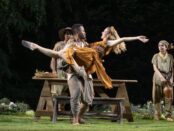
The Scottish Ballet’s exciting "Mary, Queen of Scots" tells its complicated story extremely well and balances classical and modern choreography with ease. Its minimal décor helps make swift transitions between the scenes without making the audience feel that the stage is underpopulated. The costume choices link the past and present so that we are not kept out of this Elizabethan story. The new score by Mikael Karlsson and Michael P. Atkinson avoids dissonance while also keeping it theatrical for modern audiences. This is a worthy addition to the repertory of contemporary dance. [more]
||: Girls :||: Chance :||: Music :||
The title of Eisa Davis’ "||: Girls :||: Chance :||: Music :||" tells it all: four gifted teenagers attend a prestigious girls’ music program in Berkeley, California, apparently for underprivileged students. Some have attended previously; some are new to the program. All are devoted to music: Fax for singing, Margot on the drums and percussion, Rile on the piano, and Clementine on the oboe and baritone sax. The play covered their studies and their interactions: some become friends, some enemies, and some would like to become lovers. Chance plays a role in their lives and choices. [more]
The Maids
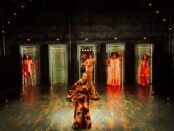
Part of the play is an eye-filling fashion show with Solange and Claire trying on Madame’s gowns or taking them out of her closet to ogle them. However, what is most remarkable about Williams’ production is his use of technology as he did in his "Picture of Dorian Gray" with Sarah Snook on Broadway and his recent "Dracula" with Cynthia Erivo on the West End. The video technology used in "The Maids" is startling, almost overpowering at times. The mirror-lined closets and doors become giant screens that show us Madame’s online posts as well as her live footage of Solange, Claire and herself (from video designer Zakk Hein). Using Tiktok filters and effects she turns them grotesque or changes their face or features. Eventually in a dream sequence, Solange leads Claire through Madame’s closets and they visit a hallucinatory world of fantasy that we see on the screens. The fact that the screens are 13 feet high adds to the power and the effectiveness of these images. [more]
I Wanttt a Unicorn Frappe!!!
While "I Wanttt a Unicorn Frappe!!!" could have been a satire on wedding and wedding planning, the mockery is much too mild and familiar to have any sting. Both Darla and Cassandra are way ahead of Jenny on noticing that Sebastian is not to interested in her – as are we. Why it takes so long for Jenny to wake up to reality is a mystery. However, the unicorn frappe may be a metaphor for the pink dream that she has about her life once married though it appears to all be in her head. The play is much too long for its content, going over the same ideas over and over. [more]
Joe Turner’s Come and Gone
Unlike earlier New York productions, for this "Joe Turner's Come and Gone" set designer David Gallo has moved the set and action up close to the audience. It is as though we have been invited into the boarding house ourselves. Surrounding the boarding house are the factories and bridges that make up Pittsburgh’s life blood. Boone is more sympathetic than previous actors who have played Herald Loomis, a troubled man but one we can sympathize with. As his wife Martha, Abigail Onwunali brings an otherworldliness that adds another level to the play. As Bynum, Santiago-Hudson also endows his character both authority, wisdom and spirituality. [more]
Indian Princesses
The play is interesting and enlightening for those of us not aware of this chapter of American history. However, the author doesn’t make it easy for the audience to follow the characters: all nine characters, fathers and daughters, are introduced simultaneously in the first scene so that it is difficult to know who is who and who goes with which. There are ways of introducing a great many characters in groups so that we can keep them differentiated but Rodriguez has not done that. Plus the characters do not always call each other by name which would help sort out the confusion. [more]
Schmigadoon!
Sara Chase, McKenzie Kurtz, Brad Oscar, Alex Brightman and the company of Cinco Paul’s new [more]
The People Versus Lenny Bruce
The trials and downfall of groundbreaking 1960s counterculture comedian Lenny Bruce is a fascinating story judging from the success of Julian Barry’s play "Lenny," Bob Fosse’s film version and a myriad of documentaries. Susan Charlotte has attempted to duplicate that success with The People Versus Lenny Bruce, adapted from civil rights lawyer Martin Garbus’ 1972 account of his part in the trial in the chapter of the same name in his book "Ready for the Defense." Unfortunately, Charlotte has not followed the theater dictum to show not tell and too much of the play is devoted to the defending lawyer’s very flat delivery of not very interesting narration. Another major problem may be that the evidence presented in 1964 is no longer very shocking in 2026 and it now seems that it should have been an open and shut case for which Bruce was convicted. [more]
The Receptionist
The Second Stage revival of Adam Bock’s "The Receptionist" first seen at Manhattan Theatre Club in 2007 appears to be more timely than ever. That may explain why is seems to shock less than it should as we have been come inured to reports of atrocities all over the world. Sarah Benson’s new production is so low-key that is possible to miss the point. But that may be the point: the banality of evil is not possible if we don’t look away when unpleasant things arise. [more]
Vanessa (Heartbeat Opera)
Inna Dukach as Vanessa and the shadow of Freddie Ballentine as Anatol in a scene from Heartbeat [more]
Broken Snow
Ben Andron’s "Broken Snow" has an interesting premise: two half-brothers who never knew of the others existence meet in an abandoned house which was their father’s last known address. The father has recently died and both men want some answers to his mysterious life. In flashbacks, we meet Kris, that father, played by television star Tony Danza. Unfortunately, much of the mystery remains at the end of the play, with too much repetitious dialogue before we get where the play is going. If this had been played as an outright thriller, it might have generated some real tension. Under Colin Hanlon’s leisurely direction, the play takes too long to build up any steam. Don’t blame the three actors who have to deal with underwritten roles with too much left to our imaginations. [more]
Beaches
Much of the snappy dialogue in Dart and the late Thom Thomas’ script comes from the previous sources but somehow fails to land as intended. Possibly under the co-direction of Lonny Price and Matt Cowart, the delivery isn’t as fast. Dart’s lyrics are both prosaic and generic telling us what we already know. They do not seem to have inspired the legendary composer Mike Stoller (of Leiber & Stoller fame) as his songs either sound very similar or as if you have heard them before. Strangely, where the best songs should go to singer Cee Cee Bloom in her diegetic cabaret acts, Bertie has the best two with “The Brand New Me” and “My Best” (i.e. friend.) As you might have expected, “Wind Beneath My Wings,” the sensational Grammy Award winning number from the movie is sung by Cee Cee at the end of the show, but only shows how lacking the new songs are. [more]
Othello (Bedlam)
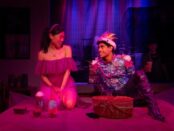
There might be some advantages to a stripped-down version of a William Shakespeare play with fewer characters for small theater companies on a tight budget but Eric Tucker’s Bedlam production of "Othello" hasn’t found it. Reduced to four actors playing all the roles, this effort reaches its limit when in the last scene after Susannah Hoffman’s Desdemona and Susannah Millonzi’s Emilia lie dead, they have to stand up and become Michael Cassio, formerly lieutenant and now general of the Venetian Army in Cyprus, and Lodovico, emissary from the Venetian court, respectively, as there are no other actors to play these parts. It is also unconvincing watching Ryan Quinn’s Othello dropping his blue button-down shirt to his shoulders as a shawl and playing Bianca, Cassio’s Cyprus girlfriend, when we have just seen him as the hero of Shakespeare’s tragedy. This production demonstrates that Shakespeare’s "Othello" might be played with six or eight actors, but not four. [more]
The Balusters
Following in the footsteps of Joshua Spector’s "Eureka Day" and Tracy Letts’ "The Minutes," also stories of local community service groups, David Lindsay-Abaire’s hilarious satire "The Balusters" is simply the best new play of the 2025-26 season. Set at a series of meetings of the Vernon Point Neighborhood Association in a landmarked enclave of an East Coast city, the pointed dialogue skewers liberals who really want to maintain the status quo as well as their white privilege. Hypocrisies abound as the nine members discuss local issues that stir up a great deal of heated debate as well as revealing their personal biases, while little change actually gets voted on. Director Kenny Leon’s terrific ensemble cast is led by Tony Award-winner Anika Noni Rose and Emmy Award-winner Richard Thomas, and the play also reunites the author with Marylouise Burke who has created roles in his "Fuddy Meers," "Wonder of the World" and "Kimberly Akimbo." [more]
Proof
Thomas Kail’s elegant and polished production now at the Booth Theatre (probably the best Broadway venues for dramas) has recast the family as African American and it works just as well – if not better - than the original production in which the family was white. Two stars from the world of film and television – Ayo Edebiri (Chef Sydney on "The Bear") and Don Cheadle ("Devil in a Blue Dress," "Crash," "Hotel Rwanda," "Traffic," etc.) – make their Broadway debuts and take to it like a duck to water. In addition, the remarkable Kara Young, nominated for the Tony Award the last four years and winning two in the last two years in a row, plays the supporting role of the sister with the assurance we have seen in her previously. [more]
Titaníque
Some shows are better Off Broadway either because the smaller theater helps the ambiance or the smaller budget inspires greater imagination or there is a “let’s put on a show” vibe that enhances the fun. "Titaníque," the Off Broadway hit musical which has traveled from The Asylum NYC to the Daryl Roth Theatre to ultimately Broadway’s St. James Theatre, is one of those shows. Not that is it not still an entertaining musical, but the feeling of spontaneity with props that looked like found objects is now missing. The cast is mainly the same but for some superstar additions particularly Emmy Award-winner Jim Parsons as a mugging Ruth DeWitt Bukater and Grammy Award winner Deborah Cox as the unsinkable Molly Brown. [more]
Rheology
"Rheology" previously seen at Brooklyn’s Bushwick Starr in the spring of 2025 has reopened at Playwrights Horizons and proves to be a unique meta-theatrical experience with both performers, a real mother and son, theoretical physicists Bulbul Chakraborty and writer/director Shayok Misha Chowdhury (Pulitzer Prize finalist for "Public Obscenities"), appearing as themselves. Written and directed by Chowdhury in association with Chakraborty, Rheology begins as a physics TED talk on sand as “capricious matter” (Bulbul’s field) then switches to a demonstration of stage directing (Misha’s field), and finally becomes a metaphysical discussion on life and death tying the two together. This is an unusual theatrical presentation, one you will ponder for a long time to come. [more]
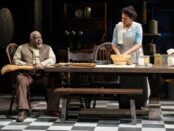
The Adding Machine
Among Bradshaw’s revisions are the use of a narrator, reducing the original cast list from 25 to four, adding an intermission, updating some of the slang to contemporary speech, and having its protagonist Mr. Zero played by a woman instead of a man. The effect of all of these changes is that the play now runs longer than it used to, and the long monologues are still in evidence and become rather tedious. The new version still includes some of the protagonist’s racist rant in the trial scene. Few of these changes make the play any better or more relevant today. [more]
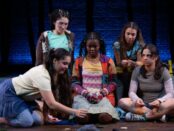
Titus Andronicus
While 'Titus Andronicus" is not for the squeamish, it has definite importance in Shakespeare’s canon showing us where he started, how he was influenced by his contemporaries, and how he developed later. Jesse Berger’s exciting and swiftly moving production is riveting at all times, not only keeping the energy up but keeping the play surprising as it develops. As we suspected from Patrick Page’s one-man Shakespeare play, he is an asset to any Elizabethan production and leads a compelling cast. This may not be your cup of tea but you will not be bored for a second, even though you may be startled or shocked. [more]
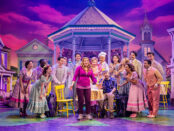
How My Grandparents Fell in Love
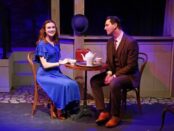
Playwright Cary Gitter and composer Neil Berg’s "How My Grandparents Fell in Love," their follow-up musical to "The Sabbath Girl" also seen at 59E59 Theaters, is a charming old school two-character musical about how Gitter’s grandparents got together in 1933. While not particularly new in content or style, it has its own appeal and a prepossessing plot and quirky characters that hold your interest. Set in Rovno, Poland in the 1930s, it also brings back to life a civilization that is gone with the wind dramatizing pre-World War II Europe. Harris Milgrim and Becca Suskauer are an engaging couple as the author’s grandparents who initially don’t like each other when they first meet just like Jane Austen’s iconic couple in Pride and Prejudice, possibly the archetype for all major rom-coms. [more]
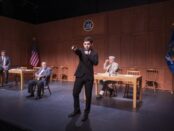
Cats: The Jellicle Ball
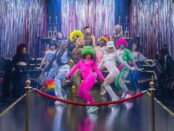
The company of PAC NYC production of “Cats: The Jellicle Ball” at the Broadhurst Theatre (Photo [more]
Nicole Travolta Is Doing Alright
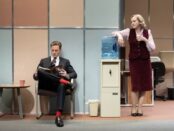
Nicole Travolta, a member of the famous Hollywood family, has turned her life into a one-woman show that is introducing her to the New York stage. "Nicole Travolta is Doing Alright" is an entertaining and humorous tale of a girl who grew up in Los Angeles and then found herself as a teenager in Florida when her parents moved there. Co-written with Paula Christensen, it is also a cautionary tale about how not to grow up when on your own. Travolta is an animated, vivacious performer in telling her life story up until now. She recounts her adventures with credit card debt, divorce by age 30 and becoming a spray tan artiste which eventually straightened out her finances. Now at age 40, she has finally learned the error of her ways. [more]
Public Charge
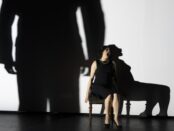
If you ever wondered what it is really like to work in the corridors of power, "Public Charge" based on the political career of Julissa Reynoso, an idealistic diplomat who was Deputy Assistant Secretary of State for the Western Hemisphere under Secretary of State Hilary Clinton and Ambassador to Uruguay during President Obama’s second term, will give you an excellent idea. Written with playwright Michael J. Chepiga, the world premiere production of "Public Charge" now at The Public Theater is a fascinating account of attempting to make change in a bureaucracy whose very policies keep anything from happening. Told by someone who lived it, it is all true as far as we know. Under Doug Hughes’ robust and forceful direction, the play is never didactic or too dense, making us feel we are living the events as Julissa encountered them. [more]
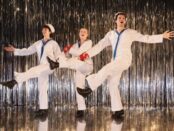
No Singing in the Navy
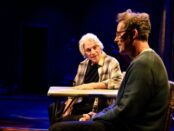
"School Pictures," Milo Cramer’s last New York show, a solo musical, was wildly inventive, hilarious funny, and extremely insightful about the New York education system, based on his own experiences as a tutor. Unfortunately, his new musical show again premiering at Playwrights Horizons seems to be out of his comfort zone though he has been a fan of musicals for years. "No Singing in the Navy" is a three-character revue which purports to be a tribute to Golden Age musicals, but its format is a series of very slight skits, à la 'Saturday Night Live," all with the same three sailors. It does use the premise from "On the Town": three sailors on leave for 24 hours before shipping out to the war, also used in a series of original Hollywood musicals, usually about sailors who become involved in putting on a show in either New York or on the coast. This show claims to have parodies of songs from "The Music Man," 'Peter Pan" and "The Sound of Music" but most theatergoers will not recognize them. A charming idea, but "No Singing in the Navy" is too thin and simplistic to make us think of those golden age musicals that still get revived on stage and reaired in their film versions. [more]
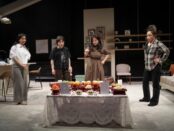
Jesa
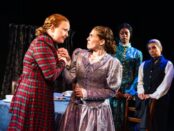
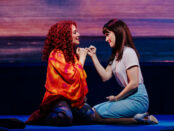
The dominant form of American theater since Edward Albee’s "Who’s Afraid of Virigina Woolf?" has been the dysfunctional family drama of which there have been countless such plays. The newest one, Jeena Yi’s debut play "Jesa" presented by Ma Yi Theater Company in residence at The Public Theater, adds a new wrinkle. This time the family is Korean American and the cast is all women, four sisters to be exact who meet to perform their parents’ jesa. Jesa is a Korean ceremony honoring the dead on the anniversary of their passing that includes food, ritual and requesting their blessings. It is this ceremony that brings together the four estranged for the first time in a long time, the first time they are honoring their mother who died a year ago. [more]
Monte Cristo
Adam Jacobs in a scene from the York Theatre’s world premiere production of the musical “Monte [more]
Antigone (This Play I Read in High School)
The world premiere of Anna Ziegler’s new play, "Antigone (This Play I Read in High School)" now at The Public Theater, is one of four ambitious attempts to update Sophocles’ tragedy playing in New York this spring. However, Ziegler overburdens her version with three separate stories which vie for our attention: a contemporary woman who read the play in high school and has admired its heroine ever since, Sophocles’ version of the Greek myth, and the one that takes up the most time in this play, a modern Antigone who has a different beef with the state. What Ziegler is really after is a Post-Roe v. Wade story about a woman who goes against the new abortion laws of her country. Unfortunately, Sophocles’ original plot as a sequel to "Oedipus Rex" and "Oedipus at Colonus" doesn’t really work with this contemporary social context. Tyne Rafaeli’s direction suggests that at any moment one of the scenes will catch fire but, unfortunately, they never do. [more]
The Paparazzi
Ryan Howell’s Art Deco unit set with the outline of the Chrysler Building gives the story a midtown feel but does not make clear when all this is happening. The costumes by Cathy Small are credible casual wear but are rather too bland to define the characters except for high-powered Betty. John Burkland’s lighting creates various moods for the unchanging set. With no references to the internet or social media, "The Paparazzi" seems like it is taking place several decades ago but the program insists that this is all happening now in 2026. [more]
Blood/Love
"Blood/Love," the Vampire Pop Opera, may just have the most energy of any musical in town. Dynamic, obsessive and seductive this rock opera is the kind they don’t seem to write any more. This is also a sound and light show that creates its own dazzling environment and does not let you look away from the stage for a moment. Even the lobby and the theater have been redecorated to look like a nightclub in black and red, along with suitable mixed drinks at the bar. Written and composed by two-time Grammy nominee Dru DeCaro and Carey Renee Sharpe who also plays the leading role of Valerie Bloodlove, this has a powerhouse score that submerges you in its sound and catches you in its web. [more]
The Silent Serenade
Mannes Opera’s production of "The Silent Serenade" now seems retro with its lilting score, a combination of Johann Strauss II and Jerome Kern who was working in Hollywood during Korngold’s tenure. This may be why the frivolous plot seems like that of a Fred Astaire/Ginger Rogers movie. (Ironically, Korngold’s romantic operas sound Puccini-esque and his orchestral film scores found influenced by Wagner.) While the libretto for the operetta is set in 1820s Naples, its anachronisms like a fashion house with models, tabloid newspapers looking for gossip, and references to Hollywood actresses make the updating to the 1950s (suggested by Teresa Wadden’s beautiful costumes, literally a fashion show in itself) much more believable. Although Korngold was used to huge orchestras both for his operas ("Die Tote Stadt," "Violanta," etc.) and at Warner Brothers, he scored his operetta for ten instruments and Mannes music director Cris Frisco gave it an excellent reading. He may have been hoping that its small scale might make it more attractive to theater impresarios. [more]
Burnout Paradise
"Burnout Paradise" is the most unique show in New York right now and enormous fun. A sort of athletic performance piece, it is also an interactive circus competition. Four members from the Australian theater collective Pony Cam perform on treadmills in four sets of 12-minute sessions each while performing set tasks and have to beat their own previous record while completing all the tasks. Genial hostess Ava Campbell explains the rules, keeps time, sells merchandise and serves Gatorade to lucky theatergoers. If the performers do not beat their previous record, audience members can request their money back. However, the show is so much fun that you will have had your money’s worth by the end no matter what the final score. In any case, the performers do collectively run about 17 miles before the evening is over. [more]
Trash
James Caverly and Andew Morrill’s Trash is a provocative play about two late 20s deaf roommates who have nothing in common except sharing an apartment. However, what is most intriguing about Trash is that it told in multiple ways. As the main characters are both deaf, they use American Sign Language to communicate. As a concession to hearing audiences, some of the dialogue is projected on three walls facing the audience. Still more unusual, there is a jukebox on stage (played by Chris Ogren) which, when fed with dollar bills, translates the ASL into spoken speech. When the lead characters really want us to know what is being said they use this method. However, this is only used partially. Much of the play is told only in ASL but Caverly and Morrill are so adept (and so dramatic) at it that we often feel like we know exactly what they are saying. They also use white boards which they hold up for all to see for simple statements or questions to the audience which sometimes require answers.
[more]
Bigfoot! A New Musical
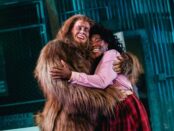
The latest show about intolerance and social outcasts is the delightful "Bigfoot! A New Musical," now at New York City Center Stage I. Similar in plot to "Bat Boy: The Musical" but with a happy ending, if the book written by Amber Ruffin and Kevin Sciretta has much in common with sketchy comedy, it is most certainly because its writers come from that genre. The game cast is led by charming and cuddy Grey Henson as the hirsute seven foot title character with the rest of the hard-working cast playing many roles in the course of 90 minutes. [more]