
School Girls; Or, The African Mean Girls Play
Beauty-pageant dreams and teenage rivalries fuel the wit and sting of Jocelyn Bioh’s "School Girls."

Jordan Rice, Nia Otchere-Sarfo, Lucia Aremu, Erin Morton and Denée Benton in a scene from the Manhattan Theatre Club production of Jocelyn Bioh’s “School Girls; Or, The African Mean Girls Play” at the Samuel Friedman Theatre (Photo credit: Matthew Murphy)
It’s been nearly nine years since I greatly enjoyed Jocelyn Bioh’s funny-sad School Girls; or The African Mean Girls Play in its MCC Theater production at Off Broadway’s Lucille Lortel Theatre. So it was refreshing to become reacquainted with this charming play about six Ghanaian school girls and a beauty pageant competition in its first Broadway production by the Manhattan Theatre Club. The play, expressively directed by Whitney White, retains much of its endearing charm although, perhaps because of the larger stage, the vibrant actresses playing high school girls sometimes border on the cartoonish when they seek to capture the naïve girlishness of their obviously younger characters.
Bioh, the daughter of Ghanaian parents who emigrated to America in the 60s, has written a perfectly suitable vehicle for a talented ensemble that gets under the skin, so to speak, of six teenagers at the Aburi Girls Boarding School, in the Aburi Mountains of central Ghana. That also happens to be where Bioh’s own mother—a self-confessed mean girl—went to school.
Bioh’s plot, set in 1986, is inspired both by her mother’s girlhood at this school and Ghana’s attempt to become the first West African country to have a contestant win the 2011 Miss Universe Pageant; the young woman in question, who didn’t place, was American-born, biracial, and of disputed Ghanaian heritage. The issue of “colorism” in African society, as Bioh calls it, was one of her main concerns in writing the play.

Denée Benton and Jasmine Amy Rogers in a scene from the Manhattan Theatre Club production of Jocelyn Bioh’s “School Girls; Or, The African Mean Girls Play” at the Samuel Friedman Theatre (Photo credit: Matthew Murphy)
Four of the girls are in thrall to Paulina (Denée Benton, striking), leader of the pack and meanest of the mean: there’s the Tweedledee-Tweedledum pair of Gifty (Nia Otchere-Sarfo) and Mercy (Jordan Rice); Ama (Lucia Aremu), nobody’s fool; and Nana (Erin Morton), overweight and so desperate to be part of the group she lets Paulina use and abuse her.
The sixth girl is Ericka (Jasmine Amy Rogers, glowing as brightly as she did in Boop! The Musical), a lovely, biracial, light-skinned girl raised in America; her father owns a local cocoa factory and family circumstances require her to finish school in Ghana. Immediately, the pack begins gravitating to the friendly, intriguingly appealing, won’t-take-guff stranger, and the domineering Paulina sees her position threatened.
The stakes keep getting higher as the girls compete to be selected in a school pageant for the Miss Ghana competition, a prelude to what the play calls the Miss Global Universe Pageant. The judge is glamorous, dark-skinned, visiting alumna Eloise Amponsah (Patina Miller, playing the ego-driven glam-girl to the max), Miss Ghana of 1966 (of which she keeps reminding us). She’s the onetime friend of the stern but motherly Headmistress Francis (Heather Alicia Simms, convincingly authoritative).
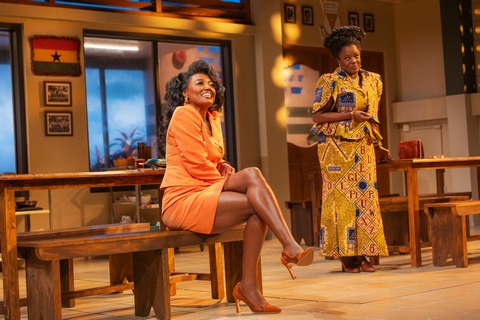
Patina Miller and Heather Alicia Simms in a scene from the Manhattan Theatre Club production of Jocelyn Bioh’s “School Girls; Or, The African Mean Girls Play” at the Samuel Friedman Theatre (Photo credit: Matthew Murphy)
The growing enmity between the dark-skinned Paulina—whom everyone, especially Paulina herself, thinks has the title in the bag—and the light-skinned Ericka, whose potential Eloise immediately spots, leads to a strikingly dramatic confrontation during which the girls reveal far more about their personal circumstances than we might otherwise have realized. It’s a gutsy scene but one that requires a heavy suspension of disbelief when you’re asked to accept that the gorgeous, forthright, vocally gifted Ericka—or, at least, this Ericka—could ever have been a social outcast among her Ohio classmates because of her skin color.
Much of the play’s appeal comes from the high-spirited girls’ ignorance about the world outside their mountain village, a world where New York’s Chinatown is considered a retail paradise, Walmart and Conway are trendy boutiques, White Castle is a dining wonderland, and Calvin Klein’s last name sounds like “Clean.” Worldly innocence aside, these kids are no different from those you might see chattering away like chipmunks almost anywhere teenage girls of any color congregate.
With the action set entirely in the school’s cafeteria, designed by Teresa L. Williams, with upstage windows allowing for nicely lit (by Stacey Derosier) landscape views, we’d expect other girls to be present, too. This isn’t a movie, though, so we just have to accept that everyone else is in class or outside playing while the action transpires. Qween Jean’s costumes make a potent contribution, ranging from the girls’ dullish uniforms to Eloise’s eye-catching ensembles to the girls’ pageant gowns, although you again have to suppress your disbelief about how these girls were able to assemble such ensembles.

Nia Otchere-Sarfo, Erin Morton, Jasmine Amy Rogers, Jordan Rice, Heather Alicia Simms, Patina Miller, Lucia Aremu and Denée Benton in a scene from the Manhattan Theatre Club production of Jocelyn Bioh’s “School Girls; Or, The African Mean Girls Play” at the Samuel Friedman Theatre (Photo credit: Matthew Murphy)
Bioh provides food for thought in her concern for preoccupations with skin color—even to the point of using dangerous bleaching cream—an issue significant beyond this West African setting. There are also its concerns with female worries about body image, while the issue of physical beauty as the key to international success and wealth for poor young women will resonate as well.
It matters little that the situations are obviously old-hat, contrived, and manipulative; the African setting (with attendant accents) gives it a delightful twist, it’s written with wit, and—the exaggerations aside—it’s so well-crafted, that you find yourself absorbed for every one of its 80 uninterrupted minutes.
School Girls; or, the African Mean Girls Play has some moments of bitterly divisive meanness but, with its plentiful laughs and tears, it’s also uplifting, unifying, and funny. When I saw it in 2017 I thought its next step was as a movie. That didn’t happen but, now that it’s on Broadway, perhaps someone will open that door.
School Girls; or the African Mean Girls Play (through November 22, 2026)
Manhattan Theatre Club
Samuel J. Friedman Theatre, 261 W. 47th Street, in Manhattan
For tickets, visit http://www.manhattantheatreclub.com
Running time: 85 minutes without an intermission


Leave a comment