
The House of the Negro Insane
A searing drama of Jim Crow’s hidden horrors, Terence Anthony's heartbreaking play finds beauty, courage and the stubborn hope of freedom amid despair.
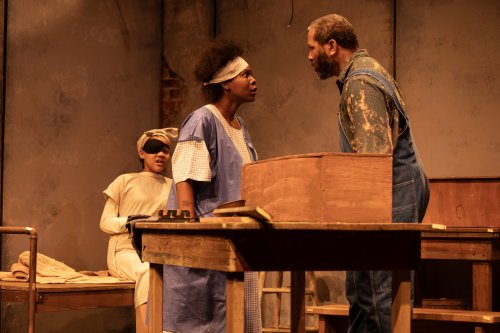
Sidney Hatcher, Wadiah Waliah and Benjamin C. Rowe in a scene from Terence Anthony’s “The House of the Negro Insane” at 59E59 Theaters (Photo credit: Steven Anderson)
Terence Anthony’s The House of the Negro Insane, now playing at 59E59 Theaters in a production directed by Daniel Carlton, is the sort of play that makes history feel less like a sequence of dates and more like a room from which no one can quite find the exit. Set in 1935, in the carpentry workshop of an Oklahoma psychiatric hospital for Black patients, the play confronts one of the most shameful corners of Jim Crow America: institutions where Black men, women, and children could be confined indefinitely under the elastic authority of a medical system that too often confused racism, poverty, disability, independence and mental illness. Anthony does not turn this material into a museum exhibit or a dutiful history lesson. Instead, he compresses an enormous national crime into an intimate drama of four people, making their confinement, fear, humor, imagination, and desperate longing for freedom immediate. The result is harrowing but also deeply humane, a piece of theater whose darkness makes its flashes of beauty all the more affecting.
At the center is Attius Grimes (Benjamin C. Rowe), a Black man who has spent seven years inside the hospital after being declared incompetent to stand trial following an encounter with a white woman that ended in his being beaten unconscious and arrested. His alleged crime is gradually complicated by the circumstances surrounding it, as is so much else in Anthony’s play. Attius has survived by becoming useful. He builds the coffins in which the hospital’s dead are carried away, working in a rough wooden workshop that has become both his prison and his refuge. Rowe plays him with a remarkable economy, allowing the character’s intelligence, suppressed anger, terror, and capacity for tenderness to emerge through the smallest details: the careful arrangement of his tools, the sweeping of the floor, the ritual of work. Attius has learned that obedience is a form of camouflage, and his habitual “Yes, sir” conceals a mind that is considerably more alert than the institution would prefer. Rowe makes the gradual thawing of that guarded man into the play’s emotional center.
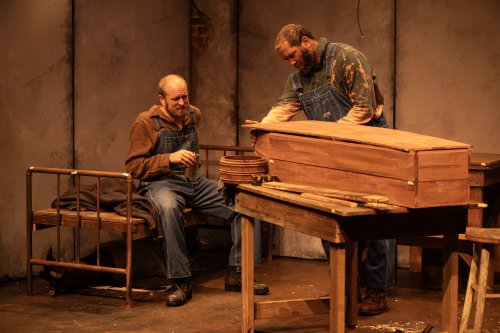
Rob Penty and Benjamin C. Rowe in a scene from Terence Anthony’s “The House of the Negro Insane” at 59E59 Theaters (Photo credit: Steven Anderson)
The arrival of Effie (Wadiah Waliah) disturbs this carefully maintained equilibrium. Effie is what the institution calls insane largely because she refuses to behave as though she has accepted the rules imposed upon her. Streetwise, funny, furious and almost ferociously alive, she has been committed after an abusive relationship and a series of circumstances that reveal how easily a Black woman’s refusal to submit could be converted into evidence of mental instability. Waliah gives Effie a marvelous combination of bravado and vulnerability. She enters the workshop like a small electrical storm, challenging Attius’ resignation and negotiating for her continued presence with an ingenuity that is both comic and heartbreaking. Her defiance is not merely a personality trait; it is her survival mechanism. Waliah understands that distinction, and when Effie’s armor finally cracks, the effect is devastating.
Then comes Madeleine (Sidney Hatcher), a child who has been abandoned at the hospital by relatives unable or unwilling to care for her. Hatcher carries an extraordinarily demanding role with luminous openness, capturing the peculiar mixture of innocence and perceptiveness that allows a child to recognize the truth of a frightening world even while continuing to imagine something better. Her relationship with Attius gives the play its tenderest dimension. She does not simply pity him or ask him for protection; she draws him into the imaginative world he has tried to suppress. Attius remembers his father’s battered recording of Stravinsky’s The Firebird, and Madeleine, who has never heard the music, transforms his memories into her own story. He becomes a tree; the Firebird comes to rest upon him; even his grim surname becomes material for her playful invention. In these scenes, Anthony discovers an extraordinary counterforce to institutional brutality: imagination as an act of freedom.
Rob Penty’s Henry completes the play’s unsettling human geometry. He is white, employed to supervise Attius, and empowered by a racial system that he himself only partially benefits from. Penty makes him frightening precisely because he is so unpredictable. Henry can be almost companionable one moment and casually vicious the next, moving from cultivated pleasantry to racial intimidation with a speed that keeps Attius perpetually off balance. His own resentment at being treated as a lowly “hayseed” by white society complicates rather than excuses his behavior. Anthony thereby makes an important point about Jim Crow: a caste system can injure those at its bottom while simultaneously teaching them to defend their tiny advantage over those beneath them. Penty gives this contradiction a wounded, ugly vitality, while Rowe’s refusal to trust him becomes an eloquent portrait of survival under constant surveillance.
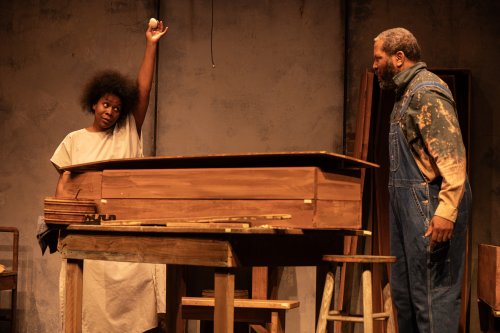
Wadiah Waliah and Benjamin C. Rowe in a scene from Terence Anthony’s “The House of the Negro Insane” at 59E59 Theaters (Photo credit: Steven Anderson)
The play’s violence is never merely decorative. It grows naturally out of the institution’s logic, so that when physical confrontations finally erupt, they feel less like theatrical surprises than the inevitable consequences of a system built upon coercion. Fight coordinator Reggie Wilson gives the confrontations a frightening physical credibility, especially in the intimate confines of 59E59’s Theater B. Carlton’s direction keeps the pressure high, allowing the four central characters to circle one another through fear, suspicion, affection, and necessity until Attius can no longer maintain the neutrality that has kept him alive. His transformation is therefore not a conventional heroic awakening. It is something more difficult and more moving: the realization that protecting oneself can eventually become indistinguishable from abandoning someone else.
That Firebird motif is one of the production’s loveliest achievements. Linwood Booker’s sound design, particularly when the music moves from the scratchy sound of an old record into the fuller imagined space of an orchestra, gives Attius a temporary escape from the workshop. Antoinette Tynes’ lighting deepens these moments, isolating Rowe in a warm, almost dreamlike world that briefly suspends the rules of the institution. The contrast between these reveries and the grim physical reality surrounding them is central to the play’s power. Anthony understands that people imprisoned by history are not therefore deprived of fantasy, memory, music, humor, or dreams. Indeed, these may be precisely the things that allow them to remain human.
Chris Cumberbatch’s scenic design gives the play an appropriately tactile home. The workshop is constructed from unfinished floors, wooden planks, worktables, tools, vises, hammers, coffins, and the other practical debris of a carpenter’s life, and the audience is brought close enough to the action to feel the oppressive physicality of the space. Most striking is the coffin-shaped entrance through which the Black characters are introduced, appearing almost as if they have emerged from death before entering the living world of the play. The image establishes the production’s central metaphor immediately: the hospital is not simply a place where people are treated, but a system that has already begun imagining their disappearance. Katherine Roberson’s costumes reinforce the social hierarchy with equal clarity, from Attius’s worn work clothes to Henry’s unmistakably working-class attire and the shapeless garments imposed upon Effie and Madeleine.
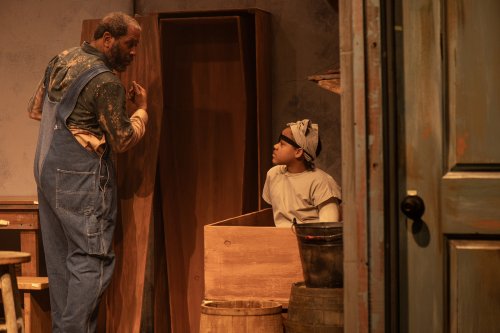
Benjamin C. Rowe and Sidney Hatcher in a scene from Terence Anthony’s “The House of the Negro Insane” at 59E59 Theaters (Photo credit: Steven Anderson)
The production’s visual and sonic vocabulary occasionally becomes more assertive than the richly detailed physical world can comfortably absorb. Booker’s projections contain striking images, including visions associated with Effie’s fantasies of Harlem, but they can sometimes appear blurred and do not always communicate as clearly with Cumberbatch’s scenic design and Tynes’ lighting as their evident ambition deserves. Likewise, some sound cues arrive with an abruptness that can feel abrasive, momentarily disrupting rather than deepening the mood. These are relatively minor imperfections in a production whose central theatrical language is otherwise remarkably coherent. The starkness of the workshop, the close proximity of the actors, the carefully controlled lighting, the music, the coffins, and the recurring images of confinement create a world that feels both historically specific and hauntingly recognizable.
What makes The House of the Negro Insane linger is Anthony’s refusal to let his characters become merely representative figures in a story about racism. The play was inspired in part by the history surrounding Henrietta Lacks and her daughter Elsie, who was confined in Crownsville Hospital for the Negro Insane, as well as by the broader history of segregated psychiatric institutions in which Black patients were subjected to neglect, experimentation, coercion and abuse. But Anthony’s achievement is to make that history breathe through individual lives. Attius, Effie, Madeleine, and Henry are not illustrations of an argument; they are people caught inside one. By the time Anthony’s larger point about racism and institutional confinement surfaces explicitly, the audience has already experienced it emotionally. The history has ceased to be abstract. It has become a man building coffins, a woman bargaining for freedom, a child inventing a Firebird, and a white overseer discovering how much power can distort the soul.
Carlton and his superb cast ultimately give the play what it needs most: a sense that even inside a place designed to extinguish hope, human beings continue to make meaning. Rowe’s quiet intensity, Waliah’s combustible charisma, Hatcher’s radiant innocence, and Penty’s menacing instability form a beautifully balanced ensemble, while the designers surround them with a world of wood, darkness, music, and looming death. The production does not make its history comfortable, nor should it. Instead, it makes that history intimate, forcing the audience to recognize the terrifying ingenuity with which societies can turn prejudice into policy and cruelty into routine. Yet it also insists upon the stubborn persistence of imagination and connection. In that sense, The House of the Negro Insane is not only a play about confinement. It is a play about the moment when someone inside the cage begins to imagine a door—and, more importantly, decides to open it for someone else.
The House of the Negro Insane (through September 6, 2026)
The Negro Ensemble Company, Inc.
59E59 Theaters, Theater B, 59 East 59th Street, in Manhattan
For tickets, visit www.59e59.org
Running time: one hour and 40 minutes without an intermission


Leave a comment