
To Have and To Hold
A sparkling modern riff on Shakespeare, as sisterhood, romance and feminist convictions collide in a hilarious, heartfelt quest to rewrite stories we inherit.
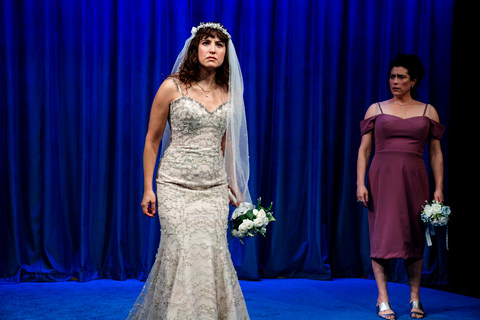
Tedra Millan and Laura Lapius in a scene from Lapidus’ “To Have and To Hold” at Chashama’s 154 Theater (Photo credit: Marcus Middleton)
There is something wonderfully perverse about naming two sisters Kate and Bianca after the heroines of Shakespeare’s The Taming of the Shrew and then setting them loose in the 21st century, where the old machinery of courtship has become at once more liberated, more commercial, and considerably more bewildering. In Laura Lapidus’ To Have and To Hold, directed by Zoë Adams, and now playing at Chashama’s 154 Theater, Shakespeare’s notoriously troublesome romantic comedy becomes the occasion for a much more contemporary inquiry: What happens when the stories we inherit about love, marriage, womanhood, and ourselves collide with the stories we have painstakingly written on our own? The result is a buoyant, intelligent, unexpectedly tender comedy that knows its Shakespeare but refuses to be imprisoned by him.
Kate, played by Lapidus herself, has constructed an entire philosophy around the conviction that marriage is “an instrument of the patriarchy,” a proposition she can elaborate with such exhilarating intellectual ferocity that one almost forgets that beneath the manifesto is a woman who is frightened of losing the person she loves most. That person is her younger sister, Bianca, her best friend and lifelong companion, whose decision to marry suddenly transforms Kate’s carefully ordered universe. The impending wedding is therefore not merely a romantic event but an existential rupture: Bianca is acquiring a new life, and Kate must confront the terrifying possibility that sisterhood, however profound, cannot remain the only story either woman tells about herself.
Lapidus’ construction of the play is particularly ingenious in the way it treats Shakespeare less as a template than as a ghostly interlocutor. The scenes move through bridal fittings, supermarkets, graveyards, apartments, and the increasingly unstable terrain of romantic possibility, with only seven months separating the opening from the final curtain. Dialogue from The Taming of the Shrew periodically surfaces in the contemporary world, sometimes as quotation, sometimes as fantasy, sometimes as a kind of linguistic flirtation. When Kate encounters Peter in a grocery store and the two suddenly begin speaking in Shakespearean verse, the effect is not academic but deliciously theatrical; the old language becomes a secret code through which two strangers recognize something in one another. Lapidus also wisely dispenses with Shakespeare’s Induction, concentrating instead on the emotional architecture of the sisters and on the larger question of whether an inherited narrative can be rewritten without losing everything valuable that came before it.
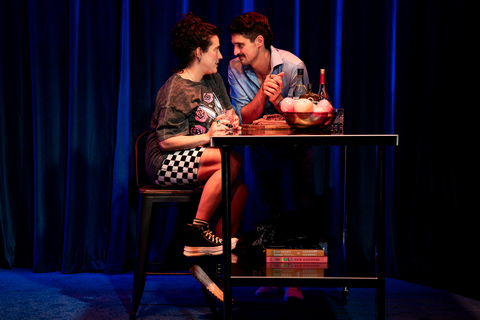
Laura Lapidus and Yuriy Sardonov in a scene from Lapidus’ “To Have and To Hold” at Chashama’s 154 Theater (Photo credit: Marcus Middleton)
The play’s most affecting invention is the sisters’ deceased mother, a Shakespeare “freak” who named her daughters after Shakespearean characters partly because she dreamed of becoming a professor. Her absence hovers over the comedy like a benevolent but complicated spirit. Kate and Bianca have inherited not merely their names but competing interpretations of what those names mean. Their mother’s decision becomes a miniature version of the play’s central argument: every life arrives burdened with stories already written, and adulthood consists, at least in part, of deciding which of them deserve to survive. Lapidus gives the sisters enough shared history—childhood jokes, peculiar accents, instinctive physical familiarity, old wounds—to make their relationship feel genuinely lived rather than conveniently theatrical. The comedy consequently acquires an emotional foundation sturdy enough to support its flights of romantic fantasy.
As Kate, Lapidus gives a performance of exhilarating contradictions. Her character can be caustic one moment and almost painfully vulnerable the next, a woman whose formidable certainty is revealed gradually to be a form of self-protection. Lapidus understands that Kate is funniest when she believes herself to be the smartest person in the room, and most touching when that confidence begins to fail her. Her physical ease with Millan creates the unmistakable impression of sisters who have been irritating, protecting, entertaining and rescuing one another for decades. And when Peter enters the picture, Lapidus discovers an entirely different register: Kate becomes electrically alive, almost against her will, as though attraction itself were an argument she has not yet learned how to rebut.
Tedra Millan’s Bianca is equally wonderful, but in a markedly different key. She brings to the role an appealing mixture of sweetness, neurosis, impatience, and emotional intelligence, allowing Bianca to emerge as far more than the conventional romantic foil. Millan and Lapidus have an uncanny rhythm together; their exchanges have the loose, spontaneous quality of private conversation overheard rather than dialogue delivered. Their teasing, silly accents, sudden irritations, and flashes of tenderness establish the extraordinary intimacy of two people who have spent most of their lives as each other’s primary witnesses. When that intimacy is threatened by Bianca’s engagement, Millan makes the resulting pain feel neither sentimental nor melodramatic. Bianca’s growing insistence that her sister recognize her right to choose a different life becomes one of the play’s most moving arguments for love as an act of generosity rather than possession.
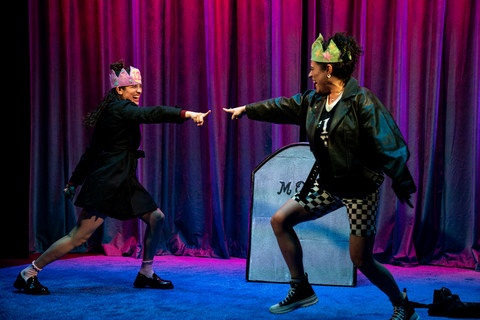
Tedra Millan and Laura Lapius in a scene from Lapidus’ “To Have and To Hold” at Chashama’s 154 Theater (Photo credit: Marcus Middleton)
Then there is Yuriy Sardarov’s Peter, Shakespeare’s Petruchio reincarnated not as a swaggering misogynist but as something much more contemporary: the seemingly impossible good man. Peter is handsome, wealthy, intelligent, successful, patient, romantic and sufficiently smitten with Kate to pursue her even when she makes the enterprise spectacularly difficult. In lesser hands, such a character could become an inert fantasy object, but Sardarov supplies him with an irresistible comic warmth and an almost disarming sincerity. His chemistry with Lapidus is immediate. The flirtation crackles, and his occasional attempts to negotiate Kate’s ideological defenses give the romance the buoyancy of a genuine game between equals. Sardarov’s star quality is particularly evident in the moments when Peter drops the polished romantic persona and becomes simply a man trying, with imperfect dignity, to make someone he adores happy.
Adams’ direction understands exactly what this material requires: speed without haste, elegance without fuss, and enough theatrical invention to keep the production perpetually in motion. Her transitions are deftly engineered so that the comedy rarely loses momentum, while her blocking frequently finds visual counterparts to the play’s emotional arguments. Characters are sometimes “frozen” in isolated pools of light, creating miniature tableaux in which the audience is invited to decide whose perspective it shares. The curtain itself becomes an unexpectedly comic participant in the action, while the silhouette of the dressers before the wedding produces a lovely image of people on the threshold of lives they have not yet imagined. Adams makes a modestly resourced production feel remarkably assured.
The design team completes the illusion with considerable flair. Se Hyun Oh’s scenic design creates a succession of distinct environments from economical materials, while Mieka van der Ploeg’s costumes capture both the bridal-world gloss of Bianca’s wedding and Kate’s gloriously disheveled aesthetic. Yang Yu’s lighting is especially evocative, giving the scene changes their own dramatic life and transforming transitional moments into miniature pieces of theater. Liam Bellman-Sharpe’s sound and music contribute a propulsive energy that helps propel the production from one emotional beat to the next. Everything conspires toward the same achievement: making a story about marriage feel less like a conventional romantic comedy than a playful investigation of the identities we construct, inherit, defend and occasionally surrender.
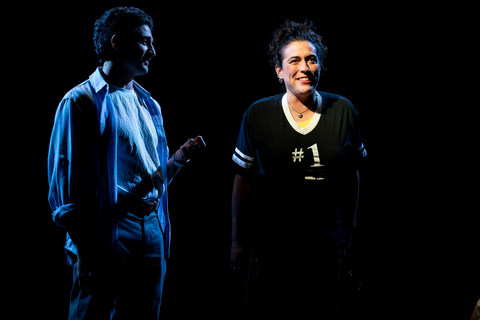
Yuriy Sardonov and Laura Lapidus in a scene from Lapidus’ “To Have and To Hold” at Chashama’s 154 Theater (Photo credit: Marcus Middleton)
What makes To Have and To Hold so pleasurable, ultimately, is its refusal to regard love as a simple answer. The play understands that romance can be liberating and constraining, that marriage can represent both social convention and genuine companionship, and that independence need not require isolation. Four centuries after Shakespeare introduced audiences to a “shrew” whose destiny was supposedly to be tamed, Lapidus offers something considerably more generous: a woman who must decide for herself what, if anything, she wishes to be. The result is a smart, funny, Shakespeare-literate summer comedy whose deepest subject is not marriage at all, but the exhilaratingly difficult business of becoming the author of one’s own life.
To Have and To Hold (through September 12, 2026)
Lily Jack Productions
Chashama’s 154 Theater, 154 Christopher Street, in Manhattan
For tickets, visit http://www.tohaveplay.com
Running time: 85 minutes without an intermission


Leave a comment