Articles by Victor Gluck, Editor-in-Chief
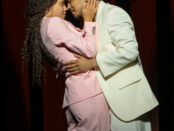
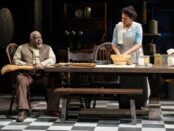
Following in the footsteps of Joshua Spector’s "Eureka Day" and Tracy Letts’ "The Minutes," also stories of local community service groups, David Lindsay-Abaire’s hilarious satire "The Balusters" is simply the best new play of the 2025-26 season. Set at a series of meetings of the Vernon Point Neighborhood Association in a landmarked enclave of an East Coast city, the pointed dialogue skewers liberals who really want to maintain the status quo as well as their white privilege. Hypocrisies abound as the nine members discuss local issues that stir up a great deal of heated debate as well as revealing their personal biases, while little change actually gets voted on. Director Kenny Leon’s terrific ensemble cast is led by Tony Award-winner Anika Noni Rose and Emmy Award-winner Richard Thomas, and the play also reunites the author with Marylouise Burke who has created roles in his "Fuddy Meers," "Wonder of the World" and "Kimberly Akimbo." [more]
Proof
Thomas Kail’s elegant and polished production now at the Booth Theatre (probably the best Broadway venues for dramas) has recast the family as African American and it works just as well – if not better - than the original production in which the family was white. Two stars from the world of film and television – Ayo Edebiri (Chef Sydney on "The Bear") and Don Cheadle ("Devil in a Blue Dress," "Crash," "Hotel Rwanda," "Traffic," etc.) – make their Broadway debuts and take to it like a duck to water. In addition, the remarkable Kara Young, nominated for the Tony Award the last four years and winning two in the last two years in a row, plays the supporting role of the sister with the assurance we have seen in her previously. [more]
Titaníque
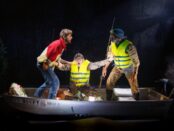
Some shows are better Off Broadway either because the smaller theater helps the ambiance or the smaller budget inspires greater imagination or there is a “let’s put on a show” vibe that enhances the fun. "Titaníque," the Off Broadway hit musical which has traveled from The Asylum NYC to the Daryl Roth Theatre to ultimately Broadway’s St. James Theatre, is one of those shows. Not that is it not still an entertaining musical, but the feeling of spontaneity with props that looked like found objects is now missing. The cast is mainly the same but for some superstar additions particularly Emmy Award-winner Jim Parsons as a mugging Ruth DeWitt Bukater and Grammy Award winner Deborah Cox as the unsinkable Molly Brown. [more]
Rheology
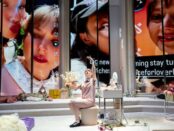
"Rheology" previously seen at Brooklyn’s Bushwick Starr in the spring of 2025 has reopened at Playwrights Horizons and proves to be a unique meta-theatrical experience with both performers, a real mother and son, theoretical physicists Bulbul Chakraborty and writer/director Shayok Misha Chowdhury (Pulitzer Prize finalist for "Public Obscenities"), appearing as themselves. Written and directed by Chowdhury in association with Chakraborty, Rheology begins as a physics TED talk on sand as “capricious matter” (Bulbul’s field) then switches to a demonstration of stage directing (Misha’s field), and finally becomes a metaphysical discussion on life and death tying the two together. This is an unusual theatrical presentation, one you will ponder for a long time to come. [more]
The Adding Machine
Among Bradshaw’s revisions are the use of a narrator, reducing the original cast list from 25 to four, adding an intermission, updating some of the slang to contemporary speech, and having its protagonist Mr. Zero played by a woman instead of a man. The effect of all of these changes is that the play now runs longer than it used to, and the long monologues are still in evidence and become rather tedious. The new version still includes some of the protagonist’s racist rant in the trial scene. Few of these changes make the play any better or more relevant today. [more]
Titus Andronicus
While 'Titus Andronicus" is not for the squeamish, it has definite importance in Shakespeare’s canon showing us where he started, how he was influenced by his contemporaries, and how he developed later. Jesse Berger’s exciting and swiftly moving production is riveting at all times, not only keeping the energy up but keeping the play surprising as it develops. As we suspected from Patrick Page’s one-man Shakespeare play, he is an asset to any Elizabethan production and leads a compelling cast. This may not be your cup of tea but you will not be bored for a second, even though you may be startled or shocked. [more]
How My Grandparents Fell in Love
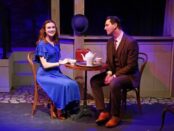
Playwright Cary Gitter and composer Neil Berg’s "How My Grandparents Fell in Love," their follow-up musical to "The Sabbath Girl" also seen at 59E59 Theaters, is a charming old school two-character musical about how Gitter’s grandparents got together in 1933. While not particularly new in content or style, it has its own appeal and a prepossessing plot and quirky characters that hold your interest. Set in Rovno, Poland in the 1930s, it also brings back to life a civilization that is gone with the wind dramatizing pre-World War II Europe. Harris Milgrim and Becca Suskauer are an engaging couple as the author’s grandparents who initially don’t like each other when they first meet just like Jane Austen’s iconic couple in Pride and Prejudice, possibly the archetype for all major rom-coms. [more]
Cats: The Jellicle Ball
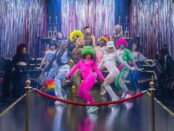
The company of PAC NYC production of “Cats: The Jellicle Ball” at the Broadhurst Theatre (Photo [more]
Nicole Travolta Is Doing Alright
Nicole Travolta, a member of the famous Hollywood family, has turned her life into a one-woman show that is introducing her to the New York stage. "Nicole Travolta is Doing Alright" is an entertaining and humorous tale of a girl who grew up in Los Angeles and then found herself as a teenager in Florida when her parents moved there. Co-written with Paula Christensen, it is also a cautionary tale about how not to grow up when on your own. Travolta is an animated, vivacious performer in telling her life story up until now. She recounts her adventures with credit card debt, divorce by age 30 and becoming a spray tan artiste which eventually straightened out her finances. Now at age 40, she has finally learned the error of her ways. [more]
Public Charge
If you ever wondered what it is really like to work in the corridors of power, "Public Charge" based on the political career of Julissa Reynoso, an idealistic diplomat who was Deputy Assistant Secretary of State for the Western Hemisphere under Secretary of State Hilary Clinton and Ambassador to Uruguay during President Obama’s second term, will give you an excellent idea. Written with playwright Michael J. Chepiga, the world premiere production of "Public Charge" now at The Public Theater is a fascinating account of attempting to make change in a bureaucracy whose very policies keep anything from happening. Told by someone who lived it, it is all true as far as we know. Under Doug Hughes’ robust and forceful direction, the play is never didactic or too dense, making us feel we are living the events as Julissa encountered them. [more]
No Singing in the Navy
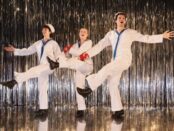
"School Pictures," Milo Cramer’s last New York show, a solo musical, was wildly inventive, hilarious funny, and extremely insightful about the New York education system, based on his own experiences as a tutor. Unfortunately, his new musical show again premiering at Playwrights Horizons seems to be out of his comfort zone though he has been a fan of musicals for years. "No Singing in the Navy" is a three-character revue which purports to be a tribute to Golden Age musicals, but its format is a series of very slight skits, à la 'Saturday Night Live," all with the same three sailors. It does use the premise from "On the Town": three sailors on leave for 24 hours before shipping out to the war, also used in a series of original Hollywood musicals, usually about sailors who become involved in putting on a show in either New York or on the coast. This show claims to have parodies of songs from "The Music Man," 'Peter Pan" and "The Sound of Music" but most theatergoers will not recognize them. A charming idea, but "No Singing in the Navy" is too thin and simplistic to make us think of those golden age musicals that still get revived on stage and reaired in their film versions. [more]
Jesa
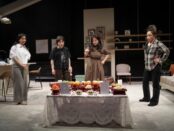
The dominant form of American theater since Edward Albee’s "Who’s Afraid of Virigina Woolf?" has been the dysfunctional family drama of which there have been countless such plays. The newest one, Jeena Yi’s debut play "Jesa" presented by Ma Yi Theater Company in residence at The Public Theater, adds a new wrinkle. This time the family is Korean American and the cast is all women, four sisters to be exact who meet to perform their parents’ jesa. Jesa is a Korean ceremony honoring the dead on the anniversary of their passing that includes food, ritual and requesting their blessings. It is this ceremony that brings together the four estranged for the first time in a long time, the first time they are honoring their mother who died a year ago. [more]
Monte Cristo
Adam Jacobs in a scene from the York Theatre’s world premiere production of the musical “Monte [more]
Antigone (This Play I Read in High School)
The world premiere of Anna Ziegler’s new play, "Antigone (This Play I Read in High School)" now at The Public Theater, is one of four ambitious attempts to update Sophocles’ tragedy playing in New York this spring. However, Ziegler overburdens her version with three separate stories which vie for our attention: a contemporary woman who read the play in high school and has admired its heroine ever since, Sophocles’ version of the Greek myth, and the one that takes up the most time in this play, a modern Antigone who has a different beef with the state. What Ziegler is really after is a Post-Roe v. Wade story about a woman who goes against the new abortion laws of her country. Unfortunately, Sophocles’ original plot as a sequel to "Oedipus Rex" and "Oedipus at Colonus" doesn’t really work with this contemporary social context. Tyne Rafaeli’s direction suggests that at any moment one of the scenes will catch fire but, unfortunately, they never do. [more]
The Paparazzi
Ryan Howell’s Art Deco unit set with the outline of the Chrysler Building gives the story a midtown feel but does not make clear when all this is happening. The costumes by Cathy Small are credible casual wear but are rather too bland to define the characters except for high-powered Betty. John Burkland’s lighting creates various moods for the unchanging set. With no references to the internet or social media, "The Paparazzi" seems like it is taking place several decades ago but the program insists that this is all happening now in 2026. [more]
Blood/Love
"Blood/Love," the Vampire Pop Opera, may just have the most energy of any musical in town. Dynamic, obsessive and seductive this rock opera is the kind they don’t seem to write any more. This is also a sound and light show that creates its own dazzling environment and does not let you look away from the stage for a moment. Even the lobby and the theater have been redecorated to look like a nightclub in black and red, along with suitable mixed drinks at the bar. Written and composed by two-time Grammy nominee Dru DeCaro and Carey Renee Sharpe who also plays the leading role of Valerie Bloodlove, this has a powerhouse score that submerges you in its sound and catches you in its web. [more]
The Silent Serenade
Mannes Opera’s production of "The Silent Serenade" now seems retro with its lilting score, a combination of Johann Strauss II and Jerome Kern who was working in Hollywood during Korngold’s tenure. This may be why the frivolous plot seems like that of a Fred Astaire/Ginger Rogers movie. (Ironically, Korngold’s romantic operas sound Puccini-esque and his orchestral film scores found influenced by Wagner.) While the libretto for the operetta is set in 1820s Naples, its anachronisms like a fashion house with models, tabloid newspapers looking for gossip, and references to Hollywood actresses make the updating to the 1950s (suggested by Teresa Wadden’s beautiful costumes, literally a fashion show in itself) much more believable. Although Korngold was used to huge orchestras both for his operas ("Die Tote Stadt," "Violanta," etc.) and at Warner Brothers, he scored his operetta for ten instruments and Mannes music director Cris Frisco gave it an excellent reading. He may have been hoping that its small scale might make it more attractive to theater impresarios. [more]
Burnout Paradise
"Burnout Paradise" is the most unique show in New York right now and enormous fun. A sort of athletic performance piece, it is also an interactive circus competition. Four members from the Australian theater collective Pony Cam perform on treadmills in four sets of 12-minute sessions each while performing set tasks and have to beat their own previous record while completing all the tasks. Genial hostess Ava Campbell explains the rules, keeps time, sells merchandise and serves Gatorade to lucky theatergoers. If the performers do not beat their previous record, audience members can request their money back. However, the show is so much fun that you will have had your money’s worth by the end no matter what the final score. In any case, the performers do collectively run about 17 miles before the evening is over. [more]
Trash
James Caverly and Andew Morrill’s Trash is a provocative play about two late 20s deaf roommates who have nothing in common except sharing an apartment. However, what is most intriguing about Trash is that it told in multiple ways. As the main characters are both deaf, they use American Sign Language to communicate. As a concession to hearing audiences, some of the dialogue is projected on three walls facing the audience. Still more unusual, there is a jukebox on stage (played by Chris Ogren) which, when fed with dollar bills, translates the ASL into spoken speech. When the lead characters really want us to know what is being said they use this method. However, this is only used partially. Much of the play is told only in ASL but Caverly and Morrill are so adept (and so dramatic) at it that we often feel like we know exactly what they are saying. They also use white boards which they hold up for all to see for simple statements or questions to the audience which sometimes require answers.
[more]
Bigfoot! A New Musical
The latest show about intolerance and social outcasts is the delightful "Bigfoot! A New Musical," now at New York City Center Stage I. Similar in plot to "Bat Boy: The Musical" but with a happy ending, if the book written by Amber Ruffin and Kevin Sciretta has much in common with sketchy comedy, it is most certainly because its writers come from that genre. The game cast is led by charming and cuddy Grey Henson as the hirsute seven foot title character with the rest of the hard-working cast playing many roles in the course of 90 minutes. [more]
Zack
While not the classic that "Hobson’s Choice" has become, Harold Brighouse’s follow-up play "Zack" proves to be a charming Edwardian comedy drama in the Mint Theater Company’s production which may be the first full New York production since 1916. Ironically, Zack has a great many things in common with "Hobson’s Choice" probably best known from the awarding-winning 1954 Sir David Lean film with Charles Laughton, John Mills, Brenda da Banzie and Prunella Scales. Britt Berke’s production glosses over the play’s deficiencies by keeping this middle-class comedy of manners going at quite a clip. While "Zack" shares many elements with "Hobson’s Choice," the two plays are very different, variations on a theme: a strong woman who saves the hero from his weaknesses, siblings who are against seeing the strength of an unambitious person, a parent who is both dominating and dogmatic, and a happy ending for the leading characters. However, both are based on the theme of the “worm turning.” [more]
Our House
Billed as a “comedy in two acts” on its title page, it is not funny nor does it deal with comic material, though the direction tries to emphasize its bitchier moments. Its plot involves homophobia, gay bashing and racism which goes a long way to explain why The Other Side of Silence (TOSOS), the oldest and longest producing LGBTQ+ theater company, would be interested in staging it. However, half of the actors emote shamefully and the other three give too restrained performances to make much impression, both of which damage the credibility of the play. [more]
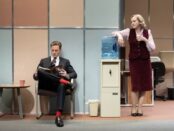
Chinese Republicans
Unlike "Glengarry Glen Ross" which also begins at luncheon meetings in a Chinese restaurant but then took us to the office in its second act, "Chinese Republicans" is mostly set at the monthly luncheons with one flashback to Ellen’s first interview with Phyllis years before and a dream sequence. Each scene reveals new pieces of information but the play seems too schematic finding no other way to reveal what we need to know. The title needs to be taken on faith as very little is made of their all being Republicans (probably to fit in at the office.) Nevertheless, the language of the play is raw, the insults cutting and the humor biting. The play covers many women’s issues found in other fields: sexual harassment, corporate culture, prejudice and racism against Asians, generation gap, social justice, and the treatment of women in the business world. "Chinese Republicans" is a tight expose of how women particularly Asian American women are treated in the work place in the 21st century. [more]
The Reservoir
Alcoholism and Alzheimer’s wouldn’t seem to have much in common. However, Jake Brasch cleverly links the two in his comedy drama "The Reservoir," the story of a recovering drunk on leave from college who goes home to discover his grandparents are sinking into old age, which he never noticed before. Rising star Noah Galvin who replaced Ben Platt in "Dear Evan Hansen" and then co-wrote and starred in the film "Theater Camp" has the role of a lifetime as Josh who never leaves the stage throughout the play and who experiences the year after he dropped out of NYU. Surrounded by some of the most well-known and experienced theater pros around (Heidi Armbruster, Peter Maloney, Mary Beth Peil, Matthew Saldívar and Chip Zien) he holds the stage even as his character relapses and regresses at the worse possible moment. [more]
The Waterfall
Not only does Phanésia Pharel’s "The Waterfall" have a great deal to say, it is also very revealing of immigrant views on the American Dream. A tour de force for two actresses, Taylor Reynolds’ production takes hold of you and never lets up for a moment. This captivating play says much about mother-daughter relationships as well as Haitian-American values. See it for Patrice Johnson Chevannes and Natalie Paul’s thrilling performances which fill the stage. [more]
The Monsters
Written and directed by Ngozi Anyanwu, author of "The Last of the Love Letters" (Atlantic Theater Company) and "Good Grief" (Vineyard Theatre), 'The Monsters" is a tour de force for two actors who have the chops for this very physical outing both emotionally and literally and luckily Aigner Mizzelle and Okieriete Onaodowan have what it takes. Aided by the choreography of Rickey Tripp, the fight direction of Gerry Rodriguez, and the work of MMA consultant Sijara Eubanks, the realistic fights mainly pantomimed with only one participant (except for Lil’s training sessions which include Big) make us believe we are seeing two people fighting. [more]
The Dinosaurs
Like Beth Wohl’s Liberation, Jacob Perkins’ "The Dinosaurs" follows a group of women who meet weekly to discuss a problem that interests them, in this case alcoholic addiction. Covering many years, the play gives six women with different stories a chance to talk candidly about their lives and travails. Beautifully written, the play, however, feels thin and repetitious and doesn’t seem to get anywhere. Directed by Les Waters, the six actresses led by Off Broadway stalwarts Kathleen Chalfant and Elizabeth Marvel create very different portraits, though at a brief 70 minutes we don’t learn that much about each one. [more]
The Tragedy of Coriolanus (Theatre for a New Audience)
Tata’s staging is also problematic making almost every scene look like every other. The mob scenes have been reduced to five actors (other than the lead characters) which does not suggest any threat whatever. Afsoon Pajoufar’s unit set is an attempt to create a Roman building and then put scaffolding around it to suggest modern renovations. However, using it for almost every scene which is just under three hours becomes monotonous and uninspired. The acting doesn’t help much with each actor seemingly having chosen one single character trait so that all are one-note in this blank-verse drama. Only Roslyn Ruff as Volumnia, the title character’s mother, shows any variety or range. (Volumnia has always been the best role in the play.) [more]
The Other Place
Going along with leaving much unsaid, Zeldin in his direction has kept things rather slow and leisurely so that the play’s 80 minutes seems much longer. Also much of the backstory is missing: what does Chris do for a living as we are told he is very rich? As his friend Terry is described as his contractor, does that make him a builder or has Terry only been hired to do the renovation on the house? The house incidentally has been made unrecognizable with walls removed to let in the light - though the view outside is still in darkness until the trees are torn down, including the tree from which Adam hanged himself. How has Annie been living since leaving the hospital? She has refused to take Chris’ money so that is not an explanation. And is his offer of money an expiation for some unnamed guilt? [more]
Just Desserts: A Musical Bake-Off
"Just Desserts" is an entertaining satire on competitions, “a musical bake-off.” With witty songs and colorful characters this show with book and lyrics by Barbara Campbell and music by Brad Ross features a high-powered cast led by cabaret and musical theater veteran Klea Blackhurst. While the audience doesn’t get to try any desserts until after the show, the three baking competitions could make your mouth water. This small musical with six actors has been seen around the country and is now offering its wares at Off Broadway’s AMT Theater. [more]
An Ideal Husband
After a several year hiatus, The Storm Theatre, one of the last classical theater companies left in New York, is back with an elegant and polished production of Oscar Wilde’s rarely seen comedy-drama "An Ideal Husband" staged by artistic director Peter Dobbins. While Wilde’s "The Importance of Being Earnest" is well known to theatergoers, "An Ideal Husband," last since on Broadway in 1985, is not but ought to be better known. This play of political corruption and moral turpitude seems more relevant than ever with the number of government scandals in our news daily. As witty as Wilde’s most famous play, An Ideal Husband also has an involving plot and colorful characters. [more]
Anonymous
Spit & Vigor Theatre Company has an interesting approach to stagecraft at least with its return engagement of Nick Thomas’ Anonymous, now at their new home at the Tiny Baby Black Box Theatre. The play which takes place at a weekly meeting of an addiction support group has the audience sit in a circle and then embeds the actors in the circle without acknowledging the rest of us. This gives the play an immediacy it might not have had otherwise. The audience feels like they are part of the monthly group even though we are not seen by the actors. On the other hand, Sara Fellini’s direction is so broad that the actors all seem like they are overacting considering that the audience is only feet away. The play would be much more convincing if they all took it down a few notches. Some of the actors seem to be hamming it up – unless it is simply that we are sitting next to them or across from them that their performances seem to be too big for the tiny venue. [more]
Blackout Songs
Joe White’s "Blackout Songs" direct from London with its original cast is a tour de force for two actors. It is also a challenge for the audience both because its single topic is addiction and as intentionally written by the author we never know what is real and what is imagined. Rising film stars American actor Owen Teague ("Unspeakable: The Murder of JonBenet Ramsey," Stephen King’s "The Stand') and Australian actress Abbey Lee ("Mad Max: Fury Road," "Black Rabbit") both making their New York stage debuts give bravura performances, though Lee’s English accent is often difficult to understand as is the British slang that they often toss off. However, director Rory McGregor’s use of a single set to present a turbulent relationship over ten years and many locales is quite remarkable. [more]
DATA
Mathew Libby’s riveting "DATA" is drawn from tomorrow’s headlines – or is this frightening story depicting events that are already happening? As directed by Tyne Rafaeli, this techno-thriller become more and more scary as we begin to realize the dangers of AI and computer algorithms to be used for immigration and citizenship rules as the story moves to its inevitable conclusion. Silicon Valley has a lot to answer for and this play demonstrates what may be in store for us very soon. [more]
The Disappear
Watching these creative people misbehave is part of the fun though a great deal must be taken on faith: Julie’s tremendous talent, Raf’s inordinate fame and highly emotional depth, Ben’s genius as a filmmaker though Raf has never seen one of his movies, and that Mira’s novels earn more money than Ben’s films. However, nothing Schmidt has written for these characters demonstrates these qualities. Julie is portrayed as pretentious and overacting. Raf is so low-key it is hard to see him as having a great deal of depth on screen. With Ben's self-dramatizing and egotistical nature, it is hard to imagine him finding time to focus on his work, while the items we hear about from Mira’s novels hardly seem like the material for best sellers. Possibly Schmidt who has directed her own play needed a second pair of eyes and ears to get her play whipped into shape. [more]
Cimino’s Defeat
Eric Faris’ "Cimino’s Defeat" seems under researched while attempting to make a play from a few salient facts. At times the play seems endless, at others repetitious with all the arguments that never reach any conclusions. A good deal of the play seems amateurish though this may be the fault of co-directors Sam Cini and Ryan Czerwonko who allow for much ranting and raving from the actors. There may well be a play in the "Heaven’s Gate" debacle but this isn’t it. [more]
Bug
Seen first Off Broadway in 2004, Tracy Lett’s "Bug" has now reached Broadway via the Steppenwolf Theatre Company production being presented by Manhattan Theatre Club. While "Bug" has the reputation as a thriller (and has all the elements.) David Cromer’s leisurely direction turns this into a character study instead. Michael Shannon’s electrifyingly crazed protagonist in the Off Broadway staging has given way to Namir Smallwood’s low-key insidious portrayal of Peter Evans, an Iraqi vet who has escaped from four years in an army hospital facility. The play which deals in conspiracy theories does seem more relevant now than two decades ago as there are so many more such theories swirling around us on a daily basis. [more]
and her Children
Hailey McAfee in a scene from Rosie Glen-Lambert and McAfee’s “and her Children” at SoHo [more]
Going Bacharach: The Songs of an Icon
Legendary composer Burt Bacharach died in 2023 and it has taken until now for there to be a fitting stage tribute to his 1,000 song output (mainly written with lyricist Hal David) which includes six Grammy Awards and three Academy Awards. Entitled Going Bacharach: The Songs of an Icon, the musical revue has been conceived by producer Jack Lewin along with Will Friedwald (who has been called “the poet laureate of vintage pop music,”) musical supervisor Tedd Firth and musical director Adrian Galante, who is also responsible for the arrangements and orchestrations as well as playing piano and clarinet in the show. While Bacharach was best known for his mellow sound as sung by Dionne Warwick who recorded most of the songs in the show, the volume of this Going Bacharach is very loud, though this may be the fault of sound designer Matt Berman. Those of us who grew up with these songs won’t recognize the arrangements while younger people may be pleased to experience them for the first time. [more]
The Opening
While ABBA’s "Chess" is receiving its first revival on Broadway, a delightful new musical about chess has come to Off Broadway’s Players Theatre. "The Opening," billed as “The Second Most Famous Musical About Chess,” is a fun entertainment which keeps you guessing throughout about the world and denizens of chess tournaments. Inspired by a true chess scandal in 2022 in which a tournament player was wrongly accused of cheating, this musical spoof has a clever book by Brooke Di Spirito, melodic music by Mateo Chavez Lewis, and witty lyrics co-written by Di Spirito and Chavez Lewis. An expert cast directed by Nick Flatto keeps the show merrily rolling along. Who knew chess could cause such shenanigans? [more]
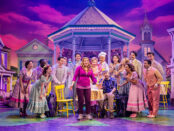
Picnic at Hanging Rock
However, where the Peter Weir film used magical lighting and the atmosphere of the actual filming at Hanging Rock to recreate a mystical, supernatural feeling, the musical instead adds songs and dialogue. Unfortunately, Bell’s lyrics are either too prosaic or too poetic without creating a magical world, while Gold’s folk-pop score often sounds the same throughout. The busy set by Daniel Zimmerman which attempts to shoehorn the school and its stairway to the second floor, the hanging rock and its environs, and the five-piece orchestra all on the same stage seems rather cluttered along with the forest of trees and foliage in the background. The many-colored costumes by Ásta Bennie Hostetter for the girl students’ dresses vie with the background for our attention and there are often too many hues on stage simultaneously. While Barbara Samuels’ lighting is often exactly right, her plot using red for the picnic seems to make many of the girls look like they have picked up terrible sunburns in a very short time. [more]
MOMIX: Alice
MOMIX’s "Alice" returns to the Joyce Theater for the first time since its 2022 premiere and continues to dazzle in its inimitable way with illusion and dance. Choreographer Moses Pendleton’s creation does not strictly follow the plot of Lewis Carroll’s two books, Alice in Wonderland and Through the Looking Glass, but appears to be a fantasia inspired by them and using all the elements of dance, gymnastics and imagery to bring it to teeming life. Using nine dancers, five women who seem to alternate as Alice, and four muscular men, the evening consists of 22 episodes taken from the two books but not always obvious as to their source. The score consist of 23 songs, some which seem to have been written specifically with the Lewis Carroll book in mind. [more]
Amahl and the Night Visitors
Albert Rhodes, Jr. and Joyce DiDonato in a scene from the Lincoln Center Theater and the [more]
Anna Christie
Michelle Williams and Tom Sturridge in a scene from Eugene O’Neill’s “Anna Christie” at St. [more]
Gotta Dance!
"Gotta Dance!" is a hugely entertaining revue of dance in the American musical recreating icon moments from 17 Broadway shows including four that started life as MGM movies starring Gene Kelly and later ended up as stage shows. Appearing under the auspices of The York Theatre, this is the work of the reconstituted American Dance Machine which existed from 1976 – 1987, and has been reestablished in 2012 by Nikki Feirt Atkins as American Dance Machine for the 21st Century along with co-founder choreographer Randy Skinner. American Dance Machine’s mission is to be a living archive of Broadway dance recreated by its original choreographers and/or dancers. All of the performers in "Gotta Dance!" are given a chance to show what they do best whether it is tap dancing, ballet, modern dance or swing. [more]
Oedipus
Icke’s version avoids the religious and ethical themes of the original but instead makes it a riveting thriller as the tension rises to almost unbearable heights – even if you know the outcome of this classic tale. In rearranging the story and telling it differently, Icke gives us the hope against hope that this time it will turn out differently. Set on the night of a political election in an unnamed country, Oedipus is first seen on video making a speech to reporters and the populace. He is not yet the ruler but a shoo-in to be elected on this night. However, he makes two promises that will lead to his downfall but he doesn’t know it yet; he will release his birth certificate and he will investigate the death of Laius, a previous leader and the previous husband of his wife Jocasta. [more]
The Surgeon and Her Daughters
According to the author’s note, he wrote the play to acquaint theatergoers with the “forgotten war” in Sudan. Unfortunately, as there is no backstory for the leading character the Sudanese Mohammed-Ahmed, we learn nothing about this war or how it has affected him. Eventually we learn that he was a surgeon there and lost his wife and daughter. We assume that he was not able to become qualified as a doctor in New York as he has been working as a sign holder for a midtown Irish bar. However, the circumstances of the deaths of his wife and daughter are never explained nor why and how he came to New York (one assumes he was seeking asylum but this is never stated either.) Not surprisingly, no one he meets in New York believes he has been a surgeon as he never tells his life story. [more]
This World of Tomorrow
This World of Tomorrow resembles the films "Back to the Future" (Bert cannot risk changing anything), "Groundhog Day" for its repetition of the same events, and "You’ve Got Mail" in which two undeclared lovers run the risk of missing each other. Both the message and the structure resemble those time travel movies of the 1940s like René Clair’s "It Happened Tomorrow" where the characters get to view a glimpse of the future only to end up back where they started. The problem with "This World of Tomorrow" is that the play attempts to do something that the movies do much better. While Derek McLane’s clever scenery making much use of projections on a series of square pillars which rearrange themselves for each scene as the projections change is appealing as well as eye-catching, it can only do so much to suggest the extensive and imposing World’s Fair, as well as other parts of New York City. All this will be more successful in a future film version in which CGI will allow us to really see the bygone fair and NYC in 1939. [more]
Meet the Cartozians
Talene Yeghisabet Monahon’s new play "Meet the Cartozians," being presented by The Second Stage at The Pershing Square Signature Center, is simply the best new American play in New York this fall. This riveting two-part play set in two time frames 100 years apart asks the questions what does it mean to be an American, what does it mean to be white in America, and what does it mean to be an Armenian American. The timeliness of these questions will not be lost on audiences well aware of the current administration’s views on immigration particularly of non-white applicants for asylum. The Armenian American playwright’s last three plays ("How to Load a Musket," "Jane Anger" and "The Good John Proctor") have all had historical backgrounds but this one is personal to Monahon as it deals with her own heritage. Director David Cromer who has proven himself to be a wizard with new plays as well as his brilliant reinvention of Thornton Wilder’s Our Town has chosen a superb cast led by two-time Tony Award-winner Andrea Martin and 2024 Tony Award-winner Will Brill who are all excellent playing two roles each. [more]
Practice
With a three-hour running time (the first act runs two hours straight without an intermission) the play is too long for its repetitiousness having the actors go over the same theater games and monologues over and over again. Of course, the play becomes an endurance test for the actors as well as viewers, whether it was intended to or not. Actors who have undergone this kind of training may be amused; those of us who have not may be bored or lose interest. Although the actors who make up the ten-member cast of "Practice" play very different personalities, we see so little of them individually that it is hard to keep them separate and they become a big blur. [more]
Sweet Smell of Success
The film version starring Burt Lancaster as sleazy yet powerful gossip columnist J.J. Hunsecker (similar to the notorious Walter Winchell) and Tony Curtis as hungry press agent protégé Sidney Falco was not a success as the ugly underbelly of tabloid journalism was not what filmgoers wanted from some of their favorite box office stars in 1957. Some of the same problems apparently recurred when nice guy John Lithgow took on the role in the stage musical in 2002. The reedited version by Guare and Carnelia (which is closer to what they originally intended) remains faithful to the original plot but gives a more humanizing backstory and a more palatable ending. They have also restored the original opening (“Rumor”) and a duet for Hunsecker’s sister Susan and her boyfriend Dallas (“That’s How I Say Goodbye”), cut on the road. [more]
Kyoto
Unlike J.T. Rogers’ Tony Award-winning "Oslo" which handled similar material about the secret Oslo Peace Accord conference, "Kyoto" by Joe Murphy and Joe Robertson makes little concession to its audience giving almost too much information and depicting too many characters, while being patently undramatic much of the time. However, the topic is so explosive that it carries its audience through its 11 conferences. (One hardly notices Natalie Pryce’s costumes so closely does one have to listen to follow the flow of the arguments.) One does come away with the knowledge these sorts of conferences are almost futile with each nation having its own agenda and limits to how far it will go even at the expense of other nations. It is almost remarkable that the Kyoto conference reached any consensus at all. The question now is how much of that was actually enforced by the signatories to the protocol. [more]
The Seat of Our Pants
Michael Lepore as the Telegram Boy, Micaela Diamond as Sabina, Ruthie Ann Miles as Mrs. Antrobus, [more]
Richard II (Red Bull Theatre)
If you know the play, you many have trouble following it as several actors double: Ron Canada plays both John of Gaunt, Duke of Lancaster (Richard’s uncle and Henry Bolingbroke’s father) and later the Bishop of Carlisle. Daniel Stewart Sherman doubles as both Sir Thomas Mowbray, Duke of Norfork and later as courtier Sir Stephen Scroop. Ryan Spahn is seen as Richard’s favorite Bagot, a Welsh Captain, and as a companion to the Queen. The ending has been changed as there is no Sir Piers Exton: another character comes to murder Richard in his cell, giving a different import to the scene. As there is no Duke and Duchess of York, the Duchess’ defense of her traitorous son after Bolingbroke becomes King Henry IV is given to the Queen instead. [more]
The Burning Cauldron of Fiery Fire
Tom Pecinka and Marianne Rendón in a scene from Anne Washburn’s “The Burning Cauldron of Fiery [more]
44 – The Musical
"Saturday Night Live" has made political satire look easy and has a lot to answer for. "44 – The Musical" written, composed and directed by Eli Bauman, who worked on the Obama campaign in Las Vegas in 2008, has created this slight parody of the 44th president’s first term. While the show is slickly produced, the writing is lazy using vulgar language – the f-word is sprinkled generously throughout the dialogue and repeated in its songs whose names are not spelled out in the program – and the satire only takes on the most clichéd items. As none of the talented cast looks or sounds like the real people they are playing, we need to keep reminding ourselves who they are. [more]
Romy & Michele: The Musical
Schiff’s book so slavishly follows her screenplay without adding new material that there is nothing much to wait for. The lyrics by Sanford and Jay alternate between not scanning and extremely simple rhymes. None of the songs tell us anything we don’t already know. With one or two exceptions, Hanggi has directed her cast to be as much like the movie as possible, leading to pale imitations of more robust characterizations. Jason Sherwood’s unit set is augmented by Caite Hevner’s projection design, neither of which creates much atmosphere. Tina McCartney’s costumes seem to be clones of those used in the movie. Much of the look of the period is created by Tommy Kurzman’s hair, wig and make-up design. [more]

Pygmalion
In their latest, Shaw’s ever-popular "Pygmalion," Staller has staged Shaw’s never-used prologue created for the 1938 film version which has the gods and goddesses on Mt. Olympus recount to the modern audience the myth of Pygmalion and Galatea which inspired Shaw’s Edwardian comedy. The set by Lindsay G. Fuori creates an Al Hirschfeld-inspired Greek temple used for all of the play’s five scenes. Four of the actors dressed in white Grecian robes (courtesy of designer Tracy Christensen) greet us and tell us the myth that we will see in Shaw’s updated 20th century comedy in which the sculptor becomes a professor of language and linguistics and the statue becomes a flower girl who wants to improve her speech well enough to get a job in a flower shop. However, Staller does not stop there but has created narrative introductions for each act which is rather intrusive though it may help some first-time viewers to understand the play. (Is there any theatergoer who has not seen the play’s musical version My Fair Lady on stage or screen?) [more]