News Ticker

Off-Broadway

To Have and To Hold

September 4, 2026

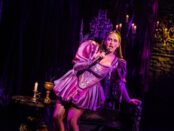
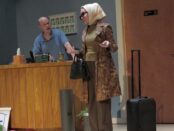
There is something wonderfully perverse about naming two sisters Kate and Bianca after the heroines of Shakespeare’s "The Taming of the Shrew" and then setting them loose in the 21st century, where the old machinery of courtship has become at once more liberated, more commercial, and considerably more bewildering. In Laura Lapidus’ "To Have and To Hold," directed by Zoë Adams, and now playing at Chashama’s 154 Theater, Shakespeare’s notoriously troublesome romantic comedy becomes the occasion for a much more contemporary inquiry: What happens when the stories we inherit about love, marriage, womanhood, and ourselves collide with the stories we have painstakingly written on our own? The result is a buoyant, intelligent, unexpectedly tender comedy that knows its Shakespeare but refuses to be imprisoned by him. [more]

A Midsummer Night’s Dream (Smoking Mirror Theatre Company)

September 3, 2026

At A.R.T./New York Theatres, Smoking Mirror Theatre Company’s production of Shakespeare’s "A Midsummer Night’s Dream," running through September 13th, offers the kind of theatrical escape that the play itself promises: a passage from the ordinary world into a place where logic loosens its grip, desire becomes unstable, and the boundary between comedy and nightmare grows deliciously thin. Co-directors John Gordon and Ruby Rich gift us a faithful restaging that conveys the fun and magic of Shakespeare’s original text while adding just enough distinctive flourishes to make a familiar work feel freshly discovered. [more]

The Real Ivanov (Initiative Productions)

August 30, 2026

Currently to be seen at the Lynn F. Angelson Theater, adaptor/director Laura Strausfeld has renamed her production "The Real Ivanov," a streamlined version which “preserves almost every line and all of the major characters.” This riveting version performed without intermission reduces the three hour play (with breaks between the acts) to a fast 100 minutes in which the audience sits on all four sides of the playing area, putting us in the arena with Chekhov’s characters. Much of this is due to Jiyoun Chang’s scenic design which uses one item in each of the four acts to set the stage for the different scenes allowing for instant transformations: a bench in Act I, a rug in Act II, a desk and chair for Act III, and a red carpet signifying a hallway for the wedding scene in Act IV. As we have gotten used to a great deal of realistic scenery in recent years, it is amazing how unnecessary it appears to be if the actors create the ambiance and the milieu. [more]

The Bathroom Attendant

August 23, 2026

If Kelly can pare away the exposition, substantially tighten the second act, eliminate the extraneous political rhetoric, deepen the comedy through character rather than topical jokes, and give Marcus a more restrained and genuinely dangerous presence, "The Bathroom Attendant" could become considerably more than the intriguing but somewhat slipshod thriller it currently is. The ingredients are there: a perfectly matched cast, resourceful staging, a vivid setting and a playwright willing to look directly at the ugly underside of American life. What is needed now is not a new play so much as a more disciplined version of the very good one already struggling to emerge. [more]

benevolent

August 20, 2026

In benevolent, Sophie McIntosh turns a basement laundry room into a small theater of female confinement, where the dirty linens of respectable New York become both literal evidence and metaphorical residue. Set in 1917 at the fictional Inwood Benevolent Home, a reformatory modeled on the city’s historical Magdalene institutions, the play places four young women on a “soiled shift,” scrubbing blood, excrement, and other unmentionable traces from the underwear of people who will never have to touch their own filth. McIntosh’s subject is grim—sexual exploitation, class privilege, racial inequality, pregnancy, institutional punishment—but her method is anything but dour. With Nina Goodheart’s richly calibrated direction, benevolent becomes a remarkably nimble comedy-drama about women discovering one another beneath the categories that society has imposed upon them. [more]

Masticate

August 19, 2026

The directing is weaker than it could’ve been. The blocking is quite flat, even when it does make full use of the space. In particular, the restaurant scenes, meant to be so busy and manic, are oddly lifeless. Despite the well-done set by Arkadia Theatre Company, it often feels as though the characters are wandering around an empty space, with little tying them to the actual scene or setting. Furthermore, Fargo’s script leans heavily on monologues, and the staging is such that other characters rarely react during these sequences, making them feel overly-long and drawn out. On the positive side, however, Fargo’s characters are mostly quite strong – Rachel is an excellently-written character, Brandon is decent comic relief, and Kimberly and Joni are both given a good amount of depth. The performances Kelso gets out of these actors in particular are also quite excellent. [more]

Isla

August 19, 2026

"Isla," the new musical-theater piece from Hit the Lights! Company now at WP Theater, is one of those productions in which the eye is continually rewarded while the mind is left waiting for the story to catch up. It is an act of love, remembrance, and theatrical ingenuity, inspired by the family history of co-artistic director Samantha Blain, whose mother and two aunts fled Cuba in 1969, during the early years of Fidel Castro’s regime, in search of freedom and a new life in the United States. Co-directed by Blain’s colleagues Roman Sanchez and Mikayla Stanley, and assembled collaboratively from family stories, recorded interviews, music, projection, movement, and puppetry, Isla possesses an almost tactile sincerity. Yet sincerity is not the same thing as dramatic necessity. The production has been given an abundance of means for telling its story; what it lacks is a sufficiently compelling story to tell with them. [more]

Broad Strokes

August 14, 2026

At first mention, a young woman suffering a stroke does not sound like a promising premise for a comedy, much less a musical comedy. It suggests frantic texts to a medically literate friend, and the sort of midnight internet search that convinces you that a headache is an aneurysm. Yet Catherine Cohen, whose comic persona has always depended upon turning private neuroses into public spectacle, has discovered in "Broad Strokes" an almost perversely fertile subject: the surreal experience of having a stroke at thirty, discovering that it was caused by a congenital hole in her heart, and then finding herself grateful, in a sense, to have been proved right about all the things she had spent her life worrying about. Under Alex Timbers’ brisk and extravagantly theatrical direction, Cohen turns a medical emergency into a fantasia of vanity, anxiety, pop culture, and self-invention. The result is a compact, highly polished Off-Broadway debut that is considerably more inventive—and considerably funnier—than its premise has any right to be. [more]

An American Daughter

August 12, 2026

In "An American Daughter," Wendy Wasserstein approaches a topic still relevant: how American women in public life are expected to be perfect in all things while the men are given a pass for similar behavior. Notice that 29 years after this play appeared on Broadway, the United States has still not had a woman president. Unfortunately, the play is too schematic to be convincing and without enough humor to carry the story to its logical ending. While this production does not make a strong case for this as one of Wasserstein’s better plays, it is still possible that a future staging with a different cast might solve the current problems in this one. [more]

The Winter’s Tale

August 12, 2026

Revivals today tend to come in several similar varieties: rewritten updates by famous contemporary playwrights, director projects that have high concepts, and entirely new plays inspired by the classics, often transposed to the present. It is a pleasure to report that director Daniel Sullivan’s riveting three hour and 20 minutes uncut production of Shakespeare’s The Winter’s Tale for The Public Theater’s Free Shakespeare in the Park is a pure staging, gimmick and update free. Although there is not a weak link in the production, Lily Rabe’s Queen Hermione is so commanding and compelling that she elevates this usually overlooked role to another place in the Shakespeare canon. With a topnotch cast led by Raúl Esparza, Rabe, Chuck Cooper and Steven Skybell, the production features crystal clear sound design by Brian Ronan (sound system design by Mike Tracey) and impeccable diction by vocal and text coach Andrew Wade which makes this easy to follow and understand for both those who are seeing it for the first time and those who know the play. [more]

The Pass

August 8, 2026

John Donnelly’s "The Pass," which arrived at London’s Royal Court Theatre in 2014 and now makes its American premiere at La MaMa, is the sort of play whose subject seems almost unnervingly well chosen for the present moment. Professional soccer has never been more culturally omnipresent in the United States, while the question of what elite sports permit—or refuse to permit—men to reveal about themselves has acquired an urgency that extends far beyond the playing field. Yet Donnelly’s play is not a consoling story about athletes discovering the liberating possibilities of love. It is considerably darker, and more interesting: a study of a man who has so thoroughly converted himself into a marketable public object that, by the time he is offered the possibility of recovering his private self, he may no longer know what that self is. Across three hotel rooms and twelve years, "The Pass" traces the wreckage produced when ambition, masculinity, desire, celebrity, and shame become so thoroughly entangled that success itself begins to resemble a form of imprisonment. [more]

The Vessel

August 6, 2026

George's accomplishment lies in recognizing that public catastrophes reverberate far beyond the headlines. His protagonists are not heroes in any conventional sense but three hourly employees earning modest wages as "Park Ambassadors," a title whose corporate optimism barely conceals the grim reality of their assignment. They answer tourists' questions, direct pedestrian traffic, and, above all, watch. They observe faces, gestures, pauses, and hesitations, searching for invisible signs that someone has arrived not to admire the skyline but to disappear from it. Such vigilance is psychologically exhausting precisely because it demands certainty where certainty can never exist. George understands that the deepest wounds inflicted by preventable tragedy are often borne by those who survive wondering whether a different word, glance, or gesture might have altered another person's fate. [more]

Hungry Women

August 6, 2026

Melissa Maney’s "Hungry Women" has a fascinating premise: what would the world be like if there were no men? Obviously, things would be different, but would they be any better? However, the play attempts to be too many things: a critique of Victorian marriage, a sci-fi play set in the future, a socio-political drama, a totalitarian power play. Divided in three parts (“Hungry Women,” “Curious Women” and “Scared Women”), the play seems to be three different one acts as the styles and tones change in each. Daniella Caggiano’s direction is superb except for a great deal of shouting in the third and last scene. However, she does not help unify the play into a coherent whole. [more]

Hershey Felder: The Piano and Me

August 1, 2026

Famous pianist Hershey Felder has toured the world with his many shows about legendary composers from Chopin and Tchaikovsky to Gershwin and Irving Berlin giving over 6,000 performances. Now he has chosen to tell his own story from his upbringing in Montreal to the present and proves himself to be a consummate storyteller both on the piano and in words, incorporating the most famous piano show pieces of the last 250 years. Called "The Piano and Me," the show is riveting for both classical music aficionados as well as those unversed in anything other than pop music of today. Playing 16 people who were instrumental in his career, he brings them all to life for us. [more]

The Saviors

July 31, 2026

"The Saviors," Bubba Weiler’s second play to be produced in New York in the past year is a coming-of-age play about how to live your life as well as loss of faith. All of its four characters are lost souls and each is trying unsuccessfully to save the other. Tenderly directed by Jack Serio who also directed Weiler’s acclaimed "Well, I’ll Let you Go," the play’s two teen altar boys, acted by Ivan Howe and Julius Rinzel, are actually 13 and 14, giving the play a verisimilitude few productions have. [more]
The Whoopi Monologues

July 26, 2026

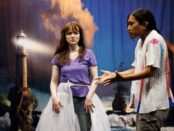
Kecia Lewis as Lurleen (foreground) and the cast of Whoopi Goldberg’s “The Whoopi Monologues” [more]
This Lime Tree Bower

July 25, 2026

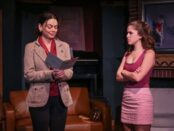
Christopher Ryan directs with remarkable confidence in the material's stillness. Presented upstairs at Quick Eternity, a cocktail bar tucked into the Seaport, the production dissolves the customary boundary between actor and audience. There is no conventional stage, scarcely any scenery, and almost no distance separating performer from spectator. Ryan wisely resists the temptation to manufacture unnecessary movement. Instead, the actors drift naturally among chairs, windowsills and walls, remaining present even while another tells his story, reacting with the smallest smile or glance. What might have become three isolated monologues instead resembles an evening in an Irish pub where conversation ricochets effortlessly from one raconteur to another. Ryan understands that McPherson's drama depends not upon theatrical embellishment but upon absolute trust in language, rhythm, and listening. The result is intimate in the truest sense: one feels less like an audience member than an invited confidant. [more]
Sukkot

July 21, 2026

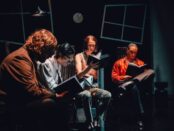
Matthew Leavitt’s "Sukkot" begins with a deceptively simple premise: a grieving widower builds a sukkah because he believes it is the closest remaining path to his late wife. From that premise emerges one of the most satisfying new family plays to arrive this season, a comedy-drama that understands grief not as a singular emotion but as an unruly collection of contradictions. It is uproariously funny without ever mocking pain, deeply moving without reaching for sentimentality, and wise enough to recognize that families often express love most fluently through irritation. The 6th Act's superb production at 59E59 Theaters, directed with remarkable assurance by Joel Zwick, allows Leavitt's finely calibrated script to breathe, laugh, and ache in equal measure. [more]

Julius Caesar (Ensemble Shakespeare Company)

July 19, 2026

In its second producing year, Ensemble Shakespeare Company is offering a fine staging of "Julius Caesar" with some debatable casting choices. As directed by Dylan Diehl, the use of theater in the round focuses the attention center stage for all except Marc Antony’s funeral oration where he climbs up various staircases to give all a vantage to hearing him give his speech. The modern dress production adds a contemporary gloss to an ancient story which still has political relevance. Except for some minor quibbles this is a fine production for both those new to "Julius Caesar" and those very familiar with it. [more]
The Taming of the Shrew

July 19, 2026

What ultimately distinguishes this production is its refusal to flatten Shakespeare into a contemporary thesis. It neither apologizes for the play's misogyny nor sensationalizes it. Instead, Otto trusts that audiences are capable of holding competing truths in their minds simultaneously: that "The Taming of the Shrew" is uproariously funny, dramatically exhilarating, and profoundly unsettling. In embracing the play's ambiguities rather than escaping them, Shakespeare CSE has launched its "Shakespeare Entirely" series with a production that is not only intellectually invigorating but also enormously entertaining—a reminder that the greatest classics endure not because they provide easy answers, but because they continue asking impossibly difficult questions with inexhaustible theatrical delight. [more]

Are You Now or Have You Ever Been: An American Docudrama

July 16, 2026

Eric Bentley’s 1972 docudrama "Are You Now or Have You Ever Been" is a powerful play based on the original testimony of the artists, writers and performers who were called to testify before the House Committee on Un-American Activities during the Communist scare of the 1940s and 50s.  Originally subtitled “The Investigations of Show-Business by the Un-American Activities Committee 1947 – 1958,” the play remains a reminder of repression and fear tactics so like today’s investigation of so-called enemies of the current administration. Although those times are now called the McCarthy Era, Senator Joseph McCarthy had nothing to do with the House of Representatives Committee that the play depicts as he had his own Senate investigation body. [more]

Henry VI: A Trilogy in Two Parts

July 15, 2026

Although the three plays have been reduced to two and many of the actors appeared previously in the 2018 production, Henry VI is still challenging for audiences unfamiliar with the Hundred Years War or the War of the Roses. Even with an ensemble of 16, the actors play between three and nine characters each so that you are never entirely sure who anyone is when they appear. With women playing men (mostly to add a few female characters to the play), it is not only often confusing but makes the wrong statement like the Duke of Gloucester played by a female and then his wife being a major character later in the play. Even with 16 cast members some of the court and battle scenes look underpopulated on the large stage. The costuming, a combination of modern and medieval by the collective threeASFour which resembles outfits by Comme des Garçons, does not entirely help even though the English wear black and white in Part I and the French wear black. Due to the number of dukes and earls, it would have been helpful if they wore defining outfits that set them apart from each other. In Part II, the Yorkists wear a white signifier while the Lancastrians wear red but this still does not make it easy to recognize particular characters. [more]

What a World! What a World!

July 14, 2026

The script from Marlin ("Shot List" at Baryshnikov Arts Center; "How to Mourn the Dead: a tragedy (in flux)" at Montclair New Works Initiative) is shaky at times but undeniably has some great moments and interesting ideas. Its central premise is quite clever: when two artists try to stage an homage to their favorite old movie, they begin fighting about anything and everything. This constant bickering mixes memorable quotes amidst deeply human moments. Both characters have a remarkable amount of interiority for a play so focused on playing out miniature Socratic dialogues, with the personalities often enhancing each character’s status as a stand-in for their respective philosophies. [more]

Pied À Terre

July 12, 2026

John S. Anastasi’s "Pied À Terre" is one of those small cast dramas with a lot of secrets to unload. Unfortunately, director Mitch Poulos has staged the play at so slow a pace that it seems to take twice as long as it should. It also has a tricky structure, going back and forth between the present and the past, so that the revelations are greatly delayed. One of the biggest secrets is revealed just before the unnecessary intermission which only serves to make the play longer. [more]

Lines

June 29, 2026

A theatrical audition has always carried the faint aura of ritual: a small room, a handful of strangers vested with authority, and an actor asked to compress talent, vulnerability, and desperation into a few fleeting minutes. "Lines," a taut new psychological chamber play by Bellamy Brewster and Ewan Lloyd, recognizes that the audition is already a form of theater—and then pushes that premise into increasingly disquieting territory. Brewster, who also directs, transforms the familiar rituals of casting into a claustrophobic examination of power, ambition, and the hidden price of artistic validation. Set entirely within the confines of an audition room, the play begins with recognizable industry conventions before gradually mutating into something far more sinister. As the process unfolds, the rules become increasingly rigid, the room itself seems to contract, and what initially appears to be a professional evaluation evolves into an unsettling psychological contest. The central question lingers over every exchange: What, exactly, is the cost of being chosen? [more]

Dad Don’t Read This

June 29, 2026

Under Claudel’s direction, the four actresses are totally believable as teenage girls circa 2014, with Yoo’s Mal giving the most layered and mysterious performance. (Yoo had her big break last season as the conflicted Raelynn in Kimberly Belflower’s John Proctor is the Villain.) Although the play is completely authentic and persuasive, as it is plotless we do not know where it is going. Nothing much happens nor do the girls grow up in the course of the play. They do eventually each reveal their fears about growing up and what the future holds for them. Each of them seems to be suffering from an unspoken trauma they only hint at. If you don’t identify with one of the four individual girls, you might be bored by the lack of action on stage though it all is very convincing. [more]

Misterman

June 28, 2026

Walsh has long been fascinated by characters imprisoned within the architecture of their own memories, people condemned to relive the past not because they have forgotten it, but because they remember it with unbearable precision. "Misterman" may be his most devastating examination of that obsession. Thomas Magill, a profoundly isolated young man living alone in the Irish village of Inishfree, believes himself chosen to shepherd his neighbors toward God's grace. Every morning he ventures into town with his pen and pad noting what his flock must work on to improve their paths to heaven, determined to save their souls, convinced that he alone sees their hidden sins and their capacity for redemption. Yet beneath this evangelical certainty lies a psyche splintering under the weight of grief, abuse, loneliness, and delusion. Walsh transforms what could have been a familiar portrait of mental illness into something metaphysical: an inquiry into the terrible cost of constructing a reality so complete that it ultimately devours its creator. [more]

Camping

June 26, 2026

What emerges over time is not merely a friendship but one of the most intricate love stories currently playing in New York. Ari and Brit have been entwined since birth, neighbors in a trailer park, companions through every formative humiliation and triumph. They know one another with an intimacy that exceeds romance even as it continually gestures toward it. Their connection exists in that difficult territory where friendship, devotion, desire, resentment, dependence, and yearning become impossible to separate. Theater often struggles to depict such relationships without reducing them to categories. Barclay refuses simplification. The result feels startlingly true. [more]

Small

June 21, 2026

Montaro’s career as an actor allows him to create a different voice and stance for each jockey, trainer and owner that he describes. That is enhanced by the atmospheric sound design by Brian Ronan, and the moody lighting by Jamie Roderick which puts us in the jockey room and track. The pitch perfect unit set design by Christopher Swader & Justin Swader represents both part of the stable and the tack room. Under the astute direction of Jessi D. Hill, not only is Montaro able to convince us that he is a teenager but we watch him grow up before us as he goes from age 12 – 20. He puts us in the middle of exciting races as he recreates his reactions to being on horseback and eventually to the abuse of his body to keep his weight down. "Small" is a unique and engaging show from someone who has been there and knows how to recreate this milieu. It is easy to imagine a follow up show where Robert Montano tells us the story of his dance career where he eventually gets to play his dream role of Bernardo in "West Side Story," but that would be another story. [more]

Romeo and Juliet (Free Shakespeare in the Park)

June 15, 2026

Associate artistic director/resident director Saheem Ali of The Public Theater believes in updating Shakespeare in ways that modern audiences can identify with. His latest production of "Romeo and Juliet" which now graces the stage of the Delacorte Theater in Central Park has taken a big risk in putting a good deal of the play into Spanish (in translations by Alfredo Michel Modenessi) but as his version takes place on the US southwestern border with a wall designed by Maruti Evans that looks much like the real one on our border, this makes perfect sense. With faces covered by bandanas, the Montagues put up signs that say “Abolish ICE” and “Defund the Wall” while the Capulets appear to be a vigilante force dressed entirely in black. One wishes the production were either more or less political. Since so many of the lines in "Romeo and Juliet" are iconic by now (most middle school students having read the play) there is little problem in following the text even if one doesn’t know Spanish. [more]

And Then the Rodeo Burned Down

June 11, 2026

Throughout, Rice and Roland demonstrate extraordinary command of tone. They move effortlessly from slapstick to philosophical inquiry, from broad clowning to moments of startling vulnerability. Their dialogue crackles with wit, but it is their physical storytelling that leaves the deepest impression. Every gesture feels considered. Every movement carries meaning. The years of collaboration between these artists are visible in every second of stage time, producing a level of trust and precision rarely encountered even among the most accomplished theatrical partnerships. [more]

Jerome

June 11, 2026

John J. Caswell’s "Jerome" is a lovely low-key play about a love, loss and illness. However, Dustin Willis who also directed Caswell’s "Wet Brain" at Playwrights Horizons never really lets us know where the play is going and its loose ends tend to get in the way. However, its excellent cast of three, two-time Tony Award winner Stephen Spinella, Jeorge Bennett Watson and Ken Barnett keep us interested in the fate of these three men, one dying of kidney and heart disease, while the others try to keep him alive and contented. [more]

In the Devil’s Hands

June 9, 2026

Helen Banner’s "In the Devil’s Hands," receiving its haunting world premiere at Zoopraxic’s newly opened Long Island City performance space, is one of those rare theatrical experiences that seems to alter the rhythm of time itself. Inspired by the true story of Alphonse Le Gastelois, the Jersey resident who voluntarily exiled himself to a barren reef after being falsely suspected of a series of crimes, Banner transforms a historical curiosity into a profound meditation on loneliness, forgiveness, memory, and the strange seductions of self-imposed isolation. Set in the aftermath of the Nazi occupation of the Channel Islands during the 1940s, the play unfolds with the inevitability of a tide, drawing audiences into a world where innocence is insufficient protection against suspicion and where exile can become both punishment and refuge. [more]

||: Girls :||: Chance :||: Music :||

June 8, 2026

The title of Eisa Davis’ "||: Girls :||: Chance :||: Music :||" tells it all: four gifted teenagers attend a prestigious girls’ music program in Berkeley, California, apparently for underprivileged students. Some have attended previously; some are new to the program. All are devoted to music: Fax for singing, Margot on the drums and percussion, Rile on the piano, and Clementine on the oboe and baritone sax. The play covered their studies and their interactions: some become friends, some enemies, and some would like to become lovers. Chance plays a role in their lives and choices. [more]

The Maids

June 7, 2026

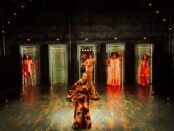
Part of the play is an eye-filling fashion show with Solange and Claire trying on Madame’s gowns or taking them out of her closet to ogle them. However, what is most remarkable about Williams’ production is his use of technology as he did in his "Picture of Dorian Gray" with Sarah Snook on Broadway and his recent "Dracula" with Cynthia Erivo on the West End. The video technology used in "The Maids" is startling, almost overpowering at times. The mirror-lined closets and doors become giant screens that show us Madame’s online posts as well as her live footage of Solange, Claire and herself (from video designer Zakk Hein).  Using Tiktok filters and effects she turns them grotesque or changes their face or features. Eventually in a dream sequence, Solange leads Claire through Madame’s closets and they visit a hallucinatory world of fantasy that we see on the screens. The fact that the screens are 13 feet high adds to the power and the effectiveness of these images. [more]

The Circuit

June 6, 2026

"The Circuit" is a multimedia dance show that takes place outside, using a combination of narration, dance, and music that allows the audience to watch a story unfold across the streets of DUMBO. Audience members are given headphones that play both the show’s score and its dialogue, delivered via prerecorded voiceover while the performers act and dance silently. Director John Kroft ("Dan Cody’s Yacht," "The Weak and the Strong") and choreographer/co-director Josh Zacher ("How the Grinch Stole Christmas," "La Cage Aux Folles") stage the performance wonderfully, making innovative use of the city as a set. [more]

I Wanttt a Unicorn Frappe!!!

June 4, 2026

While "I Wanttt a Unicorn Frappe!!!" could have been a satire on wedding and wedding planning, the mockery is much too mild and familiar to have any sting. Both Darla and Cassandra are way ahead of Jenny on noticing that Sebastian is not to interested in her – as are we. Why it takes so long for Jenny to wake up to reality is a mystery. However, the unicorn frappe may be a metaphor for the pink dream that she has about her life once married though it appears to all be in her head. The play is much too long for its content, going over the same ideas over and over. [more]

Indian Princesses

May 31, 2026

The play is interesting and enlightening for those of us not aware of this chapter of American history. However, the author doesn’t make it easy for the audience to follow the characters: all nine characters, fathers and daughters, are introduced simultaneously in the first scene so that it is difficult to know who is who and who goes with which. There are ways of introducing a great many characters in groups so that we can keep them differentiated but Rodriguez has not done that. Plus the characters do not always call each other by name which would help sort out the confusion. [more]

Dirty Books

May 28, 2026

For most of its running time, "Dirty Books"—a slyly seductive immersive production written and directed by Mara Lieberman for Bated Breath Theatre Company—behaves less like a play than like a forbidden object one has discovered hidden in a filing cabinet marked “Moral Decay.” The audience enters a narrow white-walled performance space on West 14th Street that has been transformed into a miniature museum of American censorship: stacks of banned books, clothespinned documents, timelines of obscenity law, View-Masters displaying coyly erotic photographs, typewriters waiting for confessions. Before a word of drama has officially begun, the production has already implicated us in its central question: who gets to decide what stories may be told, what desires may be spoken aloud, and what forms of intimacy are permitted to exist in public? [more]

Specimen

May 25, 2026

Visually, "Specimen" resembles the fever dream of a junk dealer raised on 1970s science fiction. We anxiously anticipate the arrival of Robot B-9 from" Lost in Space" shouting “Danger, Will Robinson!,” but that level of comfort zone never materializes…wink, wink. The set, designed collaboratively by Sharp, McCormick, and Mancinelli, is a glorious landfill of keyboards, monitors, knobs, exposed wiring, and industrial debris. It evokes a radical version of the control room from any low budget sci-fi film of the 70s, as though salvaged after decades drifting through radioactive space. David Zeffren’s lighting bathes the production in bruised blues and flashing emergency reds, transforming the basement theater into a claustrophobic purgatory of technological exhaustion. The entire environment feels one electrical surge away from extinction. [more]

The People Versus Lenny Bruce

May 23, 2026

The trials and downfall of groundbreaking 1960s counterculture comedian Lenny Bruce is a fascinating story judging from the success of Julian Barry’s play "Lenny," Bob Fosse’s film version and a myriad of documentaries. Susan Charlotte has attempted to duplicate that success with The People Versus Lenny Bruce, adapted from civil rights lawyer Martin Garbus’ 1972 account of his part in the trial in the chapter of the same name in his book "Ready for the Defense." Unfortunately, Charlotte has not followed the theater dictum to show not tell and too much of the play is devoted to the defending lawyer’s very flat delivery of not very interesting narration. Another major problem may be that the evidence presented in 1964 is no longer very shocking in 2026 and it now seems that it should have been an open and shut case for which Bruce was convicted. [more]

The Emporium

May 22, 2026

John, discovered as an infant in a basket outside the grand department store known as the Emporium, grows up haunted by the place’s almost metaphysical allure. Like so many Wilder protagonists, he is both an innocent and a seeker, a fundamentally decent American pilgrim wandering toward a destination he only dimly understands. The Emporium itself becomes at once department store, cathedral, artistic calling, romantic ideal, and existential mirage. Wilder once described the play as “a mixture of Horatio Alger and Franz Kafka,” and the description proves hilariously apt: John’s yearning possesses the earnestness of American self-invention while the bureaucratic evasions surrounding the store carry the absurd, unknowable menace of a dream. [more]

Constance: A Confession

May 20, 2026

The evening’s pleasures derive less from narrative surprise than from tonal dexterity. Sindelar knows exactly how ridiculous this world is, but resists the temptation to become smug about it. The libretto and score gleefully catalogue the linguistic debris of internet spirituality—“divine feminine,” trauma jargon, gut-health evangelism, pseudo-mystical affirmations—yet the satire lands because it is rooted in recognizable human hunger. These characters are not fools so much as spiritually malnourished people searching for coherence in a culture that increasingly offers branding in place of meaning. [more]

The Receptionist

May 19, 2026

The Second Stage revival of Adam Bock’s "The Receptionist" first seen at Manhattan Theatre Club in 2007 appears to be more timely than ever. That may explain why is seems to shock less than it should as we have been come inured to reports of atrocities all over the world. Sarah Benson’s new production is so low-key that is possible to miss the point. But that may be the point: the banality of evil is not possible if we don’t look away when unpleasant things arise. [more]

Broken Snow

May 16, 2026

Ben Andron’s "Broken Snow" has an interesting premise: two half-brothers who never knew of the others existence meet in an abandoned house which was their father’s last known address. The father has recently died and both men want some answers to his mysterious life. In flashbacks, we meet Kris, that father, played by television star Tony Danza. Unfortunately, much of the mystery remains at the end of the play, with too much repetitious dialogue before we get where the play is going. If this had been played as an outright thriller, it might have generated some real tension. Under Colin Hanlon’s leisurely direction, the play takes too long to build up any steam. Don’t blame the three actors who have to deal with underwritten roles with too much left to our imaginations. [more]

Canciones

May 14, 2026

Inside, "Canciones" unfolds less like a play than like an actual family gathering one has somehow wandered into midway through the evening. The house hums with side conversations, overlapping instructions, beer coolers on the patio, guitars in the basement, cousins teasing one another from room to room. Guests are separated organically into shifting clusters and ushered through the home not with theatrical rigidity but with the casual hospitality of relatives making space at a crowded party. Downstairs, primo Ricky, played with irresistible warmth and improvisatory ease by Sammy Rivas, and sister-in-law Jenn, wife to brother Tommy who has a history of not making an appearance at family gatherings, played by the welcoming EJ Zimmerman, invite audience members into a basement jam session lined with wood paneling, family photographs, storage bins, and the cluttered archaeology of real domestic life. He hands out instruments from a basket on the floor, riffs on guitars, jokes about getting high with cousins, and casually points to photographs of the family’s prized mariachi heirloom hanging nearby. Jenn joins on fiddle. The realism is so granular, so socially exact, that one stops observing and simply begins participating. [more]

Come and Knock Down My Door

May 14, 2026

The directing, from Philip Cruise (Fat Cat Killers, The Sex Writer), is adequate. Cruise also plays Clark, the father of Pablo’s girlfriend Samantha – who is played by Callie Fabac (Alexandria, The Sex Writer). Cruise’ directing rarely takes any big risks, but the blocking and set placement do a fine job of communicating how cramped the apartment setting is meant to feel. The (uncredited) window setpiece and the lighting cues (lighting designer Olivia Martin) skillfully create a lot of paranoia. James’ sense of panic and loss of control is well represented through the production, with him literally having no control over who enters and leaves the apartment for much of the play. The directing is competent – dutifully carrying out the vision of a deeply muddled script. [more]

73 Seconds

May 11, 2026

The title refers to the catastrophic 73 seconds between the Challenger’s launch and explosion, and Mezzocchi turns those seconds into the play’s governing existential paradox. Had Rosemary not become pregnant, might she have boarded that shuttle instead? The playwright comes to see himself simultaneously as the force that prevented his mother’s cosmic aspirations and the accidental reason she survived. Few memoir plays confront the absurd intimacy between guilt and gratitude with such honesty. The production recognizes how families construct themselves around contingencies so enormous they become nearly impossible to contemplate directly. Mezzocchi’s very existence becomes entangled with one of the most traumatic public tragedies of the 20th century. [more]

Othello (Bedlam)

May 11, 2026

There might be some advantages to a stripped-down version of a William Shakespeare play with fewer characters for small theater companies on a tight budget but Eric Tucker’s Bedlam production of "Othello" hasn’t found it. Reduced to four actors playing all the roles, this effort reaches its limit when in the last scene after Susannah Hoffman’s Desdemona and Susannah Millonzi’s Emilia lie dead, they have to stand up and become Michael Cassio, formerly lieutenant and now general of the Venetian Army in Cyprus, and Lodovico, emissary from the Venetian court, respectively, as there are no other actors to play these parts. It is also unconvincing watching Ryan Quinn’s Othello dropping his blue button-down shirt to his shoulders as a shawl and playing Bianca, Cassio’s Cyprus girlfriend, when we have just seen him as the hero of Shakespeare’s tragedy. This production demonstrates that Shakespeare’s "Othello" might be played with six or eight actors, but not four. [more]

The Door Slams, A Glass Trembles

May 4, 2026

Inspired in part by "he Magic Mountain," Thomas Mann’s 1924 meditation on illness and temporality, Zimet’s play borrows not its plot but its sensibility: the peculiar dilation and contraction of time as it is lived, remembered, and imagined. Like Mann’s sanatorium-bound protagonist, Zimet’s characters find themselves suspended in a liminal zone where past, present, and future bleed into one another with disorienting grace. The result is not mere homage but a vivid reanimation of Mann’s central insight—that time, far from being fixed, is a profoundly subjective medium. [more]

Beauty Freak

May 2, 2026

What lingers, long after the final moments—which are, indeed, superb—is not a tidy judgment but a series of disquieting questions. Clements refuses the comfort of easy condemnation, even as he lays bare the cost of moral evasion. Riefenstahl emerges neither exonerated nor simplified, but as a figure whose brilliance and blindness are inseparable. The play does not ask us to forgive her; it asks us to understand how such a figure could exist, and, more provocatively, what it means that she did. [more]

The Bad Daters

May 2, 2026

Derek Murphy’s "The Bad Daters" arrives Off Broadway from Ireland and the United Kingdom with the unassuming air of a chamber piece and the stealthy force of something far more piercing: a romantic comedy that has the good sense to distrust romance, and the better sense to proceed anyway. Murphy, an Ireland-born New Yorker with an ear for the bruised lyricism of everyday speech, has fashioned from the well-trod terrain of app-based courtship a work of surprising delicacy and cumulative emotional power. Under Colm Summers’ exquisitely modulated direction, and animated by two performances of uncommon acuity from Kate Arrington and Shane McNaughton, the production unfolds with a patience that feels almost radical, allowing its jagged edges to soften—though never quite smooth—into something like grace. [more]

Love Story

May 1, 2026

Where past and present commingle—as they so insistently do in a play like "Love Story"—the burden falls squarely on the director to furnish the audience with a legible temporal grammar. Without such guidance, fragmentation risks reading not as intentional lyricism but as simple confusion. Here, despite the production’s many sensitivities, that grammar is not always clearly articulated. Judging by the palpable hesitations in audience response—the delayed laughter, the uncertain silences—it takes an inordinate number of transitions before one fully apprehends a crucial fact: that Maria is already dead at the top of the play. This is not, in itself, a flaw; dramatic revelation can be a powerful tool. But the production does not so much reveal this reality as obscure it, leaving spectators to assemble the timeline retroactively, often at the expense of emotional continuity. [more]

Dreamcats!

April 30, 2026

Fans of feminist science fiction and revisionist fairy tales will find much to recognize in playwright Charlotte Lily Gaspard's new work. Set on a planet ruled by intelligent and mighty creatures called "Dreamcats," the play features a rebellious feline princess played with gusto by Gaspard herself. Intellectually courageous, the Princess has a secret plan to challenge the belief that her planet is the best of all possible worlds--a sacrosanct tenet that no Dreamcat has dared to investigate, still less to refute. Her project envisions comparing all the planets, but how can this be done when hardly any data on them is available? (The one map of the galaxy she has found was under wraps.) [more]

Kenrex

April 30, 2026

There are evenings in the theatre when the air seems to tighten, as though the room itself has drawn a breath it cannot quite release. Such is the case with "Kenrex," a work of unnerving command and cumulative force, written by Jack Holden and Ed Stambollouian, and directed by the latter with a vigilance that borders on the prosecutorial. What begins as a seemingly familiar excursion into the annals of American true crime—its outlines recognizable, its destination foreknown—steadily transforms into something far more disquieting: a communal autopsy, conducted in real time, of a place where the mechanisms of justice have not merely failed but quietly abdicated. [more]

Rheology

April 25, 2026

"Rheology" previously seen at Brooklyn’s Bushwick Starr in the spring of 2025 has reopened at Playwrights Horizons and proves to be a unique meta-theatrical experience with both performers, a real mother and son, theoretical physicists Bulbul Chakraborty and writer/director Shayok Misha Chowdhury (Pulitzer Prize finalist for "Public Obscenities"), appearing as themselves. Written and directed by Chowdhury in association with Chakraborty, Rheology begins as a physics TED talk on sand as “capricious matter” (Bulbul’s field) then switches to a demonstration of stage directing (Misha’s field), and finally becomes a metaphysical discussion on life and death tying the two together. This is an unusual theatrical presentation, one you will ponder for a long time to come. [more]

The Adding Machine

April 24, 2026

Among Bradshaw’s revisions are the use of a narrator, reducing the original cast list from 25 to four, adding an intermission, updating some of the slang to contemporary speech, and having its protagonist Mr. Zero played by a woman instead of a man. The effect of all of these changes is that the play now runs longer than it used to, and the long monologues are still in evidence and become rather tedious. The new version still includes some of the protagonist’s racist rant in the trial scene. Few of these changes make the play any better or more relevant today. [more]

Lost in Del Valle

April 21, 2026

Van Zandt is a cyclone that tears through the intimate confines of SoHo Playhouse’s Huron Club, detonating with the force of lived experience refined into art. What might, in lesser hands, resemble a familiar confessional is here transformed into something far more volatile and exacting: a darkly comic, genre-defying work that refuses containment even as it unfolds within a single body onstage. Van Zandt’s performance achieves the rare feat of appearing both recklessly spontaneous and meticulously controlled. He moves through the evening with a muscular precision, shifting registers and emotional temperatures with such fluency that the boundaries between character, narrator, and witness begin to dissolve. It is acting of a high order—technically exacting, yet fueled by something that feels perilously close to exposure. [more]

Flo

April 16, 2026

The show’s titular character, Flo Weinberg, is a wheelchair-bound Upper West Side resident who decides to make a deal with Satan – in exchange for her soul, she can have fame, wealth, and happiness. The final part, happiness, proves to be a difficult sticking point, and the two bicker over what happiness exactly means and how one achieves it. Toby Armour’s ("Freedom Summer," "Meltdown") script is wickedly clever, full of recurring jokes and fascinating religious themes. There’s an undercurrent of gnosticism to the play’s narrative, one that works impressively well with the show’s tone. "Flo" is a comedy at heart, but one that engages seriously with larger ideas even as it commits to being quite wacky. [more]
1 2 3 36