Off-Broadway
Not only does Phanésia Pharel’s "The Waterfall" have a great deal to say, it is also very revealing of immigrant views on the American Dream. A tour de force for two actresses, Taylor Reynolds’ production takes hold of you and never lets up for a moment. This captivating play says much about mother-daughter relationships as well as Haitian-American values. See it for Patrice Johnson Chevannes and Natalie Paul’s thrilling performances which fill the stage. [more]
The Monsters
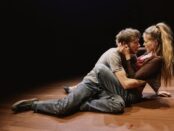
Written and directed by Ngozi Anyanwu, author of "The Last of the Love Letters" (Atlantic Theater Company) and "Good Grief" (Vineyard Theatre), 'The Monsters" is a tour de force for two actors who have the chops for this very physical outing both emotionally and literally and luckily Aigner Mizzelle and Okieriete Onaodowan have what it takes. Aided by the choreography of Rickey Tripp, the fight direction of Gerry Rodriguez, and the work of MMA consultant Sijara Eubanks, the realistic fights mainly pantomimed with only one participant (except for Lil’s training sessions which include Big) make us believe we are seeing two people fighting. [more]
Hate Radio
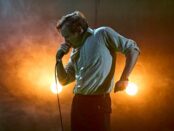
The premise—a radio broadcast—might seem theatrically inert, yet Rau ingeniously implicates the audience by issuing each spectator a set of headphones. We are not merely watching propaganda; we are tuning in. If we need to gauge our own humanity while we watch the hideous display, all we need to do is look straight ahead - on the other side of where the actors play sits the other half of the St. Ann’s Warehouse audience. The isolation produced by the earphones intensifies the intimacy of the rhetoric. One hears the laughter, the rhythm, the coded exhortations as if they were meant for one’s own ear. The imaginative leap—who would listen to this? who would believe it?—collapses. The seduction of format, the familiarity of tone, do much of the ideological work. [more]
The Dinosaurs
Like Beth Wohl’s Liberation, Jacob Perkins’ "The Dinosaurs" follows a group of women who meet weekly to discuss a problem that interests them, in this case alcoholic addiction. Covering many years, the play gives six women with different stories a chance to talk candidly about their lives and travails. Beautifully written, the play, however, feels thin and repetitious and doesn’t seem to get anywhere. Directed by Les Waters, the six actresses led by Off Broadway stalwarts Kathleen Chalfant and Elizabeth Marvel create very different portraits, though at a brief 70 minutes we don’t learn that much about each one. [more]
The Tragedy of Coriolanus (Theatre for a New Audience)
Tata’s staging is also problematic making almost every scene look like every other. The mob scenes have been reduced to five actors (other than the lead characters) which does not suggest any threat whatever. Afsoon Pajoufar’s unit set is an attempt to create a Roman building and then put scaffolding around it to suggest modern renovations. However, using it for almost every scene which is just under three hours becomes monotonous and uninspired. The acting doesn’t help much with each actor seemingly having chosen one single character trait so that all are one-note in this blank-verse drama. Only Roslyn Ruff as Volumnia, the title character’s mother, shows any variety or range. (Volumnia has always been the best role in the play.) [more]
The Other Place
Going along with leaving much unsaid, Zeldin in his direction has kept things rather slow and leisurely so that the play’s 80 minutes seems much longer. Also much of the backstory is missing: what does Chris do for a living as we are told he is very rich? As his friend Terry is described as his contractor, does that make him a builder or has Terry only been hired to do the renovation on the house? The house incidentally has been made unrecognizable with walls removed to let in the light - though the view outside is still in darkness until the trees are torn down, including the tree from which Adam hanged himself. How has Annie been living since leaving the hospital? She has refused to take Chris’ money so that is not an explanation. And is his offer of money an expiation for some unnamed guilt? [more]
Ai Yah Goy Vey! – Adventures of a Dim Sun in Search of His Wanton Father
Chang is an agile performer, and his quick shifts among characters recall the early solo work of urban shapeshifters who built entire neighborhoods out of voice and posture. Yet here the gallery of types is unevenly realized. Too often, figures arrive as the sketch of a stereotype rather than the surprise of a person. When Chang draws on the stylization of Chinese opera—particularly in the rendering of Jackie’s diva-like mother—the show briefly discovers a richer theatrical language, one in which Eastern and Western performance traditions spar and flirt on equal terms. Such moments hint at a more adventurous piece than the one that predominates. [more]
The First Line of Dante’s Inferno
The opening gesture of Dante Alighieri’s "Inferno"—that immortal confession of midlife disorientation in which a wanderer finds himself astray from the “straight road” and deposited in a “dark wood”—has rarely felt as theatrically apt as it does in "The First Line of Dante’s Inferno," Kirk Lynn’s sly, searching, and disarmingly funny new experiment in staged storytelling. Lynn, a polymath of the American theater—playwright, novelist, screenwriter, educator, and guiding spirit of the Austin collective Rude Mechs—treats Dante’s premise less as a theological map than as a psychological condition. His forest is not an allegorical afterlife but a contemporary wilderness in which several souls, one quite literally at midlife, appear to have misplaced the coordinates of their former selves. [more]
Hans Litten: The Jew Who Cross-Examined Hitler
Despite the admirable commitment to historical accuracy, Lackey’s script is littered with flimsy side characters, muddled messages, and awkward dialogue. The result is a thematically incoherent mess that feels unaware of its own central tragedy. Hans says in Act 1 that he wants to force Hitler onto the witness stand in order to stop the Nazis from coming to power. The play seems unwilling to address that this did not work – that no amount of clever rhetoric would have been enough to stop the tide of Fascism. It would be wildly unfair to blame Hans Litten for failing to stop the Nazis, but it is a grievous omission for a play about him to explicitly frame the story that way and then refuse to grapple with the implications of him failing to do so, both for him as a character and for the ideas he is meant to represent and martyr himself for. Indeed, the play revels in the grace of Hans’ martyrdom. [more]
An Ideal Husband
After a several year hiatus, The Storm Theatre, one of the last classical theater companies left in New York, is back with an elegant and polished production of Oscar Wilde’s rarely seen comedy-drama "An Ideal Husband" staged by artistic director Peter Dobbins. While Wilde’s "The Importance of Being Earnest" is well known to theatergoers, "An Ideal Husband," last since on Broadway in 1985, is not but ought to be better known. This play of political corruption and moral turpitude seems more relevant than ever with the number of government scandals in our news daily. As witty as Wilde’s most famous play, An Ideal Husband also has an involving plot and colorful characters. [more]
Anonymous
Spit & Vigor Theatre Company has an interesting approach to stagecraft at least with its return engagement of Nick Thomas’ Anonymous, now at their new home at the Tiny Baby Black Box Theatre. The play which takes place at a weekly meeting of an addiction support group has the audience sit in a circle and then embeds the actors in the circle without acknowledging the rest of us. This gives the play an immediacy it might not have had otherwise. The audience feels like they are part of the monthly group even though we are not seen by the actors. On the other hand, Sara Fellini’s direction is so broad that the actors all seem like they are overacting considering that the audience is only feet away. The play would be much more convincing if they all took it down a few notches. Some of the actors seem to be hamming it up – unless it is simply that we are sitting next to them or across from them that their performances seem to be too big for the tiny venue. [more]
Blackout Songs
Joe White’s "Blackout Songs" direct from London with its original cast is a tour de force for two actors. It is also a challenge for the audience both because its single topic is addiction and as intentionally written by the author we never know what is real and what is imagined. Rising film stars American actor Owen Teague ("Unspeakable: The Murder of JonBenet Ramsey," Stephen King’s "The Stand') and Australian actress Abbey Lee ("Mad Max: Fury Road," "Black Rabbit") both making their New York stage debuts give bravura performances, though Lee’s English accent is often difficult to understand as is the British slang that they often toss off. However, director Rory McGregor’s use of a single set to present a turbulent relationship over ten years and many locales is quite remarkable. [more]
King Lear (Compagnia de’ Colombari)
By loosening the moorings that usually tether one actor to one role, director and adaptor Karin Coonrod peers, with unusual intimacy, into Lear’s psychic weather. The choice to distribute him among ten bodies does not dilute the character; it refracts him. We are invited to watch a consciousness under siege, a man stripped so thoroughly of title, certainty, and familial illusion that what remains is not a king discovering wisdom so much as a human being stumbling toward self-recognition. Lears circulate through the auditorium, each member of the company outfitted by Oana Botez in a palette of muted greige, topped by gilded paper crowns, courtesy of Tine Kindermann, that rise a good foot and a half into the air, their fragile grandeur at once comic and faintly forlorn—a visual joke that curdles into a metaphor. The multiplicity supplies a chorus of selves: monarch and parent, tyrant and child, sovereign and supplicant. At times they seem to echo one another; at others they compete for the same thought, as if Lear’s mind were a crowded room he can no longer govern. The image captures something essential about the play’s cruelty: identity, once propped up by power and praise, proves alarmingly divisible. [more]
DATA
Mathew Libby’s riveting "DATA" is drawn from tomorrow’s headlines – or is this frightening story depicting events that are already happening? As directed by Tyne Rafaeli, this techno-thriller become more and more scary as we begin to realize the dangers of AI and computer algorithms to be used for immigration and citizenship rules as the story moves to its inevitable conclusion. Silicon Valley has a lot to answer for and this play demonstrates what may be in store for us very soon. [more]
Watch Me Walk
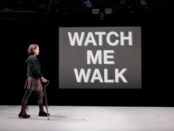
Anne Gridley begins "Watch Me Walk" by taking its title at punishingly literal face value. She introduces herself, grips her walking stick—never a cane, a semantic correction that quickly reveals its philosophical weight—and proceeds to walk the length of the stage again and again, in near silence, for so long that the initial charge of provocation slowly discharges. What remains is not suspense but facticity. In another theatrical ecosystem, this might register as endurance art or a sly conceptual prank; here, in a Soho Rep production presented in association with the recently concluded 2026 Under the Radar Festival, it operates as a recalibration of spectatorship itself. We arrive alert, waiting for the performance to “start,” only to discover that it already has—and that the only thing lagging behind is our attention. [more]
The Disappear
Watching these creative people misbehave is part of the fun though a great deal must be taken on faith: Julie’s tremendous talent, Raf’s inordinate fame and highly emotional depth, Ben’s genius as a filmmaker though Raf has never seen one of his movies, and that Mira’s novels earn more money than Ben’s films. However, nothing Schmidt has written for these characters demonstrates these qualities. Julie is portrayed as pretentious and overacting. Raf is so low-key it is hard to see him as having a great deal of depth on screen. With Ben's self-dramatizing and egotistical nature, it is hard to imagine him finding time to focus on his work, while the items we hear about from Mira’s novels hardly seem like the material for best sellers. Possibly Schmidt who has directed her own play needed a second pair of eyes and ears to get her play whipped into shape. [more]
Cimino’s Defeat
Eric Faris’ "Cimino’s Defeat" seems under researched while attempting to make a play from a few salient facts. At times the play seems endless, at others repetitious with all the arguments that never reach any conclusions. A good deal of the play seems amateurish though this may be the fault of co-directors Sam Cini and Ryan Czerwonko who allow for much ranting and raving from the actors. There may well be a play in the "Heaven’s Gate" debacle but this isn’t it. [more]
and her Children
Hailey McAfee in a scene from Rosie Glen-Lambert and McAfee’s “and her Children” at SoHo [more]
Night Stories
"Night Stories" is, first and foremost, about Jewish life. The show’s characters are mainly Holocaust survivors, yet they are never reduced to simply being symbols of suffering. They go on tangents, they make jokes, they express unimaginable pathos before quickly moving on, and they navigate life as best they can. There are so many moments in this play that are deeply human, and deeply Jewish. The production imbues Sutzkever’s poetry with a magnificent resonance. His words are as strikingly beautiful as when he first wrote them, and this modern production is a heartrendingly beautiful affirmation of life. [more]
Anna Christie
Michelle Williams and Tom Sturridge in a scene from Eugene O’Neill’s “Anna Christie” at St. [more]
If We Kiss
What "If We Kiss" captures, with rare delicacy, is the way young people experience such convergences as both comic and catastrophic. The play treats adolescent feeling with respect, refusing to condescend to its intensity while still allowing space for humor and grace. In doing so, it reminds us that first love is never merely personal: it is social, moral, and—when the generations begin to rhyme—quietly political. [more]
Predictor
Jennifer Blackmer’s "Predictor" expands a single moment of insight into a sharp examination of authorship and agency. Anchored by Caitlin Kinnunen’s quietly compelling performance as Meg Crane, the production traces the birth of a home pregnancy test with clarity, momentum, and discipline—most persuasive when it trusts process over proclamation. [more]
The Surgeon and Her Daughters
According to the author’s note, he wrote the play to acquaint theatergoers with the “forgotten war” in Sudan. Unfortunately, as there is no backstory for the leading character the Sudanese Mohammed-Ahmed, we learn nothing about this war or how it has affected him. Eventually we learn that he was a surgeon there and lost his wife and daughter. We assume that he was not able to become qualified as a doctor in New York as he has been working as a sign holder for a midtown Irish bar. However, the circumstances of the deaths of his wife and daughter are never explained nor why and how he came to New York (one assumes he was seeking asylum but this is never stated either.) Not surprisingly, no one he meets in New York believes he has been a surgeon as he never tells his life story. [more]
BUM BUM (or, this farce has Autism)
In "BUM BUM (or, this farce has Autism)," EPIC Players—New York’s indefatigable standard-bearer for neuroinclusive performance—unfurls a world premiere that feels less like a conventional new play and more like a controlled theatrical detonation. Written by autistic playwright Dave Osmundsen, the play arrives disguised as farce, yet beneath its slapstick velocity lies an exacting critique of how neurodivergent lives are shaped, softened, and rendered consumable for mainstream audiences. It is a work that understands comedy not as an escape from politics but as one of its most effective instruments. Under the brisk, clear-sighted direction of Meggan Dodd, EPIC Players has assembled a company of actors on the spectrum to bring to life the buoyantly subversive text of award-winning Osmundsen—a writer whose instinct for farce is matched only by his ear for the humiliations, large and small, that so often attend the rhetoric of “inclusivity.” [more]
The American Soldier
The American Soldier, written and performed by Douglas Taurel, is a solid evening of theater with important messages about war and the soldiers who fight them. Taurel is an excellent actor and he has done a nice job adapting the show from actual soldier's letters and their accounts of their time in battle. [more]
This World of Tomorrow
This World of Tomorrow resembles the films "Back to the Future" (Bert cannot risk changing anything), "Groundhog Day" for its repetition of the same events, and "You’ve Got Mail" in which two undeclared lovers run the risk of missing each other. Both the message and the structure resemble those time travel movies of the 1940s like René Clair’s "It Happened Tomorrow" where the characters get to view a glimpse of the future only to end up back where they started. The problem with "This World of Tomorrow" is that the play attempts to do something that the movies do much better. While Derek McLane’s clever scenery making much use of projections on a series of square pillars which rearrange themselves for each scene as the projections change is appealing as well as eye-catching, it can only do so much to suggest the extensive and imposing World’s Fair, as well as other parts of New York City. All this will be more successful in a future film version in which CGI will allow us to really see the bygone fair and NYC in 1939. [more]
Diversion
I come from a family of nurses, and apparently so does playwright Scott Organ whose play "Diversion" is set entirely in an ICU nurse’s breakroom. Organ has clearly done his homework, because he’s written an honest, intense, and yet often funny piece centering on a few days in the work life of six nurses under the pressure of a “diversion” investigation. For those unfamiliar with the word in a medical setting, “diversion” is the delicate term given to the illegal practice of diverting drugs away from their intended use, on patients, and instead toward personal use or sale. [more]
Meet the Cartozians
Talene Yeghisabet Monahon’s new play "Meet the Cartozians," being presented by The Second Stage at The Pershing Square Signature Center, is simply the best new American play in New York this fall. This riveting two-part play set in two time frames 100 years apart asks the questions what does it mean to be an American, what does it mean to be white in America, and what does it mean to be an Armenian American. The timeliness of these questions will not be lost on audiences well aware of the current administration’s views on immigration particularly of non-white applicants for asylum. The Armenian American playwright’s last three plays ("How to Load a Musket," "Jane Anger" and "The Good John Proctor") have all had historical backgrounds but this one is personal to Monahon as it deals with her own heritage. Director David Cromer who has proven himself to be a wizard with new plays as well as his brilliant reinvention of Thornton Wilder’s Our Town has chosen a superb cast led by two-time Tony Award-winner Andrea Martin and 2024 Tony Award-winner Will Brill who are all excellent playing two roles each. [more]
Practice
With a three-hour running time (the first act runs two hours straight without an intermission) the play is too long for its repetitiousness having the actors go over the same theater games and monologues over and over again. Of course, the play becomes an endurance test for the actors as well as viewers, whether it was intended to or not. Actors who have undergone this kind of training may be amused; those of us who have not may be bored or lose interest. Although the actors who make up the ten-member cast of "Practice" play very different personalities, we see so little of them individually that it is hard to keep them separate and they become a big blur. [more]
A Bodega Princess Remembers La Fiesta de los Reyes Magos, 1998
Iraisa Ann Reilly in her one-woman show “A Bodega Princess Remembers La Fiesta de los Reyes [more]
Full Contact
In its final form, the piece stands as both elegy and proclamation: a testament to a heritage reclaimed, and to the fierce, necessary act of making contact—full, unguarded, and profoundly human—with oneself. Estrada exists here in a purgatorial tension, suspended between the gravitational pull of guilt and the stark instinct toward survival. The play chronicles not simply his attempt to move forward but the Herculean labor of taking even the first tremulous step toward healing—an act rendered as perilous as any physical combat he has ever undertaken. At times it seems his own mind, a treacherous and labyrinthine opponent, threatens to drag him beneath its tide. And yet, in the fragile space between collapse and catharsis, the work finds its most haunting register: a portrait of a man grappling to reclaim his narrative before the darkness that shaped him claims him once more. [more]
Kyoto
Unlike J.T. Rogers’ Tony Award-winning "Oslo" which handled similar material about the secret Oslo Peace Accord conference, "Kyoto" by Joe Murphy and Joe Robertson makes little concession to its audience giving almost too much information and depicting too many characters, while being patently undramatic much of the time. However, the topic is so explosive that it carries its audience through its 11 conferences. (One hardly notices Natalie Pryce’s costumes so closely does one have to listen to follow the flow of the arguments.) One does come away with the knowledge these sorts of conferences are almost futile with each nation having its own agenda and limits to how far it will go even at the expense of other nations. It is almost remarkable that the Kyoto conference reached any consensus at all. The question now is how much of that was actually enforced by the signatories to the protocol. [more]
Richard II (Red Bull Theatre)
If you know the play, you many have trouble following it as several actors double: Ron Canada plays both John of Gaunt, Duke of Lancaster (Richard’s uncle and Henry Bolingbroke’s father) and later the Bishop of Carlisle. Daniel Stewart Sherman doubles as both Sir Thomas Mowbray, Duke of Norfork and later as courtier Sir Stephen Scroop. Ryan Spahn is seen as Richard’s favorite Bagot, a Welsh Captain, and as a companion to the Queen. The ending has been changed as there is no Sir Piers Exton: another character comes to murder Richard in his cell, giving a different import to the scene. As there is no Duke and Duchess of York, the Duchess’ defense of her traitorous son after Bolingbroke becomes King Henry IV is given to the Queen instead. [more]
Gruesome Playground Injuries
In Neil Pepe’s stark revival of Rajiv Joseph’s "Gruesome Playground Injuries," Nicholas Braun and Kara Young trace three decades of bruised connection. Childhood scars, teenage volatility, and a late-night reckoning unfold in jagged time jumps that reveal how two people can orbit each other without ever landing in the same emotional place. [more]
HardLove
By the time the play reaches its understated yet piercing climax, the question is no longer whether ChiChi and Theodore are “right” for one another—though that question lingers—but rather what it means for any of us to seek connection in a world where desire is both compass and mirage. "HardLove" distills the fragile thrill of two strangers attempting to divine each other’s contours—emotional, physical, moral—and uses that single night’s encounter as a prism through which larger anxieties of belonging, expectation, and becoming refract. In the end, this bold, darkly funny, and unexpectedly tender work stands as a testament to the theater’s capacity to anatomize intimacy without anesthetizing it: a funny, poignant hour that leaves its audience pondering not only these two characters but the mysterious machinery of desire itself. [more]
The Burning Cauldron of Fiery Fire
Tom Pecinka and Marianne Rendón in a scene from Anne Washburn’s “The Burning Cauldron of Fiery [more]
Ready for Company and Other Family Tales
"Ready for Company and Other Family Tales" is at times quite heartwarming. Amidst jokes and cakes, Kim Ima explores her family history across a century of change in the United States. The tone is light, Ima is quite fun as a performer, and the show never wears out its welcome. While the show is charming for what it is, yet leaves much material unexplored. Instead, there are long digressions about aunts and grandfathers that tend to blend together, making it difficult to keep track of who’s who in the winding family tree the show seeks to present. Ima herself is at ease onstage, with a definite charisma. However, the show’s subject matter often renders the entire production perfectly pleasant though somewhat forgettable. [more]
The Harvest
In a Montana farmhouse worn thin by grief and memory, "The Harvest" exposes the fractures beneath a family’s final crop. What begins as a quiet drama of duty erupts into a raw reckoning—where a mother’s long-silenced truth rewrites everything her children thought they knew. [more]
Pygmalion
In their latest, Shaw’s ever-popular "Pygmalion," Staller has staged Shaw’s never-used prologue created for the 1938 film version which has the gods and goddesses on Mt. Olympus recount to the modern audience the myth of Pygmalion and Galatea which inspired Shaw’s Edwardian comedy. The set by Lindsay G. Fuori creates an Al Hirschfeld-inspired Greek temple used for all of the play’s five scenes. Four of the actors dressed in white Grecian robes (courtesy of designer Tracy Christensen) greet us and tell us the myth that we will see in Shaw’s updated 20th century comedy in which the sculptor becomes a professor of language and linguistics and the statue becomes a flower girl who wants to improve her speech well enough to get a job in a flower shop. However, Staller does not stop there but has created narrative introductions for each act which is rather intrusive though it may help some first-time viewers to understand the play. (Is there any theatergoer who has not seen the play’s musical version My Fair Lady on stage or screen?) [more]
The Yellow Wallpaper
"The Yellow Wallpaper" is an enthralling new stage adaptation of Charlotte Perkins Gilman’s 1892 short story of the same name. Gilman’s original narrative is written as a series of diary entries by a woman who’s been confined to the upstairs room of a rented mansion by her husband, who is also her doctor. He prescribes her bed rest and little else, leading her to slowly losing her mind due to the stifling restrictions she is forced to exist under. Actress/choreographer Susannah Millonzi (Beldam's "Fall River Fishing," "Hedda Gabler," "The Crucible") and director Caitlin Morley ("Macbeth," "Twelfth Night") adapted the story together, taking a very direct approach. The diary entries become a series of monologues to be read by the nameless protagonist, the play’s only character. At the same time, the creative production and clever blocking adds significant depth to the narrative, introducing new ideas and exploring them wonderfully. [more]
Queens
Pulitzer Prize winning playwright Martyna Majok, who has specialized in plays about the immigrant experience like Ironbound and Sanctuary City, has revised her play Queens first seen at the Claire Tow Theater at LCT3 in 2018. The new version now at Manhattan Theatre Club Stage I at New York City Center still with an all-female cast has three fewer characters and is now in two acts instead of three. However, the play, though still powerful and authentic, continues to be confusing as it goes back and forth between scenes in the borough of Queens in 2017, 2001 and 2011, and with two middle scenes set in the Ukraine in 2016. Mostly taking place in the same basement apartment in New York, at one point women from both 2001 and 2017 are on stage simultaneously. It is all a little bit difficult to keep the chronology straight. [more]
The Wasp
'The Wasp" is not for the faint of heart. It confronts the audience with themes of mental illness, domestic violence, and sexual trauma, yet resists the easy descent into nihilism. For all its darkness, there is a fragile thread of mercy woven through the play’s venomous fabric—a suggestion that even amidst cycles of cruelty, one might still choose compassion. Malcolm leaves us with the uneasy sense that the line between victim and aggressor, between wasp and spider, may be far thinner than we care to admit.
And so, like the sting of its namesake, "The Wasp" lingers long after the curtain falls—sharp, unsettling, and impossible to forget. [more]
Hannah Senesh
At the center of it all stands Apple, whose performance is nothing short of revelatory. As Catherine, she is brittle yet unbowed; as Hannah, she radiates vitality and purpose. Her voice—both spoken and sung—cuts through the air with the precision of belief. A stirring portrait of resistance, resilience, and unyielding hope, Apple’s one-woman tour de force unfolds with the emotional breadth and intensity of a full ensemble. Apple commands the stage with a virtuosity that transcends mere performance; she channels something elemental and deeply human, crafting an experience that lingers long after the lights fade. It is as inspiring as it is unforgettable—a testament not only to the power of storytelling, but to the indomitable spirit it so eloquently celebrates. Around her, Simon Feil lends quiet gravity as the spectral voices of Hannah’s brother and her Nazi captor. [more]
Oh Happy Day!
"Oh Happy Day!" demonstrates an advance of technique over Cooper’s eight-scene sketch evening in "Ain’t No Mo’." However, the new play is much too talky and seems to cover some of the same material more than once, even though on another level it deals with our relationship with God. The play is an interesting entertainment but one assumes Cooper meant it to be more than that. It is, however, an artifact of the difficult times we live in. [more]
The Lucky Ones
A moving, funny meditation on mortality and friendship, Lia Romeo’s “The Lucky Ones” opens not with sentimentality but with shock — and ends with a grace note of acceptance that feels wholly earned. [more]
Playing Shylock
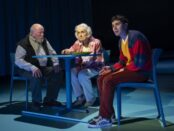
Mark Leiren-Young’s timely one-man show, "Playing Shylock" (formerly called simply "Shylock"), has arrived in New York after its premiere run in Toronto in its new version rewritten around the life and career of veteran film actor Saul Rubinek ("The Marvelous Mrs. Maisel," "Unforgiven," "Frasier") playing himself. Returning to the stage for the first time since 1990, Rubinek plays an actor performing Shylock in a (fictional) production of Shakespeare’s "The Merchant of Venice" which is shut down by protestors claiming that the play is anti-Semitic and the theater company has caved in to their demands. While the play is fascinating and provocative, it also has some flawed passages but Rubinek is commanding at all times. [more]
Did You Eat? (밥 먹었니?)
To have emerged from a childhood like Zoë Kim’s—with enough self-awareness, critical distance, and sheer emotional stamina to craft a piece of theater with even a hint of uplift—is in itself an act of tremendous courage. The piece’s very existence is a quiet triumph: a testament to survival, to the insistence of choosing a path of identity in the face of sheer cruelty, and to the reclamation of one’s own narrative. Yet "Did You Eat?" accomplishes something beyond testimony. Artistically, it is a layered, deeply felt work that reveals Kim’s aesthetic intelligence and her willingness to experiment with form, language, and the body. [more]
Art of Leaving
While Broadway was once filled with plays like this a generation or two ago, "Art of Leaving" now seems very dated. It would have been more believable set back in an earlier decade. Matt Gehring’s direction emphasizes the sit-com nature of the play which is a mistake as it makes the proceedings seem all that much more shallow. Both Aaron and Diana are very thinly written so we learn little about their 25 year marriage except that Diana has lived her life to please her unhappy and demanding husband. Jordan Lage’s Aaron is a total egoist who is lacking in sympathy, while Audrey Heffernan Meyer’s Diana seems unbelievably naïve as to what is available to women today. [more]
Let’s Love!
The fourth evening of one-act plays by Academy Award-winning screenwriter and director Ethan Coen is coyly called "Let’s Love!," when by rights it should be called "Let’s Have Sex!" In three one-acts, all on the same theme, couples are looking for love in all the wrong places - or all the wrong ways. Neil Pepe, artistic director of Atlantic Theater Company smoothly directs the high-powered cast led by Aubrey Plaza, Nellie McKay and Mary McCann as he has done the previous three Coen evenings ("Almost an Evening," "Offices," and "Happy Hour.") What is unusual about "Let’s Love!" is that the language is continually raunchy and the foul-mouthed women have all the best lines, though not the most completely written characters. [more]
Heaux Church
In "Heaux Church," writer-performer Brandon Kyle Goodman does not so much deliver a sermon as they detonate one—turning the pious pulpit upside down and shaking loose its centuries of shame, repression, and whispered taboo. What emerges from the rubble is something gloriously unholy and defiantly sacred: a new gospel of pleasure, pride, and personal liberation. Directed with ecstatic precision by Lisa Owaki Bierman, and buoyed by the ecstatic ministrations of DJ Ari Grooves, enveloping sound design of Christopher Darbassie, and flirty adult puppets of visual provocateur Greg Corbino, Goodman presides over a theatrical communion that is part revival, part stand-up confession, and part drag-tinged spiritual exorcism. [more]
Not Ready for Prime Time
Sketches are performed, in this case approximations of the originals, which is understandable (the authors Erik J. Rodriguez and Charles A. Sothers didn't have the rights to use the actual SNL material) but also a little odd for the more famous bits. It mostly doesn't matter though, and only hardcore fans will notice the difference. The women feel slighted, which makes sense if you watched the show in the 70s (and the 80s). [more]
Truman vs. Israel
Although William Spatz’s "Truman vs. Israel" depicts a fictional encounter between former President Truman and lawyer and later first Jewish woman congresswoman Bella Abzug in 1953, the play brings to life these two colorful and flamboyant personalities who are not so much known today as they once were. As directed by Randy White, the real problem with the play is that in reviewing Truman’s career leading up to the accusation of anti-Semitism, it rehashes a great deal of political history which will be unfamiliar to most theatergoers. One almost needs a score card to follow the ins and outs of Truman’s controversial career. The play also cuts between 1988 and 1953 making it confusing as to what is happening when. [more]
oh, Honey
Under Carsen Joenk’s clean, clever direction, Scotti’s writing finds a delicate equilibrium — biting, funny, and deeply humane. The quartet of women are precisely dressed by designer Iliana Paris — Lu (played with steely authority and a glint of battle-worn wisdom by Dee Pelletier), Bianca (played as a confection — all sugar, charm, and the gentle fizz of conviviality — yet beneath that polished surface something acrid brews, by Jamie Ragusa), Vicki (Karo, radiating a pitch-perfect, Aquarius-inflected, “healing crystal” chaos), and Sarah (Mara Stephens) — are not friends, as Lu icily reminds us. “We can’t talk to real friends about this crap,” she declares. “They already talk enough shit about us behind our backs.” This crap, we soon learn, is the devastating, unshareable truth they orbit: each has a son accused of sexual assault. [more]
Crooked Cross
Samuel Adams as Moritz Weissmann and Ella Stevens as Lexa Kluger in a scene from the Mint Theater [more]
The Pitch
There’s no denying that when 'The Pitch" stays in the office, it’s alive—taut, funny, and honest. Alper clearly knows this world; he writes its jargon and swagger with precision. But each time the play strays from the phones and the whiteboard, it forgets its own best pitch. As a showcase for a terrific ensemble and Keller’s crisp direction, it’s worth the listen. Yet, like a salesman who can’t stop talking after he’s closed the deal, The Pitch doesn’t know when to hang up. When it stays on the phone, it’s riveting; when it hangs up, we’re stuck on hold. [more]
Gwyneth Goes Skiing
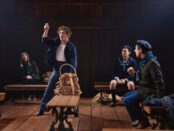
This play (with occasional music by Golden Globe-nominated songwriter and composer Leland) spends most of its first half setting up the two main characters, embellishing on their personalities in and around other key people in their lives. Karp bursts onto the stage as Gwyneth, blowing up every mannerism and resulting in many laughs throughout the show. Karp’s comic timing is finely honed, as is his caricature of Paltrow. [more]
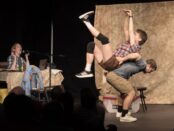
Oratorio for Living Things
To describe "Oratorio" is to flirt with the inadequacy of language. It is a musical work—a sung-through piece in the formal lineage of the oratorio, that 17th-century form that eschews staging and dialogue in favor of spiritual rumination through voice. Think Handel’s "Messiah," and then think again—"Oratorio for Living Things" shares the same bones, but not the flesh. Christian, ever the aural alchemist, reclaims and “rewilds” the form, unbinding it from its ecclesiastical constraints and infusing it with a heady blend of the sacred, the scientific, and the speculative. [more]