
Misterman
Daniel Marconi delivers a mesmerizing turn as Thomas, transforming shattered innocence into luminous madness that grips the audience from first breath to last.
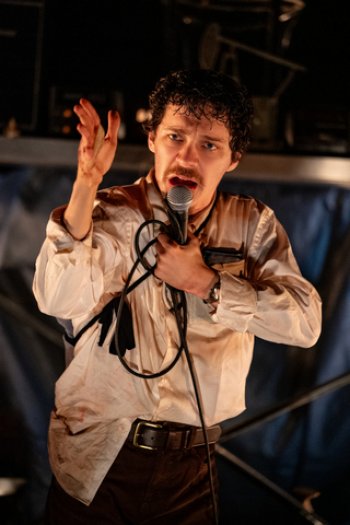
Daniel Marconi in a scene from Enda Walsh’s “Misterman” at Theatre Row (Photo credit: Daniel Rader)
There are performances that impress through technique, and there are performances that dissolve technique altogether, leaving only the unsettling sensation that one has not witnessed acting but rather the exposure of a living soul. Daniel Marconi’s astonishing turn as Thomas Magill in Enda Walsh’s Misterman belongs emphatically to the latter category. From the moment he steps into the cavernous desolation of Thomas’s world, Marconi commands the stage with such absolute conviction that the distinction between performer and character quietly evaporates. One does not watch Marconi portray Thomas; one watches Thomas exist. It is an extraordinary feat of emotional possession, sustained for the entirety of Walsh’s harrowing monologue, and it ranks among the most indelible solo performances in recent memory.
Walsh has long been fascinated by characters imprisoned within the architecture of their own memories, people condemned to relive the past not because they have forgotten it, but because they remember it with unbearable precision. Misterman may be his most devastating examination of that obsession. Thomas Magill, a profoundly isolated young man living alone in the Irish village of Inishfree, believes himself chosen to shepherd his neighbors toward God’s grace. Every morning he ventures into town with his pen and pad noting what his flock must work on to improve their paths to heaven, determined to save their souls, convinced that he alone sees their hidden sins and their capacity for redemption. Yet beneath this evangelical certainty lies a psyche splintering under the weight of grief, abuse, loneliness, and delusion. Walsh transforms what could have been a familiar portrait of mental illness into something metaphysical: an inquiry into the terrible cost of constructing a reality so complete that it ultimately devours its creator.
Labhaoise Magee’s masterfully calibrated direction understands that the play’s emotional force depends not upon spectacle but upon giving Thomas’ fractured consciousness room to breathe. Silin Chen’s immense industrial landscape—a wasteland of rusted scaffolding, exposed wiring, battered furniture, hanging garments, scattered crosses, and an army of aging cassette and reel to reel players—appears less like an abandoned warehouse than the physical anatomy of memory itself. It is both sanctuary and prison, a place where every object has become a relic preserving voices that no longer belong to the living. Thomas’ dead mother survives only as recordings on worn cassettes, with whom he carries on conversations that are alternately tender, pleading, and heartbreakingly ordinary. His abusive father exists only as a grave visited with painful ritual. The house, like its inhabitant, has fallen into profound disrepair.
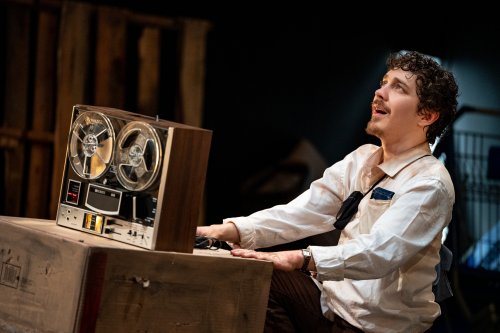
Daniel Marconi in a scene from Enda Walsh’s “Misterman” at Theatre Row (Photo credit: Daniel Rader)
Those cassette players become perhaps the production’s most inspired metaphor. Thomas has become his own recording angel, meticulously preserving every sound of village life—passing cars, barking dogs, idle conversations, birdsong—until the ordinary assumes biblical proportions. Dogs evolve into infernal hounds. Casual exchanges become divine revelations. Every familiar noise threatens either salvation or apocalypse. Walsh’s language mirrors this unstable consciousness with breathtaking dexterity, allowing sacred rhetoric and banal gossip, Biblical cadences and provincial chatter, to collide in sentences forever seesawing between heaven and hell. The result is language that feels startlingly alive, perpetually in motion, as though the words themselves were struggling to contain Thomas’ disintegrating reality.
Marconi’s achievement lies not merely in sustaining Thomas’ increasingly fractured psychology, but in revealing the contradictory humanity beneath it. His Thomas possesses volcanic bursts of rage, yet these eruptions are forever shadowed by an almost unbearable childlike innocence. He is simultaneously prophet and orphan, missionary and frightened boy. His desperate attempts to rescue others emerge less from arrogance than from an aching desire to rescue himself. Every visit to a neighbor, every prayer, every conversation with his mother’s recorded voice carries the unmistakable weight of someone flailing against drowning waters, searching desperately for any lifeline that might keep despair at bay. The loneliness radiating from Marconi’s performance becomes nearly physical in its intensity.
The miracle of the performance, however, extends beyond Thomas himself. During his daily rounds through Inishfree, Marconi effortlessly conjures an entire village from thin air. A flirtatious waitress, a vulgar mechanic, suspicious neighbors, gossiping townsfolk, even their endlessly barking dogs—all spring vividly into existence through nothing more than shifts in posture, rhythm, vocal texture, and gaze. Each character emerges fully realized, distinct without caricature, existing simultaneously within Thomas’ imagination and before the audience’s eyes. Such transformations recall Ireland’s rich tradition of theatrical storytelling, yet here they become something darker: every new voice deepens the labyrinth from which Thomas cannot escape.
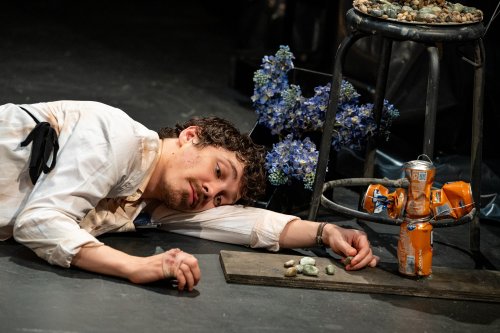
Daniel Marconi in a scene from Enda Walsh’s “Misterman” at Theatre Row (Photo credit: Daniel Rader)
Perhaps the production’s most quietly devastating image arrives whenever Thomas feels the reassuring hand of God upon his shoulder, only for the audience to recognize that the comforting touch is his own. The gesture encapsulates the play’s tragic paradox. Thomas longs for transcendence, for divine companionship, for unconditional love, yet all such assurances originate from within the very consciousness that is betraying him. Marconi’s luminous gaze invests these moments with an uncanny ambiguity. For an instant, one almost believes that grace has indeed entered the room, before recognizing that what appears miraculous may instead be the final flowering of a mind collapsing under unbearable solitude.
Every element of the production contributes to this overwhelming theatrical experience. Elliot Yokum’s exquisitely layered sound design transforms recorded voices and ambient noise into an invisible chorus surrounding Thomas’ consciousness. Shane Hennessy’s sculptural lighting shifts with uncanny sensitivity between harsh reality and spiritual hallucination, while Khari Walser’s understated costumes reinforce the production’s refusal to sensationalize its protagonist’s suffering. Together, this remarkable creative team constructs not merely a stage environment but a complete psychological cosmos, one in which memory, faith, trauma, and imagination become inseparable.
Rarely does one leave the theater with the sensation of having inhabited another person’s mind so completely. Misterman is not simply a play about madness; it is an immersive act of empathy that asks what becomes of a soul when reality itself can no longer be trusted. Walsh has written one of the great contemporary monologues, Magee has directed it with extraordinary rigor and compassion, and Marconi has delivered a performance of staggering emotional magnitude—one so fearless, so physically exhilarating, and so spiritually devastating that it lingers long after the lights have faded. It is the kind of evening that renews one’s faith in what live theater alone can accomplish: the miraculous transformation of a solitary actor into an entire universe, and of that universe into something hauntingly, heartbreakingly human.
Misterman (through July 5, 2026)
Presented by Origin Theatre Company as part of the 2026 Origin Irish Theatre Festival
Theatre Row Theatres, Theatre 5, 410 West 42nd Street, in Manhattan
For tickets, visit www.bfany.org
Running time: 90 minutes without an intermission


Leave a comment