
The Winter’s Tale
It is a pleasure to report that director Daniel Sullivan’s riveting three hour and 20 minutes uncut production of Shakespeare’s "The Winter’s Tale" is a pure staging, gimmick and update free.
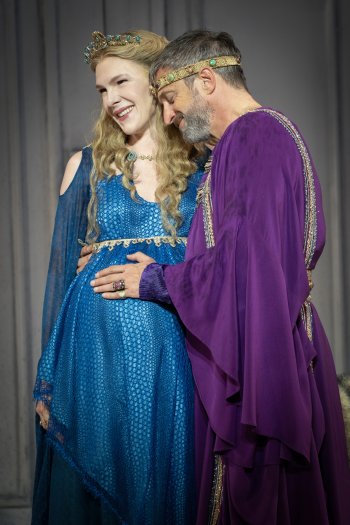
Lily Rabe as Hermione and Raúl Esparza as Leontes in a scene from Free Shakespeare in the Park’s production of William Shakespeare’s “The Winter’s Tale” at the Delacorte Theater (Photo credit: Joan Marcus)
Revivals today tend to come in several similar varieties: rewritten updates by famous contemporary playwrights, director projects that have high concepts, and entirely new plays inspired by the classics, often transposed to the present. It is a pleasure to report that director Daniel Sullivan’s riveting three hour and 20 minutes uncut production of Shakespeare’s The Winter’s Tale for The Public Theater’s Free Shakespeare in the Park is a pure staging, gimmick and update free. Although there is not a weak link in the production, Lily Rabe’s Queen Hermione is so commanding and compelling that she elevates this usually overlooked role to another place in the Shakespeare canon.
With a topnotch cast led by Raúl Esparza, Rabe, Chuck Cooper and Steven Skybell, the production features crystal clear sound design by Brian Ronan (sound system design by Mike Tracey) and impeccable diction by vocal and text coach Andrew Wade which makes this easy to follow and understand for both those who are seeing it for the first time and those who know the play.
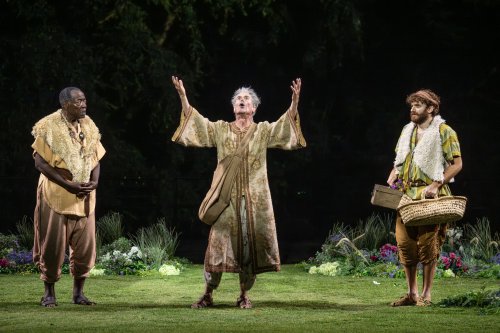
Chuck Cooper as Old Shepherd, Steven Skybell as Autolycus and Michael Khalid Karadsheh as Young Shepherd in a scene from Free Shakespeare in the Park’s production of William Shakespeare’s “The Winter’s Tale” at the Delacorte Theater (Photo credit: Joan Marcus)
One of Shakespeare’s last plays, The Winter’s Tale is often classified as a late romance or a problem comedy. In any event, it is definitely a dark play with a happy ending. Sullivan’s production seems to emphasize the fairy tale elements: the all-white wintry palace of the King of Sicilia by designer Maruti Evans, the notorious stage direction “Exit pursued by a bear” which ends Part I, the garden setting for the second half of the play set in Bohemia and the low comedy of the rogue peddler Autolycus who cheats the naïve shepherds. The theme of the play is jealousy and redemption. When his wife Hermione is able to get his childhood friend Polixenes, King of Bohemia, to remain in Sicilia longer after Polixenes turned him down, King Leontes decides that they are having an affair and his wife is pregnant with Bohemia’s child.
He imprisons his wife as an adulteress and the child is born in prison. At her trial, his wife faints and is later pronounced dead. Not through with his jealousy streak, he asks his loyal courtiers Camillo to kill Polixenes and Antigonus to abandon the baby girl on a deserted shore. When the messengers arrive from Apollo’s oracle at Delphos, Leontes is told he is wrong on all accounts and that he will have no heir until the child who is lost is found. Unbeknownst to him, his wife is not dead but in hiding.
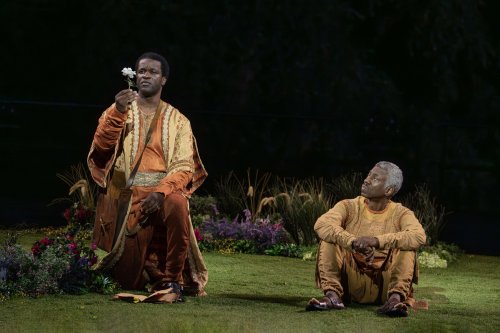
Gilbert Owuor as Polixenes and Teagle F. Bougere as Camillo in a scene from Free Shakespeare in the Park’s production of William Shakespeare’s “The Winter’s Tale” at the Delacorte Theater (Photo credit: Joan Marcus)
Left on the shores of Bohemia, the baby named Perdita by Antigonus is found by an Old Shepherd who decides to bring her up as his own and his fortunes are made by the gold left with her. The winter half of the play ends here. In the second half which begins in Bohemia in spring, it is 16 years later. Polixenes’ son Florizel masquerading as a shepherd Doricles has fallen in love with Perdita now a beautiful and accomplished young lady, but her “lowly” birth does not sit right with her father. When threatened by the king, Florizel, Perdita and Camillo (all this time in the Bohemia court pining for his home) escape to Sicilia where all turns out happily even for the Old Shepherd and his son who brought up Perdita.
Although the cast is variable in their effectiveness, they all are vigorous in their acting making this a very rewarding production of a rarely staged Shakespeare play. Rabe’s defense of her chastity to her husband is utterly thrilling particularly in the trial scene. She outshines Esparza as King Leontes who does run the emotional gamut from rage to grief. Skybell plays both Leontes’ courtier Antigonus, (who gets eaten off stage by the famous bear) at Sicilia, in part one and in the second half the peddler/rogue Autolycus who simply devours the scenery, as they say. He gives a bravura performance in a role that is usually thrown away as simply comic relief.
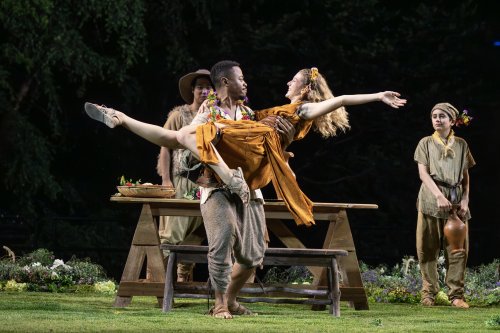
Michael Thanh Tran as Rustic, Daniel Kyri as Florizel, Isabela Ferrer as Perdita and Everett Lonergan as Rustic in a scene from Free Shakespeare in the Park’s production of William Shakespeare’s “The Winter’s Tale” at the Delacorte Theater (Photo credit: Joan Marcus)
As Polixenes, Gilbert Owuor is more low-key than the other royals but makes his presence felt. Marsha Stephanie Blake as Paulina, lady-in-waiting to the queen and wife to Antigonus, is very crisp in her angry performance but misses the irony in her lines. As the Old Shepherd who adopts Leontes and Hermione’s abandoned baby, Cooper, on the other hand, is always jovial and level-headed. As the young lovers, newcomers Isabela Ferrer as Perdita and Daniel Kyri as Florizel are charming and make a fine impression. Teagle F. Bougere appearing in his tenth Delacorte production is a wise counselor as Camillo, first to Leontes in Sicilia and then to Polixenes in Bohemia.
Sullivan’s production team is very much in tune with his fairy tale concept. Linda Cho’s Medieval costumes are very rich and dark for the royals (with Leontes’ courtiers in various shades of blue) in the first half of the play which takes place in winter and very light and colorful for the spring section set in Bohemia. Evans’ two sets include snowdrifts behind the all-white set for Sicilia, and banks of colorful flowers on a well-cared-for lawn which covers the stage in the second part, with the theater’s own trees revealed at this time. Tom Kitt’s wonderful original compositions for keyboard, violin, cello and laouto (the traditional Greek lute) add immeasurably to the many moods of the play. Bradley King’s bright lighting design enhances both the tragedy of the first act and the comedy of the second.
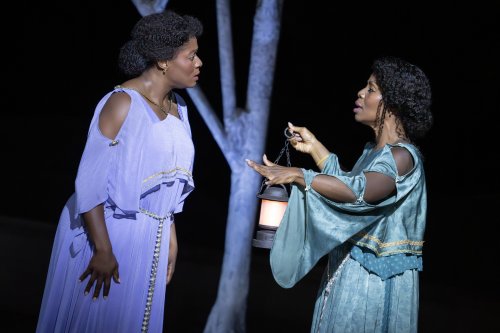
Jennifer Mogbock as Emilia and Marsha Stephanie Blake as Paulina in a scene from Free Shakespeare in the Park’s production of William Shakespeare’s “The Winter’s Tale” at the Delacorte Theater (Photo credit: Joan Marcus)
Once identified mainly with new plays including two Pulitzer Prize winners, Daniel Sullivan has now directed 12 Shakespeare plays at the Delacorte and he may have outdone himself with the success of this Winter’s Tale. He is ably abetted by choreographer/associate director Mimi Lieber who livens up the shepherds’ sheep-shearing festival in the second half with her folk dances. Both the clarity of the sound and the excellent diction make this a play all can understand and enjoy. While the revelation scene at the end may not be as magical as in some other productions, it is still absorbing and captivating. Just try to take your eyes off the “statue” of Hermione before it (she) moves. It is an almost three hour and a half hour evening but you never feel you have been sitting too long.
The Winter’s Tale (through August 23, 2026)
The Public Theater
Free Shakespeare in the Park
Delacorte Theater, enter at 81st Street and Central Park West or 79th Street and Fifth Avenue, in Manhattan
Five ways to get free tickets: distributed at Noon at the Delacorte Box Office to those on prior line, Downtown Distribution Lottery at The Public Theater, 425 Lafayette Street at Astor Place, by Mobile Ticket Lottery powered by TodayTix at http://www.publictheater.org, in person distribution at locations throughout the five boroughs on day of select performances, or In-Person Standby Line in Central Park after six PM.
Running time: three hours and 25 minutes including with one intermission


Leave a comment