
Broad Strokes
Cat Cohen turns a stroke at 30 into comic fuel, emerging louder, sharper, funnier, and gloriously alive in a triumph of resilience and self-invention.
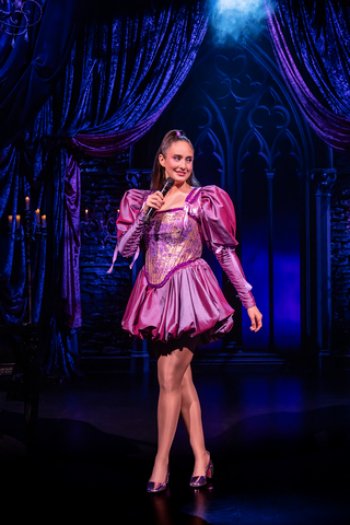
Cat Cohen in her one-woman show “Broad Strokes” at the Lucille Lortel Theatre (Photo credit: Matthew Murphy)
At first mention, a young woman suffering a stroke does not sound like a promising premise for a comedy, much less a musical comedy. It suggests frantic texts to a medically literate friend, and the sort of midnight internet search that convinces you that a headache is an aneurysm. Yet Cat Cohen, whose comic persona has always depended upon turning private neuroses into public spectacle, has discovered in Broad Strokes an almost perversely fertile subject: the surreal experience of having a stroke at 30, discovering that it was caused by a congenital hole in her heart, and then finding herself grateful, in a sense, to have been proved right about all the things she had spent her life worrying about. Under Alex Timbers’ brisk and extravagantly theatrical direction, Cohen turns a medical emergency into a fantasia of vanity, anxiety, pop culture, and self-invention. The result is a compact, highly polished Off-Broadway debut that is considerably more inventive—and considerably funnier—than its premise has any right to be.
Cohen, now in her mid-30s, was already an accomplished comedian and cabaret performer, with a Netflix special, a devoted following, a successful podcast, and years of appearances in intimate downtown rooms, when the stroke interrupted what should have been the uncomplicated excitement of an impending European tour. She had suffered migraines since childhood, and shortly before departing for Europe she noticed that one arm would not move. She took an Uber to the emergency room, where an MRI revealed the stroke and, subsequently, a patent foramen ovale, or PFO: a literal hole in her heart. The diagnosis required surgery and forced her to cancel her tour, confront a potentially enormous medical bill, and temporarily surrender the independent, itinerant life she had constructed for herself. Cohen recounts all this without soliciting pity. Indeed, her instinct is almost immediately to search for the joke—as when she discovers that her cardiologist is named Dr. Love, a coincidence so perfectly ridiculous that it seems to have been supplied by Norman Lear.
The title announces Cohen’s method. A stroke becomes not merely a terrifying interruption but another piece of evidence in the elaborate mythology she has built around her own exceptionalism. She has long described herself as “young for my grade,” and the stroke becomes an absurdly literal extension of that identity: how many 30-year-olds can claim to have had one? Her lifelong hypochondria, meanwhile, is suddenly vindicated. “There’s nothing more dangerous than a vindicated hypochondriac,” she observes, and the joke contains a surprisingly perceptive truth. Illness does not necessarily silence anxiety; sometimes it gives anxiety an enormous new vocabulary. Cohen’s imagination is forever racing ahead of reality, constructing catastrophic possibilities, and Broad Strokes finds its comic energy in the strange moment when one of those possibilities actually arrives.
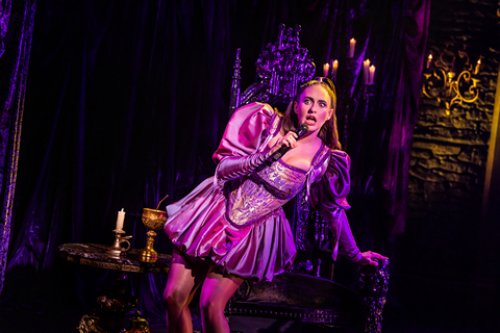
Cat Cohen in her one-woman show “Broad Strokes” at the Lucille Lortel Theatre (Photo credit: Matthew Murphy)
This is also a show about Cohen’s more fundamental obsession: her refusal to be ordinary. Early on, she recalls an acting teacher’s devastating assessment that she was “just a normal girl,” a classification she regards as something approaching an existential insult. She wants to be the heroine, the author, the lighthouse; she wants the drama of a Gothic novel without the consequences of actually inhabiting one. Her opening song, “By the Sea,” establishes the fantasy beautifully, invoking the tradition of troubled literary women who retreat toward some windswept coastline—Rebecca, Jane Eyre, The Awakening—as though a sufficiently picturesque setting might transform neurosis into destiny. Cohen’s great comic contradiction is that she longs desperately to be the center of a grand narrative while being equally desperate to prevent that narrative from becoming genuinely tragic. She wants drama, in other words, but only the entertaining kind.
Timbers understands this contradiction and gives it a theatrical environment grand enough to accommodate Cohen’s self-dramatization. Derek McLane’s scenic design transforms the small Lucille Lortel Theatre into a miniature Gothic palace of velvet, candles, chandeliers, columns, and a throne, a setting somewhere between a haunted castle and an extravagantly decorated Dracula set with a band. Jake DeGroot’s lighting punctuates Cohen’s jokes with flashes of color and sudden illumination, while Cody Spencer’s sound design gives the production the scale and punch of a concert. Kelsey Randall’s costume—an exuberant, period-inflected confection that somehow manages to be both Victorian and distinctly contemporary prom queen—makes Cohen look like a millennial Bride of Frankenstein who has wandered into a cabaret. The production is intentionally excessive: Cohen has been handed a medical crisis, and Timbers responds by giving it the visual grandeur of an operatic catastrophe.
The songs, written by Cohen with David Dabbon, are central to that transformation. There are seven of them, and they do more than interrupt the monologue with musical decoration; at their best, they give Cohen’s anxieties another register in which to express themselves. “Complete Control” turns the fantasy of mastering one’s life into pop spectacle; “Are You Mad at Me?” converts Cohen’s desperate need to please everyone into an infectious comic anthem; “I Don’t Claim This Energy” channels the peculiar emotional vocabulary of contemporary wellness culture. “Hypochondriac’s Anthem” is particularly winning because the joke gradually gives way to something more sincere: the realization that worrying has been one of Cohen’s most persistent forms of self-protection. And “Normal Girl,” the evening’s most ambitious number, begins with the intimacy of a diary entry before expanding into something resembling a full-scale musical-theater breakdown. Backed by a nimble three-piece band, Cohen sings with an airy, almost innocently pretty voice that creates a delicious discrepancy between her delivery and the frequently outrageous material.
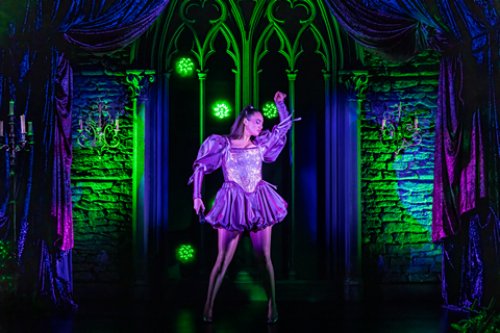
Cat Cohen in her one-woman show “Broad Strokes” at the Lucille Lortel Theatre (Photo credit: Matthew Murphy)
That discrepancy is one of Cohen’s great gifts. She can sing about pubic shaving, emergency-room indignities, sex, bodily functions, and the mechanics of heart surgery with the sweet, almost girlish musicality of a classic Broadway ingénue. The material can be bawdy without becoming merely crude because Cohen’s performance is so insistently stylized. Her voice, her facial expressions, her physical mannerisms, her catty conversational rhythms—all are instruments in a comic orchestra that she conducts with remarkable precision. Her vocabulary is particularly fertile: phrases such as “vindicated hypochondriac” or “young for my grade” become miniature character studies. She is funniest when language itself seems to have become infected with Cohen-ness, when an ordinary observation is bent just far enough out of shape to reveal an entirely different comic reality.
The show’s greatest pleasure, however, may be the way Cohen refuses to separate the ridiculous from the frightening. She can move from an account of the emergency room to a joke about Netflix recognition, from the cancellation of a European tour to the absurdity of an insurance bureaucracy, without pretending that any of these experiences are uncomplicated. She worries about having another stroke; she worries about something worse happening; she worries about worrying. Beneath the manic delivery is an unusually recognizable portrait of the contemporary self, particularly the self trained to narrate every experience immediately, to convert trauma into content, and to seek reassurance while simultaneously performing the opposite of reassurance. Cohen’s particular brilliance is that she does not present herself as an emblem of a generation. She is much too strange, vain, funny, and specific for that. The millennial details are the medium, not the message.
What makes Broad Strokes especially satisfying as theater is the sense that Cohen and Timbers have recognized each other’s appetites. Cohen’s natural habitat is intimate comedy, where her personality can ricochet directly across a room; Timbers specializes in enlarging eccentric performers and peculiar material until they acquire theatrical architecture. Here, neither overwhelms the other. The director’s maximalism gives Cohen a world to inhabit, while Cohen’s relentless personality prevents the production from becoming mere spectacle. Every effect ultimately points back toward the performer at its center. The elaborate set, the lights, the songs, the band, the costume, the sudden shifts in tone—all are extensions of the same comic proposition: if life insists on turning you into the protagonist of an unwanted medical drama, you might as well demand a throne.
There is, finally, something moving in Cohen’s insistence on turning survival into performance without pretending that performance constitutes a cure. She emerges from the experience alive, surgically repaired, and apparently healthier than before, even finding that her migraines have disappeared. But the anxiety remains. Broad Strokes does not claim that a frightening diagnosis has made Cohen wiser, calmer, or more “normal.” Instead, it has furnished her with an extraordinary new piece of material and forced her to reconsider what kind of protagonist she actually wants to be. The achievement of the evening is that the medical story becomes only one layer of a larger comic autobiography about attention, vanity, fear, ambition, and the desperate wish to remain singular. Cohen once recoiled from being called a normal girl. After Broad Strokes, she has achieved something much better: she has made being unmistakably, gloriously herself into the punch line.
Cat Cohen in her one-woman show “Broad Strokes” at the Lucille Lortel Theatre (Photo credit: Matthew Murphy)
Broad Strokes (through September 25, 2026)
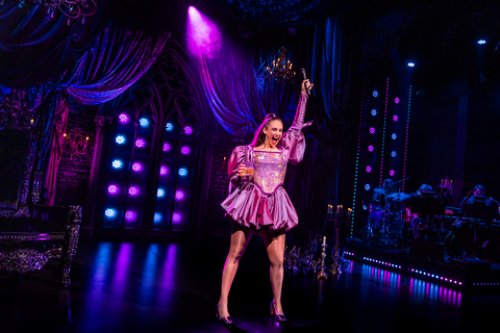
Cat Cohen in her one-woman show “Broad Strokes” at the Lucille Lortel Theatre (Photo credit: Matthew Murphy)
Lucille Lortel Theatre, 121 Christopher Street, in Manhattan
For tickets, visit www.boxoffice.lortel.org
Running time: 70 minutes without an intermission


Leave a comment