
The Pass
For Jason, a charismatic soccer star, image is everything. But every indulgence to live honestly risks exposing the truth—and destroying the career he’s built.
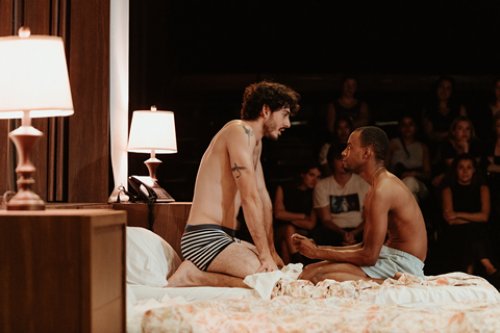
Matisse Ratron-Neal and Terry Bell in a scene from John Donnelly’s “The Pass” at La MaMa (Photo credit: Andy Henderson)
John Donnelly’s The Pass, which arrived at London’s Royal Court Theatre in 2014 and now makes its American premiere at La MaMa, is the sort of play whose subject seems almost unnervingly well chosen for the present moment. Professional soccer has never been more culturally omnipresent in the United States, while the question of what elite sports permit—or refuse to permit—men to reveal about themselves has acquired an urgency that extends far beyond the playing field. Yet Donnelly’s play is not a consoling story about athletes discovering the liberating possibilities of love. It is considerably darker, and more interesting: a study of a man who has so thoroughly converted himself into a marketable public object that, by the time he is offered the possibility of recovering his private self, he may no longer know what that self is. Across three hotel rooms and twelve years, The Pass traces the wreckage produced when ambition, masculinity, desire, celebrity, and shame become so thoroughly entangled that success itself begins to resemble a form of imprisonment.
Donnelly’s great structural conceit is both simple and quietly devastating. Each of the play’s three movements occurs in a hotel room, a place that is at once private and radically impersonal, temporary shelter masquerading as home. The first finds Jason and Ade,17-year-old football hopefuls, awaiting a career-defining match in Bulgaria; the second catches Jason years later, after professional success has transformed him into a celebrity whose carefully maintained image has become a commercial enterprise; and the third returns to Jason near the end of his career, when injury, divorce, addiction, and the accumulated consequences of his choices have begun to strip away the mythology he has constructed around himself. The rooms improve as Jason becomes richer, but the man occupying them becomes progressively less habitable.
What makes Donnelly’s writing especially potent is his understanding that repression need not produce a sympathetic victim. Jason is not merely damaged by the culture surrounding him; he actively reproduces its cruelties. He is ambitious, vain, competitive, manipulative, frightened and often appalling. His tragedy is therefore not simply that he has been denied an authentic life but that, in denying it to himself, he learns to deny generosity and authenticity to other people. The football culture that has taught him to regard vulnerability as weakness has not created all his defects, but it has given those defects a remarkably efficient training regimen. Fame then supplies money, power, and an elaborate machinery for concealing the consequences. Donnelly is less interested in asking whether Jason is secretly gay than in asking what happens to a human being who spends his entire adult existence terrified that anyone might discover anything about him that he cannot control.
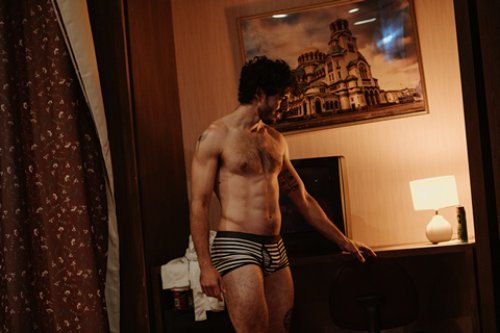
Matisse Ratron-Neal in a scene from John Donnelly’s “The Pass” at La MaMa (Photo credit: Andy Henderson)
Max Hunter’s direction understands that the play cannot survive as a solemn museum piece about early-21st-century homophobia. His production instead gives the material a restless theatrical pulse, placing the hotel room in traverse between two banks of spectators so that the audience itself becomes a kind of stadium: watching, judging, waiting for somebody to make a mistake. Hunter’s staging repeatedly emphasizes performance as both metaphor and condition of existence. Jason is always being observed, and the audience is made uncomfortably aware that it, too, is watching a man construct and dismantle himself. The production can occasionally push too hard, particularly when its energy threatens to overwhelm the quieter psychological tensions in Donnelly’s script, but Hunter’s instinct is fundamentally right. He treats The Pass not as a period piece about a vanished sporting culture but as a volatile contemporary drama about the price of living under permanent scrutiny.
Matisse Ratron-Neal gives the production its blazing center. His Jason is magnetic precisely because the actor refuses to make him easily forgivable. From the beginning, Ratron-Neal gives him the physical confidence of someone accustomed to being watched, admired, and accommodated, but underneath that swagger there is an almost desperate need to control every room he enters. As the years pass, the performance darkens without ever becoming merely grim. The younger Jason’s appetite for success becomes the older Jason’s obsession with reputation; confidence hardens into narcissism, and narcissism finally begins to resemble panic. Ratron-Neal is particularly impressive in the final section, when Jason’s physical and psychological deterioration become inseparable. His face seems to register several incompatible emotions at once—rage, humiliation, longing, resentment, terror—and the result is a portrait of a man discovering, much too late, that self-invention has its limits.
Terry Bell’s Ade is the production’s essential counterweight. Where Jason continually attempts to dominate the emotional atmosphere around him, Bell gives Ade an appealing openness, nervous intelligence, and underlying warmth. His early scene establishes a friendship shaped by competition but also by an intimacy neither man possesses the vocabulary to acknowledge. When Ade returns years later, Bell makes the transformation quietly but unmistakably. This is no longer the young man desperate to prove himself; he has built a life outside the machinery that once defined him. Bell’s achievement is to make Ade’s apparent contentment feel earned rather than sanctimonious. There is anger in him, certainly, but also an adult’s recognition of the difference between loving someone and allowing that person to destroy you. His final encounter with Jason acquires its force because Bell lets disappointment coexist with compassion.
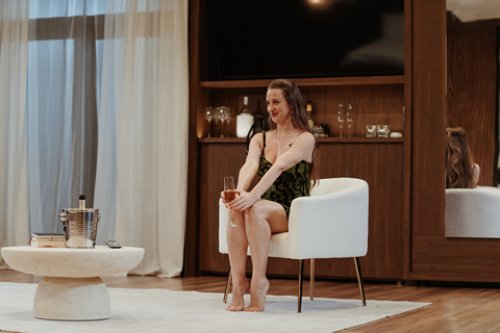
Ino Badanjak in a scene from John Donnelly’s “The Pass” at La MaMa (Photo credit: Andy Henderson)
Ino Badanjak is the production’s electric surprise. As Lyndsey, the woman Jason encounters during the second chapter of his career, she enters a play dominated by male anxiety and immediately alters its atmospheric pressure. Badanjak refuses to make Lyndsey a mere plot device or a glamorous accessory to Jason’s celebrity. She is funny, calculating, observant, vulnerable and dangerous in precisely the proportions the situation requires. Her scene with Ratron-Neal becomes an elaborate contest over who understands whom first, and Badanjak plays every shift in power with delicious precision. Her laughter, in particular, becomes a weapon: what Jason regards as a carefully managed situation repeatedly threatens to become something he cannot control. Badanjak gives the middle section a buoyancy and theatrical confidence that make it the production’s most gripping passage.
The irony of the scene becomes especially pointed as Jason empties Lyndsey’s purse onto the carpet, frantically searching for the ever-present camera. If he goes through with the encounter and the resulting footage reaches the public, he can reassure the media—and his fans—that he is precisely the heterosexual celebrity they believe him to be, even as the revelation effectively destroys his marriage. If he refuses, he may preserve something closer to fidelity to his own desires, but he leaves intact the question mark hanging over his sexuality, the very ambiguity he has spent his career trying to eradicate. Jason is thus trapped in the perfect celebrity paradox: whatever he chooses, the public image he has worked so obsessively to control will exact its price.
Oliver Rowland-Jones, meanwhile, gives the final movement an entirely different kind of energy as Harry, the young bellhop drawn into Jason’s increasingly unstable orbit. Rowland-Jones captures the dangerous mixture of curiosity, celebrity worship, nervous excitement, and poor judgment that makes Harry both funny and unsettling. His performance is deliberately more vulnerable than those of the two older men, and that vulnerability exposes something important about Jason: the older star has become so accustomed to turning people into instruments of his own emotional survival that he scarcely recognizes the moral cost of doing so. Rowland-Jones’ presence therefore gives the final section a disturbing freshness, even when the play itself begins to circle material it has already established.
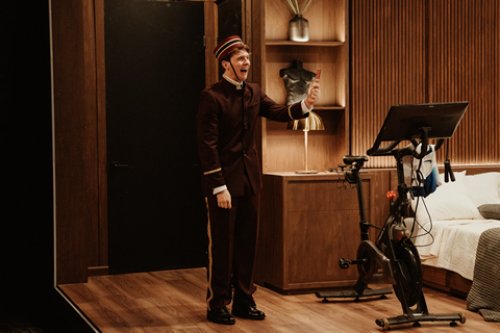
Oliver Rowland-Jones in a scene from John Donnelly’s “The Pass” at La MaMa (Photo credit: Andy Henderson)
The production’s design team makes an equally persuasive argument for the hotel room as the play’s central metaphor. Seth Byrum’s handsome, adaptable scenic design transforms the playing space across the three periods, allowing the changing quality of Jason’s surroundings to chart his material ascent while revealing the stubborn sameness of his emotional circumstances. The increasingly luxurious rooms are still rooms in which nobody truly lives. Cheyenne Sykes’ lighting gives each environment its own psychological temperature, moving from intimacy to exposure and from glamour to something closer to delirium. Megan Culley’s sound design supplies the production with an anxious undercurrent, while Dwight Bellisimo’s video work expands the claustrophobic rooms into the larger media culture that Jason has spent his life trying to control. Amanda Roberge’s costumes efficiently register both Jason’s changing fortunes and the increasingly elaborate costume of celebrity he wears around himself.
If The Pass occasionally strains its own dramatic machinery—the running time can feel longer than the material requires, and some of Donnelly’s repetitions are more emphatic than necessary—that excess ultimately belongs to the play’s strange fascination. This is a drama about a man who cannot stop repeating himself because he has never learned how to change. The final confrontation between Jason and Ade therefore feels less like the conventional catharsis of a sports drama than an exhausted reckoning with roads not taken. The match is long over. The trophy, the endorsements, the money, the carefully manufactured image—all the things Jason once imagined would constitute a life—remain, while the life itself has somehow disappeared.
What lingers is the play’s bleakly compelling suggestion that the greatest casualty of repression is not simply the love one is forbidden to pursue, but the capacity to recognize what one has sacrificed. Donnelly’s footballers inhabit a culture in which winning is supposed to solve everything, yet Jason’s victories only make his eventual defeat more absolute. Hunter and his four-actor ensemble bring that contradiction vividly to the stage, with Ratron-Neal providing a ferocious portrait of self-destruction, Bell a deeply affecting study in survival, Badanjak a sparkling embodiment of resistance, and Rowland-Jones an unsettling glimpse of innocence caught in another person’s collapse.
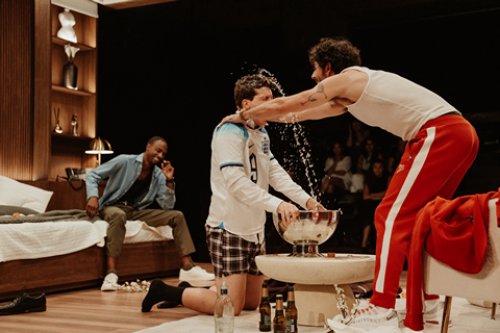
Terry Bell, Oliver Rowland-Jones and Matisse Ratron-Neal in a scene from John Donnelly’s “The Pass” at La MaMa (Photo credit: Andy Henderson)
The Pass may begin as a play about soccer, but its real subject is the terrible distance between the person we perform for the world and the person we might have become had we ever been permitted to live honestly. In this beautifully engineered, intensely acted production, that distance becomes not merely tragic but theatrical: a room, a career, a friendship, and finally a life, all closing in around a man who has spent too long pretending he has everything under control.
The Pass (through September 4, 2026)
The Max Hunter Company
Shares at La MaMa
The Ellen Stewart Theatre 66 East 4th Street, in Manhattan
For tickets, visit www.lamama.org/shares
Running time: two hours without an intermission


Leave a comment