
Giulia: The Poison Queen of Palermo
Exciting new musical inspired by the true story of 17th century apothecary Giulia Tofana by and with quadruple threat singer-songwriter Jennifer Nettles.
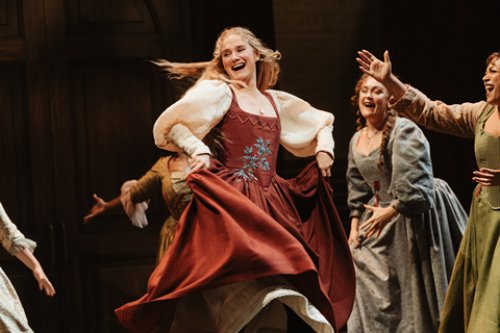
Jennifer Nettles in title role and the company of the new musical “Giulia: The Poison Queen of Palermo” at the Perelman Performing Arts Center (PAC NYC) (Photo credit: Andy Henderson)
Feminism did not start in the 20th century. Three-times Grammy winner country singer-songwriter Jennifer Nettles has written an exciting new musical (book, music and lyrics!) inspired by the true story of Giulia Tofana, the 17th century Sicilian woman who is reputed to have poisoned 600 men. Set in 1653, these were the days when the Catholic church forbid divorce and men were kings of their castle with downtrodden wives who were at their beck and call. Brilliantly directed by Mary Zimmerman, Giulia: The Poison Queen of Palermo now at the Perelman Performing Arts Center (which last season gave us Cats: The Jellicle Ball) is a dynamic show with suitably Broadway pretensions in its elaborate production.
The always commanding Nettles who is not unknown to Broadway audiences having been a star replacement in both Chicago and Waitress plays her own heroine Giulia, a woman who runs an apothecary shop where she dispenses love potions and preparations to poor women to get with child or end unwanted pregnancies. Stuck with an abusive second husband Carlo who is often out of work, Giulia reaches her limit when he sexually assaults Vitoria, her daughter from her first marriage, and she decides to put a stop to him with aqua tofana, a concoction of her own invention. Afterwards, she realizes she can help other abused Palermo wives to put an end to their bad marriages, seeing herself as a vigilante.
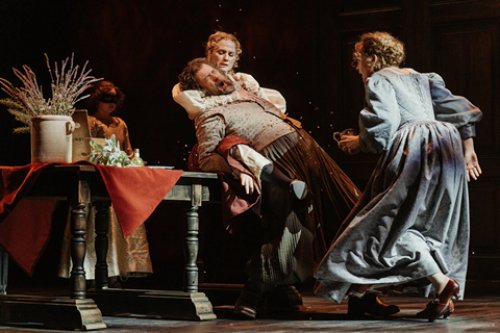
Jennifer Nettles as Giulia, Andrew Kober as Pietro and Emily Fink as Maria in a scene from the new musical “Giulia: The Poison Queen of Palermo” at the Perelman Performing Arts Center (PAC NYC) (Photo credit: Andy Henderson)
Palermo is ruled by the strict Cardinale who is also using Giulia to help deal with his syphilis. Nevertheless, he has an ambitious architect protégé who becomes the Governatore in order to build much needed aqueducts in a city plagued with drought. However, when Giulia puts a stop to his interest in her underage daughter, he becomes an enemy as does the entitled Duchessa when Giulia refuses to give her aqua tofana to poison her boring elderly husband. At the height of Giulia’s success, the Governatore and the Duchessa attempt to put a stop to her activities. While little is known about the real Giulia Tofana and there are at least six possibilities to her death, the musical comes up with a surprising and startling new one for its finale.
The show, heavily indebted to such shows as Sweeney Todd and Hamilton, both famous historical musicals, is not yet perfect. Several plot points are brought up and then dropped like Governatore’s building of the aqueducts. Who is he and how did he get so much power? Up until the end of the show, no one in Palermo seems to notice the number of women becoming widows. How did Giulia get away with it? Did Giulia feel guilty about all her poisonings? The show is also totally humorless but the energy and enthusiasm of the hard-working cast cover up this flaw in the dialogue and plot.
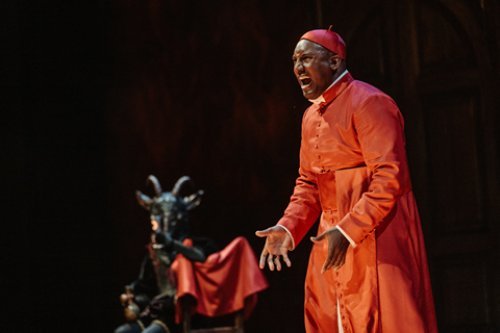
Quentin Earl Darrington as Cardinale (foreground) and Naomi Serrano as the Little Devil (background) in a scene from the new musical “Giulia: The Poison Queen of Palermo” at the Perelman Performing Arts Center (PAC NYC) (Photo credit: Andy Henderson)
The cast make the most of their juicy roles. Nettles commands the stage whenever she is on it, though she is rather unsubtle in her interpretation of Giulia. Quentin Earl Darrington is an authoritative adversary as the Cardinale, while Christopher M. Ramirez is always over the top as the Machiavellian Governatore with a permanent sneer to his lips. Didi Romero’s Duchessa is memorably spoiled and selfish, a product of a corrupt aristocracy. Bre Jackson, a character called La Capitana, used both as a narrator and a seer steals every scene she is in. In his brief appearance as Giulia’s drunken second husband Carlo, Matthew Amira is suitably dastardly and abusive. The seemingly large female chorus, Giulia’s customers, friends and relatives, stand out as engaging characters and backup singers.
Zimmerman’s colorful production has been greatly aided by her designers who have accomplished equally exciting work. The rich, beautiful multicolored costumes for the women by Ana Kuzmanić are each embroidered with a different flower in a contrasting color. Part of the ensemble is dressed as commedia dell’arte players from that time period. Daniel Ostling’s unit set has three arched cabinets which when opened reveal additional backdrops while also serving as Giulia’s storage spaces for her wares. The lighting by T.J. Gerckens creates varying moods for the many scenes.
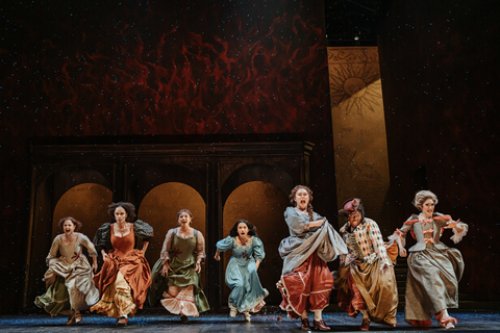
The company of the new musical “Giulia: The Poison Queen of Palermo” at the Perelman Performing Arts Center (PAC NYC) (Photo credit: Andy Henderson)
Nettles’ wonderfully propulsive score is made up of one power ballad after the other, each one better than the last. She sings her solos with bravura and aplomb: “Next Time,” “Premeditation,” “The River” and “Fly Away.” Along with Austin McCormick’s thrilling choreography, she and the female ensemble have a joyful time with their songs “Happily Ever After,” “Split Second Life Changing Moment,” “It’s Never Enough,” “Speed of Light,” “Power” and “Cheers.” Romero’s Duchessa stops the show with her imperiously comic “Always Get What I Want.”
Darrington’s Cardinale gives excellent dramatic performances with his solos “Shame” and “The Wolf.” Ramirez’s Governatore literally devours the scenery with his two arias, “Bones” and “An Ounce of Prevention” as well as his duet with the Cardinale, “Work Together.” Jackson’s La Capitana captivates on opening each act (“Welcome to Palermo” in Act I and “Making a Killing” in Act II) and makes us wish she had more to do. As Vitoria, Naomi Serrano impresses with her plaintive second act solo “When I Still Believed.”
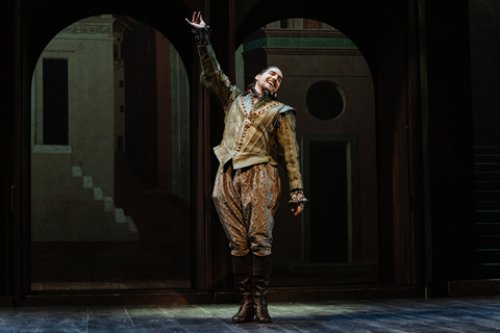
Christopher M. Ramirez as Governatore in a scene from the new musical “Giulia: The Poison Queen of Palermo” at the Perelman Performing Arts Center (PAC NYC) (Photo credit: Andy Henderson)
Jennifer Nettles’ Giulia: The Poison Queen of Palermo proves her to be a quadruple threat talent as an actress, bookwriter, composer and lyricist. It is difficult to believe that this is a first attempt at writing a book musical. While the show needs some tweaks particularly to fill in missing information, it is an exciting work and has been given a dynamic production by Mary Zimmerman. And let’s not forget the cast of 12 who seem like many more who fill out the amazing story. We should be hearing much more from Nettles in the future.
Giulia: The Poison Queen of Palermo (extended through August 2, 2026)
Perelman Performing Arts Center (PAC NYC), 251 Fulton Street, at the corner of Greenwich Street, in Lower Manhattan
For tickets, visit http://www.pacnyc.org
Running time: two hours and 35 minutes including one intermission


Leave a comment