
Machine Learning
Two couples participate in a paid study where they are observed by non-human entities intending to learn how to be suited as human companions.
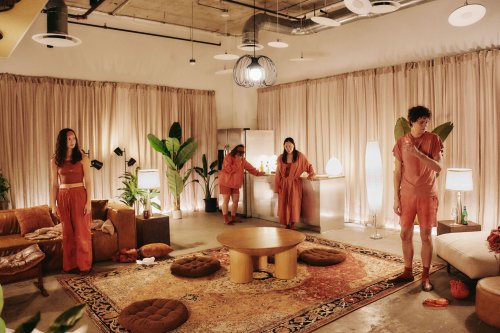
Delaney Rowe, Emma Ramos, Michele Selene Ang and Douglas Smith in a scene from Kate Vozella’s “Machine Learning” at Manhattan Neighborhood Network (Photo credit: Valerie Terranova)
The Manhattan Neighborhood Network black box theater is completely re-envisioned as a warm and inviting space for the audience as it takes its seats for the world premiere of Machine Learning, a darkly comedic play by Australian playwright Kate Vozella. Numerous light sources cast a comforting glow over inviting set pieces and surfaces placed with both imagination and efficiency by set designer Tyler Herald and carefully lit by lighting designer Christopher Wong.
In Machine Learning, two couples sign up to live in a studied residence for several months where they’re observed by non-human entities that seek to learn how humans interact with each other. The first couple to enter this petri dish are Willa (Michele Selene Ang) and Lucia (Emma Ramos). Willa is visibly uncomfortable, and Lucia quickly finds the wine which will help soothe both their nervous energies as they acclimate to the surroundings which they will occupy for a few months. Willa has been on leave from work, purportedly due to a recent traumatic event we don’t learn about until later; concerned and supportive of Willa, Lucia is nevertheless optimistic that the ground-breaking experience they’re embarking on will enrich her own writing of a novel she’s been working on.
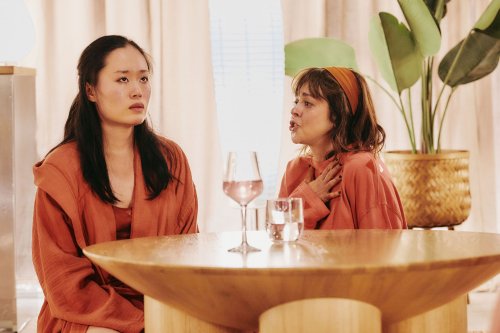
Michele Selene Ang and Emma Ramos in a scene from Kate Vozella’s “Machine Learning” at Manhattan Neighborhood Network (Photo credit: Valerie Terranova)
After Willa and Lucia leave the main room, the other couple enters the space, the feisty and provocative Georgia (Delaney Rowe) with the gentle, boyish Charlie (Douglas Smith). Clearly in Georgia’s thrall, Charlie hangs onto Georgia’s every word and gesture despite her mercurial and fiery nature. Will and Lucia return just as Georgia has worked Charlie up into sexual frenzy, and conflicting energies take off as the four individuals begin their months-long observation period.
As the play progresses, these interactions, both between and across the couples, give the non-human observers and the audience plenty of drama and intrigue to witness. The character defects of jealousy, divisiveness, manipulation, and aggression provide plenty of fodder for the artificial intelligence to “learn” about how humans behave in relationships, all for the purpose of grooming non-human “companions.”
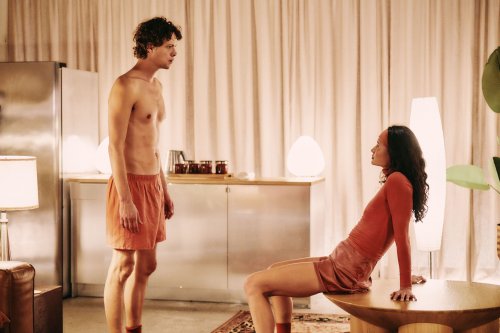
Douglas Smith and Delaney Rowe in a scene from Kate Vozella’s “Machine Learning” at Manhattan Neighborhood Network (Photo credit: Valerie Terranova)
Ang’s Willa is emotionally volatile but desperately earnest; Ramos in the role of Lucia is plucky and good natured but single minded and shrewd. In the role of Charlie, Smith is vulnerable and painfully optimistic, and Rowe’s turn as the sociopathic-adjacent Georgia is scheming yet has her empathetic moments. Director Colm Summers sets the playwright’s desired fast pace, whipping the actors through their lines and shaping the conflicts to maximum peaks. All four of these capable performers are ensemble players and keen listeners, expertly wearing their characters on their sleeves, and providing engagingly organic performances.
Costume designer Karen Boyer has outfitted the cast in uniforms reminiscent of spa clothing, subtly providing a feel-good surface on top of the roiling unrest. The omniscient voice of the artificial intelligence, spooky door clicks and other sounds are provided courtesy of sound designer Liam Bellman-Sharpe.
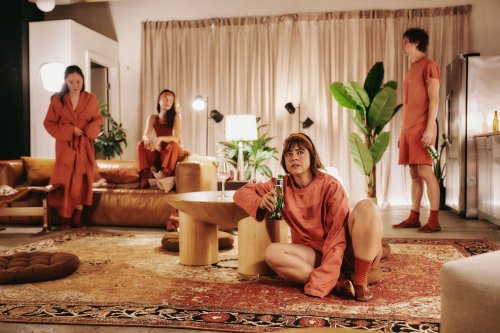
Michele Selene Ang, Delaney Rowe, Emma Ramos and Douglas Smith in a scene from Kate Vozella’s “Machine Learning” at Manhattan Neighborhood Network (Photo credit: Valerie Terranova)
Playwright Vozella weaves several themes throughout her intelligent, incisive script–art vs. life, originality vs. artifice, fidelity vs. betrayal, dishonesty vs. transparency, and more–all of which dangle at the play’s end without clear conclusion, which might very well be the point of this thought-provoking ride.
Machine Learning (through October 30, 2026)
Little Engine Theater
Manhattan Neighborhood Network, 509 West 38th St, in Manhattan
For tickets, visit http://www.littleenginetheater.com/
Running time: 90 minutes without an intermission


Leave a comment