
King of the Yees
A wildly inventive, bighearted comedy that transforms family friction, cultural identity and ancestral lore into a delirious, deeply moving adventure.
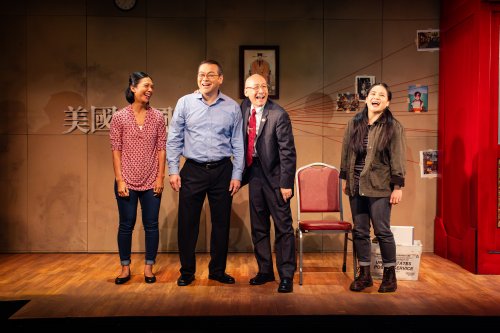
Maureen Sebastian, David Shih, Francis Jue and Kelly Marie Tran in a scene from Lauren Yee’s “King of the Yees” at The Pershing Square Signature Center (Photo credit: HanJie Chow)
At first glance, King of the Yees, Lauren Yee’s exuberantly shape-shifting comedy receiving its New York premiere at the Pershing Square Signature Center under the inventive direction of Joshua Kahan Brody, seems determined to make the simple act of following a play an exercise in genealogical confusion. There are two Laurens and two Larrys, a play being rehearsed inside the play we are watching, and a playwright who has fashioned theatrical versions of herself and her father only to have their real-life counterparts arrive and disrupt the proceedings. The Lauren played by Maureen Sebastian is an actor’s interpretation of the playwright; the Lauren played by Kelly Marie Tran is the playwright’s fictionalized self-portrait; and Francis Jue plays the father whose presence threatens to overwhelm both women’s versions of the story. David Shih, meanwhile, embodies the father as he exists in the play within the play. Got it? The delightful complication is that Yee’s elaborate contraption is not merely a theatrical prank. It is an ingenious way of dramatizing the difficulty of understanding a family whose members inhabit different versions of their shared history. In a work that gleefully blurs the boundaries between autobiography, invention, cultural mythology and outright absurdity, the confusion is not a problem to be solved so much as the beginning of an unusually affectionate inquiry into what it means to belong.
Yee, whose later plays Cambodian Rock Band and Mother Russia demonstrate her appetite for mixing serious political subjects with pop-cultural irreverence, here turns her attention to her own Chinese American inheritance. Her father, Larry Yee, is a devoted member and leader of the Yee Fung Toy Family Association, a longstanding men’s organization in San Francisco’s Chinatown whose members share a surname rather than necessarily a bloodline. The association represents a community sustained by traditions that have outlived the circumstances that originally made them indispensable, and Larry regards its survival as a personal responsibility. His daughter, a successful playwright who lives across the country, has rather different priorities. She does not speak Chinese, has married a Jewish man, has taken his surname, Zwillinger, and is contemplating a move to Berlin. The family name that Larry regards as a precious inheritance is, for Lauren, something she has already begun to relinquish.
Yee’s great subject is the distance that can open between generations even when affection remains intact: the parent who understands cultural continuity as an obligation, and the child who experiences it as a question she has not yet decided how to answer. The play’s most persuasive achievement is its recognition that neither position can be dismissed as simply right or wrong. Heritage can sustain a person, but it can also become a set of expectations that the next generation must negotiate before it can claim the past as its own.
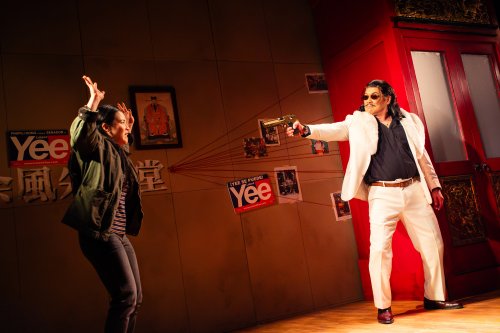
Kelly Marie Tran and David Shih in a scene from Lauren Yee’s “King of the Yees” at The Pershing Square Signature Center (Photo credit: HanJie Chow)
Brody, the director, has the unenviable task of making Yee’s deliberately unstable theatrical architecture feel like a coherent evening rather than an assortment of comic sketches held together by a family name. His production, which gradually expands from a relatively contained rehearsal-room comedy into an extravagant excursion through Chinatown’s folklore and popular mythology, finds its footing in the contrast between the two acts. The opening establishes the play’s self-conscious machinery: Larry interrupts his daughter’s rehearsal, takes an interest in the audience, and begins to commandeer a production that was supposed to be about him only on Lauren’s terms. He is particularly interested in whether any Yees have come to watch. Lauren looks out at the predominantly white audience and wonders how that could possibly be the case.
Brody allows the joke to land as both a comic provocation and an acknowledgment of the distance between a community’s self-image and the audience to whom its stories are being told. Once Larry disappears, the staging acquires a new freedom, plunging Lauren into a fantastical quest involving gangsters, elders, mythical ancestors and a Sichuan Chinese opera-inspired face changer. The occasional physical-comedy sequence feels more laborious than the production’s nimble dialogue, but Brody’s overall command of the tonal shifts is impressive. He understands that the evening’s wildness must ultimately serve the relationship at its center, and that the most spectacular transformation is not the one performed onstage but the one taking place in Lauren’s understanding of her father.
Jue’s Larry is a marvelous creation, a man whose irrepressible sociability conceals a more vulnerable need to remain useful to the community he has spent his life serving. Jue, a performer of exceptional warmth and comic precision, makes Larry’s intrusiveness inseparable from his generosity. He arrives with the confidence of someone who assumes that every gathering is improved by his participation, cheerfully interrupts the rehearsal, and proceeds to offer unsolicited information about Chinatown, the family association, and the many Yees whose accomplishments he considers a matter of collective pride. His enthusiasm can be exhausting, especially for a daughter whose life has moved beyond the geography and expectations that define his own.
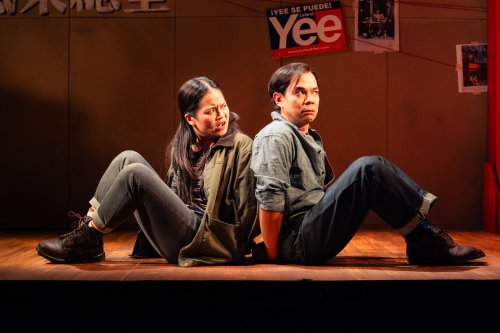
Kelly Marie Tran and Jon Norman Schneider in a scene from Lauren Yee’s “King of the Yees” at The Pershing Square Signature Center (Photo credit: HanJie Chow)
Yet Jue never reduces him to a provincial father whose principal function is to embarrass his adult child. Larry’s pride is real, his affection is unmistakable, and his jokes frequently contain a more complicated truth than he intends. His devotion to Leland Yee, a California politician unrelated to the playwright who was arrested on public-corruption charges in 2014, supplies the play with its absurdly consequential plot mechanism. Larry has invested so much of himself in helping another Yee that the politician’s disgrace threatens not merely his judgment but his faith in the usefulness of his loyalties. Jue makes that disillusionment register beneath the bluster, allowing the character’s disappearance to acquire emotional weight even as the play turns it into the pretext for a gloriously improbable adventure.
Tran, making her New York stage debut, brings an appealingly understated presence to Lauren, a woman who appears to have inherited her father’s name without inheriting his certainty about what it demands of her. Known for her screen work, including the Star Wars films and Raya and the Last Dragon, Tran is particularly effective at conveying the exasperation of an adult daughter who has spent years trying to maintain a reasonable distance from a father whose love arrives with a running commentary on how she might improve her life. Her Lauren is guarded, practical, and frequently bewildered by the emotional and cultural obligations that Larry treats as self-evident. The character’s reserve can make her seem comparatively passive when the surrounding theatrical universe erupts into comic extravagance, but Tran turns that apparent limitation into an asset: Lauren is not a natural inhabitant of the fantastic world she must traverse. She has to learn how to enter it.
Tran’s performance grows more affecting as the adventure progresses, revealing the hurt beneath Lauren’s impatience and the uncertainty beneath her apparent indifference to her heritage. Her relationship with Larry is complicated by the knowledge that loving someone does not automatically mean understanding them, and that geographical distance can become a convenient substitute for emotional inquiry. When Lauren finally begins to see Chinatown through her father’s eyes, Tran makes the change feel earned rather than imposed by the requirements of a sentimental conclusion. Her character is not converted into an unquestioning guardian of tradition; she becomes more curious about the person who has carried it.
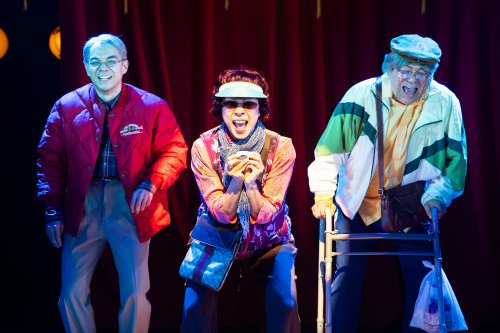
Jon Norman Schneider, Maureen Sebastian and David Shih in a scene from Lauren Yee’s “King of the Yees” at The Pershing Square Signature Center (Photo credit: HanJie Chow)
Sebastian, as the actor Maureen, supplies one of the production’s sharpest comic counterpoints. Her character is initially assigned to play Lauren in the daughter’s autobiographical drama, only to find herself displaced when the real Lauren arrives and Larry begins rewriting the rehearsal according to his own enthusiasms. Left to her own devices with Shih’s Dave, she becomes part of a sly secondary comedy about the absurdities of theatrical casting and the identities actors are expected to assume. In one especially funny exchange, Maureen reveals that she is Korean, prompting Dave to coach her in a Chinese person’s pronunciation of the word “Chinese.” Their repeated attempts to manufacture cultural authenticity expose the crude assumptions that can govern representation, especially when Asian American performers are treated as interchangeable embodiments of an identity that casting directors may not have bothered to distinguish. Sebastian makes the scene funny without allowing its underlying discomfort to disappear. Her versatility becomes even more apparent in the second act, when she shifts among Chinatown personalities and fantastical figures with an ease that makes each new incarnation feel like another facet of the production’s playful interrogation of stereotype. She is especially good at locating the human vanity inside the exaggeration. The joke is rarely just that a character is ridiculous; it is that the character has a perfectly recognizable reason for believing herself entirely sensible.
Shih, who plays the fictionalized Larry as well as a succession of characters in Lauren’s increasingly surreal search, is a splendid partner for Sebastian. The two actors’ double existence—performers who portray the family and then comment, in effect, on the business of portraying it—gives the production some of its most revealing moments. Their backstage-like exchanges expose the gap between an actor’s convenient version of a character and the complicated person who has inspired it. Shih is particularly entertaining as Raymond “Shrimp Boy” Chow, the real-life Chinatown underworld figure whose connection to the Leland Yee scandal makes him an ideal subject for the play’s transformation of recent history into theatrical folklore.
The character’s exaggerated menace is deliciously excessive, and Shih understands how to exploit the discrepancy between the grandiosity of the gangster stereotype and the absurdity of its presentation. He is equally effective as a Sichuan face changer, whose mysterious theatrical skills offer Lauren a lesson in the pleasures of cultural forms that cannot be reduced to explanatory dialogue. The production’s slow-motion action sequence occasionally strains for a laugh that does not quite arrive, but Shih’s physical agility and comic commitment carry much of the material. Across his various roles, he demonstrates how easily theatrical artifice can reveal the mechanisms of representation while simultaneously making them entertaining.
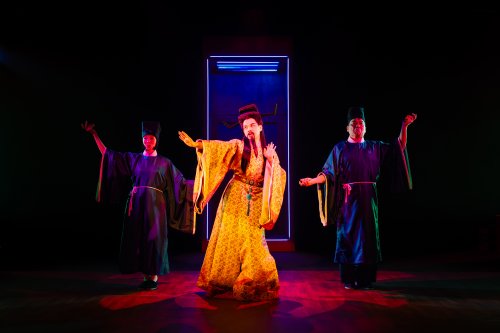
Maureen Sebastian, John Norman Schneider and David Shih in a scene from Lauren Yee’s “King of the Yees” at The Pershing Square Signature Center (Photo credit: HanJie Chow)
Jon Norman Schneider completes this remarkably adaptable ensemble with a succession of performances that seem to delight in the distance between the ordinary and the extravagant. As Schneider moves among a purported audience member whose last name might indicate a “cousinship” to Yee, an inspired very-bearded chiropractor, Chinatown figures, and the play’s more mythological inhabitants, he gives the production a comic elasticity that keeps its elaborate game from becoming a mere exercise in disguise. His Model Ancestor is a particular triumph: a figure from the Yee family’s legendary past whose appearance owes at least as much to contemporary drag culture as to ancestral reverence.
Seen earlier this season at the Public Theater as Shakespeare’s King Henry VI, Schneider has experience looking resplendent in regal finery; the ancestor (a Queen?) arrives with the attitude of someone who has understood that history is never more persuasive than when it knows how to make an entrance. The role is ridiculous in precisely the right way, but Schneider also helps to make it meaningful. The ancestor is not simply an opportunity for a flamboyant costume reveal; he embodies the transformation that takes place when a family story, passed down through generations, becomes a source of theatrical invention. Schneider’s work, like that of his fellow ensemble members, is a reminder that cultural inheritance is not necessarily preserved by solemnity. It may survive just as effectively through exaggeration, performance, and a willingness to make the past strange enough to be seen anew.
The design team provides the production with the visual and aural vocabulary required to make its sudden changes of reality legible. Krit Robinson’s scenic design establishes the headquarters of the Yee Fung Toy Family Association as a recognizable social space before opening onto the more fluid environments of Lauren’s quest. Jiyoun Chang’s lighting helps distinguish the grounded world of family obligations from the uncertain territory of myth and memory, while Fan Zhang’s sound design adds musical punctuation and comic emphasis to the production’s many transformations. Michelle J. Li’s costumes are a particular delight, giving the ensemble the means to move from recognizable contemporary figures to Chinatown caricatures and supernatural personages without sacrificing the specificity of each role. The costumes often do more than the scenery to establish the world of a given scene, and their exuberance becomes an argument in itself for the imaginative vitality of cultural tradition.
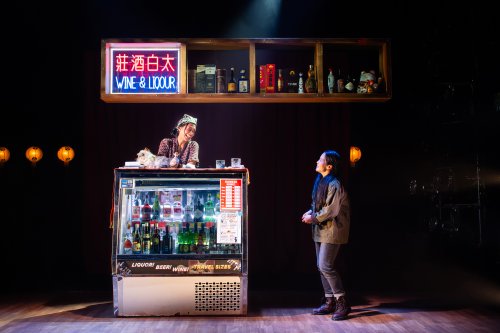
Maureen Sebastian and Kelly Marie Tran in a scene from Lauren Yee’s “King of the Yees” at The Pershing Square Signature Center (Photo credit: HanJie Chow)
Tommy Kurzman’s wigs, hair and makeup further facilitate the actors’ rapid transformations, while Steve Cuiffo’s illusions provide the production with its more mysterious theatrical effects. The lion dance, the face-changing spectacle, and the increasingly flamboyant manifestations of the ancestral realm all benefit from this coordinated work. The production’s most successful visual ideas do not attempt to reproduce Chinatown naturalistically; they evoke the place as it exists in memory, family anecdote, popular imagination and the stories a child has heard often enough to mistake for history.
The play’s most substantial complication is its structure. The first act spends considerable time exposing the apparatus of the play within the play, including an audience question-and-answer session and a series of conversations in which the actors discuss their own relationship to the identities they have been hired to portray. The material is frequently funny, particularly when it turns its attention to the assumptions surrounding Asian American representation, but the self-referentiality occasionally threatens to become an end in itself. Yee is interested in the responsibilities of the storyteller: whether a playwright who fictionalizes her family preserves its history or distorts it; whether a cultural community can recognize itself in a work addressed to outsiders; and whether a daughter who has moved away can claim authority over the place her father has never abandoned. These are rich questions, and the play is at its strongest when it dramatizes them through the conflict between Lauren and Larry. It is less compelling when it pauses to explain the fact that it is asking them.
The second act, by contrast, gives those questions a theatrical form. After Larry disappears in the aftermath of Leland Yee’s arrest, Lauren must seek three offerings—the strongest cheapest whiskey, the sweetest oranges, and the loudest firecrackers—to gain access to the place where her father has gone. Her encounters with Chinatown’s fantastical inhabitants become a series of comic trials, each requiring her to engage with customs and stories she has previously regarded from a distance. A lion dancer suddenly performing to “All That Jazz,” or a mythical ancestor who seems to have wandered out of a drag pageant, might appear to be an arbitrary gag in a less carefully conceived work. Here, such extravagances suggest that tradition is neither a museum piece nor an obligation to be accepted without question. It is a living repertoire, capable of absorbing new references while retaining the power to connect one generation to another.
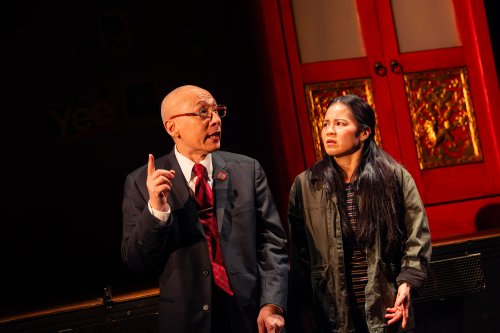
Francis Jue and Kelly Marie Tran in a scene from Lauren Yee’s “King of the Yees” at The Pershing Square Signature Center (Photo credit: HanJie Chow)
What ultimately distinguishes King of the Yees is the tenderness that emerges from beneath its comic tumult. The play is not really about whether Lauren will become more Chinese, whether the family association will flourish, or whether Larry’s sometimes questionable loyalties can be vindicated. It is about the discovery that a parent’s stories, however embellished or exasperating, constitute a form of intimacy that may become intelligible only when the child is prepared to listen differently. Larry’s devotion to the Yees can seem quaint, even absurd, but it is also his way of insisting that people belong to one another, that an individual life acquires meaning through its connection to lives that preceded it.
Lauren’s journey does not require her to abandon the independence she has built for herself. Instead, it allows her to recognize that distance and attachment need not be mutually exclusive, and that she can question her father’s values without dismissing the history that shaped them. Yee’s closing movement toward reconciliation is admittedly sentimental, but it is sentiment earned through the play’s willingness to expose the awkwardness, contradictions and outright ridiculousness of family affection. When Lauren realizes that the story she thought she was telling about the past was actually leading her toward a new understanding of the present, the evening’s theatrical convolutions resolve into something quietly moving. King of the Yees may wear a bewildering number of faces, but its generosity lies in understanding that no family, no culture and no person can be adequately represented by a single one.
King of the Yees (through November 15, 2026)
Signature Theatre
Alice Griffin Jewel Box Theatre, The Pershing Square Signature Center, 480 West 42nd Street, in Manhattan
For tickets, visit http://www.signaturetheatre.org
Running time: two hours and 10 minutes including one intermission


Leave a comment