News Ticker

Krit Robinson

Rheology

April 25, 2026

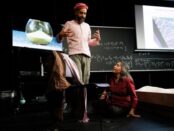
"Rheology" previously seen at Brooklyn’s Bushwick Starr in the spring of 2025 has reopened at Playwrights Horizons and proves to be a unique meta-theatrical experience with both performers, a real mother and son, theoretical physicists Bulbul Chakraborty and writer/director Shayok Misha Chowdhury (Pulitzer Prize finalist for "Public Obscenities"), appearing as themselves. Written and directed by Chowdhury in association with Chakraborty, Rheology begins as a physics TED talk on sand as “capricious matter” (Bulbul’s field) then switches to a demonstration of stage directing (Misha’s field), and finally becomes a metaphysical discussion on life and death tying the two together. This is an unusual theatrical presentation, one you will ponder for a long time to come. [more]

No Singing in the Navy

April 7, 2026

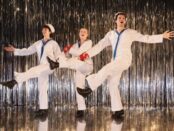
"School Pictures," Milo Cramer’s last New York show, a solo musical, was wildly inventive, hilarious funny, and extremely insightful about the New York education system, based on his own experiences as a tutor. Unfortunately, his new musical show again premiering at Playwrights Horizons seems to be out of his comfort zone though he has been a fan of musicals for years. "No Singing in the Navy" is a three-character revue which purports to be a tribute to Golden Age musicals, but its format is a series of very slight skits, à la 'Saturday Night Live," all with the same three sailors. It does use the premise from "On the Town": three sailors on leave for 24 hours before shipping out to the war, also used in a series of original Hollywood musicals, usually about sailors who become involved in putting on a show in either New York or on the coast. This show claims to have parodies of songs from "The Music Man," 'Peter Pan" and "The Sound of Music" but most theatergoers will not recognize them. A charming idea, but "No Singing in the Navy" is too thin and simplistic to make us think of those golden age musicals that still get revived on stage and reaired in their film versions. [more]

Oratorio for Living Things

October 20, 2025

To describe "Oratorio" is to flirt with the inadequacy of language. It is a musical work—a sung-through piece in the formal lineage of the oratorio, that 17th-century form that eschews staging and dialogue in favor of spiritual rumination through voice. Think Handel’s "Messiah," and then think again—"Oratorio for Living Things" shares the same bones, but not the flesh. Christian, ever the aural alchemist, reclaims and “rewilds” the form, unbinding it from its ecclesiastical constraints and infusing it with a heady blend of the sacred, the scientific, and the speculative. [more]