
Dreamcats!
While forbidden, thwarted love is at the center of “Dreamcats!,” a new puppet musical for ages seven and up, another plotline concerns the censorship of libraries.
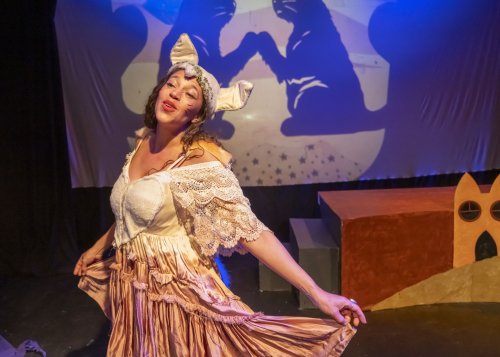
Charlotte Lily Gapard in a scene from her “Dreamcats!” at the Gene Frankel Theatre (Photo credit: Richard Termine)
Fans of feminist science fiction and revisionist fairy tales will find much to recognize in playwright Charlotte Lily Gaspard’s new work. Set on a planet ruled by intelligent and mighty creatures called Dreamcats, the play features a rebellious feline princess played with gusto by Gaspard herself. Intellectually courageous, the Princess has a secret plan to challenge the belief that her planet is the best of all possible worlds–a sacrosanct tenet that no Dreamcat has dared to investigate, still less to refute. Her project envisions comparing all the planets, but how can this be done when hardly any data on them is available? (The one map of the galaxy she has found was under wraps.)
This plotline isn’t in the 2024 paperback The Origin of Puccini the Cat from Cool Grove Press which Gaspard wrote and illustrated with her papercut art, as I discovered when I received a review copy. But a love story between the Princess and a male Dreamcat has travelled from her book to her play, and many of her published papercuts have morphed into shadow puppets. Dreamcats! has clearly had a long and productive gestation.
In the play, the Princess badly needs trustworthy aid in her iconoclastic quest and manages to find it in a friend of her royal family: a cat-of-integrity, known by his surname, Puccini. In Justin Gordon’s endearing interpretation of the leading male role, Puccini is a gentlecat. Although he confesses to the Princess that he longs to spend his life with her, he doesn’t force the point after she responds that her father has promised her to another. In the course of the play, they grow closer, pushing limits. (The production’s choreographer, Emily Edwards, gets an additional credit for intimacy direction.) It’s his dilemma that opens him up to the ideal of freedom. When he catches a sympathetic Blue Bird–a puppet skillfully manipulated and poignantly voiced by Tau Bennett–Puccini perceives that he’s similar to his captive and, rather than eating him, lets him fly off.
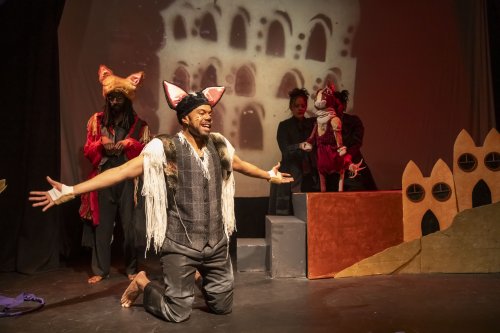
Justin Gordon in a scene from Charlotte Lily Gapard’s “Dreamcats!” at the Gene Frankel Theatre (Photo credit: Richard Termine)
Goodness often gets rewarded in fairy tales. One Pink Flamingo, played with great strength by Maria Camia in a hilarious costume of Gaspard’s design, is impressed by Puccini’s kindness to a fellow-bird. She pledges to help the cat, not in solving his pressing love problem but with the other major plotline: the research project. (How she learned that secret isn’t explained.) According to Pink Flamingo, birds can find valuable sources inaccessible to cats. “Our libraries are not classified and heavily redacted, like yours.” In a vigorous rendition of “Things Aren’t What They Seem” composed by Nebraska (FKA Jessie Davis), she boldly names who’s responsible for censorship on the planet: “Your King” who “Burns the books rewrites herstory leaving only royal glory.”
Cryptic parts of her song–like “Just think of what’s to gain when they lock you in their cage”–foreshadow punishment for Puccini. Will imprisonment turn out to be merely metaphorical? That question will be left open in this review, so as not to foil surprises. Suffice it to say that it’s deliciously ironic that the puppeteer who plays the King–an imposing puppet-cat designed by William PK Carter–turns out to be the very same Maria Camia. As Pink Flamingo, she had sung to Puccini, “Your King calls you names, labels you insane.” As King Marl, she’s the one who calls Puccini a scoundrel.
Now it’s the Princess who takes up the cage motif, as she tries to free birds which her father has captured. (Another, stronger verb is also used: kidnapped.) To no avail. Set designer Andrew Robinson has created a space where our imagination can be fired up by shadows. Gothic horror is also hinted at by the place-name Antrano, which invokes Walpole’s terrifying Castle of Otranto. But the home of the Dreamcats is “the Sandcastles of Antrano” and the humor in that parody should work against fear.
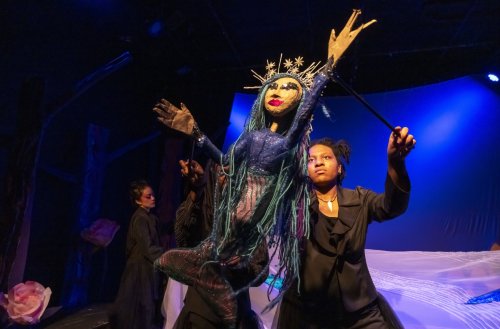
Puppeteer Laurynn Starkey in a scene from Charlotte Lily Gapard’s “Dreamcats!” at the Gene Frankel Theatre (Photo credit: Richard Termine)
There are more reasons for optimism about the love pair. Readers of fairy tales know that helpers like Pink Flamingo can almost always be counted on to honor any pledge they’ve made. And the Blue Bird has served as a literary harbinger of happiness and hope at least since Maeterlinck. Whatever troubles may occur, there’s the implicit promise of a sequel to come, since “The Midnight Radio Show” is a serial.
May I suggest that, in any future production, dialogue be slowed for intelligibility, to match the exemplary visibility provided by lighting designer Alison Costa? It would also be great if Sophie Yuqing Nie, the sound engineer, lowered the volume of instrumental accompaniments so that singers don’t have to strain. Could the program list the names of composers next to the titles of their pieces and, also, the names of puppeteers alongside the puppets they manipulate? The Midnight Radio Show’s DREAMCATS! draws on many gifted young performers and creators. Their work deserves to be noted so that audiences can decide if they want to follow these people’s future careers.
Dreamcats! (through May 3, 2026)
The Midnight Radio Show
The Gene Frankel Theatre, 24 Bond Street, in Manhattan
For tickets, call 212-777-1767 or visit
http://www.onthestage.tickets/show/midnight-radio-show
Running time: 65 minutes without an intermission


Leave a comment