
Rheology
A fascinating evening that begins as a TED talk on physics and ends on a metaphysical note, enacted by the author and his own mother.
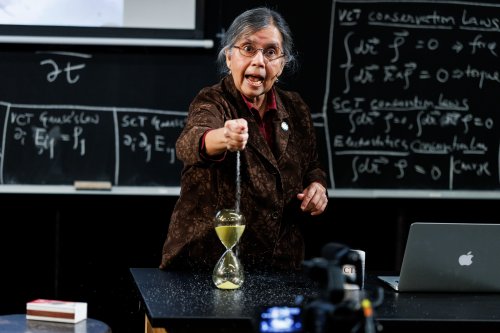
Bulbul Chakraborty in a scene from Shayok Misha Chowdhury and Chakraborty’s “Rheology” at Playwrights Horizons (Photo credit: Maria Baranova)
Rheology previously seen at Brooklyn’s Bushwick Starr in the spring of 2025 has reopened at Playwrights Horizons and proves to be a unique meta-theatrical experience with both performers, a real mother and son, theoretical physicists Bulbul Chakraborty and writer/director Shayok Misha Chowdhury (Pulitzer Prize finalist for Public Obscenities), appearing as themselves. Written and directed by Chowdhury in association with Chakraborty, Rheology begins as a physics TED talk on sand as “capricious matter” (Bulbul’s field) then switches to a demonstration of stage directing (Misha’s field), and finally becomes a metaphysical discussion on life and death tying the two together. This is an unusual theatrical presentation, one you will ponder for a long time to come.
When the audience enters the Peter Jay Sharp Theater at Playwrights Horizons, Bulbul is at a huge blackboard writing equations. In front of her are a lab table with a large hour glass, a laptop, a tv monitor, a sandbox, a tv camera and a chair. When she begins addressing the audience she explains that her field is theoretical physics and that she is interested in the properties of sand, how it can sometimes work as a solid and sometimes work as a liquid. Using the hour glass as an example, she asks us if the sand inside is acting as a solid or a liquid? This study of materials deforming from one state to another is the science of Rheology.
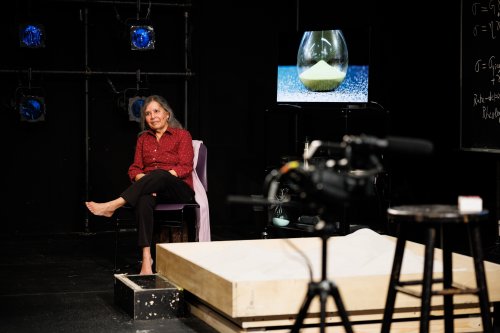
Bulbul Chakraborty in a scene from Shayok Misha Chowdhury and Chakraborty’s “Rheology” at Playwrights Horizons (Photo credit: Maria Baranova)
Bulbul is most interested in “substances like sand that hold together even as they come apart from themselves.” She mentions the sand lizard which walks on sand with its feet, and then burrows into and swims through it like a fish. Bulbul wants to come up with a comprehensive theory that will explain how sand behaves, the rules for why sand remains in “force balance” when additional grains are added so that the total returns to a stable position.
She begins to do an experiment in which she pours sand into a plastic cup in which she has put a pencil. If she pours enough sand into the cup, the sand will hold the pencil up which would not be true of positioning it in water. As she begins pouring, she begins coughing from the dust rising from the experiment, turning red as if she couldn’t breathe. Seated in the audience all along, author and director Misha suddenly asks why she stopped. He tells us that he speaks to her daily but realizes that someday that will not be possible. Then he reveals that now that his mother is in her 70s he has nightmares about her death which he does not imagine that he would survive. Like the sand, it is as if time is running out as time is finite.
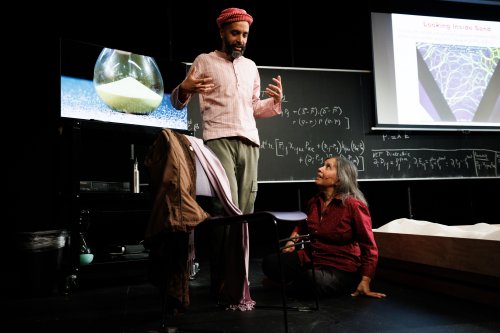
Shayok Misha Chowdhury and Bulbul Chakraborty in a scene from their “Rheology” at Playwrights Horizons (Photo credit: Maria Baranova)
Bulbul disagrees with him and suggests he devise an experiment to test his hypothesis. He asks her to reenact the coughing scene in various ways. He finally goes on stage to direct her in the scene with her ultimately lying in white sheets on the lab table simulating death. He enacts his grieving as he thinks it will occur. Bulbul, pretending to be dead, tells us about how the body succumbs to the laws of thermodynamics, that eventually bodies become granular matter, which is a word that comes from the word for “mother.”
Eventually she gets up and tells us how Misha behaved when she first left him in daycare and how he carried on when she had to go off to work. But he gradually realized that he was missing out on playing with the other children and stopped crying and adapted to the routine of daycare. Bulbul continues her original lecture about how matter responds to external stresses. She points out that like “fragile matter,” Misha will not die at her death because he is elastic and will hold his shape. She tells him to put her theory to the test in the future that he will re-arrange himself and adapt to his new life situation.
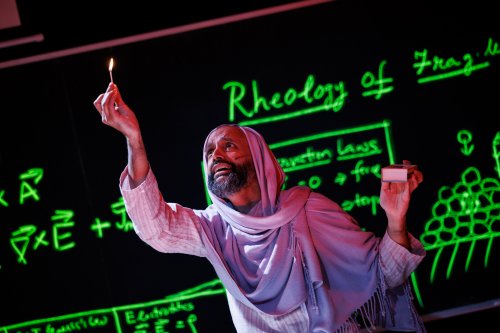
Shayok Misha Chowdhury in a scene from Chowdhury and Bulbul Chakraborty’s “Rheology” at Playwrights Horizons (Photo credit: Maria Baranova)
Bulbul is utterly charming playing herself and we can see why she is so celebrated as a college classroom professor. She also proves to be an expert actress taking direction from her son for the cough scene reenactments. More stagey than his mother, Misha is also quite expert an actor playing the grieving son as well as himself as a child attempting to copy his mother’s equations. We also see him as a director staging her scene in various ways and for various effects. Krit Robinson’s set is a complete science lab recreated onstage on which Kameron Neal’s video of documentary footage from their earlier lives plays on a large screen hanging over the blackboard. Remarkably, all of the Matt Cartin’s seeming unnecessary props get used by the end of the evening. The costumes by Enver Chakartash could be from their own wardrobe, they are so real to the situations. Mextly Couzin and Masha Tsimring’s subtle lighting design leads us to the various places around the theater where the action takes place.
Rheology begins as a science experiment, moves on to a demonstration of stage directing and acting, and ends up as a colloquy on life and death. Watching as the physical experiment segues into metaphysics is quite remarkable, teaching us several lessons along the way. Throughout the evening, musician George Crotty plays the cello with melancholy but beautiful live music from the back of the theater. While neither Chakraborty nor Chowdhury are professional actors, they are charming company as they portray their own (albeit) scripted lives for us. As one part of the play transforms into another, we are almost seeing the metaphorical sand change its shape which is where the play begins. The play itself is an example of its title, one thing morphing into another. Rheology is a unique theatrical experience which only these performers could have created and enacted.
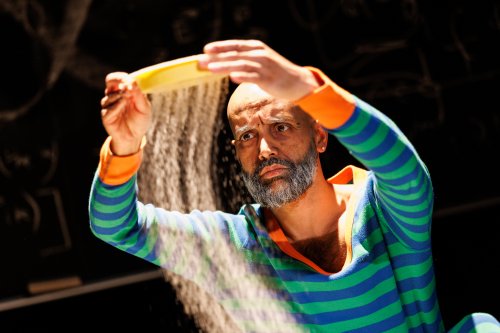
Shayok Misha Chowdhury in a scene from Chowdhury and Bulbul Chakraborty’s “Rheology” at Playwrights Horizons (Photo credit: Maria Baranova)
Rheology (extended through May 29, 2026)
Playwrights Horizons in association with The Bushwick Starr
The Bushwick Starr, HERE Arts Center and Ma-Yi Theater Company production
Peter Jay Sharp Theater, 416 W. 42nd Street, in Manhattan
For tickets, visit http://www.playwrightshorizons.org
Running time: 90 minutes without an intermission


Leave a comment