
The Fear of 13
A new Broadway play about the broken American legal system criminally uses its star power.
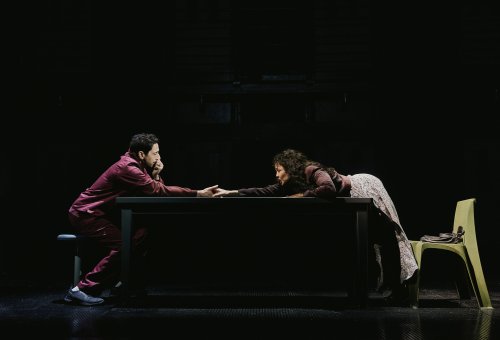
Adrien Brody and Tessa Thompson in a scene from Lindsey Ferrentino’s “The Fear of 13” at the James Earl Jones Theatre (Photo credit: Emilio Madrid)
Renowned theatrical spoilsport Bertolt Brecht decried the stupefying effect of catharsis. By contrast, the new Broadway offering The Fear of 13 revels in it. Adapting liberally from British filmmaker David Sington’s 2015 documentary of the same name, playwright Lindsey Ferrentino turns the true story of Nick Yarris–a Pennsylvania man who served an unjust 22-year death row sentence for rape and murder–into something that feels decidedly less true. Admittedly, Ferrentino adheres to the basic facts of Nick’s brutal mistreatment, but, with the masterful assistance of director David Cromer, packages them into an easily digested and forgettable form.
As Nick, Adrien Brody contributes to these qualities through a generic wrong-side-of-the-tracks performance that earned him a 2025 Olivier nomination for the play’s London run (losing to John Lithgow for his turn as Roald Dahl in Giant, which can also currently be seen on Broadway). Although Brody has come to wear the role as a second skin, the documentary evidence suggests it doesn’t belong to Nick. That verisimilitude would be too complicated for Ferrentino’s aim, which is to create a romance ruined by a broken American legal system. Unfairly forfeiting decades of existence remains a tragedy in Ferrentino’s recontextualization, but she makes it subordinate to losing a soulmate. Brecht would not have been touched.
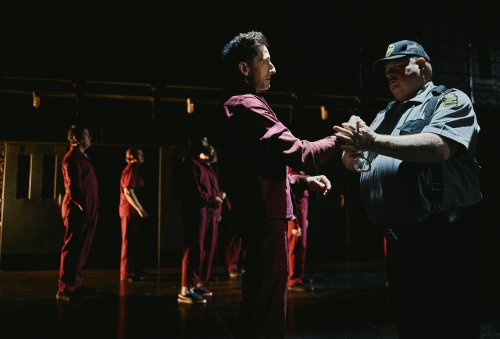
Adrien Brody and Joel Marsh Garland in a scene from Lindsey Ferrentino’s “The Fear of 13” at the James Earl Jones Theatre (Photo credit: Emilio Madrid)
While in prison, Nick meets and marries Jacki (Tessa Thompson), a prison volunteer and anti-death-penalty advocate whose smittenness stems from the supposed murdering rapist’s autodidactic literary knowledge and use of two-dollar words like “incredulous.” It’s always helpful when a possibly contrite playwright provides an apt adjective for the facial expression of someone watching her work, but that doesn’t spare the completely adrift Thompson from having to make sense of a shockingly self-abnegating person who, it seems, might be mostly a product of Ferrentino’s flattening imagination. The real Jacki did wed Nick in a carceral ceremony, but, in the documentary, she is an unseen and unheard figure in Nick’s complex, monologuing reflections about their relationship. Meanwhile, Ferrentino’s Jacki is a soliloquizing, visible partner for both the chronicling of Nick’s exponential miseries and the depiction of how she chooses to suffer along with him, even before the eventual results of exonerating DNA evidence. Frustratingly, the lines Ferrentino gives Thompson to deflect the audience’s obvious questions about staged Jacki’s prison passion include an unconvincingly introspective “Just know that I know.” Thompson might as well have simply shrugged her shoulders.
As with her book for the documentary-based musical The Queen of Versailles–from earlier this Broadway season–Ferrentino runs into trouble when she runs out of film. That leads to ham-handed contrivances, like initially trying to sow doubt about whether Nick is actually innocent. We’re apparently meant to wonder if Nick is merely an ingratiating liar skilled at spinning tall tales to shift attention from the monstrous acts for which he was found guilty. Except, your honor, even apart from the documentary, we know conclusively that Nick didn’t sexually violate and kill anyone, because The Fear of 13 is widely advertised as a play about a man who was “wrongly convicted.” That prefatory reveal necessarily lays the emotional groundwork for immediately and unproblematically investing in the plight of a pair of star-crossed lovers, if nothing else.
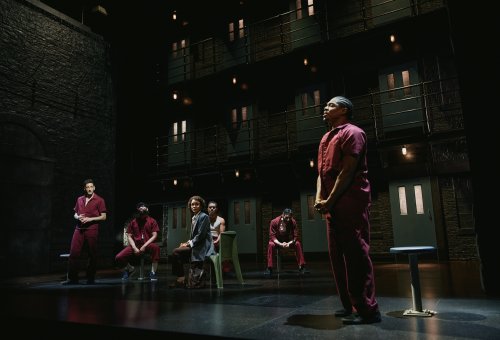
The Company of Lindsey Ferrentino’s “The Fear of 13” at the James Earl Jones Theatre (Photo credit: Emilio Madrid)
Holding visual surprises in the style of an Advent calendar, scenic designer Arnulfo Maldonado’s towering block of prison cells has a few sliding flourishes to break the dismal monotony. Besides dramatically expansive lighting and sound efforts from Heather Gilbert and Lee Kinney, respectively, that fleeting variety is also supplied through some other set legerdemain, including the sudden appearance of Jacki’s home, a cozy space where she distractedly watches sitcoms about casual friendships and accepts collect calls from the penitentiary. It might not be a lot of character development, but it’s better than what is afforded the rest of the sizable cast, which is largely tasked with embodying multiple roles as guards, prisoners, cops, criminal-court drones, or additional miscreants. While Thompson’s Jacki helps Brody’s Nick fight for his freedom, the other actors whiplash between bringing Nick’s tumultuous past and dispiriting present to narratively thin life.
The flimsiness of their characters is particularly offensive inside the prison walls, where the non-Nick inmates are primarily ensemble filler and the guards vacillate from outright sadism to comic relief. Attempting to humorously soften the proceedings forthwith, Ferrentino has a guard (Joel Marsh Garland) harangue the prisoners and audience about proper behavior: “No photography, no phone calls…no candies with crinkly-ass wrappers.” As with The Queen of Versailles and its end-stage capitalist antiheroine, Ferrentino wants to hold up a mirror to society, but it’s a funhouse one.
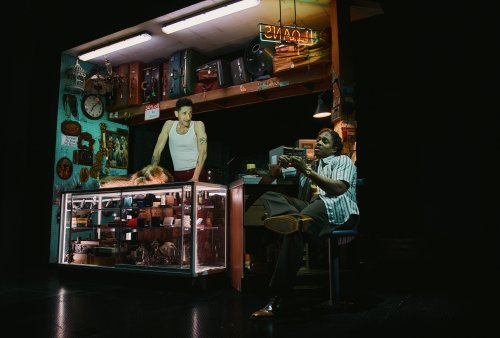
Adrien Brody and Ephraim Sykes in a scene from Lindsey Ferrentino’s “The Fear of 13” at the James Earl Jones Theatre (Photo credit: Emilio Madrid)
The best segments in The Fear of 13 are lifted directly from the documentary, most notably Nick’s poetic takes on time and a haunting story he tells about two mutually besotted prisoners (Ephraim Sykes and Michael Cavinder) that culminates in a heart-wrenching lamentation. Oddly, Ferrentino cuts Nick’s recollection of learning the word triskaidekaphobia, which is the clinical term for the play’s title, though it does acquire horrific meaning in what is simultaneously the beginning and the conclusion of Nick’s painful journey. Unfortunately, however, Ferrentino isn’t willing to leave the audience in reasonable distress, crafting a mawkish, post-prison epilogue that elides the socioeconomic causes for Nick’s anguish and essentially indicates an all-encompassing return to innocence for both protagonist and witnesses. Brecht would not have approved of letting us off the hook.
The Fear of 13 (through June 28, 2026)
James Earl Jones Theatre, 138 West 48th Street, in Manhattan
For tickets, call 212-239-6200 or visit http://www.thefearof13broadway.com
Running time: one hour and 55 minutes without an intermission


Leave a comment