News Ticker

Articles by Samuel L. Leiter

About Samuel L. Leiter (6 Articles)
Samuel L. Leiter, PhD., Distinguished Professor Emeritus of Theatre, CUNY, is the author/editor of 31 books, ranging from Japanese theatre to Broadway. His most recent book is Brooklyn Takes the Stage: Nineteenth-Century Theater in the City of Churches (2024). A voting member of the Drama Desk, he also reviews for Theater Pizzazz and Theater Life.

Fallen Angels

April 23, 2026

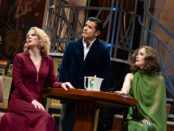
It’s therefore a delight to see two such skilled actresses as Byrne and O’Hara, both using ultra-posh accents, willing to play against their striking beauty to get laughs, demonstrating both physical dexterity and perfect timing. At first, it seems as if everyone, the stars included, is trying express some stereotypical notion of what being in a Coward comedy requires, from the ultra-sophisticated speech, mannerisms, and elevated tone, and it takes a few minutes to begin seeing through the self-consciously lacquered veneer to the characters inside. Although Coward now and then comes through with a bon mot matching his reputation, much of the laughter is generated by throwaway comments and responses, gestures, facial expressions, and bodily reactions. Ellis creates amusing business with props, like long cigarette holders, and food, like strawberries. What Byrne does with a slinky green gown and veil, using her elegant slimness to visually hysterical advantage, will long remain in my memory, just as will the image of the glamorously blonde O’Hara, flopped upside down over a club chair as she ever so slowly slides down it to the floor. [more]

Death of a Salesman

April 20, 2026

As you may have read, a lot of critics are saying that “attention must be paid” to the sixth Broadway revival of "Death of a Salesman," Arthur Miller’s 1949 “tragedy of the common man,” innovatively directed by Joe Mantello at the Winter Garden. Indeed, it is an attention‑getting, nearly three-hour mounting, led by sterling performances from Nathan Lane and Laurie Metcalf as Willy and Linda Loman, and Christopher Abbott and Ben Ahlers as their sons, Biff and Happy. My companion was so moved when it ended she could barely speak. I was impressed but with tearless results. [more]

Becky Shaw

April 10, 2026

Gionfriddo’s play, which runs nearly two and a half hours, is directed with finely calibrated control by Trip Cullman. It’s a tart, unsettling, and often wickedly funny examination of the emotional minefields that define modern intimacy. At its center is the seemingly innocuous act of a blind date, but as in so many comedies of manners, what begins as social ritual quickly metastasizes into something darker, probing the uneasy intersections of manipulation, vulnerability, and power. [more]

Giant

March 27, 2026

It doesn’t matter that this debate never took place because, aside from an overly contrived moment regarding Jessie’s copy of Dahl's review, it’s plausible enough to believe in, and it makes for a memorably dramatic, politically hot stage confrontation. In the second act, things cool down dramatically as Dahl, perhaps showing self-doubt, begins to question even the serving girl and the old retainer on what to do; perhaps we’re meant to feel a sliver of sympathy for him. [more]

Chess

November 23, 2025

Strong’s book belies his name, its overlong (two hours, 40 minute) narrative, with all its scheming realpolitik, being more formulaic than authentic. Its points about the individual vs. the state, personal ambition vs. national loyalty, truth vs. propaganda, the pressures of celebrity, and so on, are clear, but Chess is too addicted to larger-than-life histrionics to make us more than cerebrally grateful or deeply invested in the choices the characters must face. [more]

Little Bear Ridge Road

November 16, 2025

However, like its characters in their narrow world, the play itself—which premiered last year at Chicago’s dynamic Steppenwolf Theatre—seems small and isolated on a Broadway stage, even at the relatively intimate Booth. Despite a typically sterling performance by Laurie Metcalf, whose presence in a part that fits her like a glove is the principal reason to make a visit worthwhile, Hunter’s dramatic tropes seem too familiar to generate the kind of breakthrough excitement warranted by the price of a Broadway ticket. [more]