
Kenrex
Jack Holden’s Olivier Award-winning performance as an ugly American is central to this nail biter about what happens when justice is thrown out the window.

Jack Holden in Holden and Ed Stambollouian’s “Kenrex” at the Lucille Lortel Theatre (Photo credit: Manuel Harlan)
There are evenings in the theatre when the air seems to tighten, as though the room itself has drawn a breath it cannot quite release. Such is the case with Kenrex, a work of unnerving command and cumulative force, written by Jack Holden and Ed Stambollouian, and directed by the latter with a vigilance that borders on the prosecutorial. What begins as a seemingly familiar excursion into the annals of American true crime—its outlines recognizable, its destination foreknown—steadily transforms into something far more disquieting: a communal autopsy, conducted in real time, of a place where the mechanisms of justice have not merely failed but quietly abdicated.
Across the middle decades of the twentieth century, Ken Rex McElroy cast a long and corrosive shadow over Skidmore, Missouri, amassing indictment after indictment—21in all—for offenses that ranged from the brutal to the unspeakable, and yet, with a kind of perverse consistency, evading conviction each time. The law circled him but never closed in; procedure faltered, witnesses wavered, and the machinery of justice, such as it was, seemed unable—or unwilling—to hold. In 1981, the equilibrium collapsed. What followed has since hardened into legend: a public killing carried out in full view, its authorship dissolved into collective silence. Though many saw, no one spoke; no charges were filed, no verdict rendered. The absence of resolution became, in its way, the final, defining fact.
Kenrex stages this history not as a procedural but as an act of recollection. The narrative is filtered through David Baird, the Nodaway County prosecutor, who revisits the case after the fact, setting it down for the record with the uneasy authority of someone who both witnessed and failed to contain it. What unfolds is less a reconstruction than a reckoning—an account shaped as much by omission and hindsight as by the events themselves. The story is a case that refuses to settle into closure. Baird’s interlocutor, an unseen federal presence, provides a frame that is less explanatory than atmospheric—a suggestion of institutional scrutiny that hovers without ever fully resolving. The choice is canny. Rather than impose order, the structure amplifies unease, allowing the narrative to unfold with a sense of inevitability that feels at once documentary and mythic, as though we are listening not to testimony but to the aftershocks of it.
At the center of this widening circle stands a figure whose reputation precedes him, a man whose history of violence has seeped so thoroughly into the soil of his town that his name carries the weight of a condition rather than an identity. The production resists the easy satisfactions of lurid detail, instead permitting the portrait to emerge obliquely—through rumor, recollection, and the wary speech of those who have learned, over time, the cost of speaking plainly. The effect is chilling: menace not as spectacle but as atmosphere, something inhaled as much as observed.
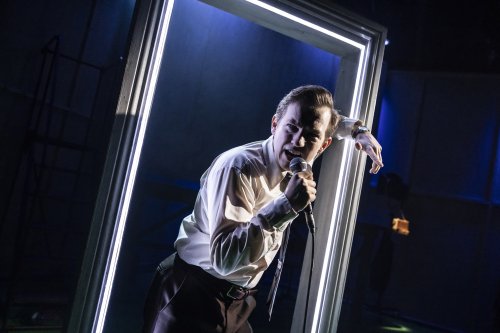
Jack Holden in Holden and Ed Stambollouian’s “Kenrex” at the Lucille Lortel Theatre (Photo credit: Patricia Raith Photography)
That the outcome is never in doubt becomes, paradoxically, the engine of suspense. The play understands that foreknowledge can sharpen, rather than dull, the edge of anticipation; what grips is not the question of what will happen, but when—and at what psychic price. Scene by scene, the tension accrues with meticulous patience, each encounter another turn of the screw, until inevitability itself begins to feel like a form of pressure exerted on the audience.
Holden’s performance—singular in both senses—is the production’s animating force. Assuming a vast array of roles, 35 in all, he navigates them with a dexterity that is less about display than about calibration. A tilt of the head, a recalibrated center of gravity, a subtle retexturing of the voice: these are the means by which a town’s entire population comes into being. There is no ostentation in the transformations; rather, a kind of disciplined fluency, as though the actor were tuning himself to frequencies already present in the room.
Among these figures, certain presences gather particular force. The antagonist is rendered not as a theatrical monster but as a distortion of the human form—his physicality skewed, his movements carrying a suggestion of imbalance that feels both literal and moral. Aiding and abetting him, a defense attorney of unnerving polish slides through legal language with serpentine ease, turning procedure into a kind of choreography. Around them orbit townspeople whose brief appearances nonetheless register with startling clarity: a voice too bright for comfort, a posture that betrays more than it conceals, a silence that speaks.
Stambollouian’s direction is acutely aware of how little is required to conjure a world when the elements are in precise alignment. A microphone becomes both instrument and witness; a shift in stance redraws the architecture of a room. The staging operates on the principle of suggestion rather than replication, inviting the audience to complete the image even as it withholds it. This economy yields a paradoxical richness: the less we are shown, the more insistently the environment asserts itself.

Jack Holden in Holden and Ed Stambollouian’s “Kenrex” at the Lucille Lortel Theatre (Photo credit: Manuel Harlan)
Sound, in this production, is not accompaniment but argument. John Patrick Elliott’s live score—restless, percussive, and at times almost aggressively present—refuses to recede into the background, instead pressing against the action like an externalization of collective anxiety. It surges, fractures, intrudes, punctuating the narrative with bursts of energy that feel less like commentary than like eruptions. Complementing this is Giles Thomas’ sound design that treats the actor’s voice as a mutable instrument, capable of slipping between registers—broadcast, private exchange, mediated communication—with disconcerting ease.
Visually, the production embraces a stark, vertical grammar. Scenic designer Anisha Fields’ platforms, moving staircase, lit thresholds, and lighting and video designer Joshua Pharo’s shifting planes of light create a landscape that is less geographic than psychological, a terrain of ascent and descent through which Holden moves with increasing urgency. The spatial arrangement suggests a town built not outward but upward, layers of experience stacked uneasily atop one another, each liable to collapse into the next.
What emerges, over the course of the evening, is not merely a chronicle of events but a study in collective calculus: the point at which endurance curdles into action, at which the distinction between legality and justice becomes untenable. The play approaches this terrain with notable restraint, declining the easy catharsis of moral pronouncement. Instead, it presents the audience with a series of pressures—economic, social, institutional—that bear down until silence itself begins to read as a decision.
The climactic moment, long anticipated, arrives with a severity that is all the more devastating for its control. There is no indulgence here, no theatrical excess—only a sequence of sounds and absences that land with the force of something both irrevocable and, in its own terrible logic, foreordained. In the aftermath, what lingers is not shock but a kind of exhausted recognition.
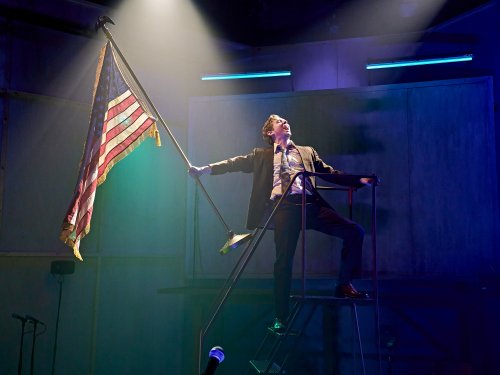
Jack Holden in Holden and Ed Stambollouian’s “Kenrex” at the Lucille Lortel Theatre (Photo credit: Manuel Harlan)
What the production ultimately reveals—quietly, insistently—is a searching inquiry into justice and retribution in small-town America, where economic precarity, limited horizons, and a faltering legal apparatus simmer beneath the surface of an otherwise unremarkable community. The townspeople are not rendered as vigilantes in the crude sense, but as individuals worn down by a system that has repeatedly failed to protect them. In that context, their collective silence following McElroy’s murder becomes less an omission than a statement—an uneasy, tacit acknowledgment of a line crossed.
The staging captures this moral dissonance with striking clarity: Holden, in a gesture at once simple and loaded, disconnects the power cords from a ring of microphones, collapsing the apparatus of testimony into mute objects. It is an image that lingers, distilling the central tension of the piece—the fraught distance between what the law can codify and what a community, under sustained pressure, comes to accept as justice.
If the framing device raises questions it ultimately declines to answer, this feels less like oversight than intention. Kenrex is not concerned with tidy resolutions; its interests lie in the residue of events, in the ways a community absorbs and carries what cannot be publicly acknowledged. In this, the production achieves something rare: it transforms a known story into an experience that feels newly urgent, its implications radiating outward long after the final moment has passed.
Kenrex (through June 27, 2026)
Lucille Lortel Theatre, 121 Christopher Street, in Manhattan
For tickets, visit www.tickets.kenrextheplay.com/
Running time: two hours and 15 minutes including one intermission


Leave a comment