
Love Story
If theater rehearses life, Aurora Stewart de Peña’s play quietly becomes a profound rehearsal for loss—and for the courage to keep loving anyway.
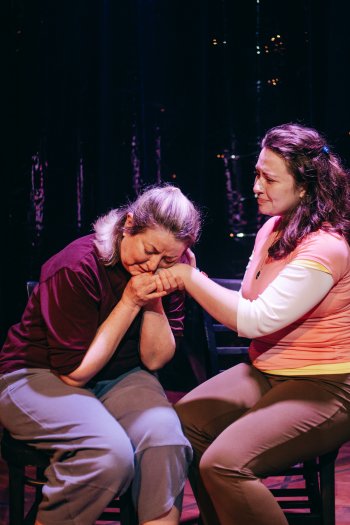
Ramona Floyd and Ally Callaghan in a scene from Aurora Stewart de Peña’s “Love Story” at The Tank (Photo credit: Geve Penn)
There are evenings in the theater when one feels not so much entertained as quietly undone—taken apart, almost imperceptibly, until what remains is something rawer, less defended, and undeniably human. Love Story, presented Off-Broadway by The Tank in association with Voyage Theater Company, aims for precisely this sort of disassembly. Written by Aurora Stewart de Peña, the production is by turns disarming, disorienting, and intermittently transcendent—though not always as cohesive as its ambitions might suggest.
From the moment one enters the intimate space, Luke Hofmaier’s pre-show playlist—an evocative drift through indie melancholy and art-pop cool—establishes an atmosphere of emotional residue. The music does more than set a tone; it frames the experience as one already half-remembered, as though we are stepping into a memory rather than a narrative. This sensibility permeates the play, which unfolds less as a story than as a series of reverberations, echoing across time, consciousness, and the unreliable terrain of grief.
Where past and present commingle—as they so insistently do in a play like Love Story—the burden falls squarely on the director to furnish the audience with a legible temporal grammar. Without such guidance, fragmentation risks reading not as intentional lyricism but as simple confusion. Here, despite the production’s many sensitivities, that grammar is not always clearly articulated. Judging by the palpable hesitations in audience response—the delayed laughter, the uncertain silences—it takes an inordinate number of transitions before one fully apprehends a crucial fact: that Maria is already dead at the top of the play. This is not, in itself, a flaw; dramatic revelation can be a powerful tool. But the production does not so much reveal this reality as obscure it, leaving spectators to assemble the timeline retroactively, often at the expense of emotional continuity.
The theater, of course, offers no rewind button. One cannot revisit an earlier moment with newly acquired understanding, cannot toggle back to recontextualize a line or gesture. Clarity, therefore, is not a luxury but a necessity—particularly in a work so structurally dependent on temporal fluidity. What might read as poignantly elliptical on the page can, in performance, become frustratingly opaque. This is where the directorial hand of Rose Burnett Bonczek feels curiously light. One senses that greater rigor in the rehearsal room—more precise calibration of transitions, clearer differentiation of temporal states, perhaps even a more disciplined physical vocabulary for the actors—could have rendered the play’s chronology more immediately intelligible. As it stands, the audience is left to do a kind of dramaturgical guesswork that the production itself ought to have resolved.
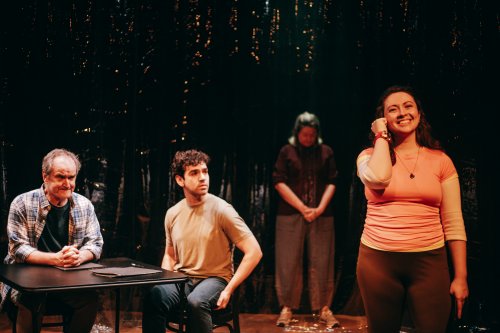
Mickey Ryan, Julio Cesar Gutierrez, Ramona Floyd and Ally Callaghan in a scene from Aurora Stewart de Peña’s “Love Story” at The Tank (Photo credit: Geve Penn)
And yet, even within this lack of clarity, there are moments when the disorientation feels almost apt—when the confusion mirrors the very condition the play seeks to evoke: grief as a collapse of time, a simultaneity of before and after. The challenge, unmet here, is to shape that disorientation into something purposeful rather than accidental.
At its core, Love Story is a play about rehearsal, though not merely in the theatrical sense. Its characters circle not only a script but their own memories, compulsively revisiting and revising the past in an attempt to stabilize what cannot be held. The absent center of this orbit is Maria, a young woman whose presence flickers through the piece like a corrupted file—visible, audible, but never fully recoverable. Stewart de Peña’s writing embraces fragmentation, allowing scenes to bleed into one another, past into present, reality into speculation.
This structural fluidity is one of the play’s greatest strengths, though it occasionally courts diffuseness. The introduction of a metatheatrical figure known as “Stage Directions”—played with quiet authority by Yassmin Alers—adds a layer of philosophical intrigue, suggesting a dramaturgical consciousness hovering over the action. The device recalls certain modernist antecedents, yet here it functions less as intellectual scaffolding than as an emotional guide, gently steering the audience through the play’s shifting registers. Still, the accumulation of these techniques can, at times, feel more suggestive than fully integrated.
The performances, however, ground the piece with remarkable consistency. Ally Callaghan’s Maria is a volatile and deeply affecting presence, oscillating between mordant humor and existential dread with a kind of reckless transparency. Her monologues—particularly those cataloguing imagined deaths—achieve a delicate balance of absurdity and devastation, illuminating the mind’s desperate need to narrativize loss. It is a performance that feels lived rather than constructed, even when the text around it threatens to dissipate.
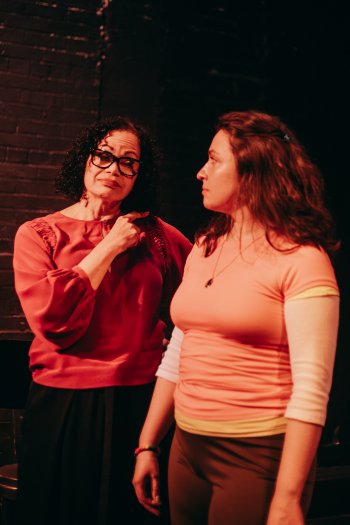
Yassmin Alers and Ally Callaghan in a scene from Aurora Stewart de Peña’s “Love Story” at The Tank (Photo credit: Geve Penn)
As Noelle, Maria’s mother, Ramona Floyd offers a portrait of grief that is striking in its restraint. Her performance resists theatrical grandiosity, favoring instead a series of quiet implosions—moments in which language falters and the body bears the weight of what cannot be said. Opposite her, Julio Cesar Gutierrez’s Marc, Maria’s boyfriend, embodies a different register of mourning: obsessive, tactile, anchored in objects that promise proximity to the loss. Mickey Ryan’s Phillip, Marc’s father, meanwhile, provides a contemplative counterpoint, his reflections on memory and dreaming, immersed in the loss of his wife prior to the events of the play, lending the production a measure of philosophical coherence.
The play’s thematic preoccupations—love as legacy, memory as both archive and invention—are articulated with genuine sensitivity. Objects become vessels of continuity: a watch, a photograph, a cosmetic gesture preserved in muscle memory. These are not merely props but conduits, through which the living maintain an ongoing dialogue with the dead. In its most compelling moments, Love Story captures the peculiar temporality of grief, its refusal to obey linear progression, its tendency to resurface with undiminished force at the most ordinary of moments.
Yet the intensity the play seeks is not always modulated. There are passages where its emotional insistence borders on saturation, where the accumulation of affect risks diminishing its impact. Grief, as the production rightly suggests, does not resolve—but in theatrical terms, it must still be shaped. Here, the piece occasionally struggles to balance its immersive ambition with the discipline required to sustain it.
The staging, spare to the point of austerity, proves both an asset and a limitation. Micaela Bottari’s design of folding chairs, a table, a handful of carefully chosen objects—these elements create a flexible, suggestive environment in which memory can take form. Sarai Frazier’s lighting transitions, often abrupt, function as perceptual blinks, reinforcing the play’s concern with the instability of experience. Patricia Marjorie’s costumes are appropriately lived-in and character centered.
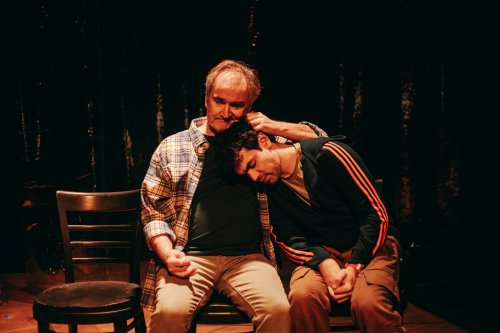
Mickey Ryan and Julio Cesar Gutierrez in a scene from Aurora Stewart de Peña’s “Love Story” at The Tank (Photo credit: Geve Penn)
What lingers, ultimately, is not a single image or line, but a sensation: the sense that those we have lost continue to inhabit us in ways both consoling and destabilizing. Love Story does not offer resolution—indeed, it is too honest for that—but it leaves open a narrow, flickering space for possibility. One leaves not with answers, but with a heightened awareness of absence, and of the fragile, ongoing work required to live alongside it.
Love Story (through May 17, 2026)
The Tank & Voyage Theater Company
The Tank, 312 West 36th Street, in Manhattan
For tickets, visit www.thetanknyc.org
Running time: 80 minutes without an intermission


Leave a comment