
The Bad Daters
Desolate circumstances put two lonely people into the algorithmic theater of online romance—poor Cupid doesn't know what he's gotten himself into.
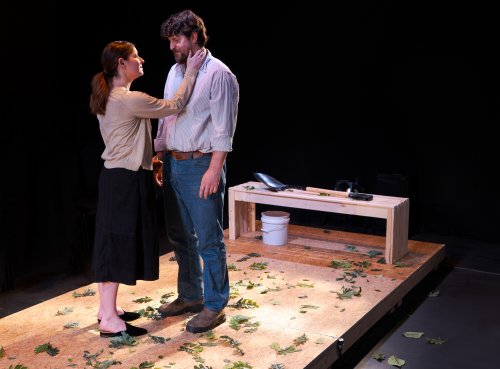
Kate Arrington and Shane McNaughton in Derek Murphy’s “The Bad Daters” at the Paradise Factory (Photo credit: Emma Kazaryan)
Derek Murphy’s The Bad Daters arrives Off Broadway from Ireland and the United Kingdom with the unassuming air of a chamber piece and the stealthy force of something far more piercing: a romantic comedy that has the good sense to distrust romance, and the better sense to proceed anyway. Murphy, an Ireland-born New Yorker with an ear for the bruised lyricism of everyday speech, has fashioned from the well-trod terrain of app-based courtship a work of surprising delicacy and cumulative emotional power. Under Colm Summers’ exquisitely modulated direction, and animated by two performances of uncommon acuity from Kate Arrington and Shane McNaughton, the production unfolds with a patience that feels almost radical, allowing its jagged edges to soften—though never quite smooth—into something like grace.
The premise, at first glance, suggests a familiar architecture: two mismatched strangers, Wendy and Liam, meet under dubious circumstances and circle one another warily, their initial encounter so freighted with awkwardness as to seem almost doomed. She arrives armored—psychically and, hilariously, quite literally—equipped with pepper spray, a battery-powered whistle, and a near-ritualistic devotion to hand sanitizer, as though modern intimacy were less a prospect than a contagion. He, by contrast, presents as a figure of almost excessive gentleness, a man whose soft-spoken demeanor barely conceals a more complicated interior life. That Murphy contrives to make their second date plausible, their third inevitable, and their continued entanglement quietly absorbing is a testament not only to his structural finesse but to his deep compassion for human contradiction.
What distinguishes The Bad Daters is the tensile balance it maintains between acerbity and ache. Murphy’s wit is unmistakably Irish—dry, self-lacerating, and alert to the absurdities of social performance—but it is never merely decorative. Rather, it functions as both shield and scalpel, revealing the characters’ vulnerabilities even as it allows them to obscure those same wounds. Wendy, in Arrington’s superbly calibrated performance, is all angles and defenses, her “honesty” weaponized into a kind of preemptive strike against rejection. Arrington locates, within that brittle exterior, a flickering instability—moments when the character’s ferocity falters, and something more tentative, more frightened, threatens to emerge.
McNaughton’s Liam, meanwhile, is rendered with a quiet, devastating restraint. His affability, initially disarming, gradually acquires a different valence as the contours of his past come into view—most notably the suicide of his wife, and her final injunction that he “make an effort.” It is a line that reverberates throughout the play, transforming Liam’s tentative reentry into the world of dating into an act of moral, even existential, courage. McNaughton charts this evolution with remarkable subtlety, allowing the character’s passivity to give way, almost imperceptibly, to a firmer sense of self. When he finally confronts Wendy—rejecting her corrosive brand of “honesty” as a license for cruelty—the moment lands with the force of a small detonation, precisely because it violates the expectations he himself has so carefully established.
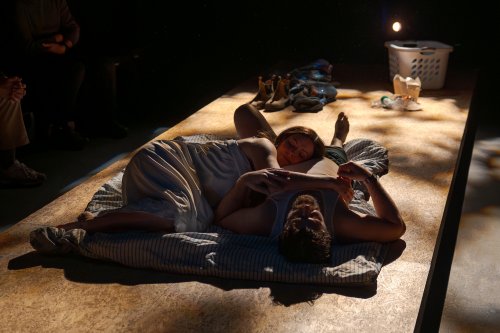
Kate Arrington and Shane McNaughton in Derek Murphy’s “The Bad Daters” at the Paradise Factory (Photo credit: Emma Kazaryan)
Murphy structures the play as a series of encounters that feel at once discrete and cumulative, each scene stripping away another layer of performance, another carefully maintained illusion. What emerges is not a conventional love story but a process of mutual recognition, in which two deeply guarded individuals begin, haltingly, to apprehend one another—and themselves—with greater clarity. The question is never simply whether they will end up together, but whether they can tolerate the exposure that such togetherness requires.
Summers’ direction honors this delicate progression, resisting the temptation to overemphasize either the comedy or the pathos. His production’s rhythms are finely judged, its silences as eloquent as its bursts of verbal sparring. There is a palpable trust in the material—and in the audience’s ability to sit with discomfort, to recognize the uneasy proximity of humor and hurt.
For those familiar with Murphy’s earlier work, The Bad Daters may register as a departure in its focus on romantic connection, yet its thematic preoccupations remain strikingly consistent. Love, here as elsewhere, is less a balm than a challenge; redemption, less a destination than a practice. What has shifted is the tonal register: the darkness, while still present, is leavened by a newfound tenderness, a willingness to entertain the possibility that even the most damaged selves might, under the right (or perhaps merely persistent) conditions, move toward something like repair.
The obdurate narrowness of the Paradise Factory—a railroad apartment that seems, at first blush, to conspire against theatrical expansiveness—proves less a limitation than a provocation. Tyler Herald, embracing the venue’s spatial austerity, answers with a scenic design of quiet ingenuity, conjuring a park of suggestive openness and a bedroom of intimate specificity, each environment unfolding with a kind of imaginative elasticity that belies the room’s constraints. The effect is not merely compensatory but generative: a demonstration that constraint, in the right hands, can yield abundance.
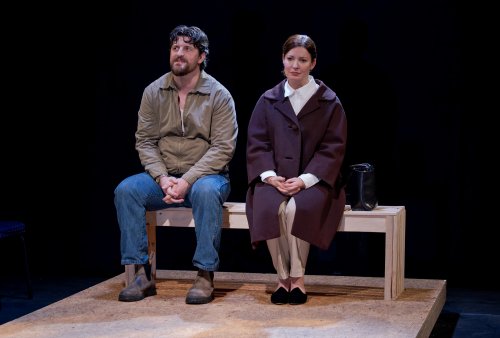
Shane McNaughton and Kate Arrington in Derek Murphy’s “The Bad Daters” at the Paradise Factory (Photo credit: Emma Kazaryan)
This spirit of resourceful transformation extends throughout the production’s design elements. Betsy Chester’s lighting is exquisitely attuned, shaping the emotional topography with a sensitivity that feels almost novelistic in its nuance—illuminating not just bodies in space but the shifting interior weather of the play itself. Tye Hunt Fitzgerald’s sound design, by contrast, operates with a sly inventiveness, threading the action with textures that expand the world beyond the visible, suggesting dimensions the eye alone cannot apprehend.
And then there are Kindall Houston Almond’s costumes, which perform their own subtle dramaturgy. At first, the characters appear neatly contained—buttoned, quite literally, into versions of themselves that feel provisional, even defensive. But as the evening progresses, and as comfort (or its uneasy approximation) takes hold, those sartorial constraints begin to loosen, signaling, with quiet eloquence, the gradual shedding of armor. It is a design choice as psychologically astute as it is visually precise, and emblematic of a production in which every element, however modest in scale, contributes to a larger, deeply considered whole.
By the play’s end, Murphy resists the consolations of neat resolution. What he offers instead is something more elusive and, ultimately, more satisfying: a sense of ongoingness, of two lives tentatively aligned but not yet resolved. It is a conclusion that feels truer to the messy contingencies of contemporary intimacy—and, in its modest way, more hopeful. One leaves the theater with the impression not that Wendy and Liam have been transformed, exactly, but that they have begun, at last, to change. It is a searching, tender study of loneliness and the fragile, hard-won mechanics of connection…a pity we couldn’t stick around for that wedding though…
The Bad Daters (through May 17, 2026)
Paradise Factory & Strike Crew
Paradise Factory, 64 East 4th Street, in Manhattan
For tickets, visit www.paradisefactory.org
Running time: 75 minutes without an intermission


Leave a comment