
News Ticker

David Shih

King of the Yees

October 21, 2026

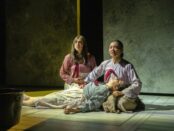
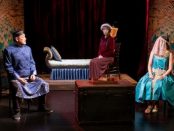
Brody, the director, has the unenviable task of making Yee’s deliberately unstable theatrical architecture feel like a coherent evening rather than an assortment of comic sketches held together by a family name. His production, which gradually expands from a relatively contained rehearsal-room comedy into an extravagant excursion through Chinatown’s folklore and popular mythology, finds its footing in the contrast between the two acts. The opening establishes the play’s self-conscious machinery: Larry interrupts his daughter’s rehearsal, takes an interest in the audience, and begins to commandeer a production that was supposed to be about him only on Lauren’s terms. He is particularly interested in whether any Yees have come to watch. Lauren looks out at the predominantly white audience and wonders how that could possibly be the case. Brody allows the joke to land as both a comic provocation and an acknowledgment of the distance between a community’s self-image and the audience to whom its stories are being told. Once Larry disappears, the staging acquires a new freedom, plunging Lauren into a fantastical quest involving gangsters, elders, mythical ancestors and a Sichuan Chinese opera-inspired face changer. The occasional physical-comedy sequence feels more laborious than the production’s nimble dialogue, but Brody’s overall command of the tonal shifts is impressive. He understands that the evening’s wildness must ultimately serve the relationship at its center, and that the most spectacular transformation is not the one performed onstage but the one taking place in Lauren’s understanding of her father. [more]
Henry VI: A Trilogy in Two Parts

July 15, 2026

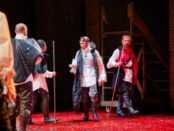
Although the three plays have been reduced to two and many of the actors appeared previously in the 2018 production, Henry VI is still challenging for audiences unfamiliar with the Hundred Years War or the War of the Roses. Even with an ensemble of 16, the actors play between three and nine characters each so that you are never entirely sure who anyone is when they appear. With women playing men (mostly to add a few female characters to the play), it is not only often confusing but makes the wrong statement like the Duke of Gloucester played by a female and then his wife being a major character later in the play. Even with 16 cast members some of the court and battle scenes look underpopulated on the large stage. The costuming, a combination of modern and medieval by the collective threeASFour which resembles outfits by Comme des Garçons, does not entirely help even though the English wear black and white in Part I and the French wear black. Due to the number of dukes and earls, it would have been helpful if they wore defining outfits that set them apart from each other. In Part II, the Yorkists wear a white signifier while the Lancastrians wear red but this still does not make it easy to recognize particular characters. [more]

Sumo

March 12, 2025

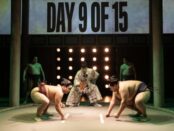
Despite its predictable overarching plot, "Sumo," produced jointly by the Ma-Yi Theater Company and La Jolla Playhouse, is never boring. Partly, that's because, as Mitsuo, Shih is villainously charismatic, portraying the preening bully with the disarming and false sense that there is a method to his sadism. But, even more compellingly, Sumo is an immersive and sumptuous eyeful--no matter your personal predilections for loincloths and bare, overhanging bellies--with a set, props, costumes, projections, and all that glorious sumo hair provided by Wilson Chin, Thomas Jenkeleit, Mariko Ohigashi, Hana S. Kim, and Alberto "Albee" Alvarado respectively. As for the main event, there is certainly loads of cheer-inducing sumo wrestling throughout the play, but it's the sumo karaoke after the intermission that adds much-needed joy to the proceedings. That exhilarating scene, aided by Paul Whitaker's vibrant lighting effects mixed with Fabian Obispo's equally energetic sound design, also offers director Ralph B. Peña the opportunity to let the actors cut loose, at least for a little while. [more]

ONCE UPON A (korean) TIME

September 1, 2022

Commissioned by the Ma-Yi Theater Company, Daniel K. Isaac’s brilliant "ONCE UPON A (korean) TIME" was born out of the actor-playwright’s realization that he knew way more about Shakespeare and the Western canon than his own rich Korean culture of folk tales and origin myths.  He has fashioned, over the course of five scenes, beautifully layered storytelling in situations clouded by utter despair, without sacrificing great brushstrokes of humor. [more]

Gnit

November 9, 2021

Will Eno’s wry, contemporary 'Gnit" solves the problem of attempting to stage Ibsen’s unwieldy, five-hour verse play "Peer Gynt." The play given its world premiere at the Humana Festival of New American Plays in 2013 is now making its New York debut at Theater for a New Audience in a production directed by Oliver Butler, a longtime collaborator with Eno. Heavily influenced by the plays of Samuel Beckett and Eugene Ionesco, "Gnit" is a journey of the self to enlightenment with travel throughout the world. Part road movie, part folklore, and part horror story, "Gnit" makes an old play new again. [more]

[Veil Widow Conspiracy]

June 21, 2019

The set designer (Yu-Hsuan Chen) and lighting designer (Reza Behjat) have obviously worked collaboratively to create some effective—and often beautiful—stage pictures. Loops of light are a striking visual leitmotif throughout the show. Costume designer Mariko Ohigashi was given a particularly challenging assignment: imagining garments for three distinctly different worlds. She has delivered the period costumes of the original story (with help from Makoto Osada), the T-shirts with production titles that are worn on the film set, and the simple windbreakers that appear in the futuristic scenes—and she’s done it all with both nuance and flair. [more]

Henry VI (NAATCO)

August 22, 2018

Presented by NAATCO (National Asian American Theatre Company), it has a virtually all-Asian excellent cast of sixteen, several of whom play roles of opposite genders. Creatively conceived by Stephen Brown-Fried and superbly directed by him, his Orson Welles-like vision transcends the difficult material. This sterling production is also an inspired example of Americans succeeding at Shakespeare. [more]

Awake and Sing! 

July 16, 2015

"Awake and Sing!" seems at first an odd choice for NAATCO, the acting company dedicated to the advancement of Asian actors, but after an initial wary uneasiness, the cast, under the direction of Stephen Brown-Fried, soon takes command of Odets’ dated language, a mixture of poetic metaphor and heightened colloquialisms which was difficult to speak even in the 1930’s. [more]