
Queeney Todd: The Demon Bottom of Fleet Street
A gloriously debauched collision of opera, drag, and musical theater, this outrageous, vocally dazzling revenge romp turns high art into heavenly mayhem.
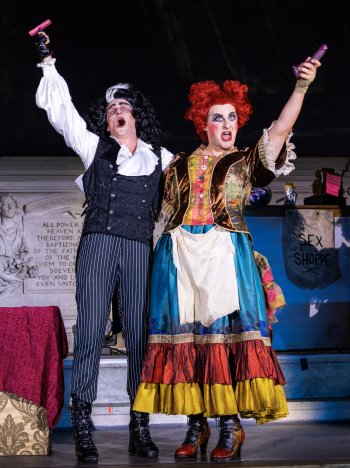
Nathaniel Sullivan and Matt Dengler in a scene from “Queeney Todd: The Demon Bottom of Fleet Street” at Judson Memorial Church (Photo credit: Russ Rowland)
There are operatic traditions, and then there is Heartbeat Opera’s annual Drag Opera Extravaganza, which regards tradition less as a sacred inheritance than as a well-stocked dressing room from which to borrow, plunder, and emerge in something scandalously more revealing. Now in its 11th incarnation, this Halloween-season bacchanal has established itself as a distinctly New York ritual, drawing opera devotees, drag aficionados, and the merely curious into Judson Memorial Church for an evening in which high culture and low comedy discover that they have considerably more in common than either might care to admit. This year’s offering, Queeney Todd: The Demon Bottom of Fleet Street, is a deliriously indecorous reinvention of Sweeney Todd, an extravaganza of queer revenge, operatic excess, sexual misadventure, and musical-theatre mischief that demonstrates, with considerable glee, how much vitality can be released when reverence is abandoned but affection remains intact. The result is a full-throated triumph of theatrical imagination, performed with such musical sophistication and such gloriously unbuttoned abandon that even the most outrageous material acquires the peculiar dignity of art.
The premise is as cheerfully appalling as its title suggests. Queeney Todd, played by the formidable baritone Nathaniel Sullivan, returns to London after a decade away, determined to settle accounts with the men who have mistreated him before he succumbs to the dreaded specter of “twink death.” His particular grievance begins with an expensive evening of preparation for a succession of Grindr rendezvous, none of whose prospective participants bothers to appear. The resulting humiliation inspires a campaign of retribution, although Queeney is considerably less interested in throat-slitting than in a more anatomically specific form of vengeance. His fortunes become entangled with those of Mrs. Lovedick, the proprietor of a struggling sex shop; a procession of unpredictable clients and lovers; and the Barber of Seville, whose arrival threatens to upset the increasingly lucrative enterprise that grows out of an accidental castration. What begins as a revenge fantasy gradually mutates into a gleefully preposterous conspiracy, with the characters discovering that even the most intimate injuries can become commercial opportunities. The writing, credited collectively to the show’s director Kemar Jewel, Jacob Ashworth, Peregrine Teng Heard, and Garrett Bell, understands that the most effective obscenity is not simply a matter of saying the unsayable. It is a matter of constructing an entire theatrical universe in which the unsayable becomes the organizing principle.
Sullivan supplies the evening with a wonderfully commanding center of gravity. As Queeney, he combines the vocal authority expected of a seasoned operatic baritone with an almost aristocratic capacity for indignation, making a character whose grievances are at once ridiculous and entirely sincere. His Queeney is not a conventional villain but a wounded romantic who has mistaken sexual vindication for justice, and Sullivan gives this absurd quest a surprising emotional coherence. His voice retains its richness and precision amid the production’s relentless interruptions, while his comic timing allows the character’s grandiose declarations to coexist with the petty humiliations that propel them. There is a particular pleasure in watching a singer capable of inhabiting the formidable dramatic terrain of Strauss or Handel devote comparable seriousness to a man whose principal enemies are unreliable hookups and the ravages of aging. Sullivan never treats the joke as an excuse to coast; rather, he invests the nonsense with enough conviction to make the entire ludicrous enterprise fly.
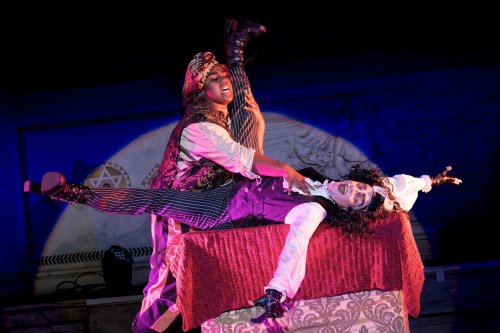
Eliza Bonet and Nathaniel Sullivan in a scene from “Queeney Todd: The Demon Bottom of Fleet Street” at Judson Memorial Church (Photo credit: Russ Rowland)
Matt Dengler, meanwhile, is the production’s magnificently unpredictable wild card. Initially appearing as Mrs. Lovedick, the proprietor of the failing sex shop who becomes Queeney’s confidante and collaborator, Dengler establishes a comic persona of such extravagant proportions that the character seems to have been conceived expressly to devour the surrounding narrative. His rendition of “The Worst Thighs in London” announces a performer with a fearless appetite for vulgarity, but the real delight lies in the way he keeps discovering new dimensions of absurdity within it. As the evening progresses, Mrs. Lovedick’s ambitions expand, the character’s secrets begin to emerge, and Dengler eventually hijacks the show for a gloriously excessive tribute to Angela Lansbury. Snatches of Lansbury’s Broadway repertoire, from Anyone Can Whistle to Mame and Sweeney Todd, mingle with nods to her television career, including Murder, She Wrote. The transformation becomes a show within the show, a deliciously self-aware eruption of theatrical ego that recalls the anarchic spirit of Oh, Mary! without merely reproducing its formula. Dengler understands that camp is most potent when played with absolute conviction. His performance is not content to steal scenes; it repeatedly persuades the scenes to surrender themselves.
Jewel, who directs and choreographs, brings the sensibility of a ballroom legend to a production that depends on the collision of carefully calibrated theatricality and magnificent disorder. The choreography does more than provide decorative punctuation between musical numbers: it establishes the physical vocabulary of a world in which seduction, competition, humiliation, and self-invention are all forms of performance. Jewel knows how to turn a gesture into a declaration and an entrance into an event, while keeping the ensemble’s exuberance from dissolving into shapeless commotion. The production’s sexual frankness is inseparable from its theatrical intelligence; bodies become instruments of comic timing, choreography becomes a means of storytelling, and even a barber’s striptease can function as a dramatic turning point. Jewel’s direction also respects the peculiar demands of the material, allowing musical sophistication and deliberately tasteless humor to occupy the same stage without apologizing for either. The governing principle is not that anything goes, but that almost anything can become theatrically exhilarating when its performers understand precisely what they are doing.
Dan Schlosberg’s arrangements provide the musical architecture for this glorious assault on good taste, and the small band assembled here performs a feat of sonic prestidigitation worthy of the production’s larger theatrical deceptions. With Jacob Ashworth on violin, Anjali Shinde on flutes, Wil Dannenberg on horns, and Schlosberg himself on piano and keyboard, the four musicians conjure the breadth, color and dramatic sweep of an orchestra many times their number. The score seems to expand before our ears, moving effortlessly among operatic grandeur, Broadway exuberance, and contemporary pop without ever sounding undernourished or makeshift. Sondheim’s Sweeney Todd is an obvious point of departure, but it is only one ingredient in an extravagantly seasoned musical feast that also draws on Puccini, Verdi, Bizet, Rossini, Handel, Offenbach, Alan Menken, and contemporary pop. Familiar melodies arrive in new contexts, sometimes with lyrics of magnificent indecency: Handel’s “See, the raging flames arise” becomes “See, the raging gays arise,” accompanying Queeney’s preparations for a rendezvous, while “La donna è mobile” acquires an entirely unexpected significance after one of his anatomical interventions. The Habanera from Carmen, Figaro’s “Largo al factotum,” and a montage of dangerously unreliable operatic tenors are among the delights, alongside detours into Ginuwine, Disney, and Swan Lake. Schlosberg’s achievement, both as arranger and performer, is not merely to make these disparate idioms coexist, but to give each its proper musical character while maintaining the illusion of an ensemble of orchestral proportions. The musicians may occupy only a corner of the room, but their sound fills the entire theatrical universe.
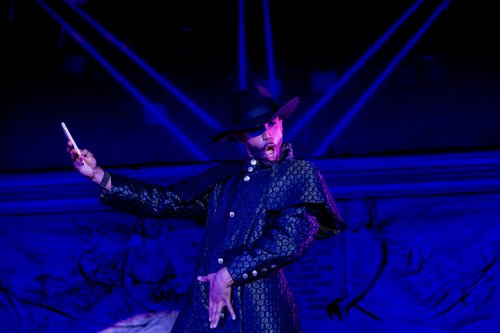
Jonathan Burke in a scene from “Queeney Todd: The Demon Bottom of Fleet Street” at Judson Memorial Church (Photo credit: Russ Rowland)
The supporting performers make certain that the extravaganza never becomes a two-person showcase. Eliza Bonet brings a sparkling combination of vocal agility, comic nerve, and theatrical fearlessness to Rosina, whose demand for London’s most prodigious sexual equipment sets another round of complications in motion. Her coloratura is a source of genuine pleasure, not merely a parody of operatic ornamentation, and she navigates the production’s outrageous demands with the ease of a performer who understands that vocal brilliance and comic excess can reinforce each other. Imara Miles, as the Top and a succession of other men who cross Queeney’s path, gives the proceedings a different kind of vocal richness. Her mezzo-soprano lends weight and warmth to a parade of characters whose shifting identities and desires might otherwise become little more than a sequence of punch lines.
The production’s queer wit is particularly effective in the way it allows gender, sexual role, and theatrical identity to remain fluid without turning that fluidity into a lecture. Jonathan Burke, meanwhile, makes a splendidly memorable entrance as the Barber, combining a striptease and lip-sync performance with the sort of physical assurance that can make a roomful of spectators forget, if only temporarily, that they have come to hear opera. His arrival is a full-fledged theatrical event, and the subsequent musical and sexual complications benefit from his buoyant presence. The Stonewall Chorale adds a welcome communal dimension to the proceedings, while the ensemble as a whole sustains an energy that is as disciplined as it is infectious.
Maiko Ando’s makeup deserves its own ovation. In a production where the performers inhabit characters who are already theatrical exaggerations of theatrical exaggerations, Ando’s work helps distinguish a procession of divas, villains, lovers and assorted miscreants while embracing the artifice that makes drag such a potent instrument of transformation. David Quinn’s costumes perform an equally indispensable service, supplying the extravagant silhouettes, visual contrasts, and gloriously excessive flourishes that allow this world to careen between Victorian grotesquerie, seductive glamour, and pop-cultural parody.
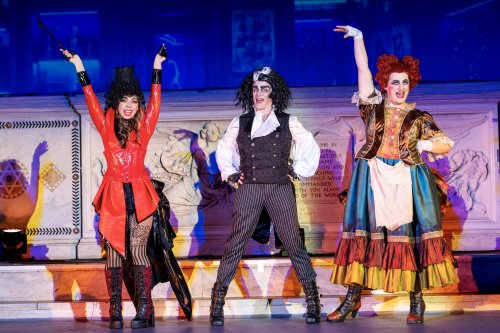
Eliza Bonet, Nathaniel Sullivan and Matt Dengler in a scene from “Queeney Todd: The Demon Bottom of Fleet Street” at Judson Memorial Church (Photo credit: Russ Rowland)
Yung-Hung Sung’s lighting, Doaa Ouf’s projections, and Kodi Lynn Milburn’s sound design further sharpen the production’s shifts in mood and reference, supporting the musical and comic action without distracting from its wonderfully unruly momentum. Together, these contributions make the visual and aural world as richly imagined as the performances themselves: nothing feels incidental, yet nothing appears to be straining for importance. The entire enterprise has the deliciously overdetermined look of a fever dream whose every detail has been considered, then gleefully pushed one step beyond good taste.
What finally makes Queeney Todd so exhilarating is the intelligence beneath its outrageousness. The production assumes that opera’s emotional extremity, its spectacular villains, its doomed lovers, and its barely concealed erotic obsessions are already close relatives of drag and camp. It does not pause to explain every reference, provide translations for its arias, or reassure newcomers that they are in on the joke. Instead, it offers multiple points of entry: a familiar tune, an absurdly pointed lyric, a virtuoso vocal flourish, a spectacular costume, a striptease, or simply the contagious pleasure of watching talented performers commit themselves completely to an impossible premise. For the initiated, the operatic references and musical in-jokes offer an additional layer of delight; for everyone else, the sheer theatrical abundance is more than sufficient.
The humor can be so shamelessly stupid that it loops back into sophistication, but the underlying affection for the material is unmistakable. Heartbeat Opera knows these musical traditions from the inside, and that knowledge gives its irreverence both precision and generosity. The 11th Drag Opera Extravaganza may be a seasonal ritual, but its spirit is gloriously resistant to respectability. Queeney Todd leaves the audience with the sense that opera has not been diminished by its encounter with drag, nor drag ennobled by its encounter with opera. Both have simply been reminded of the pleasure of being outrageously, unapologetically alive.
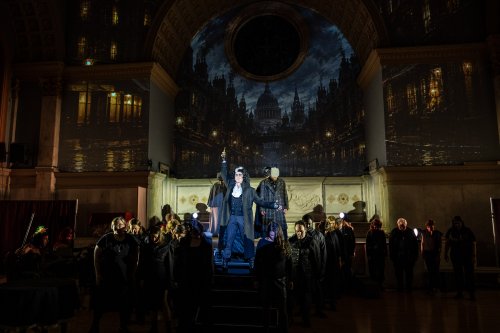
Nathaniel Sullivan and the cast of “Queeney Todd: The Demon Bottom of Fleet Street” at Judson Memorial Church (Photo credit: Russ Rowland)
Queeney Todd: The Demon Bottom of Fleet Street (through October 31, 2026)
Heartbeat Opera
Judson Memorial Church, 55 Washington Square South, in Manhattan
For tickets, visit http://www.heartbeatopera.org
Running time: 90 minutes without an intermission


Leave a comment