
The Ask
An absorbing clash of generations, ideology and philanthropy, brought vividly to life by Marilu Henner and Shannon Purser in battles of wills and principles.
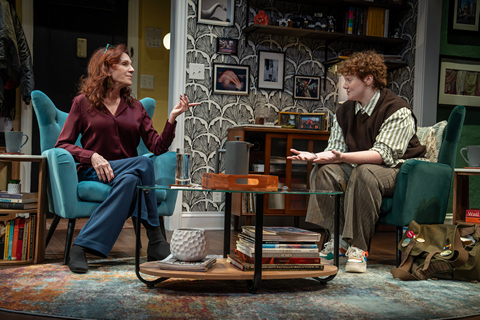
Marilu Henner and Shannon Purser in a scene from Matthew Freeman’s “The Ask” at Theater 555 (Photo credit: Joan Marcus)
Matthew Freeman’s The Ask, now receiving a return engagement at Theater 555, takes a seemingly routine exercise in nonprofit fundraising and discovers, beneath its polished courtesies and ideological minefields, a small-scale version of one of the American left’s most consequential internal struggles: what happens when the people who financed a movement find themselves at odds with the generation that has inherited its institutions? The premise is deceptively simple. In December 2022, Tanner (Shannon Purser), a young, nonbinary gift-planning officer for the American Civil Liberties Union, visits Greta (Marilu Henner), a wealthy, longtime supporter whose annual contribution has lapsed. The assignment is to restore the relationship, explain the organization’s evolving priorities, and persuade Greta to make an even more substantial gift. What ought to be a conversation about charitable giving becomes something closer to a domestic inquisition, as Greta gradually makes clear that her missing donation was no oversight. She has withheld it deliberately, and she has grievances to air before she will consider opening her checkbook again. Freeman’s play, directed by Jessi D. Hill, is at its most engaging when it recognizes that money, particularly money bestowed in the name of principle, rarely travels without an accompanying expectation of influence.
Greta’s dissatisfaction initially seems to concern the ordinary indignities of institutional life. Her longtime contact at the ACLU, Carol, has disappeared from the picture without the courtesy of a personal explanation, leaving Greta to wonder whether the organization’s recent staff reductions have claimed someone with whom she had developed a genuine relationship. She is irritated by the organization’s relentless fundraising emails, whose impersonal abundance seems to have replaced the human connection that once made giving meaningful. More consequentially, she believes the ACLU has wandered from the civil-liberties mission that inspired her support in the first place. Her political convictions were forged in an era when the organization’s defense of the free-speech rights of a Nazi group seeking to march in the heavily Jewish community of Skokie, Illinois, demonstrated the sometimes uncomfortable consistency required by principle. To Greta, the point was never that every cause deserved endorsement, but that constitutional protections meant little if they were reserved for the congenial. Now she sees resources flowing toward such concerns as student-debt forgiveness and rural broadband while the organization seems unable to secure the nationwide abortion access she regards as essential. Her disillusionment is genuine, even when her reasoning is imperfect, and the play wisely refuses to reduce it to a mere symptom of reactionary old age.
The most combustible issue, however, emerges when the conversation turns to language. Greta, a longtime feminist who has spent decades supporting women’s rights, recoils when Tanner refers to “pregnant people,” hearing in the phrase an unwillingness to acknowledge women as a distinct political constituency. Tanner, by contrast, understands inclusive terminology as an effort to protect people whom traditional categories have excluded. Neither character is simply inventing the stakes, and Freeman’s achievement lies in showing how a disagreement over words can become a dispute about history, recognition and the ownership of political ideals. Greta wants acknowledgment that her generation’s battles were not rendered irrelevant by the arrival of a new vocabulary; Tanner is attempting to represent an organization whose mission extends beyond the boundaries of any one donor’s convictions. The difficulty is that Tanner cannot engage Greta on equal terms. They have been sent to secure a gift, not to conduct an unrestricted seminar on the philosophy of social justice. Their professional obligations require diplomacy precisely when the conversation most demands candor. Greta, meanwhile, enjoys the advantages of wealth, age and a home in which she is entirely at ease. The imbalance makes their encounter less a conventional debate than a contest in which one participant has considerably more freedom to speak than the other.
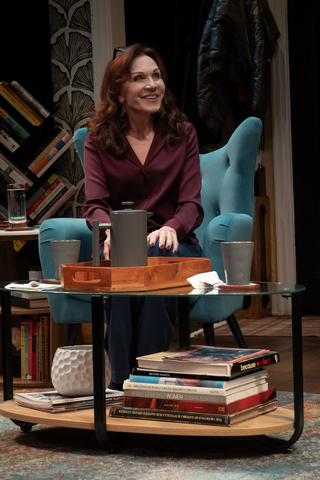
Marilu Henner in a scene from Matthew Freeman’s “The Ask” at Theater 555 (Photo credit: Joan Marcus)
Henner gives Greta the commanding, restless vitality that makes this imbalance theatrically productive. Her character is not especially easy to like, and that is part of the performance’s considerable appeal. Henner’s Greta has the brisk confidence of someone accustomed to having her calls returned, her opinions entertained, and her complaints treated as matters requiring immediate attention. She moves around her apartment with the proprietary assurance of a woman who has spent a lifetime acquiring both possessions and the authority to defend them. Her indignation can be disproportionate, her assumptions embarrassingly insulated from the experiences of ordinary Americans, and her insistence on being heard can overwhelm the person supposedly there to listen. A question about whether people still ski in the age of climate change captures her almost comically privileged perspective. Yet Henner never allows the character to become a caricature of an entitled liberal baby boomer. Beneath Greta’s bluster is the pain of a person who believes an institution she helped sustain has abandoned both her and the relationship that once connected her to its work. When she speaks about the principles that first drew her to the ACLU, the fervor has the unmistakable ring of an old conviction rather than a convenient argument deployed to win a quarrel. Henner’s portrayal is less conciliatory than Betsy Aidem’s in the production’s 2024 world premiere at The Wild Project, but its sharper edges make Greta feel more recognizably human: an aging activist whose commitment to justice has survived even as her certainty about the people administering it has begun to falter.
Purser, in the more circumscribed role of Tanner, finds a different and subtler source of dramatic tension. Tanner’s professional geniality is both their armor and their predicament. They must acknowledge Greta’s complaints without endorsing them, explain the organization’s priorities without sounding defensive, and maintain a cordial manner while a prospective donor subjects their language and convictions to sustained interrogation. Purser makes the effort visible without resorting to broad gestures of exasperation. A flicker in the eyes, a hesitation beneath a reassuring smile, or a momentary failure to maintain the expected composure reveals the emotional labor required to keep the encounter from becoming irretrievably hostile.
The character’s relative lack of personal disclosure is itself revealing: Greta knows remarkably little about the young person sitting across from her, and shows little curiosity about a life beyond the narrow circumstances of the meeting. When Greta briefly leaves the room on a phone call it allows Tanner’s carefully maintained façade to collapse into tears; Purser exposes the hurt that has accumulated beneath the professional pleasantries. Greta returns and offers a tissue and a glass of water, a gesture of genuine human sympathy that briefly suggests the possibility of connection. But she soon resumes talking about herself, and the moment passes without fundamentally changing the terms of the encounter. Purser makes that fleeting opening poignant. Tanner may be younger, but they are not emotionally invulnerable; their restraint is not an absence of feeling but the price of doing a job in which candor can be professionally expensive.
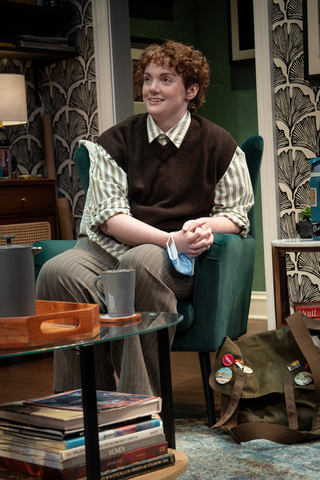
Shannon Purser in a scene from Matthew Freeman’s “The Ask” at Theater 555 (Photo credit: Joan Marcus)
Freeman’s writing benefits from the specificity of his subject and his familiarity with the institutional machinery that drives it. Drawing on experience as an ACLU fundraiser, while making clear that the characters and encounter are fictional, he understands that the solicitation of a major gift is never merely a financial transaction. The donor wants assurance that her contribution matters; the organization needs the contribution but cannot afford to let any individual benefactor dictate its mission. The tension becomes especially pointed when Tanner explains how political circumstances affect giving: a liberal administration may reduce the urgency that once inspired donations during Donald Trump’s presidency, prompting Greta to observe that bad presidents are apparently good for fundraising. Such exchanges illuminate the peculiar economics of political commitment, in which an organization’s success can undermine the very urgency on which its financial support depends.
Freeman is also alert to the irony that both characters believe themselves to be defending the same broad principles while disagreeing over their application. Greta wants to preserve a recognizable continuity with the causes that mobilized her; Tanner represents an institution attempting to accommodate a wider understanding of whose rights require protection. Neither position is inherently absurd, and the play is strongest when it allows the audience to appreciate the moral logic of both without pretending that their differences can be settled by a particularly well-worded appeal. The script occasionally circles its subject rather than driving relentlessly toward it, but its patience allows the emotional consequences of institutional change to emerge from the small indignities of an ordinary meeting.
Hill’s direction gives the production a convincing naturalistic framework, even if the staging sometimes seems more comfortable with conversational realism than with the sharper tactical maneuvering the material invites. The characters spend much of the play seated, exchanging courtesies, explanations and increasingly pointed objections; Greta’s physical restlessness provides a useful counterweight to Tanner’s comparatively contained presence. There is an underlying game here that could be pushed further: each character is trying to persuade the other, each is assessing the cost of conceding ground, and each hopes to leave the room with something that matters. Greta wants more than a renewed relationship with the ACLU; she wants recognition that her values and contributions still possess authority. Tanner needs a significant gift, but also a measure of confidence that their own efforts are worthwhile. Hill’s production becomes considerably more absorbing as these competing objectives surface, and the polite meeting begins to resemble a struggle over who has the right to define the terms of progressive politics. Compared with the 2024 Wild Project production, the return engagement feels less like an exercise in discovering the play’s central confrontation and more like a study of its accumulated disappointments. Colleen Litchfield as Tanner in 2024 may have provided specific actions during the silences whereas Purser now uses those moments to gird her loins, finding new ways to color the repeated lines of reasoning. The intervening two years have also lent certain lines a different resonance: a once-earnest assurance that a political figure will never win another election now carries a retrospective irony that the original production could not have anticipated.
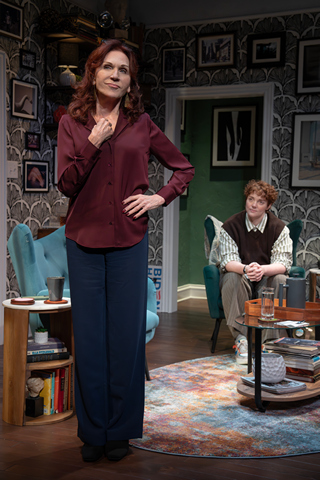
Marilu Henner and Shannon Purser in a scene from Matthew Freeman’s “The Ask” at Theater 555 (Photo credit: Joan Marcus)
The designers collectively establish the social world in which this battle can unfold without turning Greta’s wealth into a distracting display. Craig Napoliello’s set confines the action to a carefully furnished section of an Upper West Side apartment, its photographs, coffee-table books, and casually positioned artwork suggesting a life of cultivated comfort and considerable means. The room’s limited footprint is theatrically useful: for all Greta’s resources, the confrontation takes place within a narrow domestic enclosure from which neither participant can easily escape the conversation. Nicole Wee’s costumes make the generational contrast immediately legible. Greta’s sleek, richly colored clothing and expressive boots suggest the self-assurance of a woman whose identity was shaped by an earlier era of feminist rebellion, while Tanner’s looser, more understated attire reflects a different relationship to gender presentation and professional authority.
Venus Gulbranson’s lighting keeps the actors’ expressions accessible, allowing the slightest disturbance in their carefully managed faces to register, though the occasional shifts toward warmth announce their intentions a little too emphatically. Ben Scheff’s sound design uses Greta’s persistently interruptive phone to evoke the intrusions of contemporary life, then introduces the city’s ambient noise more noticeably as the meeting approaches its end, reminding us that the intimate world of the apartment exists within a larger society neither character can control. Together, these contributions provide a persuasive environment for a play whose principal action takes place in language, silence, and the small physical gestures that expose what its characters cannot quite bring themselves to say.
What ultimately makes The Ask worthwhile is its recognition that generational conflict on the left cannot be reduced to a contest between enlightened youth and benighted elders, or between principled veterans and fashionable newcomers. Greta has advantages that Tanner does not, but Tanner also belongs to a professional and cultural world that Greta increasingly struggles to understand. Each generation can mistake its own vocabulary for the natural language of justice; each can become so absorbed in correcting the other that it loses sight of the common commitments that made the argument possible. Freeman’s play is especially resonant in a country where enormous intergenerational transfers of wealth are anticipated even as older Americans continue to exercise considerable influence over the institutions their heirs will eventually inherit.
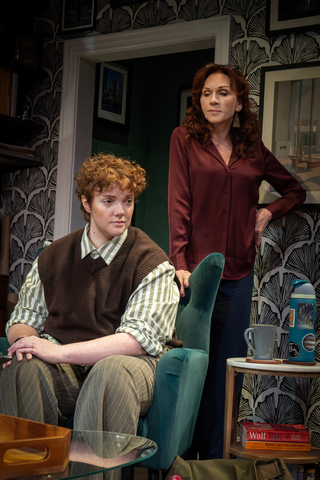
Shannon Purser and Marilu Henner in a scene from Matthew Freeman’s “The Ask” at Theater 555 (Photo credit: Joan Marcus)
The question is not simply who will control that money, but what happens when the values attached to it no longer align with the priorities of those expected to receive it. Hill’s production does not turn every exchange into a dramatic explosion, and its measured pace occasionally leaves the conflict simmering longer than necessary. But Henner and Purser give the encounter a human texture that keeps it from becoming an abstract argument about terminology, philanthropy, or generational resentment. In Greta’s wounded insistence and Tanner’s painstaking diplomacy, the play finds something more enduring than a debate over the correct language of political solidarity: the difficult, often uncomfortable effort to remain connected to a cause when the people carrying it forward no longer seem to recognize you.
The Ask (through November 22, 2026)
Theater 555, 555 West 42nd Street, in Manhattan
For tickets, visit http://www.theaskplay.com
Running time: 90 minutes without an intermission


Leave a comment