
Burning Leaves
A tender, beautifully acted drama about the transformative power of theater, the courage to embrace identity, and the delicate boundaries of human connection.
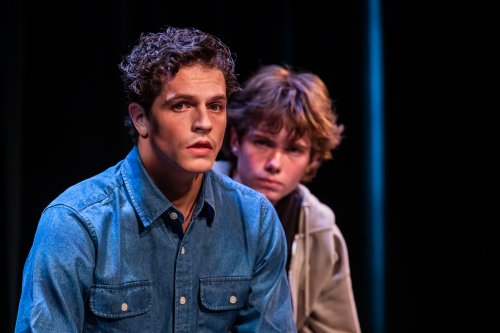
Brady Dalton Richards and Campbell Idol in a scene from The Other Side of Silence (TOSOS) production of Tom Rowan’s “Burning Leaves” at The Jeffrey and Paula Gural Theatre at A.R.T./New York Theatres (Photo credit: Mikiodo)
In Tom Rowan’s Burning Leaves, a play of considerable tenderness and moral complexity, the distance between being someone’s inspiration and becoming someone’s responsibility proves both exhilarating and perilous. Presented by The Other Side of Silence (TOSOS), the long-running LGBTQIA+ theater company whose work has consistently illuminated lives too often pushed to the margins, this production finds an abundance of humanity in a story about a young teacher, a vulnerable teenager, and the sometimes treacherous territory between emotional intimacy and professional obligation. Set in 2007, in a small Illinois town where acceptance of gay identity is hardly a civic virtue, the play examines what it means for a young person to encounter, perhaps for the first time, an adult who makes a more expansive future seem imaginable. Its achievement lies in recognizing that the need for such a connection is real, even as the consequences of acting upon it can be devastating.
Rowan has a gift for constructing characters whose contradictions emerge naturally from their speech, behavior, and competing needs. Matt Leland, a gay actor who has abandoned a nascent New York career to teach theater in Pittsville, arrives at his new position with more enthusiasm than self-assurance, a tendency toward inadvertent profanity, and a past he would prefer to leave undisturbed. Lodging with Jane Potter, the school’s guidance counselor, and her teenage daughter, Hallie, he discovers a classroom of students hungry for the possibilities that theater might offer. Among them is Jesse Wade, a 16-year-old whose artistic promise is matched by profound emotional distress. Having lost his mother to cancer, survived a suicide attempt, and endured the hostility of his homophobic father, Jesse has retreated into himself. Matt’s recognition of his talent begins to unlock something in the boy, and a theater excursion to Chicago gives Jesse the occasion to articulate feelings that have previously been too frightening to acknowledge. When Matt discovers Jesse’s candid confession in a drama journal, the resulting confrontation opens a door neither is entirely prepared to walk through. Rowan understands the dramatic power of withheld information, but his writing is equally effective when it permits a character to speak with startling, unguarded frankness.
Graydon Gund’s direction gives the play a fluidity that allows its various strands—coming-of-age drama, romantic disappointment, domestic tension, and small-town political conflict—to inform one another without losing their individual force. He recognizes that the central relationship cannot be reduced to a simple contest between propriety and desire: Matt’s responsibility to Jesse is inseparable from the teenager’s desperate need to be seen, while the teacher’s own loneliness makes the emotional demands of his new life more complicated than he initially acknowledges. Gund also gives the ensemble room to develop a persuasive sense of community, one in which even apparently incidental disagreements acquire consequence.
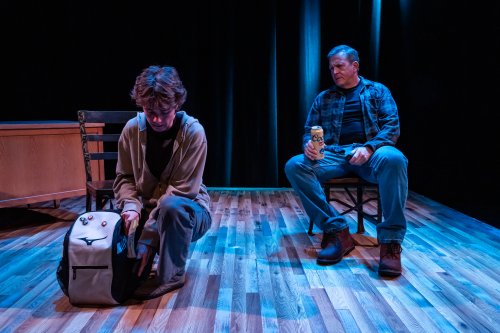
Campbell Idol and Jonathan Stewart in a scene from The Other Side of Silence (TOSOS) production of Tom Rowan’s “Burning Leaves” at The Jeffrey and Paula Gural Theatre at A.R.T./New York Theatres (Photo credit: Mikiodo)
The town’s debate over a proposed nuclear power plant, promising employment to an economically struggling population while threatening its inhabitants and environment, offers a parallel study in the costs of belonging. Matt has his students interview residents on opposing sides of the controversy and transform their findings into an original theatrical production. The project gives Hallie an opportunity to exercise her political convictions and writing abilities, while exposing Alicia, a classmate intent on starring in the school’s musical, to the frustration of discovering that a production may have purposes beyond showcasing her talents. When Alicia retaliates against Matt with false accusations, the play’s questions about power, prejudice and the vulnerability of those who fail to conform acquire an especially painful urgency.
As Matt, Brady Dalton Richards gives a performance of unusual delicacy, making his nervous mannerisms and slightly beleaguered cheerfulness expressions of a man attempting to persuade himself that he has successfully begun again. His Matt is generous without being saintly, awkward without becoming a caricature, and instinctively attentive to the students whose abilities he recognizes before they recognize them in themselves. Richards also makes palpable the attraction Matt initially inspires in Jane, the affection he develops for her daughter, and the alarm that accompanies his growing investment in Jesse’s future. Yet the performance’s greatest strength may be its gradual revelation of the grief and damage concealed beneath Matt’s affability. He has left New York for reasons that remain obscure until he finally explains himself to Jesse in the second act. Rowan gives him a monologue of devastating candor, and Richards delivers it with a restraint that allows the magnitude of the disclosure to register without theatrical embellishment. The scene becomes more than an explanation of a character’s past: it reveals the loneliness that has shaped his present and makes his desire to help Jesse at once more understandable and more fraught.
Campbell Idol is equally compelling as Jesse, tracing the young man’s movement from near-paralyzing isolation toward the tentative discovery that his identity need not be a source of shame. Idol conveys the character’s pain without making suffering his sole defining characteristic; Jesse’s awkwardness, intelligence and developing artistic confidence remain visible even when fear threatens to overwhelm him. Theater gives him a language for emotions he has scarcely permitted himself to name, and his encounter with Shakespeare—particularly the resonance of Hamlet’s meditation on existence—becomes part of his struggle to understand his own life.
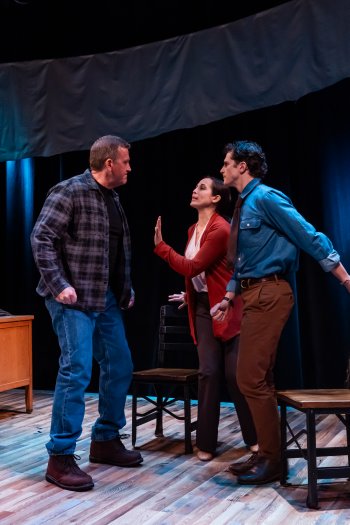
Jonathan Stewart, Annemarie Rosano and Brady Dalton Richards in a scene from The Other Side of Silence (TOSOS) production of Tom Rowan’s “Burning Leaves” at The Jeffrey and Paula Gural Theatre at A.R.T./New York Theatres (Photo credit: Mikiodo)
Idol makes Jesse’s growing openness feel neither automatic nor conveniently redemptive. Each small advance seems to require a fresh expenditure of courage, and the actor’s gradual relaxation into his own personality is moving precisely because it never suggests that one sympathetic adult can simply erase years of hurt. The rapport between Idol and Richards supplies the production with its emotional center. Their scenes are animated by genuine curiosity and affection, but also by an uncertainty that keeps their bond from becoming an uncomplicated fantasy of rescue. The play’s most consequential question is not whether Matt can help Jesse, but how he can do so without confusing the young man’s need for guidance with an obligation to satisfy every emotional need he brings to him.
Annemarie Rosano as Jane Potter contributes a welcome complication to the household’s emotional life. Initially drawn to Matt, she approaches him with a mixture of warmth, flirtation, and the practical generosity of someone accustomed to managing a family and a school community largely on her own. Rosano makes Jane’s disappointment at discovering that Matt is gay entirely human, but she does not soften the prejudices that surface after he confides in her. Her eventual response to Alicia’s allegations demonstrates how readily affection and ethical conviction can buckle under social pressure. The performance is particularly effective because Jane is neither an obvious villain nor an infallible guardian of the young people in her care; she is a person whose better instincts must contend with assumptions she has not fully examined.
Sophie Tananbaum gives Hallie a spirited intelligence and a refreshing impatience with the limitations imposed by her surroundings. Politically engaged and increasingly confident in her own writing, Hallie helps shape the student production and proves a loyal ally to Jesse and Matt when their positions become precarious. Becky Rusch makes Alicia’s self-absorption and theatrical ambition an active source of conflict rather than a collection of adolescent mannerisms, while Jonathan Stewart supplies a chilling counterweight as Jesse’s father, Carl, an unemployed construction worker whose aggression and homophobia expose the bleakness of the environment from which his son is trying to escape. Together, the supporting performers establish a community whose tensions feel specific rather than merely illustrative.
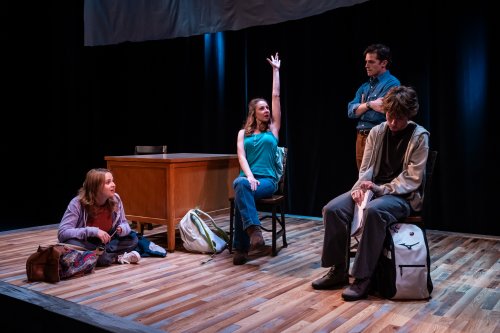
Sophie Tananbaum, Becky Rusch, Brady Dalton Richards and Campbell Idol in a scene from The Other Side of Silence (TOSOS) production of Tom Rowan’s “Burning Leaves” at The Jeffrey and Paula Gural Theatre at A.R.T./New York Theatres (Photo credit: Mikiodo)
The design team serves Rowan’s intimate drama with an economy that proves well suited to its changing locations and shifting emotional temperatures. Evan Frank’s scenic design relies on a spare platform and a few pieces of furniture, allowing a desk and chairs to suggest the classroom, school offices, and Potter household, while a rearrangement can evoke Matt’s car. Projections on a broad expanse of fabric help establish place and atmosphere, but also extend the theatrical world created by the students, most memorably when Jesse’s engagement with Hamlet acquires a significance beyond the school assignment. Reesa Graham’s props include a pocketknife whose presence lends an unsettling material dimension to Jesse’s distress. David Castaneda’s lighting and Morry Campbell’s sound design distinguish locations and changes in mood without overwhelming the action, while Ricky Lurie and Q Le’s costumes situate the characters within the period and their respective social worlds. The production’s modest physical vocabulary is an asset: it directs attention toward the actors and makes the act of theatrical creation, so central to the story, part of the production’s own expressive logic.
Burning Leaves ultimately succeeds because it treats the search for acceptance as both a private struggle and a public responsibility. Its nuclear-plant subplot broadens the drama’s concerns beyond sexual identity, suggesting that a community’s treatment of its most vulnerable members is connected to the larger question of whose well-being it is willing to sacrifice for comfort, convention, or economic necessity. The play does not pretend that compassion eliminates boundaries, or that good intentions invariably protect those who act upon them. Instead, Rowan and Gund ask what meaningful mentorship demands of the mentor, what courage costs the person who must risk being known, and how easily fear can turn a potentially transformative relationship into a source of danger.
Richards and Idol give those questions extraordinary emotional immediacy, supported by an ensemble that understands the damage prejudice can inflict even when it presents itself as ordinary common sense. In the image of fallen leaves gathered and burned, the title offers a quiet suggestion of both loss and renewal. The past cannot simply be discarded, but its remnants may become the material from which something new is made. This production leaves its audience with the hope that the connections capable of helping young people imagine a life beyond their immediate circumstances might also inspire the adults around them to become worthy of the trust they are given.
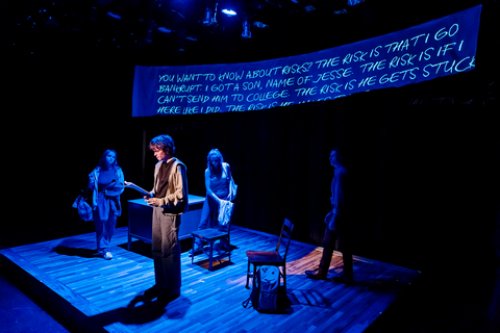
Sophie Tananbaum, Campbell Idol, Becky Rusch and Brady Dalton Richards in a scene from The Other Side of Silence (TOSOS) production of Tom Rowan’s “Burning Leaves” at The Jeffrey and Paula Gural Theatre at A.R.T./New York Theatres (Photo credit: Mikiodo)
Burning Leaves (through October 17, 2026)
The Other Side of Silence (TOSOS)
The Jeffrey and Paula Gural Theatre at A.R.T./New York Theatres, 502 West 53rd Street, in Manhattan
For tickets, visit http://www.tososnyc.org
Running time: two hours and 15 minutes including one intermission


Leave a comment