
benevolent
Sophie McIntosh and Nina Goodheart turn female confinement into riveting theater, with four superb performances balancing wit, danger, desire and heart.
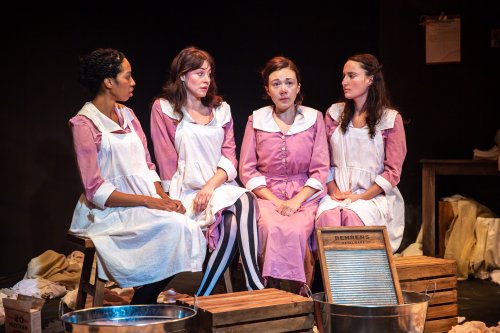
Mia Fowler, Chani Reese, Livvy Marcus and Rachel Ravel in a scene from Sophie McIntosh’s “benevolent” at IATI Theater (Photo credit: Nina Goodheart)
In benevolent, Sophie McIntosh turns a basement laundry room into a small theater of female confinement, where the dirty linens of respectable New York become both literal evidence and metaphorical residue. Set in 1917 at the fictional Inwood Benevolent Home, a reformatory modeled on the city’s historical Magdalene institutions, the play places four young women on a “soiled shift,” scrubbing blood, excrement, and other unmentionable traces from the underwear of people who will never have to touch their own filth. McIntosh’s subject is grim—sexual exploitation, class privilege, racial inequality, pregnancy, institutional punishment—but her method is anything but dour. With Nina Goodheart’s richly calibrated direction, benevolent becomes a remarkably nimble comedy-drama about women discovering one another beneath the categories that society has imposed upon them.
McIntosh has made a particular specialty of using genre as a means of approaching female interiority, and benevolent may be her most assured exercise yet. She initially seems to arrange her quartet according to the almost fairy-tale logic of “good,” “incorrigible,” “ruined,” and “bad”: Abby (Livvy Marcus), a sheltered 17-year-old from a wealthy family; Sarah (Rachel Ravel), a Coney Island singer imprisoned for soliciting donations; Emma (Mia Fowler), a Black former sex worker repeatedly caught in the machinery of the law; and Margaret (Chani Reese), a worldly white prostitute whose clientele once afforded her considerably more protection and money than Emma could command. Yet McIntosh steadily dismantles those easy distinctions. Each woman is both victim and agent, both constrained and capable of constraint, and the play’s deepest intelligence lies in refusing the comforting fiction that oppression automatically produces solidarity.
The four actresses make these distinctions vividly, never turning their characters into social types. Reese gives Margaret the evening’s most immediately magnetic performance, finding beneath her wisecracks and practiced sensuality a woman who has learned to survive by making cynicism useful. Her Margaret is debauched without being a caricature, funny without becoming glib, and unexpectedly tender in her attraction to Sarah. Ravel meets her with a beautifully modulated performance as Sarah, whose irreverence masks both uncertainty and an almost touching faith in the possibility that friendship might survive beyond the institution’s walls. Their growing intimacy has the spontaneous awkwardness and genuine erotic charge of something neither woman quite knows how to name.
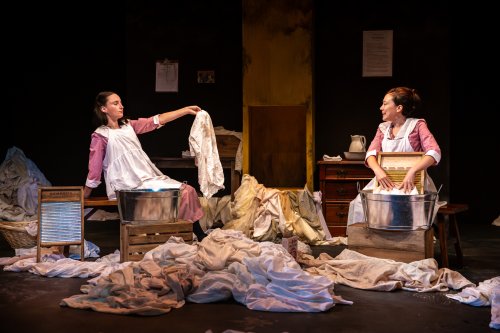
Rachel Ravel and Livvy Marcus in a scene from Sophie McIntosh’s “benevolent” at IATI Theater (Photo credit: Nina Goodheart)
Fowler’s Emma is quieter, and all the more affecting for it. There is an almost managerial competence to her: she knows how the laundry works, how pregnancy can be ended, how institutions operate, and how much information it is prudent to reveal. Yet Fowler gradually lets the character’s composure fracture, exposing the trauma beneath Emma’s practical intelligence and the complicated hopes she invests in the possibility of a permanent position at the home. Her history as a Black woman whose economic circumstances have forced her into prostitution gives McIntosh’s examination of class and sex work an essential racial dimension, and Fowler makes Emma’s contradictions feel lived rather than programmatically supplied.
Marcus, meanwhile, performs an extraordinary transformation as Abby. Initially she is almost comically unsuited to the basement, a privileged child treating incarceration as an educational excursion before returning to her wealthy family and, she imagines, eventually taking over the very institution that has confined her. Marcus plays the girl’s innocence for laughs without ever making her foolish. Her physicality changes as Abby’s understanding of herself and the dangers surrounding her deepens; the neat ringlets, the pristine white tights, and bright assumptions of childhood gradually give way to something harder won. When the play forces her to confront the violence implicit in her own supposedly protected life, Marcus gives the revelation a crystalline, devastating force.
Goodheart’s direction is the indispensable fifth performance. Having directed McIntosh’s previous three premieres, she understands how to let the playwright’s tonal volatility become an asset rather than a liability. The production can move from a joke about the provenance of a revolting stain to erotic discovery, from buddy-comedy banter to genuine horror, without treating any of those registers as a betrayal of the others. Goodheart allows the 100-minute play room to breathe, even permitting transitions to linger for the sheer pleasure of remaining with these women. The result is a claustrophobia that never becomes static: the basement seems simultaneously to shrink around them and expand into an entire social universe.
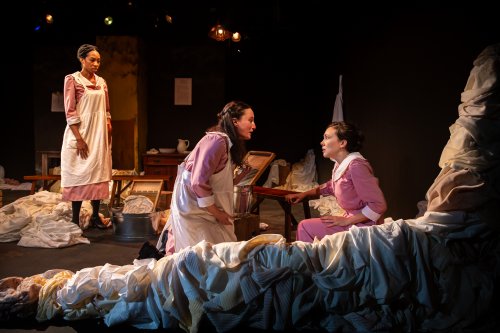
Mia Fowler, Rachel Ravel and Livvy Marcus in a scene from Sophie McIntosh’s “benevolent” at IATI Theater (Photo credit: Nina Goodheart)
That tonal intelligence becomes particularly potent in McIntosh’s treatment of the body. The screams of another inmate laboring somewhere above them haunt the play from its opening moments, while pregnancy becomes an ever-present threat, touching each woman differently. Margaret and Emma possess hard-earned knowledge of unwanted pregnancy; Sarah knows what desperation has driven women in her family to do; Abby, whose mother died in childbirth, experiences the prospect with primal terror. When pregnancy finally becomes immediate rather than theoretical, McIntosh constructs the ensuing crisis with the precision of a thriller, even as she mischievously continues to subvert our expectations. The play can make a washboard erotic, an abortion terrifying, and a pile of bloody laundry grotesquely comic without losing sight of the human stakes.
The production’s designers complete this world with unusual tact. Junran “Charlotte” Shi’s set, dominated by a laundry chute and mountains of linen, makes the basement feel both prison and installation, while the real water in the tubs and the periodic arrival of fresh garments make labor seem endless. Paige Seber’s lighting gives the dingy room an unexpected warmth; Saawan Tiwari’s period costumes differentiate the women even within their institutional pink uniforms, from Margaret’s daring stockings to Abby’s carefully arranged innocence; and Max Van’s sound design turns dripping pipes, wet fabric, and distant screams into an atmospheric score. The effect is not decorative but enveloping: the audience, like the women, seems unable to get out.
What makes benevolent so moving is McIntosh’s refusal to make its heroines exemplary. They betray one another. They misunderstand one another. They protect themselves at one another’s expense. Their sisterhood is real precisely because it is imperfect, and Goodheart’s staging never sentimentalizes it. Beneath the 1917 setting is a disturbing recognition that the mechanisms of bodily and social control have hardly vanished; they have merely changed their vocabulary. Yet the play does not reduce its women to symbols of historical oppression. Through Reese, Ravel, Fowler, and Marcus—and through McIntosh’s sharply observed writing and Goodheart’s exquisitely judged direction—they become four unruly, funny, frightened, desirous, contradictory human beings. benevolent understands that the most radical thing a reformatory can deny a woman is also the thing this splendid production gives back to its characters: the right to be complicated.
benevolent (through September 5, 2026)
Good Apples Collective
IATI Theater, 64 East 4th Street, 2nd floor, in Manhattan
For tickets, visit https://www.goodapplescollective.com/benevolent
Running time: one hour and 40 minutes without an intermission


Leave a comment