
The Cherry Orchard (LG Arts Center SEOUL)
A dazzling Korean reinvention of Chekhov is a great fit as it crackles with wit, dazzling performances, sumptuous design, and vivid contemporary resonance.
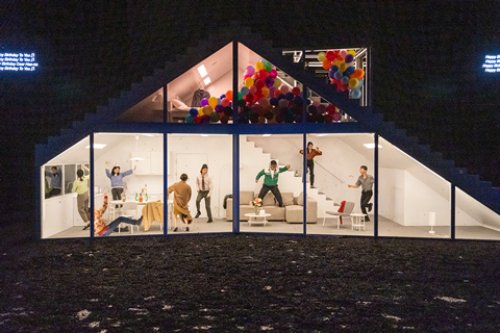
The cast of the LG Arts Center SEOUL production of Anton Chekhov’s “The Cherry Orchard” at the Park Avenue Armory (Photo credit: Stephanie Berger)
What playwright and director Simon Stone does with The Cherry Orchard is less a conventional modernization than a cultural transplant: Anton Chekhov’s doomed Russian estate becomes a glittering Korean corporate dynasty, and the old anxieties about inheritance, class, obsolescence, and the inability to recognize that history has moved on to acquire the glossy, feverish atmosphere of a contemporary K-drama. Produced by LG Arts Center Seoul and arriving at the Park Avenue Armory after engagements in Seoul, Busan, Hong Kong, Singapore, and Australia, Stone’s nearly three-hour reinterpretation retains the skeleton of Chekhov’s 1904 play while replacing its landed aristocracy with a Korean chaebol family whose sprawling business empire—cars, technology, hospitality, medical supplies, “and anything else from which money can be made”—is staggering toward collapse. The result is exuberantly theatrical, unexpectedly funny, and alive to the strange comedy that Chekhov always understood could coexist with catastrophe.
The premise is deliciously simple. Song Do-young, the widowed matriarch, has returned from an extended, alcohol-soaked stay in New York with her younger daughter, Hae-na, to the family’s architectural showpiece, a spectacular glass house outside Seoul. The company is hemorrhaging money; thousands of workers are protesting outside; and Hwang Doo-sik, the family’s worldly young neighbor and a self-made technology mogul, arrives with the inconvenient news that the dynasty cannot continue pretending that its wealth is inexhaustible. Doo-sik is the son of the family’s former chauffeur, making his rise a pointed contemporary equivalent of Chekhov’s Lopakhin. The family knows he is probably right. What they cannot imagine is a future in which they are no longer at its center.
The transformation of Chekhov’s social world into that of the chaebol is especially fertile. These are not merely wealthy people with a failing business but members of a dynasty whose identity has become inseparable from the institution they inherited. Do-young’s older daughter, Hyun-sook, occupies a senior position within the company but remains mysteriously powerless; Hae-na has returned from studying film in New York with an appropriately Chekhovian fascination with a dead bird; Do-young’s brother, Jae-young, has little interest in running the empire and considerably more interest in his vintage record player; and the household’s younger generation drifts between romantic entanglements, ambition, idealism, and bewilderment. Even the servants have been transformed with characteristic ingenuity, producing a buoyant romantic subplot involving the chauffeur, the secretary, and the outspoken young housemaid.
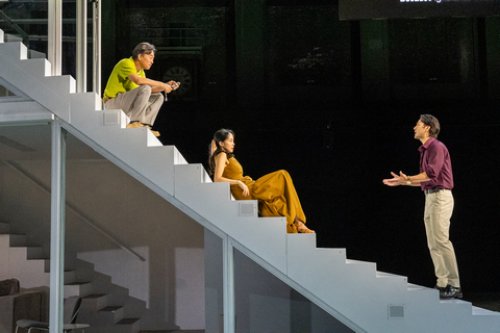
Son Sang-kyu, Jeon Do-Yeon and Park Hae-soo in a scene from the LG Arts Center SEOUL production of Anton Chekhov’s “The Cherry Orchard” at the Park Avenue Armory (Photo credit: Stephanie Berger)
Park Hae-soo gives Doo-sik the kind of star turn that makes an adaptation’s conceptual machinery seem almost effortless. Best known to American audiences for Squid Game, Park brings something more interesting than mere authority to the young entrepreneur: a trace of loneliness beneath the polish, as though every achievement has failed to erase the memory of where he began. At first, he approaches the Songs with disarming geniality, almost tenderly explaining the financial realities they refuse to confront. But as the family’s resistance hardens, so does he, and Park lets the character’s latent steel emerge with thrilling precision. His Doo-sik is simultaneously an outsider, a would-be insider, a romantic, and the embodiment of an economic order that has already arrived. His scenes crackle because Park never reduces him to the obvious symbol of upward mobility; he remains a man with desire, pride, affection, and something to prove.
Son Sang-kyu, meanwhile, finds an unexpectedly ravishing comic path through Jae-young, Do-young’s older brother. His character is a modern reincarnation of Chekhov’s Gayev, except that the old bookcase has been replaced by a beloved portable record player. Son treats this object with the reverence of a priest attending to a relic, transforming what could have been a throwaway modernization into a miniature portrait of a man desperately preserving a world that is disappearing around him. There is something almost unbearably sweet about his Jae-young: a ridiculous, privileged, profoundly sheltered man whose helplessness becomes touching precisely because Son refuses to play it merely for laughs. His clowning has a melancholy undertow, and his physical expressiveness makes him one of the production’s great sources of comic oxygen.
Jeon Do-yeon is magnificent as Song Do-young, the Korean Ranevskaya, entering her glass kingdom as though she were returning to a party that has been waiting indefinitely for her arrival. Jeon gives the matriarch a volatile mixture of charm, selfishness, erotic recklessness, maternal damage, and almost pathological refusal to contemplate consequences. She can turn from seduction to wounded innocence in the space of a sentence, and from hilarity to devastation without announcing the transition. That she is capable of pursuing her daughters’ romantic interests only makes her more fascinating: Do-young is not simply irresponsible but constitutionally incapable of understanding the emotional wreckage created by her appetites. Jeon plays her not as a monster but as a woman who has mistaken perpetual motion for freedom. The performance gives Stone’s adaptation its emotional center.
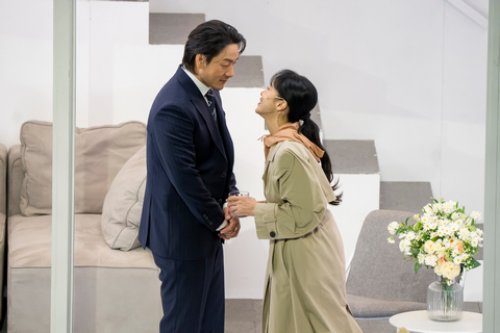
Park Hae-soo and Jeon De-yeon in a scene from the LG Arts Center SEOUL production of Anton Chekhov’s “The Cherry Orchard” at the Park Avenue Armory (Photo credit: Stephanie Berger)
And Simon Stone proves himself an unusually instinctive Chekhovian by understanding that fidelity need not mean antiquarianism. He preserves the architecture of the original—the return home, the impending financial disaster, the younger generation’s impatience, the doomed household, the changing seasons, the sale, the departure—while rebuilding its social machinery from the ground up. His dialogue, translated into Korean by dramaturg Yi Dan-bi and presented through English supertitles, is fleet, crisp, comic, and wonderfully conversational. Stone also understands something that productions of The Cherry Orchard sometimes forget: Chekhov’s comedy is not an interruption of the tragedy but one of its engines. Even with a doomed company, collapsing fortunes, frustrated children, and thousands of workers at stake, people continue to flirt, drink, bicker, dance, boast and behave absurdly. The laughter is therefore not a betrayal of Chekhov but a way into him.
Stone’s great achievement is to make the old play feel newly legible without sanding away its strangeness. The Song family’s corporate wealth connects the drama to the particular history of South Korean conglomerates, while the family’s emotional paralysis remains unmistakably Chekhovian. Their problem is not simply that they are losing money; it is that they cannot conceive of themselves without the structures that produced their privilege. The past has become a kind of luxury prison. By the time the family begins to understand what is happening, the future has already been sold.
The supporting ensemble gives this corporate Orchard its wonderfully unruly human density. Moon Choi makes Hyun-sook’s frustrated competence palpable, a woman who can diagnose the family’s predicament but cannot wrest control from the people who created it. Lee Ji-hye brings Hae-na a beautifully offbeat mixture of sophistication and vulnerability, while Nam Yun-ho’s Byun Dong-lim supplies the household with its idealistic conscience, a perpetual student who would like to convert Doo-sik’s capitalist energy into something more humane. Park Hee-jung, Lee Ju-won, and Lee Se-jun turn the servant love triangle into a miniature romantic comedy, and the entire ten-member company has the rare ability to sustain Stone’s heightened style without losing the sense that these people have lives beyond the plot.
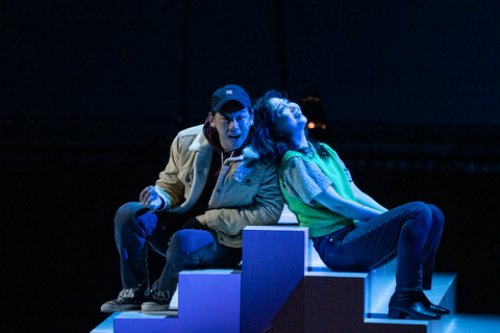
Nam Yun-ho and Lee-Ji-hye in a scene from the LG Arts Center SEOUL production of Anton Chekhov’s “The Cherry Orchard” at the Park Avenue Armory (Photo credit: Stephanie Berger)
Saul Kim’s scenic design is itself a kind of dramaturgy. In place of Chekhov’s orchard, Kim gives us an enormous, gleaming, multilevel glass house, its white triangular architecture rising in stepped planes like a futuristic mountain—or, viewed from another angle, the skeleton of some magnificent creature approaching extinction. Characters climb its surfaces, disappear behind its transparent walls, gather on its terraces, and survey the diminishing empire below them. The glass is both luxury and exposure: the Songs live inside an architectural trophy that simultaneously displays and imprisons them. With James Farncombe’s lighting, the structure becomes a shifting emotional landscape, capable of glowing with seductive warmth before being swallowed by darkness, saturated reds, icy blues, or a startling storm of black snow. The absence of literal cherry trees becomes almost beside the point. The orchard has become the house itself, and the house has become a metaphor for everything the family cannot bear to lose. Mel Page’s costumes quietly complete the contemporary Korean corporate world, while Jang Young Gyu’s music and sound design add an atmospheric pulse beneath the comedy and impending collapse.
The production’s Korean identity is never decorative. It is embedded in the rhythms of the language, the social hierarchy, the business culture, the family dynamics, and the particular historical weight carried by land, inheritance, and collective memory. One of the most intriguing ideas arrives almost in passing, when the orchard is connected to Koreans who died under Japanese occupation. The remark opens a startling subterranean dimension to Stone’s adaptation, suggesting that an orchard can signify not merely private property but ancestral memory, national trauma, dispossession, and the ghosts attached to the land itself. Stone wisely does not belabor the point. It lingers like an image glimpsed through glass.
And then there is the comedy, which may be the production’s most delightful surprise. The Cherry Orchard has often been treated as a solemn monument, but Stone remembers that Chekhov himself insisted on its comic nature. Here, the jokes move through the production with the velocity of gossip, and the actors attack them with an almost musical sense of timing. The play’s extravagance—the glass architecture, the corporate dynasty, the doomed romances, the vintage technology, the drunken parties, the philosophical arguments, the absurdly intimate family quarrels—never feels like an attempt to make Chekhov fashionable. Instead, it reveals how naturally his characters migrate into the present. They are still vain, frightened, loving, ridiculous, hopeful people watching one world disappear while insisting that another cannot possibly replace it.
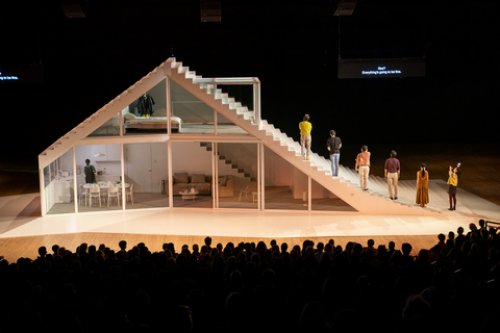
The cast of the LG Arts Center SEOUL production of Anton Chekhov’s “The Cherry Orchard” at the Park Avenue Armory (Photo credit: Stephanie Berger)
The Armory’s enormous Drill Hall gives the production an almost mythic scale, while simultaneously creating a fascinating contradiction: this is ultimately a small family drama unfolding inside an architectural space vast enough to contain a city. Yet that tension only amplifies the production’s central image. The Songs have built a world larger than themselves and still cannot survive inside it. As the glass house glows against the Armory’s blackness, Stone’s The Cherry Orchard becomes less a museum-piece adaptation than a theatrical act of cultural migration, carrying Chekhov from imperial Russia into contemporary Seoul and discovering that his fundamental questions have survived the journey intact. What happens when inherited power mistakes itself for permanence? What does it mean to love a world that is already disappearing? And how do we behave when the future arrives before we are emotionally prepared to meet it? Stone and this superb Korean company do not answer those questions so much as make them shimmer, hilariously and painfully, in the glass.
The Cherry Orchard (through September 26, 2026)
Originally produced and premiered at LG Arts Center SEOUL
Co-presented by Park Avenue Armory
Co-commissioned by Adelaide Festival
Wade Thompson Drill Hall, Park Avenue Armory, 643 Park Avenue, in Manhattan
For tickets, visit http://www.armoryonpark.org
Running time: two hours and 45 minutes with one intermission


Leave a comment