
Julius Caesar (Ensemble Shakespeare Company)
Vigorous and energetic production of Shakespeare's Roman history play in the round with some debatable casting decisions.
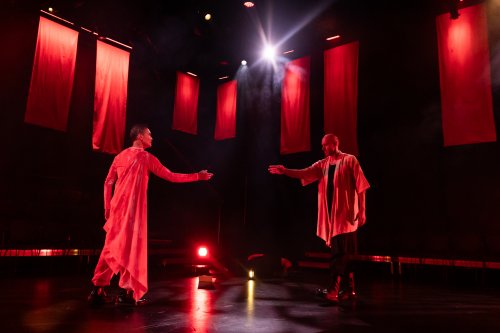
Mark Dacascos as Julius Caesar and Rob Hatzenbeller as Brutus in a scene from Ensemble Shakespeare Company’s production of Shakespeare’s “Julius Caesar” at The Flea Theater (Photo credit: Jay Evelyn Studios)
Ensemble Shakespeare Company may have found something special in its use of modern dress productions in the round to erase the distance between audiences and Shakespeare’s Elizabethan plays. Their current production of Julius Caesar performed at The Sam, The Flea’s second floor black box theater, is vigorous, exciting, easy to follow and engrossing with generally fine diction except for a few accents that are difficult to follow in Shakespeare’s blank verse.
The flaw in Dylan Diehl’s directorial design is in her attempt at non-traditional casting. In a play that has only two female characters, what is the point of casting one of them as a man? And where a character has always been played as a frat boy athlete and later has the famous affair with Cleopatra, does it make sense to cast a woman? In addition, the original genders are maintained in the dialogue so that we hear a man addressed as she and vice versa. Not that these actors did not acquit themselves well but the credibility of these roles is called into question.
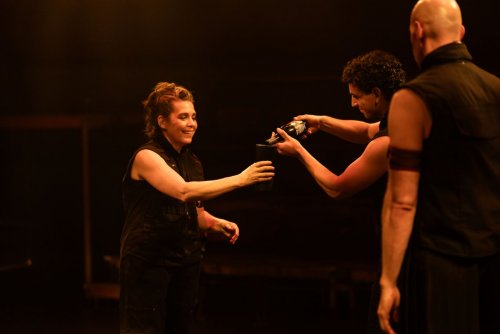
Celeste Moratti as Cassius, Diego Millan as Lucius and Rob Hatzenbeller as Brutus in a scene from Ensemble Shakespeare Company’s production of Shakespeare’s “Julius Caesar” at The Flea Theater (Photo credit: Jay Evelyn Studios)
Julius Caesar is one of those classics whose relevance keeps returning due to the political climate of the day. Its theme of political power and expediency over moral and civic responsibility remains powerful in our own time so many centuries after the Roman empire. Diehl keeps the debate over power and principle clear and accessible. Though costume designer Micaela Hecht has dressed all of the actors in white t-shirts and black pants with occasional white togas thrown over the shoulders of the senators to symbolize their rank, there is never a problem identifying the characters, partly because they are so different physically and they also differentiate their roles so well.
The well-known story is taken from Plutarch’s Parallel Lives which Shakespeare used for four of his five Roman plays. Julius Caesar returns to Rome in triumph from vanquishing the army of Pompey and is offered the crown three times by his second-in-command Marc Antony. His increasing reluctance to refuse the crown worries a group of Roman senators who are afraid that he would like to be dictator or emperor of Rome, something that was strictly forbidden. Although a soothsayer warns Caesar to “beware the ides of March,” as does his wife Calpurnia who has a dream, he ignores their advice. Senator Cassius works on another senator Brutus to get him to join a conspiracy to assassinate Caesar in the Capitol on that day, a place where Caesar’s bodyguard is not allowed to enter.
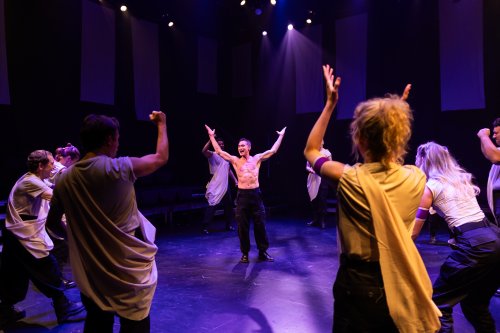
Mark Dacascos as Julius Caesar and the cast of Ensemble Shakespeare Company’s production of Shakespeare’s “Julius Caesar” at The Flea Theater (Photo credit: Jay Evelyn Studios)
After the assassination, the conspirators remain to explain to the crowd their reasons. However, when they allow Marc Antony permission to speak at his funeral, he stirs up the populace to fury. This leads to Brutus and Cassius having to fight a civil war with Marc Antony, Caesar’s adopted son Octavius and general and statesman Lepidus, who have formed a triumvirate. Brutus and Cassius have a falling out over monies to be paid to their armies but make up in time to fight the Battle of Phillippi. When they lose the battle, both men commit suicide. Marc Antony praises Brutus as the “noblest Roman of them all” as he was engaged in the conspiracy for the good of Rome rather than his own ambition.
Diehl’s direction handles the four-side space excellently so that each side of the audience has something to see. In the title role, Mark Dacascos handles the arrogance and superiority well. Strangely he appears bare-chested before the Roman crowd at one point revealing his buff physique, which suggested that he would have been better cast as the athletic Marc Antony. As Brutus, tall Rob Hatzenbeller who towers over the other actors bring a gravitas and soberness to the role of the “noblest Roman of them all.”
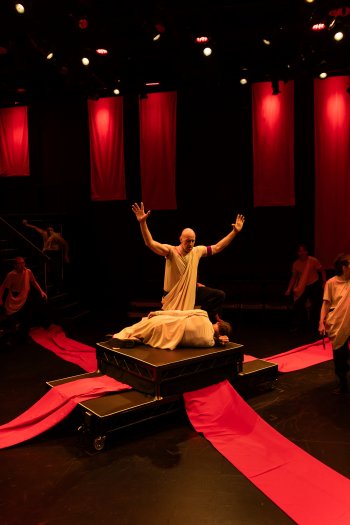
Rob Hatzenbeller as Brutus standing over the body of Caesar (Mark Dacascos) in a scene from Ensemble Shakespeare Company’s production of Shakespeare’s “Julius Caesar” at The Flea Theater (Photo credit: Jay Evelyn Studios)
Celeste Moratti as Cassius (a role usually played by a man) suggest the deviousness and slyness of this leader of the conspirators while being fiery and intense. Ella Olesen as Marc Antony offers fire and brimstone to a role usually played by a man. As Brutus’ wife Portia, Paul Marchegiani is impressively impassioned but is unaccountably is addressed as “she” but dressed as man. Erin Roth also brings poise and dignity to Caesar’s wife Calpurnia. Among the smaller roles, Gerrard Lobo as Decius, Titinius, and the Third Plebian puts his muscular physicality to good use.
The minimal design elements work well for this fluid production which is reputedly the entire text allowing the scenes to segue one into the other. Joshua Warner’s scenic design makes use of only three staircases in the corners of the space and a pedestal brought out for the assassination scene which is suitably lit in red in Annie Garrett-Larsen’s lighting plot. At other times the lighting becomes blue for moonlit scenes. Four red carpets project from the pedestal suggesting both royalty and later blood. There are also banners hanging around the space, some of which are pulled down during the riot scenes. Jacqueline Holloway’s fight direction is as energetic as the rest of the production.
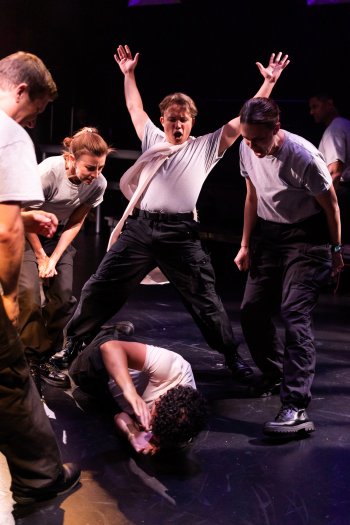
Truman Gaudoin as the Fifth Plebian and the cast of Ensemble Shakespeare Company’s production of Shakespeare’s “Julius Caesar” at The Flea Theater (Photo credit: Jay Evelyn Studios)
In its second producing year, Ensemble Shakespeare Company is offering a fine staging of Julius Caesar with some debatable casting choices. As directed by Dylan Diehl, the use of theater in the round focuses the attention center stage for all except Marc Antony’s funeral oration where he climbs up various staircases to give all a vantage to hearing him give his speech. The modern dress production adds a contemporary gloss to an ancient story which still has political relevance. Except for some minor quibbles this is a fine production for both those new to Julius Caesar and those very familiar with it.
Julius Caesar (through July 26, 2026)
Ensemble Shakespeare Company
The Sam at The Flea Theater, 20 Thomas Street, in Manhattan
For tickets, visit http://www.EnsembleShakespeareCompany.com
Running time: three hours including one intermission


Leave a comment