
Fish
A darkly comic coming-of-age tale in which teenage bravado, family grief, and online deception collide, revealing the perils of growing up in a dangerous world.
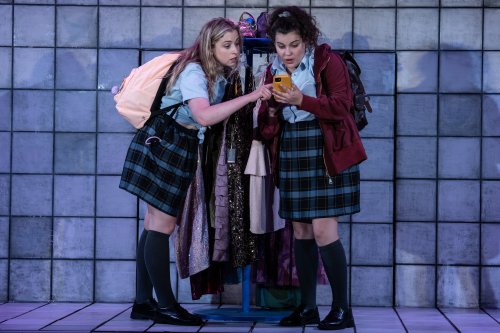
Alyssa May Gold and Yasmin Ranz-Lind in a scene from Melis Aker’s “Fish” at WP Theater (Photo credit: Joan Marcus)
Melis Aker’s Fish, sensitively directed by Tatiana Pandiani, is a darkly comic, unexpectedly tender examination of adolescence, family grief, and the perilous freedoms of the Internet, beginning with the sort of indignity that can make a 17-year-old girl feel that civilization itself has failed her: a disastrously timed menstrual period, discovered just as she is preparing to go swimming. The scene is intimate, embarrassing, funny, and faintly horrifying, establishing the territory in which Aker’s play excels, where the humiliations of an ordinary teenage existence collide with circumstances so extraordinary that the usual methods of coping—sarcasm, sexual bravado, friendship, and the occasional terrible decision—prove woefully inadequate.
Set in London in the summer of 2016, when Brexit looms and the world seems to be tilting toward a new and more openly hostile political order, Fish follows a young woman whose efforts to escape the claustrophobia of her private life lead her into an international web of radicalism, deception, and potential catastrophe. The play’s many concerns do not always coalesce as seamlessly as they might, and some of its metaphors announce themselves rather too emphatically, but its humor, emotional intelligence, and increasingly unnerving sense of danger make it a distinctive coming-of-age drama.
Aker’s protagonist, Karya, played by Yasmin Ranz-Lind, has spent the past year living in the shadow of her older brother, Emir, who disappeared without explanation. Her Turkish mother, Ceyda, has become convinced that he is alive and may have joined ISIS, a possibility she pursues after discovering an online video of masked militants in which she believes she recognizes her son. The police are unpersuaded, but Ceyda, whose maternal certainty has become almost a form of private religion, refuses to abandon the search. Karya, meanwhile, is caught between wanting the family to move forward and needing to understand what has happened herself. Her brother’s absence has become the organizing principle of the household, leaving little room for the confusion, sexual curiosity, and restless self-invention that ought to occupy a girl her age. Even her mother’s concern, however genuine, can feel like a kind of erasure. The family is grieving without knowing precisely what it has lost, suspended between hope and bereavement, while Karya struggles to establish an identity that does not depend on her missing sibling or her mother’s consuming sorrow.

Alyssa May Gold and Yasmin Ranz-Lind in a scene from Melis Aker’s “Fish” at WP Theater (Photo credit: Joan Marcus)
The playwright’s ingenious, if occasionally overextended, plot emerges from Karya’s friendship with Libby, a brash schoolmate whose confidence far exceeds her judgment. At Libby’s encouragement, Karya begins contacting ISIS-linked accounts on Twitter, initially hoping to discover something about Emir. When the search yields little, she adopts a more provocative strategy, presenting herself as a potential bride to men who promise to help her travel to Syria. The discovery that she can extract money from these would-be suitors transforms the enterprise from amateur investigation into an intoxicating exercise in power. For a girl who has felt invisible in her own home, the ability to manipulate men who regard themselves as powerful is exhilarating. What begins as a joke between friends becomes a dangerous game of financial deception, sexual performance, and ideological proximity, with consequences neither girl is equipped to anticipate. Aker has a keen ear for the merciless comedy of teenage intimacy: the competitive vulgarity, the exaggerated sophistication, the casual insults that serve as declarations of affection, and the desperate attempts to sound worldly before one has accumulated much experience of the world. Her girls can be appallingly foolish without ceasing to be recognizable, and the play’s most effective comic scenes derive their force from the unsettling proximity between adolescent mischief and genuine peril.
Ranz-Lind gives Karya a compelling mixture of defiance, anxiety, and bewildered self-assurance. Her performance captures the peculiar volatility of adolescence, when a young person can feel simultaneously invincible and mortifyingly exposed, and when the desire to be taken seriously may lead to an extravagant overestimation of one’s own abilities. Karya’s transformation from an uncertain girl seeking information into an increasingly audacious online manipulator is both amusing and alarming, not least because Ranz-Lind makes us understand how little separates the two states of being. Her expressions register thoughts that Karya herself cannot yet articulate; beneath the posturing, one senses a young woman trying to convert helplessness into agency by any means available. Ranz-Lind also makes the character’s predicament physical. Karya is acutely conscious of her body, its betrayals and possibilities, and of the way other people appear to see her. Her struggle to understand her sexuality becomes inseparable from her desire to be visible, and from the more painful question of whether being noticed is the same as being understood. The performance supplies a psychological continuity that the script occasionally leaves implicit, helping us follow Karya even when the various strands of Aker’s storytelling threaten to pull apart.
Alyssa May Gold makes Libby an entertainingly exasperating accomplice, all swagger, impatience, and adolescent certainty. She has the instincts of a natural instigator: she can turn a passing grievance into a scheme and a scheme into an adventure, secure in the conviction that somebody else will deal with the consequences. Yet Gold gives the character enough youthful vulnerability to prevent her from becoming merely the obligatory reckless friend. Her rapport with Ranz-Lind is especially effective in the girls’ exchanges about sex, bodily embarrassment, and the social hierarchies of school, where their banter moves with the speed of a game whose rules change whenever one of them appears to be losing.
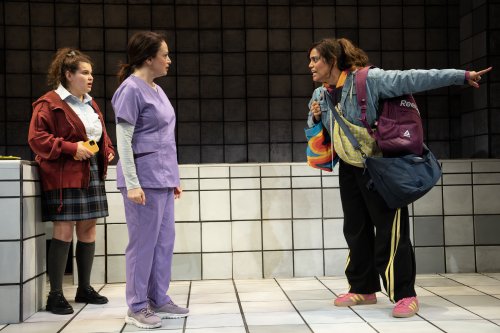
Yasmin Ranz-Lind, Roxanna Hope Radja and Sara Haider in a scene from Melis Aker’s “Fish” at WP Theater (Photo credit: Joan Marcus)
Sara Haider, as Isha, Emir’s former girlfriend, adds a cooler, more guarded presence. Isha has experiences that Karya cannot fully comprehend, including rejection by her family and exposure to prejudice and domestic violence. Haider suggests the burdens beneath Isha’s self-possession without turning her into an explanatory device for the play’s broader social concerns. The ensemble’s interplay is one of the production’s pleasures: these young women possess distinct relationships to danger, desire and belonging, even when the script occasionally places more demands on their symbolic significance than on their dramatic development.
Roxanna Hope Radja, as Ceyda, provides the play with its richest emotional counterweight. Elegant, funny, and formidable, she portrays a mother whose determination can be both loving and suffocating, whose capacity for comic exasperation coexists with an almost unbearable uncertainty about her son. Ceyda has not simply lost a child from her daily life; she has lost the possibility of knowing what has become of him, and the absence leaves her unable to distinguish hope from the refusal to accept an unimaginable alternative. Radja allows us to see how the search for Emir has consumed a woman already burdened by work, loneliness, and the responsibilities of raising a family on her own. Her attempts to enlist the police, her fixation on the video, and her insistence that she knows her son’s eyes are at once funny in their stubbornness and devastating in their desperation. Radja is particularly affecting when Ceyda’s formidable exterior gives way to a flicker of fear, or when a casual flirtation with Jon, the swimming instructor, reveals the woman beneath the maternal role. The character’s grief is not always integrated as persuasively into the play’s comic machinery as it might be, but Radja makes its emotional reality unmistakable. In her performance, Ceyda is not simply the obstacle against which Karya defines herself; she is a person struggling to remain intact while the future of her family has become impossible to imagine.
Pandiani’s direction gives Fish a brisk, assured theatricality, allowing its comedy to flourish without entirely dissipating the anxiety beneath it. Pandiani understands the absurdity of placing ordinary teenage concerns alongside the machinery of international extremism, and she finds a rhythm in the abrupt transitions between schoolgirl gossip, domestic confrontation, and online encounters that threaten to turn lethal.
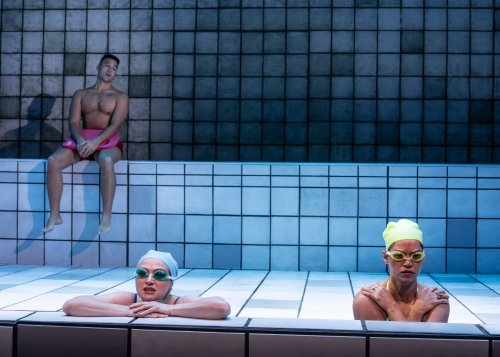
Kario Marcel, Roxanna Hope Radja and Sara Haider in a scene from Melis Aker’s “Fish” at WP Theater (Photo credit: Joan Marcus)
Kario Marcel’s Jon, the swimming instructor who becomes an object of interest to both Karya and Ceyda, offers a welcome source of grounded physical comedy and bemused patience. The swimming lessons, however, are among the play’s less convincing elements. They gesture toward Karya’s effort to acquire a new kind of confidence, Ceyda’s longing for a more expansive life, and the possibility of learning to navigate unfamiliar waters, but the aquatic symbolism can become so conspicuous that the characters seem to be swimming through an idea rather than an experience. The mother-daughter scenes around the pool sometimes suffer from a similar overstatement: their indirectness is psychologically credible, but the connection between their private tensions and the play’s wider political concerns remains intermittently elusive. Still, Pandiani handles the shifts in tone with considerable skill, and the production’s humor never entirely loses sight of the vulnerability that makes these characters worth following.
The design team gives Pandiani an imaginative physical vocabulary with which to stage the play’s rapid changes of place and emotional temperature. Emmie Finckel’s tiled, multilevel set is an especially resourceful achievement, transforming with little fuss from a family kitchen to a swimming facility, a charity shop, a school bathroom, and the other provisional spaces through which Karya moves. A narrow recess at the front of the stage allows the performers to suggest swimming in a pool that contains no water, an illusion made surprisingly persuasive by the actors’ movements and by the spatial imagination of the staging. LED-lined panels slide across the set, dividing and reframing the playing area while providing visual transitions that feel integrated into the production rather than merely functional. G Clausen’s sound design supplies the swimming scenes with the reverberant acoustics of an indoor pool, while also giving Karya’s online encounters an increasingly claustrophobic atmosphere. Working with lighting designer Reza Behjat, Clausen helps translate the digital world into theatrical terms through distorted, disembodied voices, electronic cues, and a pulsing Twitter emblem that makes the virtual environment feel both seductive and ominous. Siena Zoë Allen’s costumes convincingly locate the characters in their social world, with the girls’ clothes helping distinguish their contrasting approaches to self-presentation. Together, the designers create a fluid, sometimes startling stage environment in which the ordinary and the threatening occupy the same space.
The play’s most ambitious ideas concern the relationship between private vulnerability and public catastrophe. In 2016, Twitter was becoming an increasingly consequential instrument of political communication, even as it offered extremists a means of recruitment and propaganda; in Aker’s drama, the same medium that promises Karya access to information and a measure of control exposes her to forces she barely understands. The setting also gives the family’s predicament a wider resonance. As Britain approaches Brexit, the Turkish characters inhabit a society in which questions of immigration, national identity, and belonging are becoming more charged, while Ceyda herself is not immune to the prejudices that threaten people like Isha.
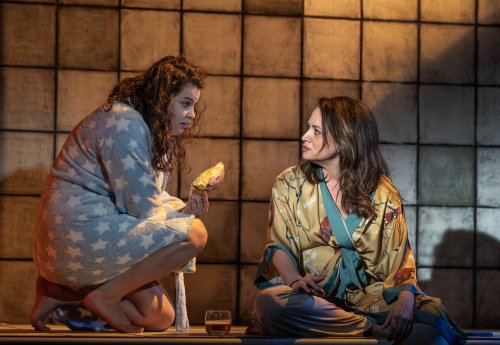
Yasmin Ranz-Lind and Roxanna Hope Radja in a scene from Melis Aker’s “Fish” at WP Theater (Photo credit: Joan Marcus)
Aker’s interest in the contradictions of womanhood is equally apparent: Karya and Libby are expected to navigate sexual scrutiny and social judgment even as they are encouraged to perform maturely, while Ceyda confronts a different set of bodily and emotional transitions. These themes do not always form a seamless dramatic argument, and the play’s presentation of online communication sometimes has the slightly dutiful quality of a theatrical demonstration, with glowing symbols and unseen voices standing in for a medium that remains difficult to dramatize. But the staging makes the danger legible, and the comedy sharpens rather than diminishes the sense of how quickly a private experiment can escape its creators’ control. In a world where digital mistakes can become permanent public records, Karya’s miscalculations carry an unnerving contemporary force.
What distinguishes Fish, finally, is its refusal to make either adolescence or grief tidy. Aker’s plot can feel overburdened by its many ambitions, and the swimming-pool motif is asked to bear more symbolic weight than it can comfortably sustain. Yet the play’s emotional generosity is considerable. It understands that a teenager’s foolishness may conceal a serious attempt to recover agency, that a mother’s obsession may be inseparable from love, and that a family can remain bound together even when its members have no idea how to speak to one another. Nor does Aker offer the cheap satisfaction of resolving Emir’s disappearance simply to close the narrative. Instead, the ending finds a more credible form of relief in the possibility that mother and daughter might begin to recognize one another again, not because their uncertainties have vanished, but because they have learned to live alongside them. The result is a comedy with a dark undertow, a portrait of young women discovering both their power and its limits, and a reminder that growing up has always involved venturing into dangerous waters. The Internet has merely made it easier for the sharks to find you.
Fish (extended through November 1, 2026)
WP Theater in a co-production with Signature Theatre Company in Association with New Light Theater Project, with consulting producer Noor Theatre
WP Theatre, 2162 Broadway, in Manhattan
For tickets, visit http://www.wptheater.org
Running time: 90 minutes without an intermission


Leave a comment