
Night of January 16th
Ayn Rand's legendary courtroom drama returns to the New York stage with members of the audience as the nightly jury.
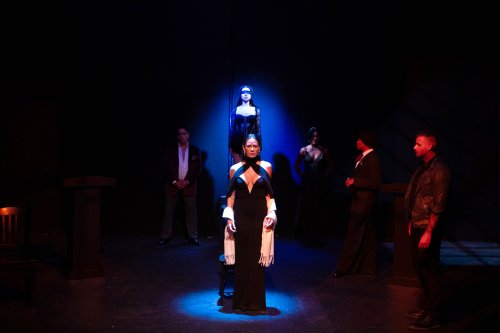
Christa B. Allen as defendant Karen Andre, backed by Gary Martins, Hannah Beemer, Maryam Basir, Prince Hamadi and Matt de Rogatis in a scene from the Ruth Stage production of Ayn Rand’s “Night of January 16th” at Theatre Row (Photo credit: Gabby Scimeca)
Ayn Rand’s trial play Night of January 16th may be melodramatic but it is a satisfying film noir for the stage. Originally written as Penthouse Legend, it was first produced in Los Angeles as Woman on Trial, then retitled with its current title by its Broadway producer in 1935. Should you know the Hollywood version, it only shares the title and the names of a few of the characters but not a line written by Rand. Its success has partly been due to the fact that the jury is chosen from the audience each night. In the current Ruth Stage revival on Theatre Row, the 15 people who buy tickets in the first row become that night’s jury. As you would expect, there are two different (brief) endings.
Night of January 16th was inspired by the life and death of Ivar Kreuger, the Swedish “Match King” who committed suicide when his business empire crashed. Rand was also influenced by Bayard Veiller’s 1927 Broadway play The Trial of Mary Dugan starring Ann Harding as a showgirl who is prosecuted for killing her wealthy lover. Whatever the impetus, the play makes use of many themes that interested Rand in all of her fiction: the superman who is above the laws the rest of us live by, the business tycoon who has it all, and the conflict between individualism and conformity, as well as her philosophy of objectivism. There are definitely characters who are prototypes of those in her later major novels The Fountainhead and Atlas Shrugged.
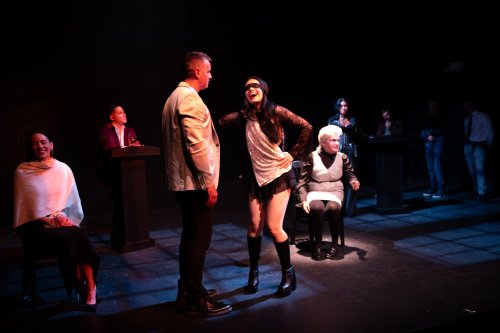
Matt de Rogatis as Bjorn Faulkner and Hannah Beemer as Lady Justice and the company of the Ruth Stage production of Ayn Rand’s “Night of January 16th” at Theatre Row (Photo credit: Gabby Scimeca)
The publicity materials for the current revival claim to radically reimagine “the courtroom thrill as a bold heightened descent into a dark, purgatorial parallel reality.” However, the production’s first act is almost expressionistic in its minimalist setting, added flashbacks, all of the actors on stage throughout the trial, and the use of an actress dressed in black lace with her eyes covered to represent Lady Justice, not a member of Rand’s original cast list. The Judge (played by director Theo Devaney) appears on a huge video screen in extreme close up like 1920s German movies. By the play’s third act, we are in the realm of realism with testimony that sounds like a 1930’s Warner Brother film for Humphrey Bogart or James Cagney. (Before writing this play Rand had worked as a junior screenwriter for Cecil B. DeMille and had sold an unproduced screenplay to Universal Studios.)
On the night of January 16th Swedish business tycoon Bjorn Faulkner (who had come to New York the year before) fell from his penthouse on the 15th floor of his Faulkner Building where he had lived with his secretary and lover Karen Andre who is accused of killing him. Hover she had been jilted by him when he married Nancy Lee Graham, only daughter of banker John Graham Whitfield, President of the Whitfield National Bank, four months before, but continued to live in the penthouse. Karen had worked for Faulkner for ten years starting in Sweden but had been fired two weeks into the marriage by orders of his wife. At the time of his death Faulkner’s company was bankrupt and it was inferred that he had defrauded it of millions of dollars (just as Kreuger had.)
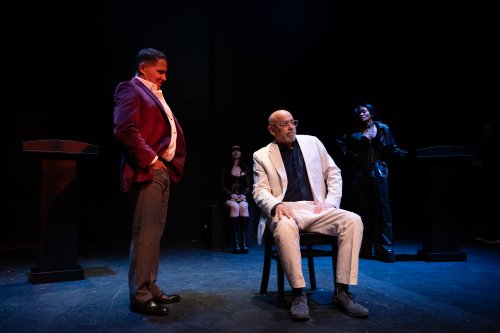
Gary Martins as Defense Attorney Stevens and Jim Kempner as John Graham Whitfield in a scene from the Ruth Stage production of Ayn Rand’s “Night of January 16th” at Theatre Row (Photo credit: Gabby Scimeca)
In the first act, District Attorney Flint (a very sexy Maryam Basir) interviews Dr. Kirkland (a serious Prince Hamadi), the building’s night watchman John Hutchins (a nervous Nelson DePasquale) who may have been the last man to see Faulkner alive, private detective Homer Van Fleet who had been hired by Mrs. Faulker the day after her wedding (a mousy Joe Pandosh), police Inspector Elmer Sweeney (a tough Milton Elliott), and Swedish housekeeper Madga Swenson who had followed Faulkner from Scandinavia (a caricaturish Bethany Lanza). All are cross examined by Defense Attorney Stevens (a smooth, self-possessed Gary Stevens).
Then a surprise witness Nancy Lee Faulkner shows up, having returned unexpectedly from California where she had been taken by her father after her husband’s death (ingenue Emily Slass). Nancy claims she and her husband had a perfect marriage and he had not been seeing Karen since her firing. She also claims that she hired the private detective not to spy on her husband but as protection as she feared a mob hit on him and thought this would deter them. As the act ends on Nancy’s testimony with a recess, Karen who has been sitting at the front of the stage near her attorney throughout states “One of us is lying. And we both know which one!” By this time the audience has probably made up their mind about Karen Andre’s guilt.
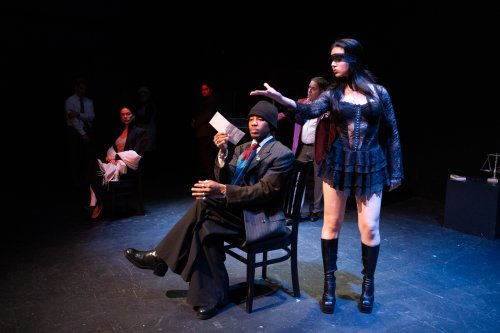
Prince Hamadi as James Chandler and Hannah Beemer as Lady Justice in a scene from the Ruth Stage production of Ayn Rand’s “Night of January 16th” at Theatre Row (Photo credit: Gabby Scimeca)
In the second act, other witnesses are called to the stand: John Graham Whitfield, Faulkner’s father-in-law who throws shade on the deceased (an aloof, haughty, imperious Jim Kempner), Police handwriting expert John Chandler (again Prince Hamadi, this time quite fey), Faulkner’s Swedish bookkeeper for eight years Siegurd Jungquist (the deft and precise Dylan Joseph Lee Catania) and finally, Karen Andre herself (a cool, calm and collected Christa B. Allen) who we find is still in love with Faulkner who she does not believe is dead. She admits her affair with Faulkner began the day she came for her interview ten years before and that she admired him for his use of power and bigger than life personality that did thing other people didn’t. And then mystery witness “Guts” Regan (suave Matt de Rogatis) appears and claims Karen is lying to protect Faulkner but it is no longer necessary. Of course, in Act Three, Regan’s testimony contradicts most of what we have heard.
Although the production works as a tense courtroom drama, many of the director’s choices are problematic. Although the widow is described as all in black, here she is in a white print dress while all the other women are in black courtesy of costume designer Alexandra Rose. Keeping the entire cast on stage throughout is at times distracting particularly when they are all asked to make eerie humming sounds. Christian Specht’s dark lighting would be more suitable for a film noir while his set made up of nothing more than two podium and two chairs is more suitable to an expressionistic film. The flashback scenes in which de Rogatis portrays a silent Bjorn Faulkner (dressed in a white suit) and Lady Justice personifies Karen Andre are actually spot on, though these were not written by Rand herself. Allen’s Karen Andre seems to be based on The Fountainhead’s Dominique Francon, cold, unfeeling and detached, a strong choice but possibly mistaken.
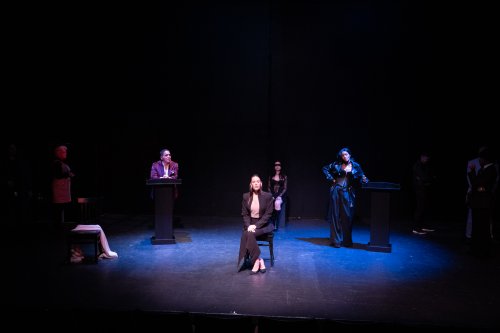
Christa B. Allen as Karen Andre and the company of the Ruth Stage production of Ayn Rand’s “Night of January 16th” at Theatre Row (Photo credit: Gabby Scimeca)
This is a rare and fascinating chance to see the rarely produced Night of January 16th on stage. The play still works as a trial drama and the extreme nature of the protagonists is still credible in the 21st century. Theo Devavey’s choices may be intrusive but the play is still allowed to wend its way to its surprising conclusion. You end up somewhere very different than you started. And of course, every night there is the increased appeal of hearing how the jury of 15 votes.
Night of January 16th (through October 18, 2026)
Theatre Five at Theatre Row, 410 W. 42nd Street, in Manhattan
For tickets, visit http://www.RuthStage.org
Running time: two hours and 25 minutes including one intermission and one pause


Leave a comment