
The Vessel
Brendan George's moving drama follows three workers patrolling a tourist attraction where every shift could end in tragedy—and friendship becomes survival.
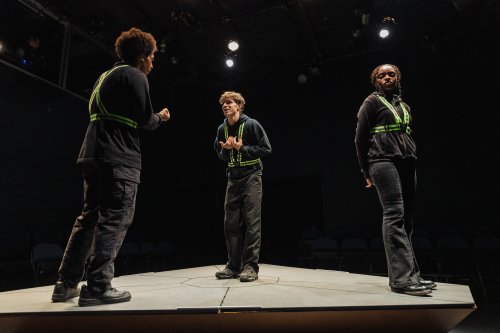
Sofonyas, Will Ingram and Anastasia Locke in a scene from Brendan George’s “The Vessel” at 59E59 Theaters (Photo credit: Jacob Ruth)
Among the more curious monuments erected during New York’s recent age of speculative excess, few have inspired as much bewilderment as the Vessel, Thomas Heatherwick’s shimmering lattice of staircases rising from Hudson Yards like an immense bronze beehive with no discernible destination. Conceived as an architectural spectacle and an Instagram landmark, it soon acquired a far darker identity after a succession of young visitors died by suicide from its elevated walkways. Brendan George’s The Vessel, now receiving an absorbing production at 59E59 Theaters from Through the Tollbooth Co. in association with Thrown Stone Theatre Company, confronts this unsettling history without succumbing to sensationalism. Rather than dramatizing death itself, George turns his attention to those condemned to inhabit its aftermath—the ordinary workers charged with preventing impossible tragedies while employed by a corporation slow to acknowledge the obvious dangers of its own creation. The result is one of the season’s most quietly devastating new American plays.
George’s accomplishment lies in recognizing that public catastrophes reverberate far beyond the headlines. His protagonists are not heroes in any conventional sense but three hourly employees earning modest wages as “Park Ambassadors,” a title whose corporate optimism barely conceals the grim reality of their assignment. They answer tourists’ questions, direct pedestrian traffic, and, above all, watch. They observe faces, gestures, pauses, and hesitations, searching for invisible signs that someone has arrived not to admire the skyline but to disappear from it. Such vigilance is psychologically exhausting precisely because it demands certainty where certainty can never exist. George understands that the deepest wounds inflicted by preventable tragedy are often borne by those who survive wondering whether a different word, glance, or gesture might have altered another person’s fate.
Peter Charney’s direction wisely refuses melodrama. He stages the play with remarkable restraint, trusting silence as much as speech and allowing emotional revelations to emerge gradually rather than announcing themselves. The production never exploits the subject of suicide for theatrical shock; instead, Charney cultivates an atmosphere of uneasy attentiveness, mirroring the emotional state of the workers themselves. Every conversation carries the faint possibility that ordinary banter may suddenly yield to crisis, and every pause acquires a terrible ambiguity. His pacing deftly balances moments of surprising humor with accumulating psychological pressure, reminding us that even people tasked with confronting unimaginable circumstances continue to joke, argue, and seek companionship simply because life insists upon itself.
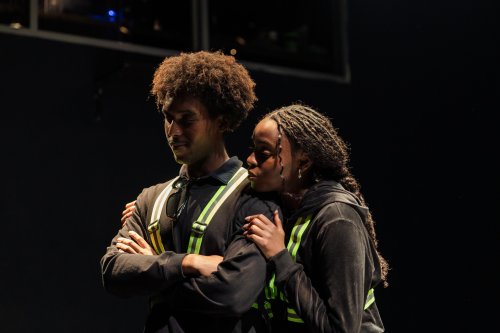
Sofonyas and Anastasia Locke in a scene from Brendan George’s “The Vessel” at 59E59 Theaters (Photo credit: Jacob Ruth)
Brendan George’s script is particularly impressive for the generosity with which it imagines its three central characters. Drake, Missy, and Viggo are not reduced to symbolic functions within a social critique but emerge as fully realized young adults attempting to construct meaningful identities inside an emotionally impossible workplace. Their conversations wander naturally through eccentric facts, awkward flirtations, philosophical speculation, and workplace gossip before circling back toward grief and responsibility. What initially appears to be casual conversation gradually reveals itself as an elaborate strategy for survival, each digression another attempt to postpone confronting experiences that language alone cannot adequately contain.
Sofonyas delivers the evening’s most commanding performance as Drake, whose quiet intelligence masks profound reservoirs of guilt accumulated long before his employment at the Vessel. Having previously worked security at an elementary school touched by violence, Drake carries trauma upon trauma, and Sofonyas communicates this burden with extraordinary subtlety. His performance possesses a remarkable stillness that continually threatens to fracture beneath its own emotional weight. Even while reciting trivia about architecture or correcting a colleague’s assumptions, one senses a man whose mind never fully escapes the possibility of catastrophe. It is an understated, deeply humane portrayal that anchors the production’s moral center.
Anastasia Locke proves equally compelling as Missy, whose buoyant exterior gradually reveals itself as a carefully maintained defense against memories she cannot entirely suppress. Locke captures the exhausting labor involved in remaining optimistic when optimism has become less a disposition than an act of daily discipline. She gives Missy a warmth that binds the three coworkers together while allowing moments of vulnerability to surface with heartbreaking simplicity. Rather than presenting resilience as effortless heroism, Locke reveals its true cost, suggesting how emotional endurance often consists of choosing compassion repeatedly despite accumulating evidence that compassion alone cannot prevent suffering.
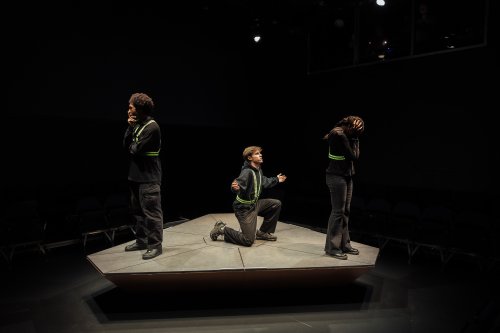
Sofonyas, Will Ingram and Anastasia Locke in a scene from Brendan George’s “The Vessel” at 59E59 Theaters (Photo credit: Jacob Ruth)
Will Ingram completes the ensemble with a wonderfully textured performance as Viggo, the enthusiastic newcomer from Utah whose openness initially appears almost comic before acquiring surprising emotional complexity. Ingram expertly charts Viggo’s transformation from eager outsider into indispensable companion, balancing youthful exuberance with mounting anxiety as he discovers the hidden demands of the position he has accepted. His search for belonging becomes one of the play’s most affecting threads, particularly as George allows Viggo’s idealism to survive without becoming naïveté. Even amid despair, he insists upon the possibility of human connection, and Ingram imbues that conviction with infectious sincerity.
The production surrounding these performances exhibits admirable confidence in theatrical economy. Tony DiBernardo’s elegantly spare scenic design transforms a simple geometric platform into a persuasive abstraction of the Vessel itself, suggesting both the monument’s vertiginous architecture and the emotional isolation it imposes upon those stationed within it. Yiyuan Li’s expressive lighting subtly modulates the emotional temperature of each encounter, while Emma Hasselbach’s sound design envelops the intimate playing space with the uneasy rhythms of an attraction that never entirely sleeps. The audience surrounds the performers on all sides, collapsing the comfortable distance between observer and participant until we, too, become witnesses sharing responsibility for what unfolds.
What lingers longest after The Vessel concludes is not simply its indictment of institutional negligence—though George is rightly unsparing toward the bureaucratic complacency that allowed multiple preventable deaths before meaningful safety measures were finally installed—but its profound faith in ordinary human solidarity. These three young workers cannot save everyone who ascends the monument’s endless staircases. What they can do is watch over one another with tenderness, patience, and imperfect devotion. In an era when public life increasingly asks individuals to absorb the consequences of systemic failures, George offers no facile solutions, only the modest but indispensable grace of companionship. Under Peter Charney’s sensitive direction and through three beautifully calibrated performances from Sofonyas, Locke, and Ingram, The Vessel transforms one of New York’s most controversial landmarks into an eloquent meditation on responsibility, grief, and the fragile acts of care that make endurance possible. It is an unusually compassionate work of contemporary theater and one of the more memorable new plays to arrive this season.
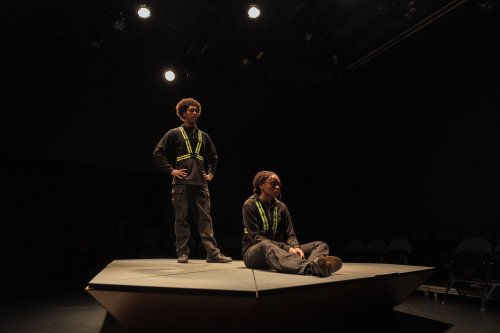
Sofonyas and Anastasia Locke in a scene from Brendan George’s “The Vessel” at 59E59 Theaters (Photo credit: Jacob Ruth)
The Vessel (through August 30, 2026)
Through The Tollbooth Co. in association with Thrown Stone Theatre Company
Theater C at 59E59 Theaters, 59 East 59th Street, in Manhattan
For tickets, visit www.59e59.org
Running time: 90 minutes without an intermission


Leave a comment