
Così fan Tutte (Teatro Grattacielo)
There’s a wager, two obvious disguises, and the fragile calculus of emotions as a perceptive director peels back layers to reveal Mozart's original intentions.
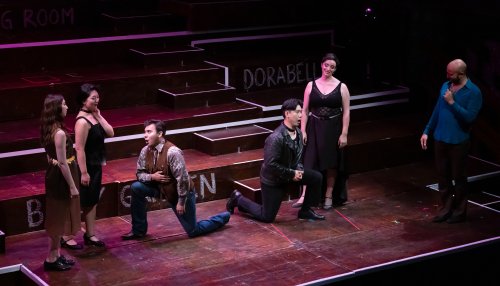
Giovanna Yang as Despina, Lina Chung as Fiordiligi, Ricardo Diaz as Ferrando, Young Kwang Yoo as Guglielmo, Mairin Srygley as Dorabella and Nicola Ziccardi as Don Alfonso in a scene from Teatro Grattacielo’s production of Mozart’s “Così fan Tutte” at the Ellen Stewart Theatre of La MaMa (Photo credit: Jennifer Katzman)
Mozart’s Così fan tutte emerges not as a polished relic from the operatic canon but as something startlingly intimate: a mirror held to the audience itself. Teatro Grattacielo’s new production at La MaMa’s Ellen Stewart Theatre transformed one of opera’s most notoriously slippery comedies into a deeply human meditation on desire, fidelity, and the unsettling realization that none of us is quite as certain of ourselves as we imagine. Before a capacity crowd—a heartening sight in itself—Mozart’s music seemed less to revive the past than to breathe anew in the present. If anyone still wishes to proclaim opera a dying art, they need only have spent an evening in this room.
There is perhaps no opera that has aged more intriguingly than Così fan tutte. When Mozart and his incomparable librettist Lorenzo da Ponte completed their final collaboration, audiences embraced its elegant wit while often recoiling from its moral ambiguity. Generations dismissed it as a brittle farce built upon an implausible wager. Time, however, has revealed something richer. Beneath da Ponte’s sparkling comedy lies one of Mozart’s most compassionate scores, one that refuses to condemn its lovers even as it exposes every contradiction in their hearts. Teatro Grattacielo wisely understands that Così is neither comedy nor tragedy alone, but an exquisite balancing act between the two.
Director Cate Pisaroni, making an impressive stage directorial debut, approaches the work with uncommon confidence. Rather than imprisoning the opera inside period elegance, she strips away decorative realism almost entirely. Oscar Escobedo’s spare scenic design creates an abstract emotional landscape where clean architectural lines replace drawing rooms and gardens, allowing every glance, hesitation, and betrayal to occupy center stage, producing a space where psychological truth matters infinitely more than historical accuracy. Pisaroni invites her audience to dwell within uncertainty rather than resolve it, and the result is an evening that never trivializes the opera’s emotional bruises.
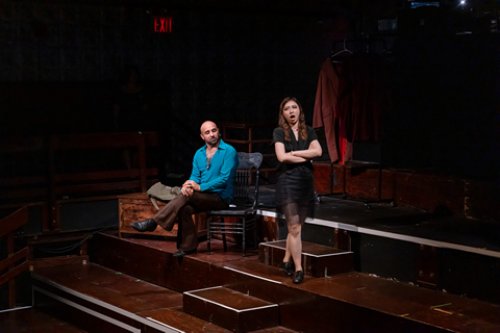
Nicola Ziccardi as Don Alfonso and Giovanna Yang as Despina in a scene from Teatro Grattacielo’s production of Mozart’s “Così fan Tutte” at the Ellen Stewart Theatre of La MaMa (Photo credit: Jennifer Katzman)
Her boldest invention is the addition of Cupid as an omnipresent observer and mischievous manipulator, a role Pisaroni performs herself with wit and uncanny grace. Sporting white wings that suggest equal parts cherub and cabaret master of ceremonies, Cupid becomes the opera’s living conscience, silently nudging events while watching the characters discover uncomfortable truths about themselves. What could easily have become an intrusive conceit instead deepens the production’s central idea: that identity itself is fluid, contradictory, and forever unfinished. Mozart understood that long before psychology gave it vocabulary.
The familiar plot remains deliciously intact. Two idealistic officers, Ferrando and Guglielmo, confidently accept Don Alfonso’s wager that their fiancées’ fidelity can withstand any temptation. Pretending to depart for war, they return disguised as flamboyant “Albanians,” each attempting to seduce the other’s beloved while the irrepressible maid Despina gleefully aids the deception. It remains one of opera’s most improbable premises, yet Pisaroni wisely declines to apologize for its artifice. Instead, she leans into its theatricality, allowing the disguises to reveal emotional truths that realism never could. By the time the masquerade collapses, the audience has ceased asking whether the story is believable and instead wonders whether any relationship can truly survive without illusion.
Musically, the evening belongs to conductor and pianist Abdiel Vázquez, whose return to Teatro Grattacielo following last season’s acclaimed Le nozze di Figaro confirms him as one of the company’s indispensable artistic voices. Leading Jonathan Lyness’ elegantly reduced orchestration for eleven musicians (flute, oboe, clarinet, bassoon, horn, percussion, two violins, viola, cello and bass), Vázquez reveals just how astonishingly conversational Mozart’s writing truly is. Rather than sounding diminished, the score acquires remarkable transparency. Individual instrumental colors emerge with crystalline clarity: woodwinds whispering conspiratorially beneath declarations of love, the bassoon offering dry commentary worthy, strings weaving emotional currents beneath every ensemble. Mozart’s miraculous finales become what they have always secretly been—chamber music elevated into dramatic action. Even Vázquez’s brief, playful insertion of stadium-organ flourishes, accompanying two baseball-jacketed lovers with unmistakable New York Yankee swagger, lands as an affectionate wink rather than an interruption, delighting an audience already thoroughly in on the joke.
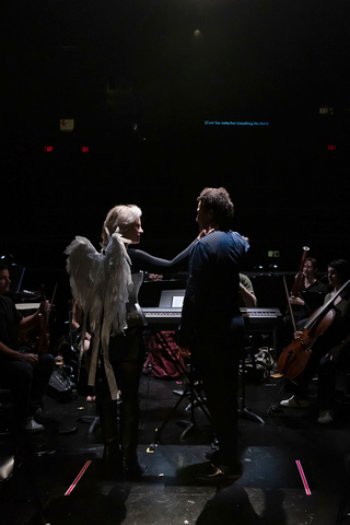
Cate Pisaroni as Cupid and Conductor Abdiel Vásquez in a scene from Teatro Grattacielo’s production of Mozart’s “Così fan Tutte” at the Ellen Stewart Theatre of La MaMa (Photo credit: Jennifer Katzman)
The cast proves fully equal to Mozart’s formidable demands. Lina Chung’s Fiordiligi combines vocal brilliance with genuine moral anguish, allowing every impossible leap in the role to feel like an extension of emotional conflict rather than technical display. Mairin Srygley’s warmly expressive Dorabella offers a beautifully complementary portrait of a woman discovering feelings she scarcely knew herself capable of. An ailing Ricardo Diaz still manages to sing Ferrando with luminous lyricism, while Young Kwang Yoo brings robust charisma, sex appeal, and comic confidence to Guglielmo. Giovanna Yang’s sparkling Despina never overplays the servant’s comic antics, instead grounding them in sharp intelligence, while Nicola Ziccardi lends Don Alfonso precisely the blend of worldly sophistication and dangerous amusement that makes the philosopher both manipulative and oddly sympathetic. Throughout the evening, Mozart’s ensembles—the true measure of any Così—unfold with exhilarating precision, every vocal line maintaining its individuality while contributing to the larger emotional tapestry.
The visual details display similar intelligence. Anabel Simotas’ contemporary costumes largely clothe the company in elegant black, allowing carefully chosen bursts of character to punctuate the monochrome palette. Ferrando’s fringed leather vest, Guglielmo’s swaggering leather jacket and delightfully incongruous pizza box, Despina’s nurse disguise, and Cupid’s winged white bustier all acknowledge the production’s playful relationship with time without ever descending into novelty for its own sake. Will Rossiter’s lighting gently sculpts the minimalist environment, while Matthew Deinhart’s projections add subtle layers of atmosphere without distracting from the performers. Every design choice reinforces Pisaroni’s central insight: these characters are perpetually trying on new identities, hoping one might finally fit.
Perhaps most admirable is Teatro Grattacielo’s unwavering commitment to accessibility without artistic compromise. Performed in fluent Italian with clear English supertitles and accompanied by exceptionally thoughtful program notes, the production welcomes opera veterans and newcomers with equal generosity. That openness extends beyond this single performance through the company’s partnership with the emerging artists of the Camerata Bardi Vocal Academy, affirming a belief that opera flourishes not by guarding tradition but by inviting fresh voices into it. In an era when cultural institutions often speak anxiously of shrinking audiences, Teatro Grattacielo offers a far more persuasive narrative. Here was a full house laughing, listening, and leaning into Mozart’s most complicated comedy—not because the company simplified it, but because it trusted audiences to embrace its complexity. The result was not merely an admirable revival of a masterpiece but a stirring reminder that great opera continues to evolve whenever imaginative artists approach it with curiosity, intelligence, and love.
Così fan tutte (through July 19, 2026)
Teatro Grattacielo
Shares at La MaMa, Ellen Stewart Theater, 66 East 4th Street, in Manhattan
For more information on Teatro Grattacielo, visit www.grattacielo.org/season
Running time: three hours including one intermission


Leave a comment