
Romeo and Juliet (Free Shakespeare in the Park)
Saheem Ali's production uses the US/Mexican border wall and Spanish translations to add relevance to this 400-year-old play.
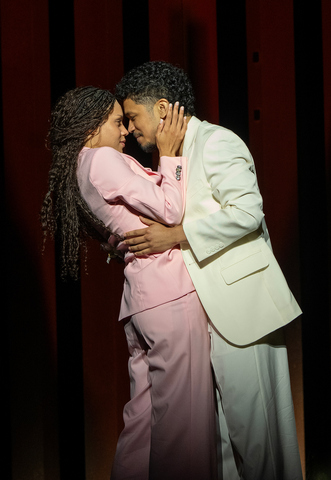
Ra’Mya Latiah Aikens and Daniel Bravo Hernández in a scene from The Public Theater’s production of “Romeo and Juliet” at the Delacorte Theater (Photo credit: Joan Marcus)
Associate artistic director/resident director Saheem Ali of The Public Theater believes in updating Shakespeare in ways that modern audiences can identify with. His latest production of Romeo and Juliet which now graces the stage of the Delacorte Theater in Central Park has taken a big risk in putting a good deal of the play into Spanish (in translations by Alfredo Michel Modenessi) but as his version takes place on the US southwestern border with a wall designed by Maruti Evans that looks much like the real one on our border, this makes perfect sense.
With faces covered by bandanas, the Montagues put up signs that say “Abolish ICE” and “Defund the Wall” while the Capulets appear to be a vigilante force dressed entirely in black. One wishes the production were either more or less political. Since so many of the lines in Romeo and Juliet are iconic by now (most middle school students having read the play) there is little problem in following the text even if one doesn’t know Spanish.
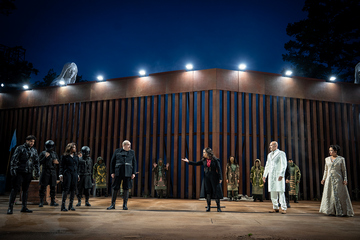
LaChanze, Glenn Fleshler, Jessica Pimentel, Jason Manuel Olazábal and Mariand Torres in a scene from The Public Theater’s production of “Romeo and Juliet” at the Delacorte Theater (Photo credit: Joan Marcus)
Ali also begins the play in designer Evans’ graveyard with three black-robed figures wearing horned headdresses like figures from Mexico’s Day of the Dead celebration which is in keeping with his updating. Romeo and the white robed Montagues are Mexican, and Juliet and the black dressed Capulets are American. The play now works on a racial divide. It won’t please purists but if you go with the concept, it is a very exciting staging of a four-hundred-year-old play. It reminds one of the 1950s updating that Arthur Laurents, Stephen Sondheim and Leonard Bernstein used to create their version in West Side Story for the postwar generation.
The feud between Romeo and Juliet’s families now has a new interpretation separating them with a real wall between their communities, Juliet’s balcony perched literally over the border wall with her suitor on the other side. The casting is a combination of star names, featured players and talented newcomers. As Juliet, Ra’Mya Latiah Aikens, recent NYU graduate, is a force of nature, an independent modern woman who thinks for herself and has her own ideas. Her Romeo played by Daniel Bravo Hernández is not quite as good but matches her with passion and recklessness. As her mother Lady Capulet, Tony Award winner LaChanze is an outspoken woman who knows her place in her society. As her father Lord Capulet, Glenn Fleshler, a regular both on and off Broadway, is rather one dimensional, angry with Juliet for flouting his rule but showing little beneath.
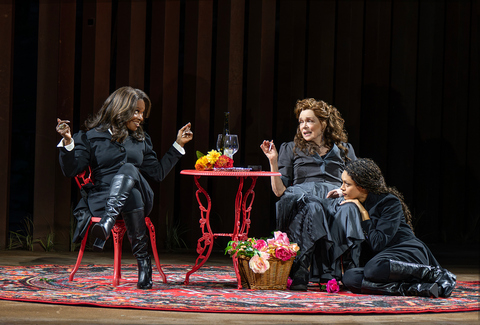
LaChanze, Deirdre O’Connell and Ra’Mya Latiah Aikens in a scene from The Public Theater’s production of “Romeo and Juliet” at the Delacorte Theater (Photo credit: Joan Marcus)
Francis Jue, a 2025 Tony Award winner for Yellow Face, is amusing as Friar Lawrence, adviser to both Romeo and Juliet. Deirdre O’Connell, 2022 Tony Award winner for Dana H. steals every scene she is in with her drunk antics and unplaceable accent. As Lord and Lady Montague, Romeo’s parents, Jason Manuel Olazábal and Mariand Torres are given so little to do by the play that we can get no sense of them. Ali’s crowd scenes are rather sparse even though the play implies large scale brawls.
Nor does it help that Zack Lopez Roa’s Benvolio and Caleb Joshua Eberhardt’s Mercutio, as Romeo’s friends with whom he knocks around, are rather pallid with Mercutio throwing away the famous “Queen Mab” speech. Ariyan Kassam’s Tybalt, cousin to Juliet, is rather thuggish than politic. Another false step is making Jessica Pimental Escalus, the Duke of Verona, and having her addressed as masculine where the character is clearly being played as a woman.

Ariyan Kassam, Zach Lopez Roa and Caleb Joshua Eberhardt in a scene from The Public Theater’s production of “Romeo and Juliet” at the Delacorte Theater (Photo credit: Joan Marcus)
As Paris, Juliet’s suitor, Martin K. Lewis outfitted with glasses is a nerdy choice of Lord Capulet, partly explaining Juliet’s lack of interest. (One of several excisions in the text is Paris’ deadly encounter with Romeo in the last scene of the play.) Rachel Crowl’s one scene as the Apothecary from whom Romeo tries to buy poison in Mantua is memorable though her outfit dressed as a Catholic priest is more than a little strange. (Were only religious people able to sell drugs in Shakespeare’s time though the rest of the costuming by Oana Botez is clearly contemporary?)
Botez’s big moment is the collection of carnival outfits and headdresses for the Capulet’s ball which are really stunning. While the stage often looks empty, set designer Evans has furniture arrive center stage by a trap door in the stage floor. The use of guns rather than Elizabethan swords keeps the modern influence though we do miss the extended sword fights that is usual in this play, everything seems to happen too fast. Both LaChanze’s Lady Capulet and Aikens’ Juliet sing additionally as part of the entertainment at the ball. A new addition to the ending is Friar Lawrence singing his opening lines once again as well as a real wedding or renewal of vows at every performance. While this is quite endearing, tragedies do not need happy endings. Saheem Ali’s Romeo and Juliet is spirited and fast-paced, easy to follow but not entirely well-thought-out all the way through.
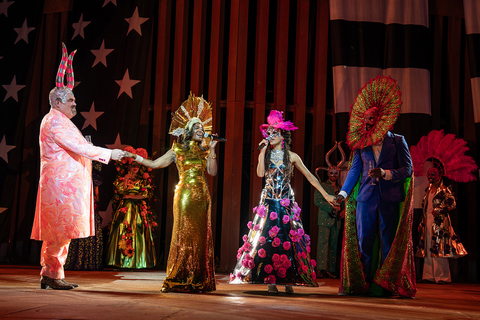
Glenn Fleshler, LaChanze, Ra’Mya Latiah Aikens and Martin K. Lewis in a scene from the The Public Theater’s production of “Romeo and Juliet” at the Delacorte Theater (Photo credit: Joan Marcus)
Romeo and Juliet (through June 28, 2026)
The Public Theater
Delacorte Theater, enter at 81st Street and Central Park West or 79th Street and Fifth Avenue, in Manhattan
Five ways to get free tickets: distributed at Noon at the Delacorte Box Office to those on prior line, Downtown Distribution Lottery at The Public Theater, 425 Lafayette Street at Astor Place, by Mobile Ticket Lottery powered by TodayTix at http://www.publictheater.org, in person distribution at locations throughout the five boroughs on day of select performances, or In-Person Standby Line in Central Park after six PM.
Running time: two hours and 45 minutes with one intermission


Leave a comment