
Girl, Interrupted
Previously adapted into a popular movie, Susanna Kaysen's memoir about her teenaged confinement in a psychiatric hospital has now made its way to the stage.
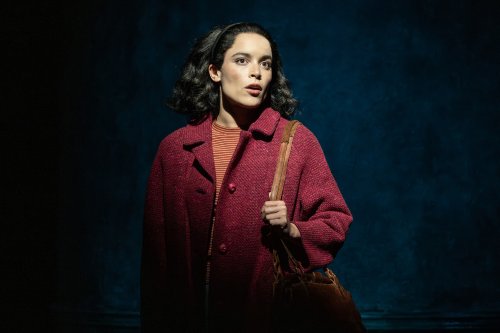
Juliana Canfield as Susanna in a scene from Martyna Majok’s adaptation of “Girl, Interrupted” at The Public Theater (Photo credit: Joan Marcus)
The Public Theater’s adaptation of Girl, Interrupted is billed as a play with music. Curiously, the show isn’t simply advertised as a musical–or as a concept album with lots of free-associative liner notes. Based on Susanna Kaysen’s fragmented memoir about her 18 months of psychiatric confinement in the late 1960s, the production juxtaposes, rather than blends, the labors of iconic songwriter Aimee Mann and Pulitzer Prize-winning dramatist Martyna Majok. This approach allows each artist to pursue her own creativity while sparing director Jo Bonney from having to narratively merge their idiosyncratic contributions. It apparently explains, too, why Girl, Interrupted isn’t officially a musical, since Mann’s score doesn’t have to push the plot forward–though, in fairness, Majok isn’t worried about doing that on the script side, either.
Whatever one calls Girl, Interrupted, the show achieves a modest victory: it doesn’t knock off the melodramatic film version of Kaysen’s 1993 book, which closed out the decade by culturally conflating the respective public personas of stars Angelina Jolie and Winona Ryder with their troubled characters. If anyone is taking bets, this laudable avoidance of nostalgia will probably annoy and confuse fans of the movie who are strangers to the book. They might even regard Majok as a tad pretentious for using a painting by Johannes Vermeer as a framing device, unaware that the impetus for doing so is right there in Kaysen’s title.
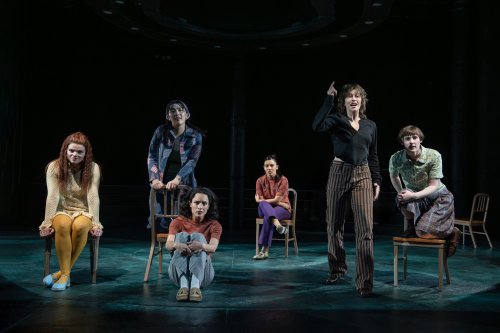
Katherine Reis as Daisy, Mia Pak as Grace, Juliana Canfield as Susanna, Gabi Campo as Tori, King Princess as Lisa and Sally Shaw as Polly in a scene from Martyna Majok’s adaptation of “Girl, Interrupted” at The Public Theater (Photo credit: Joan Marcus)
During a trip to the museum, the Dutch master’s canvas Girl Interrupted at Her Music becomes Susanna’s portal to the past. It triggers disjointed, long-ago memories of McLean Hospital, where, barely an adult, Susanna (Juliana Canfield) admitted herself after a doctor’s hasty evaluation of her suicide attempt. Unfortunately, the help Susanna sought became a trap, one that also ensnared other young and vulnerable female souls. As the times were a-changin’ outside, they were collectively walled off in a common room watching the seismic happenings on television.
Through plays like Cost of Living, Ironbound, and Sanctuary City, Majok has demonstrated her insightfulness as an excavator of marginalized lives; disappointingly, the ones in Girl, Interrupted remain buried. Overly faithful to the elliptical writing style of her source material, Majok condenses each of Susanna’s fellow patients into a set of mental health struggles and traumas: Lisa (King Princess), a sociopath proudly identifying as a psychopath; Tori (Gabi Campo), the drug addict with the financial means to keep using; Daisy (Katherine Reis), whose eating disorder is fueled by presumably incestuous abuse; Polly (Sally Shaw), severely disfigured from setting herself on fire; and Grace (Mia Pak), a would-be writer who serves as a worst-case psychological scenario for anyone, like her roomie Susanna, attempting to transform words into a life. Bathed in Heather Gilbert’s gloomy lighting, all of these characters are little more than a diagnosis and a song, left mostly hidden within the shadows of Susanna’s mind.
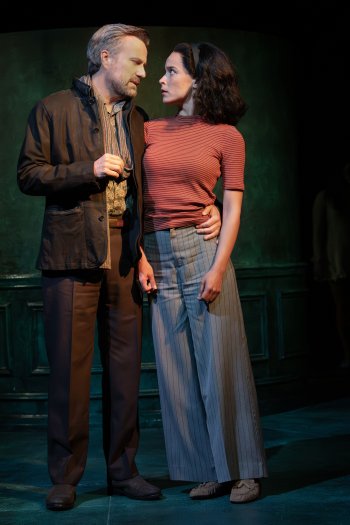
Manoel Feliciano as Mr. Anderson and Juliana Canfield as Susanna in a scene from Martyna Majok’s adaptation of “Girl, Interrupted” at The Public Theater (Photo credit: Joan Marcus)
Susanna gets lost there herself as she patchily remembers a depressive spiral that included an inappropriate relationship with a high school teacher (Manoel Felciano). Both in the past and the present, there is a lot for Susanna to figure out, with the single seeming certainty being that nobody on the hospital staff thought she could become a writer. That’s decidedly true of the stately, skirt-suited Dr. Wick (Emily Skinner), whose therapeutic prerequisite for Susanna’s institutional release is that she strive for something less impractical than a literary career. It’s a surprisingly dismissive stance to take, especially during an era when female writers greatly outnumbered female psychiatrists. But neither Majok nor Mann offers Dr. Wick the chance to explain herself.
Practicality arrives as a mailed marriage proposal, which Valerie (Ta’Rea Campbell), a Black nurse, encourages Susanna to accept. Given Susanna’s limited social options as a woman, Valerie considers marriage “a realistic plan” to permanently exit the hospital and get on with some sort of life. When Susanna pushes back on this advice, Valerie hints at her own additional burdens from racism. Evidently, the purportedly evolving world outside the hospital hasn’t afforded Valerie so much as a glimmer of hope. One can sense Majok’s frustrated dramatic desire to pivot to Valerie’s experiences–but that wasn’t the assignment–while Mann leaves Valerie’s inner turmoil entirely off the song list.
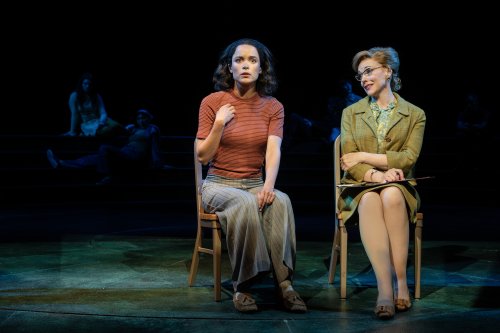
Juliana Canfield as Susanna and Emily Skinner as Dr Wick in a scene from Martyna Majok’s adaptation of “Girl, Interrupted” at The Public Theater (Photo credit: Joan Marcus)
After the protracted development of a staged Girl, Interrupted stalled in 2020, Mann repurposed her work as the pandemic album Queens of the Summer Hotel. Now back to its theatrical roots, Mann’s score is performed on a spare set (from the design collective dots) and well served by two actors (Felciano and Lauren Jeanne Thomas) who double as highly effective musicians. Regrettably, though, while Mann’s lyrics aim for anguished poetry, they occasionally only induce winces. The most salient example is Daisy’s song “Home By Now,” a German-masked admission of her horrible secret: “My daddy loves me, he’s my Liebchen/I’m his eine kleine Frau.” It’s disturbingly rivaled by “Burn It Out,” Polly’s attempt to share the annihilating impulses that led to her self-immolation: “I knew the secrets that live in fire/I saw the promise that flames inspire.” Sidestepping impossible challenges, choreographer Sonya Tayeh understandably focuses her efforts elsewhere.
Striving for a final note of solidarity, the show’s entire female cast lines up for the closing number “I See You.” Filtered through Susanna’s much-belated subjectivity, the hospital staff and patients turn towards each other to merely acknowledge “despair” and “ennui.” That can’t possibly be right; there must have been so much more to see.
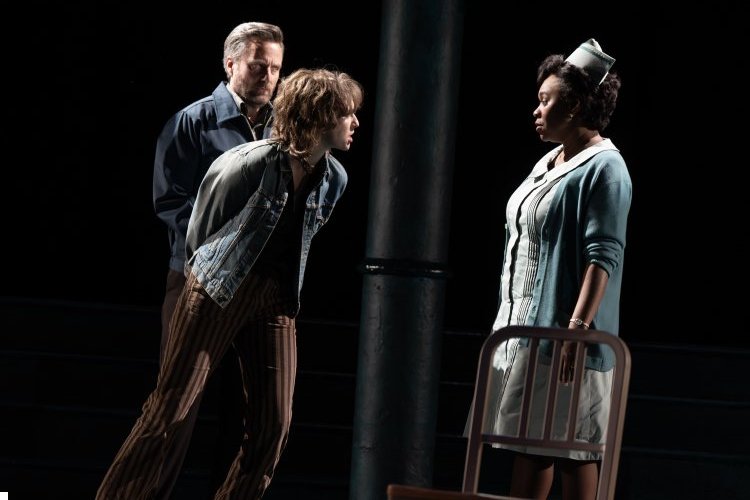
Manoel Felicianos as the Doctor, King Princess as Lisa and Ta’Rea Campbell as Valerie in a scene from Martyna Majok’s adaptation of “Girl, Interrupted” at The Public Theater (Photo credit: Joan Marcus)
Girl, Interrupted (through July 12, 2026)
Martinson Hall at The Public Theater, 425 Lafayette Street in Manhattan
For tickets, call 212-967-7555 or visit http://www.publictheater.org
Running time: one hour and 50 minutes with no intermission


Leave a comment