
In the Devil’s Hands
Rory Greenwood is the heartbreaking center of a tale about a man who chooses solitude at society's margins over people who will always doubt him.
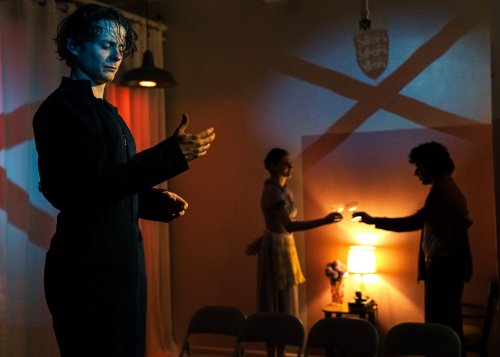
Rory Greenwood, Phoebe Light and Umer Khan in a scene from Helen Banner’s “In the Devil’s Hands” at Zoopraxic in Long Island City (Photo credit: Diego Quintanar)
Helen Banner’s In the Devil’s Hands, receiving its haunting world premiere at Zoopraxic’s newly opened Long Island City performance space, is one of those rare theatrical experiences that seems to alter the rhythm of time itself. Inspired by the true story of Alphonse Le Gastelois, the Jersey resident who voluntarily exiled himself to a barren reef after being falsely suspected of a series of crimes, Banner transforms a historical curiosity into a profound meditation on loneliness, forgiveness, memory, and the strange seductions of self-imposed isolation. Set in the aftermath of the Nazi occupation of the Channel Islands during the 1940s, the play unfolds with the inevitability of a tide, drawing audiences into a world where innocence is insufficient protection against suspicion and where exile can become both punishment and refuge.
Banner, who also directs and serves as production designer, demonstrates remarkable confidence in her storytelling. The play begins with an ingenious meta-theatrical device: a radio interview between Banner herself and composer Joshua Dumas, who doubles as interviewer. These recurring voiceovers establish the work’s fascination with vanished histories and disappearing voices, literalized through discussions of the Channel Islands’ fading accents while simultaneously evoking the larger erosion of communal memory. What emerges is a dialogue between past and present, history and invention, reality and myth, all of which enrich the story of Jason, a young agricultural laborer who retreats to an isolated outcropping known as The Devil’s Hands after being wrongly implicated in a series of brutal attacks.
The premise possesses the irresistible pull of a folktale. Jason persuades his closest friend, Dill, to row him to an uninhabited cluster of rocks in the sea, where he intends to remain until another crime proves his innocence. Yet what begins as a temporary act of defiance slowly transforms into something far more psychologically complex. Even after his innocence becomes evident, Jason cannot forgive the community that doubted him. The wound of suspicion festers into a stubborn estrangement, and Banner’s script examines with extraordinary subtlety the seductive power of grievance. Jason’s exile becomes both a protest and a means of control, a withdrawal from society that paradoxically binds those left behind ever more tightly to him.
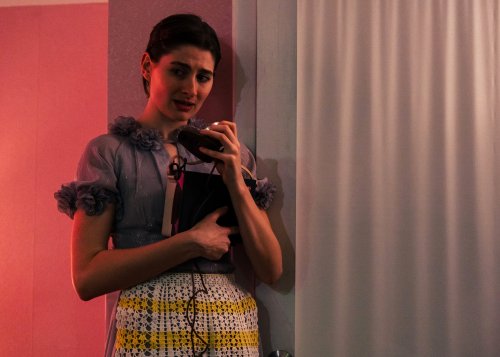
Phoebe Lloyd in a scene from Helen Banner’s “In the Devil’s Hands” at Zoopraxic in Long Island City (Photo credit: Diego Quintanar)
The production’s immersive design is nothing short of revelatory. Zoopraxic’s fifteen-seat “micro-theater” places spectators mere feet from Banner’s extraordinary rocky island set, a raised outcropping that dominates the room and serves as both landscape and state of mind. Throughout the performance, Joshua Dumas’ live sound design supplies the ceaseless murmur of wind and water, creating an auditory environment so persuasive that one begins to feel genuinely marooned alongside Jason. There are no blackouts, no conventional scene changes, only the gradual passage of time marked through exquisitely calibrated shifts in lighting that evoke dawns, dusks, and changing seasons. The result is an experience of remarkable intimacy and immersion, one that collapses the distance between audience and character while emphasizing the vast emotional gulf separating Jason from the world he has abandoned.
At the center of this achievement is Rory Greenwood’s astonishing performance as Jason. Rarely has stubbornness appeared so heartbreaking. Greenwood charts the character’s evolution with extraordinary precision, allowing illness, loneliness, resentment, resilience, uncertainty, and fleeting hope to register through the smallest shifts in posture, gaze, and vocal cadence. His Jason becomes a living paradox: a man seeking freedom who has imprisoned himself, a victim of communal judgment who gradually becomes captive to his own refusal to forgive. Probably one of the most haunting moments in the play comes when Lydia presses Jason to return home for Dill’s wedding, to not only be Dill’s best man, but to dance with Lydia. Fighting back tears, his words reveal the essence to which he reduces her request: “Why are you trying to go dancing with a man you have such a low opinion of?” His solitariness over the years have clearly instructed him in an exacting use and value of language. Greenwood’s performance is mesmerizing from beginning to end, holding the audience in a state of rapt attention even during the character’s longest stretches of solitude.
Greenwood is magnificently supported by Umer Khan and Phoebe Lloyd. Khan brings tremendous warmth and emotional complexity to Dill, whose loyalty to his friend becomes increasingly difficult to sustain as years pass and opportunities for reconciliation are repeatedly rejected. Lloyd is equally compelling as Lydia, Dill’s spirited sister and the object of Jason’s quiet affection. Her scenes possess a tenderness that cuts through the play’s melancholy atmosphere, and she beautifully embodies the possibility of human connection that Jason simultaneously desires and resists. Together, the trio creates a network of relationships so richly realized that every conversation carries the weight of lives that might have unfolded differently.
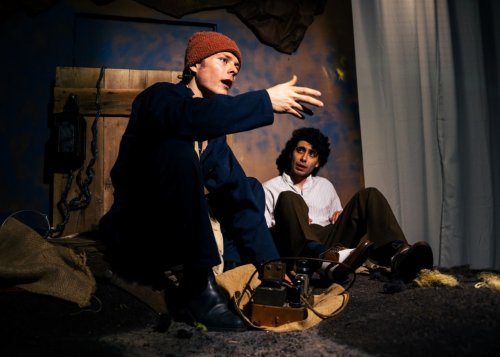
Rory Greenwood and Umer Khan in a scene from Helen Banner’s “In the Devil’s Hands” at Zoopraxic in Long Island City (Photo credit: Diego Quintanar)
Most remarkably, In the Devil’s Hands refuses easy conclusions. Each evening, the performers determine the play’s ending, allowing the narrative to reinvent itself anew with every performance. Far from feeling gimmicky, this device deepens the play’s central preoccupation with choice, memory, and the stories people construct about their own lives. By the final moments, Banner has crafted something genuinely rare: a work that is intellectually provocative, emotionally devastating, and formally adventurous all at once. Few productions this season ask such searching questions about what human beings owe one another, and fewer still do so with such grace, compassion, and theatrical ingenuity. Long after leaving Zoopraxic’s tiny theater, audiences may find themselves still listening for the sound of waves and wondering whether home is a place one returns to or a place one finally learns to forgive.
In The Devil’s Hands (through June 14, 2026)
A/Park Productions
Zoopraxic, 11-51 44th Road, in Long Island City, Queens
For tickets, visit www.zoopraxic.com
Running time: 85 minutes without an intermission


Leave a comment