
Mary, Queen of Scots (Scottish Ballet)
Exciting retelling in dance of the tumultuous lives of two cousin queens who never met.
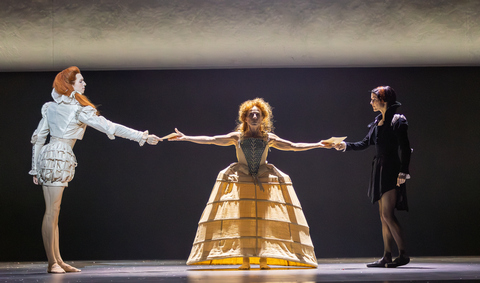
Harvey Littlefield as Young Elizabeth, Charlotta Öfverholm as Older Elizabeth and Roseanna Leney as Mary in a scene from the Scottish Ballet’s production of Sophie Laplane and James Bonas’ “Mary, Queen of Scots” at the David H. Koch Theater (Photo credit: Andy Ross)
The Scottish Ballet’s full-length evening of their new Mary, Queen of Scots is a fascinating dramatization of history: the relationship between Queen Elizabeth I and her eventual victim Mary, Queen of Scots, as well as the highlights of the life of Mary who in 44 years packed more life than most people ever do in lives twice as long. The production brought to the David H. Koch Theater choreographed and co-created by Sophie Laplane and directed and co-created by James Bonas is engrossing, using the lens of Elizabeth’s memories of the two stories. However, it is very important that American audiences read the plot summary in the program or they may be confused by the plot which has many unfamiliar characters unless one is versed in the story. (Mary’s third marriage to Lord Bothwell which only lasted one month is left out, understandably not to make the plot too confusing.)
Born to a Scottish father and a French mother, Mary inherited the throne of Scotland when she was six days old after the death of her father James V. At age five, she was sent to France as the betrothed of the Dauphin Francois to whom she is married at age 15. The ballet picks up the story when the now Francois I, King of France, dies two years later. Mary returns to Scotland with her ladies-in-waiting historically known as the “Four Marys.” At age 26, she marries Henry Stuart, Lord Darnley, English on his father’s side and Scottish on his mother’s side. He proceeds to dispatch Mary’s musician, confidant and secretary David Rizzio. Mary gives birth to the eventual King James VI of Scotland and James I of England. However, Darnley’s ambition to be the Scottish king infuriated the Scottish nobles (who may have had the help of Mary) and he is murdered two years later. This leads to her imprisonment and abdication in favor of her son. Fleeing to England at age 26 in hope of gaining Elizabeth’s protection, she is instead imprisoned for 19 years. During that time Mary is implicated in various plots to kill Elizabeth and is eventually tried and executed at age 44. A complex but linear story of politics, passion and betrayal.
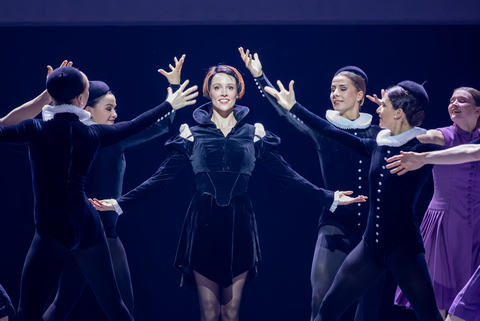
Roseanna Leney as Mary (center) with ensemble in a scene from the Scottish Ballet’s production of Sophie Laplane and James Bonas’ “Mary, Queen of Scots” at the David H. Koch Theater (Photo credit: Andy Ross)
The ballet begins with the Older Elizabeth (Charlotta Öfverholm) on the last day of life writhing in a snow storm. She then imagines Mary in France as the consort of Francis. When he dies at age 16 after less than two years of ruling, Mary (Roseanna Leney) turns to his mother Queen Catherine de’ Medici for comfort but is roundly rebuffed. Joined by David Rizzio, an Italian musician, Mary and her ladies leave for Scotland where they are more welcome.
At the English court, Henry Stuart, Lord Darnley is a fixture while the Younger Elizabeth (Harvey Littlefield) plans for his future. She also has her spymaster Walsingham send out moles to European courts including Scotland. Given permission to visit Edinburgh, Darnley attracts Mary’s attention by entering her court on his knees. Considered by history to have been bisexual, he begins an affair with Rizzio. Mary marries Darnley and becomes pregnant, but she also discovers the affair between the two men. The Scottish lords, Darnley among them, resent Rizzio’s sway over Mary and arrange to have him murdered.
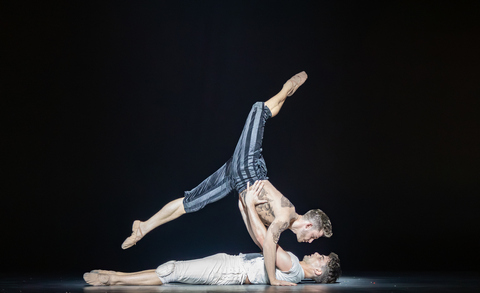
Evan Loudon as Darnley (on floor) and Javier Andreu as Rizzio in a scene from the Scottish Ballet’s production of Sophie Laplane’s “Mary, Queen of Scots” at the David H. Koch Theater (Photo credit: Andy Ross)
In Act Two, Darnley accuses Mary of infidelity and that the child is not his. Mary has had enough and Darnley dies. While Mary holds her baby, Elizabeth imagines having one of her own. The court turns against Mary for the murder of Darnley and she escapes to England. Letters pass between Mary and Elizabeth though they never meet. Instead of giving her sanctuary, Elizabeth arrests her as a threat to her reign. Mary’s now grown-up son James VI pledges loyalty to Elizabeth. When the Babington Plot to assassinate Elizabeth and place Mary on the throne of England is uncovered from letters that are decoded, Mary is sentenced to death. Dressed in a black robe with a red outfit underneath, she is executed.
The original score by Mikael Karlsson in collaboration with Michael P. Atkinson successfully mixes 19th century music with modern, making dramatic use of drums to warn of danger along the way. Soutra Gilmour’s design concept also mixes Elizabethan and contemporary. Each court is given a look of its own: the French court with Catherine’s silver metallic gown suggests Chanel. The English court with its punk-inspired mohawks for Elizabeth’s soldiers and hooded spies had a modern look. Both Elizabeths are dressed in what look like white undergarments, the Older Elizabeth in a long bouffant gown, and the Younger Elizabeth in short frilly pants. While Mary is dressed in the black velvet she favored (albeit in pants to make dancing more accessible), her Scottish court is dressed in lavender-skirted outfits which suggest kilts. Elizabeth’s court jester who also symbolizes Death is surprisingly dressed in neon lime-green. Gilmour’s set alternates between black and white walls to distinguish the scenes, and is enhanced by Bonnie Beecher’s atmospheric lighting.
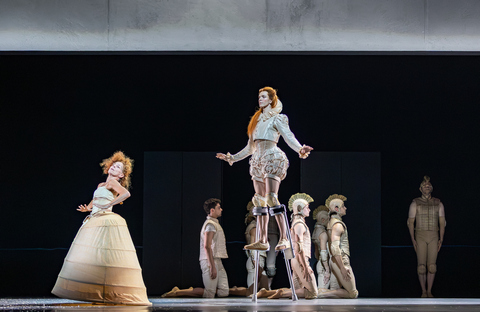
Charlotta Öfverholm as Older Elizabeth and Harvey Littlefield as Younger Elizabeth in a scene from the Scottish Ballet’s production of Sophie Laplane’s “Mary, Queen of Scots” at the David H. Koch Theater (Photo credit: Andy Ross)
The choreography mixes classical and modern dance, at times suggesting Jerome Robbins or Martha Graham, at others, George Balanchine. Charlotte Öfverholm as the Older Elizabeth is given conventionally classical steps while Harvey Littlefield as the Younger Elizabeth, is often seen on stilts, making her (him) the tallest one on stage. While Öfverholm’s elderly queen is obviously conflicted and confused, Littlefield’s Elizabeth is imperious, demanding and at times sadistic. Roseanna Leney’s Mary is quite impressive mostly on toe, suggesting a Tchaikovsky heroine.
As Rizzio and Darnley, danced by Bruno Micchiardi and Nicol Edmonds on opening night have a very physical erotic pas de deux which makes perfectly clear the creators’ point of view on their relationship. At a certain point, Mary becomes a spider attempting to devour Darnley both with a startling huge silhouette on the back wall (courtesy of projection designer Anouar Brissesl) and pantomimed dance steps with her ladies-in-waiting.
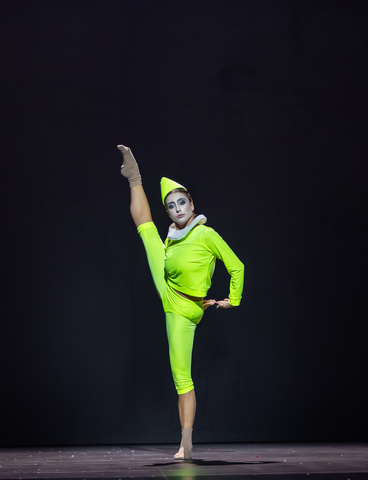
Kayla-Maree Tarantolo as The Jester in a scene from the Scottish Ballet’s production of Sophie Laplane’s “Mary, Queen of Scots” at the David H. Koch Theater (Photo credit: Andy Ross)
As the Jester/Death, Kayla-Maree Tarantolo is amusing as she cavorts whimsically around the stage like a butterfly in a summer garden. Thomas Edward’s Walsingham does a fine depiction of an underling who takes orders. As Catherine de’ Medici, Madeline Squire’s hand gestures tell the entire story of her relationship with her daughter-in-law Mary. The Mary and Elizabeth proxies danced (only once) by Anna Williams and Grace Horler, respectively, have impressive classic ballet choreography to do.
The Scottish Ballet’s exciting Mary, Queen of Scots tells its complicated story extremely well and balances classical and modern choreography with ease. Its minimal décor helps make swift transitions between the scenes without making the audience feel that the stage is underpopulated. The costume choices link the past and present so that we are not kept out of this Elizabethan story. The new score by Mikael Karlsson and Michael P. Atkinson avoids dissonance while also keeping it theatrical for modern audiences. This is a worthy addition to the repertory of contemporary dance.
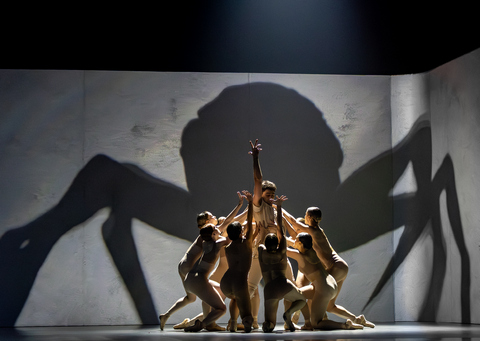
Evan Loudon as Darnley and ensemble in a scene from the Scottish Ballet’s production of Sophie Laplane’s “Mary, Queen of Scots” at the David H. Koch Theater (Photo credit: Andy Ross)
Mary, Queen of Scots (June 4 – 7, 2026)
Scottish Ballet
David H. Koch Theater, 20 Lincoln Center Plaza at 63 Street and Columbus Avenue, in Manhattan
For tickets, visit http://www.davidhkochtheater.com/tickets-and-events/mary-queen-of-scots
Running time: two hours and 15 minutes including one intermission


Leave a comment