
A Walk on the Moon
Pleasant but innocuous musical version of the 1999 hit movie about about two romances at a Catskills bungalow colony the summer of the first moon landing.
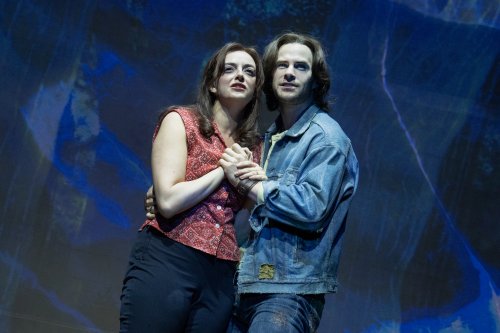
Talia Suskauer as Pearl and Sam Gravitte as Walker in a scene from the new musical “A Walk on the Moon” at the Laura Pels Theatre (Photo credit: Joan Marcus)
The new musical A Walk on the Moon by original screenwriter Pamela Gray and composer and lyricist AnnMarie Milazzo is pleasant but innocuous. Based on the hit 1999 movie set during the summer of 1969 that starred Diane Lane, Liev Schreiber, Viggo Mortensen, Tovah Feldshuh and Anna Paquin, the stage musical feels like a watered-down version of the film. While the film had time appropriate songs from the 1960s, the stage version has new bland, unmemorable songs that do not forward the plot. The hard-working cast headed by Talia Suskauer, Max Chernin, Sam Gravitte and Andréa Burns under the direction of Sheryl Kaller never make us forget the performances from the film.
The summer of 1969 was memorable for two historic events: on July 20, American astronaut Neil Armstrong walked on the moon for the first time and the Woodstock Festival in Bethel, New York, ran from August 15 – 18, attracting a crowd of 460,000. Gray’s story uses this as the backdrop for a midlife romance of Pearl, a bored housewife from Flatbush, married directly out of high school, with the blouse salesman at the Dr. Fogler’s, the Jewish Catskills bungalow colony that the Kantrowitz family with children 15-year-old Alison and nine-year-old Danny, and Marty’s mother Lillian go to every summer. Unfortunately, Pearl’s husband Marty can’t take off the summer from his job as a television repair man, and he comes up from NYC for weekends fighting the traffic each time. Teenaged daughter, Alison, an anti-war activist, is having her own coming-of-age crisis, getting her period and having her first kiss with a new boyfriend Ross.
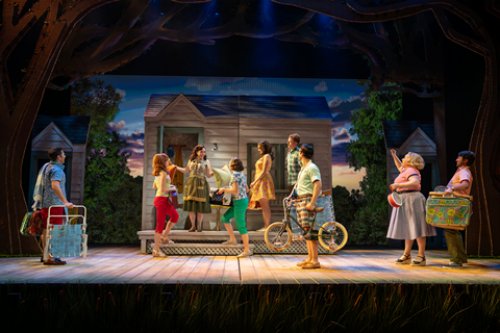
Andréa Burns (in doorway) and the Company of “A Walk on the Moon” at the Laura Pels Theatre (Photo credit: Joan Marcus)
The problem for Pearl begins when Marty is unable to come up for the moon landing weekend because so many people want their televisions fixed so they don’t miss the historic event. Pearl has already met Walker Jerome, the new blouse man, a replacement for the old one who retired, a free-spirited hippie who lends her his copy of Jack Kerouac’s On the Road and gives her his phone number. The night of the moon landing, they begin an affair which continues when Marty cannot come up due to the Woodstock traffic. Pearl claims to still love Marty and her marriage, but she and Walker escape to Woodstock and all hell breaks loose when they are seen by Alison and Ross. Lillian who reads tarot cards and tea leaves guesses what is going on and calls her son to get up to the bungalow colony no matter how long it takes. The confrontations that occur result in the climax of the story.
Pearl has been ripe for a change: pregnant at 17 after sleeping with her first boyfriend, she was married to Marty soon after. Whatever dreams she had were assigned to the scrap heap and she had been nothing but a wife and a mother ever since. But this is the summer of possibilities: we hear Neil Amrstrong state “That’s one small step for man, one giant leap for mankind,” a clarion cry for change. And although The Feminine Mystique was published in 1963, now in 1969 Pearl is first being introduced to it by the other women she plays Mah-Jongg with outside their bungalows. Woodstock is the last straw with an entire generation letting loose and doing their own thing.
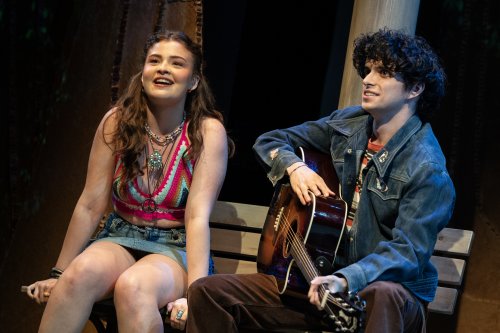
Sophie Pollono as Alison and Oscar Williams as Ross in a scene from the new musical “A Walk on the Moon” at the Laura Pels Theatre (Photo credit: Joan Marcus)
The only updating Gray has done since writing her screenplay is to add a great many four-letter words, reducing Danny’s part, and scrapping the blouse man’s iconic van. The climactic scene in the movie when Danny gets stung by multiple wasps after shooting down their hive is also missing. She also comes down harder on Pearl than before, outing her affair to the entire bungalow colony (didn’t we have divorce in 1969 for unhappily married wives?) A good deal of the dialogue comes from the film and the plot stays close to the original. You get the undeniable feeling that Gray is not a feminist nor is she in favor of divorce, which seems to make the new A Walk on the Moon very old-fashioned, and possibly dated in its outlook.
While the movie’s characterizations were quite thin, the cast which had charisma and personality to spare filled in the gaps. In a stage show, this doesn’t work as we have more time to ponder these questions: all we know about Pearl is that she became pregnant at 17 and gave up her spoken dreams for motherhood, Marty wanted a career in science but ended up a television repairman after he married Pearl and had to give up his scholarship to college, the blouse man has a brother missing three years in Vietnam and plans to drive to California, etc. Milazzo’s songs are a combination of pop, rock, hard rock, heavy metal and folk song with the folk songs to a guitar the loveliest. However, the lyrics by Milazzo with additional words by Gray are prosaic and tell us what we know already.
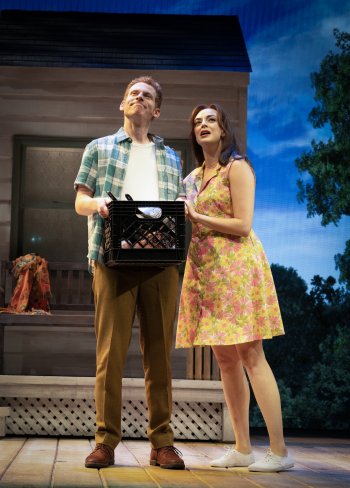
Max Chernin as Marty and Talia Suskauer as Pearl in a scene from the new musical “A Walk on the Moon” at the Laura Pels Theatre (Photo credit: Joan Marcus)
Most successful is the visual aspect of the show: Tal Yarden’s scenic and video designs are colorful and eye-filling. The set for three of the bungalow colony accommodations is backed by beautiful skyscapes of the lake and wooded grounds that bring such places from the past to life. The downstage set for the woods has dark inviting trees, while the psychedelic swirls for Woodstock are vivid and intriguing. Ricky Lurie’s costumes are a bit muted by colorful and different for each character. Some of director Kaller’s staging is awkward but that may be because of the arrangement of the set.
Suskauer fails to make Pearl sympathetic as did Diane Lane in the movie but then we never know what her dreams were. As Marty, Chernin is the dull husband who has grown to have little conversation over the years. Gravitte’s Walker is not much more than long haired hippie who comes and goes as he wishes. Burns as Marty’s mother Lillian is less incisive than she usually is and does not make us forget Feldshuh’s performance in the movie. Best is Pollono as teenager daughter Alison, committed, feisty and clear headed. Oscar Williams as her boyfriend Ross is kind of an awkward youth still finding his way. Pearl’s neighbors and Maj-Jongg players Megan Kane as Bunny, Caroline Pernick as Eleanor and Becca Suskauer as the irrepressible Rhoda give fine support. Feldshuh herself plays the voice of Mrs. Fogler who makes the announcements about the events of the colony.
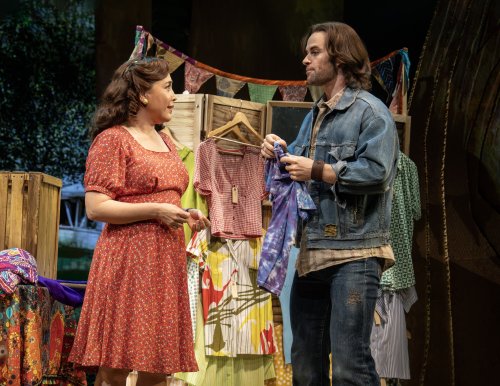
Andréa Burns as Lillian and Sam Gravitte as Walker in a scene from the new musical “A Walk on the Moon” at the Laura Pels Theatre (Photo credit: Joan Marcus)
A Walk on the Moon is an engaging musical without the wow factor. The cast certainly tries hard. It might have helped if there had been some blockbuster songs but such is not the case. You know why Pearl is bored with Marty but other than the fact he is a free-spirit, you do not know why she is attracted to Walker. If you haven’t seen the cult movie, you might enjoy the musical more than if you do: you won’t realize what the show is missing. The musical of A Walk on the Moon seems like a lot of missed opportunities.
A Walk on the Moon (through August 22, 2026)
Laura Theatre at the Harold and Miriam Steinberg Center for Theatre, 111 W. 46th Street, in Manhattan
For tickets, visit http://www.awalkonthemoonmusical.com
Running time: two hours and 20 minutes including one intermission


Leave a comment