
News Ticker

Diane Lane

A Walk on the Moon

July 5, 2026

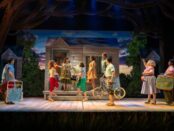
The new musical "A Walk on the Moon" by original screenwriter Pamela Gray and composer and lyricist AnnMarie Milazzo is pleasant but innocuous. Based on the hit 1999 movie set during the summer of 1969 that starred Diane Lane, Liev Schreiber, Viggo Mortensen, Tovah Feldshuh and Anna Paquin, the stage musical feels like a watered-down version of the film. While the film had time appropriate songs from the 1960s, the stage version has new bland, unmemorable songs that do not forward the plot. The hard-working cast headed by Talia Suskauer, Max Chernin, Sam Gravitte and Andréa Burns under the direction of Sheryl Kaller never make us forget the performances from the film. [more]

The Cherry Orchard

October 25, 2016

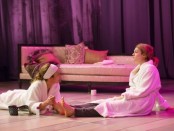
Directed by high profile new British director Simon Godwin, associate director of the U.K.’s National Theatre, making his New York debut, this "Cherry Orchard" seems to have no interpretation or explanation for a new staging. Stephen Karam, the author of last season’s acclaimed "The Humans," has written a new version which seems to be heavy on American ideas in this Russian play, while both the sets and costume designs get in the way of coherence and understanding. All in all this is a great disappointment considering the talent involved. [more]

The Mystery of Love & Sex

March 23, 2015

Bathsheba Doran’s new drama, "The Mystery of Love & Sex," now at Lincoln Center Theater’s Mitzi E. Newhouse, is yet another play whose title is a misnomer. The story is really about friendship and self-identity for a young college-age couple who grew up together in a Southern suburb. Along the way, the play brings in racism, sexism, homophobia and religious mania, as well as the confusions of youth, as the couple try to maintain their close relationship while falling in love with other people. Although director Sam Gold’s cast is made up of veteran actors Diane Lane and Tony Shalhoub and newcomers Mamoudou Athie and Gayle Rankin doing fine work, the play’s first act is entirely exposition and is basically used to set up the situation. This is a play that would do well to lose its intermission as it really doesn’t begin until its second act. [more]