
Animal Wisdom
Kenita R. Miller embodies the composer fusing revival hymns, delta laments, mountain ballads, and spectral harmonies into a hypnotic rite of transcendence.
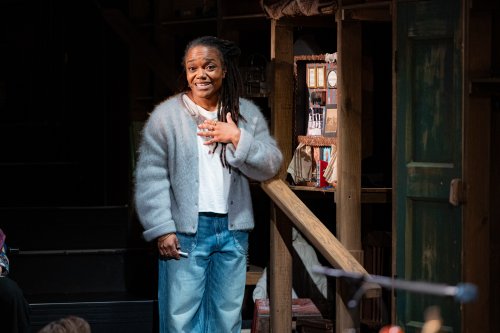
Kenita R. Miller in Heather Christian’s “Animal Wisdom” at The Pershing Square Signature Center (Photo credit: Ben Arons)
There are evenings in the theater when one feels not merely entertained but altered—mysteriously unfastened from the ordinary mechanisms of perception and delivered into some older, stranger chamber of human experience. Signature Theatre’s revival of Heather Christian’s astonishing Animal Wisdom, now directed with ecstatic precision by Keenan Tyler Oliphant, belongs emphatically to that rare category. To call it a musical is technically accurate in the same way that calling a cathedral a building is technically accurate. What Christian has fashioned is less a stage work than a séance disguised as an oratorio, a requiem disguised as autobiography, and a communal rite disguised—very loosely—as theater.
The evening begins with a sly acknowledgment of its own displacement. This piece, we are informed, was intended for a ruined church or some other “holy space,” though the observation quickly becomes theological rather than logistical: theaters, after all, are continually deconsecrated and reconsecrated. By the time the performance ends, one understands precisely what Christian means. The Romulus Linney Courtyard has ceased to function as a conventional performance venue. It has become a sanctum for grief, memory, and ecstatic release.
Christian first performed Animal Wisdom herself nearly a decade ago at the Bushwick Starr, introducing downtown audiences to a voice so singular that conventional genre labels simply collapsed around it. The intervening years have only clarified the magnitude of her achievement. Christian writes music that seems excavated rather than composed: Southern gospel, Appalachian folk, Pentecostal exaltation, blues lamentation, liturgical chant, and avant-garde noise all coexist in a sonic vocabulary that feels at once ancient and utterly unprecedented. Her lyrics move associatively, spiritually, by dream logic rather than narrative logic. The result is not confusion but immersion. One stops trying to decode the work and instead submits to it.
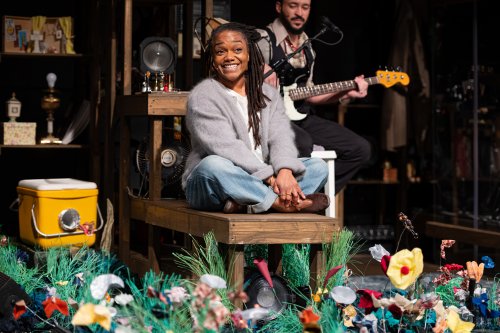
Kenita R. Miller and Kris Saint-Louis in Heather Christian’s “Animal Wisdom” at The Pershing Square Signature Center (Photo credit: Ben Arons)
In this production, the formidable Kenita R. Miller assumes the role of H—Christian’s autobiographical surrogate—with such total emotional permeability that the distinction between performer and medium begins to dissolve. Earlier this season, Miller brought the same lush vocals and radiant warmth she displays here to her work with The HawtPlates in Dream Feed, the beautifully haunting offering at this year’s Under the Radar Festival. Before the evening properly begins, Miller introduces herself plainly, reminding us that these are Heather’s stories, not her own. Yet within minutes that disclaimer becomes irrelevant. Miller inhabits H with a startling combination of authority and vulnerability, her voice capable of moving from conversational intimacy to volcanic spiritual release in a single phrase. She does not perform the songs so much as surrender herself to them.
H emerges as a woman haunted in every conceivable sense: by ancestors, by memory, by inherited sorrow, by Catholic mysticism, by Southern folklore, by the peculiar loneliness of artistic sensitivity. She comes from a lineage of migraine-stricken musicians who commune with the dead as casually as others speak with neighbors. Ghosts populate her cosmology with unnerving matter-of-factness. A grandmother transmigrates into a cardinal. A grandfather resides in a car. Rainstorms heighten spectral activity. Coca-Cola possesses sacramental properties. The marvelous thing about Christian’s writing is that none of this is offered with coy whimsy or self-conscious eccentricity. The supernatural is simply woven into daily existence, another current running beneath ordinary life.
The production’s visual world, designed with intoxicating intricacy by Emmie Finckel, resembles the inside of a memory in the process of decaying and flowering simultaneously. The stage overflows with devotional clutter: votive shrines, fishnet vines, antique tchotchkes, collapsing domestic relics, strands of trembling lights, fragments of gardens both living and dead. Every corner appears inhabited by history. The environment does not merely decorate H’s psyche; it externalizes it. Meanwhile, Masha Tsimring’s miraculous lighting transforms the room from humid Southern dusk to supernatural visitation with almost imperceptible fluidity. At moments, the theater glows as though lit from within by memory itself.
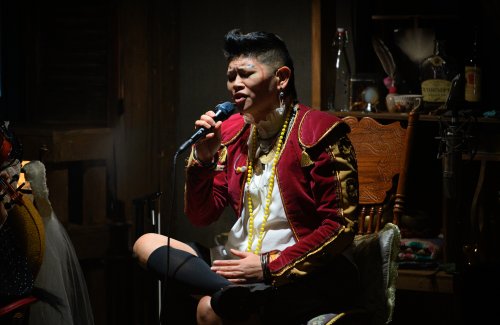
El Beh in Heather Christian’s “Animal Wisdom” at The Pershing Square Signature Center (Photo credit: Ben Arons)
Equally essential is the incomparable six-piece band, functioning not as accompaniment but as an animate spiritual collective. Under the musical direction of Alexandra Crosby, the ensemble performs with astonishing emotional responsiveness. The musicians drift in and out of character, testimony, ritual, and chorus. At one point they answer “spiritually adjacent icebreaker questions” drawn from a jar, an absurdly charming gesture that somehow deepens rather than disrupts the ceremonial atmosphere. Their presence grounds the evening in communal humanity even as the music continually strains toward transcendence. While the cast’s stage clothing is lived in and probably what they came to the theatre wearing, one hilarious moment finds Crosby, cellist El Beh, violinist Francesca Dawis, percussionist Caro Moore, bassist Kris Saint-Louis, and guitarist Zack Zaromatidis donning Brenda Abbandandolo’s whimsical costumes and wigs to provide variations on a theme of Doris, Christian’s first piano teacher.
The music lifts our emotions into rapture. Christian possesses a near-supernatural instinct for escalation. Songs begin as murmurs, fragments, private confessions, only to accumulate harmonic force until they seem capable of lifting the room bodily into the air. The harmonies arrive not neatly but overwhelmingly, crashing open emotional spaces one did not realize had been sealed shut. Again and again, Miller and the ensemble achieve the sort of full-bodied sonic communion typically reserved for actual houses of worship. The effect is less theatrical than physiological; one feels the music vibrating through the rib cage like an exorcism.
What makes Animal Wisdom so extraordinary, however, is that its grandeur never abandons specificity. Christian understands that the sacred reveals itself through tiny material details: a grandfather feeding his wife fruit from a silver spoon, the smell of wet gardens, the exhaustion following spiritual summoning, the strange comfort of cheap soda after grief. These details tether the work to earthly life even while its ambitions reach toward metaphysical inquiry. Inheritance, mortality, loneliness, devotion, fear, eros, memory—Christian attempts to hold all of it simultaneously, and astonishingly, she nearly does.
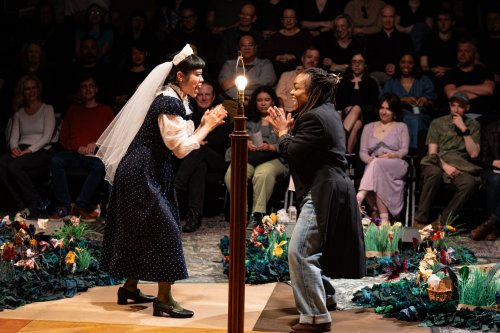
Francesca Dawis and Kenita R. Miller in Heather Christian’s “Animal Wisdom” at The Pershing Square Signature Center (Photo credit: Ben Arons)
Director Oliphant proves an ideal steward for this impossible material. His staging embraces both the ritual solemnity and the anarchic humor embedded within Christian’s sensibility. The production is richer, stranger, and more theatrically expansive than the original Bushwick incarnation without sacrificing any intimacy. Oliphant understands that the evening’s apparent shapelessness conceals rigorous emotional architecture. The performance moves inexorably from anecdotal remembrance toward collective mourning, from storytelling toward surrender.
Then comes the final passage, among the most overwhelming sustained sequences currently on any New York stage. The theater descends into total blackout—not symbolic darkness but genuine obliteration. Exit signs vanish. Architectural boundaries dissolve. One no longer sees the performers or fellow audience members. Out of this void emerges a vast choir, their voices swelling through the darkness with terrifying beauty. The effect is almost impossible to describe without sounding hyperbolic. One does not watch this section so much as endure and absorb it. The music ceases to feel performed and instead becomes environmental, elemental, tidal. Nick Kourtides’ sound design here does not merely support the score; it enlarges it into an enveloping atmosphere of ecstatic resonance, surrounding the audience in waves of sound that feel at once intimate and cosmic.
In lesser hands, such unapologetic spiritual ambition might curdle into pretension. Christian avoids that fate through radical sincerity. There is no irony here, no defensive cleverness, no fashionable detachment. Animal Wisdom asks audiences to entertain the possibility that music might genuinely heal, that ritual might genuinely matter, that communion with the dead might be emotionally real regardless of one’s theological convictions. Astonishingly, the production earns that audacity.
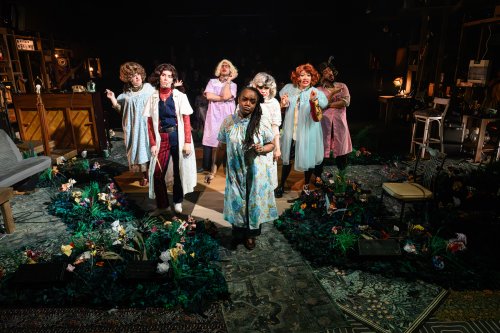
Alexandra Crosby, Caro Moore, Zack Zaromatidis, Kenita R. Miller, Francesca Dawis, El Beh and Kris Saint-Louis in Heather Christian’s “Animal Wisdom” at The Pershing Square Signature Center (Photo credit: Ben Arons)
By the evening’s conclusion, the audience has not merely witnessed a performance but participated in an act of collective grieving and release. One leaves the theater feeling curiously weightless, as though some unnamed sorrow has been drawn quietly out of the body. Heather Christian has created one of the most unclassifiable works in contemporary American theater, and also one of the most profound. Animal Wisdom is not simply unforgettable. It feels consecrated.
Animal Wisdom (through June 14, 2026)
Signature Theatre produced in association with Pipeline Arts Productions
Romulus Linney Courtyard Theatre at The Pershing Square Signature Center, 480 West 42nd Street, in Manhattan
For tickets, visit http://www.signaturetheatre.org
Running time: two hours without an intermission


Leave a comment