
The Emporium
An unfinished Thornton Wilder play becomes a haunting meditation on art, longing, and humanity’s endless need to begin again and again across time.
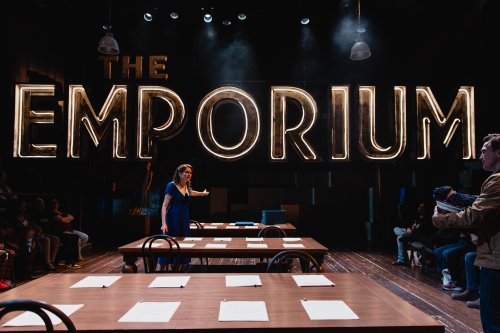
Candy Buckley and Joe Tapper in a scene from Thornton Wilder’s “The Emporium” at the Classic Stage Company (Photo credit: Marc J. Franklin)
There is something almost unbearably poignant about encountering a major playwright’s unfinished work: not merely the thrill of discovery, but the sensation of standing inside the workshop of a restless intelligence still arguing with itself. At the Classic Stage Company, Thornton Wilder’s The Emporium arrives not as a polished relic unearthed intact from the archives, but as a glorious, perplexing, half-assembled cathedral of ideas—one that playwright Kirk Lynn has lovingly, audaciously, and with extraordinary sensitivity shaped from the hundreds of handwritten pages Wilder left behind. The result is less a completed play than a séance with one of the great American theatrical minds, and it proves utterly enthralling.
Billed as Thornton Wilder’s The Emporium, presumably in acknowledgment of its unusual authorship, the production originates from a cache of roughly three hundred and sixty manuscript pages discovered by Lynn among Wilder’s papers at Yale’s Beinecke Library. Wilder began the play in 1948, announced it for Broadway more than once, reportedly imagined Montgomery Clift in the leading role, and then—unable to solve whatever structural or philosophical riddles vexed him—kept rewriting it through the 1950s before abandoning it altogether. One leaves the theater understanding exactly why he could not let it go. The Emporium contains, in embryonic form, nearly every obsession of Wilder’s career: commerce and transcendence, cosmic recurrence, theatrical illusion, the loneliness of ambition, the terrifying freedom of modern life, and humanity’s stubborn determination to continue despite repeated disappointment.
Director Rob Melrose’s production embraces the play’s unfinished quality not apologetically but ecstatically. From the outset, the evening announces itself as both literary excavation and theatrical event. Joe Tapper begins not quite as a character but as a delighted emissary from the archives, recounting Lynn’s discovery before seamlessly slipping into the role of John Foster, the foundling whose life story becomes the play’s central pilgrimage. The transition from scholarship to fiction happens so fluidly that one scarcely notices reality giving way to myth. Wilder’s favorite theatrical trick—the revelation that storytelling itself is the subject—is already in motion.
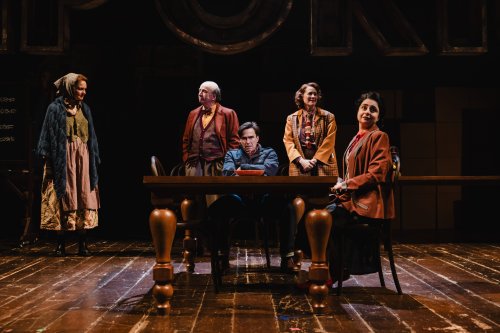
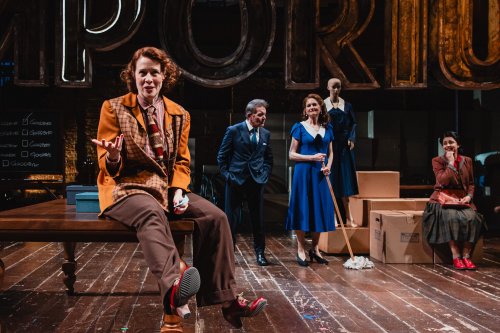
Candy Buckley, Patrick Kerr, Joe Tapper, Eva Kaminsky, Mahira Kakkar in a scene from Thornton Wilder’s “The Emporium” at the Classic Stage Company (Photo credit: Marc J. Franklin)
John, discovered as an infant in a basket outside the grand department store known as the Emporium, grows up haunted by the place’s almost metaphysical allure. Like so many Wilder protagonists, he is both an innocent and a seeker, a fundamentally decent American pilgrim wandering toward a destination he only dimly understands. The Emporium itself becomes at once department store, cathedral, artistic calling, romantic ideal, and existential mirage. Wilder once described the play as “a mixture of Horatio Alger and Franz Kafka,” and the description proves hilariously apt: John’s yearning possesses the earnestness of American self-invention while the bureaucratic evasions surrounding the store carry the absurd, unknowable menace of a dream.
Tapper gives a marvelously openhearted performance. His John radiates hopefulness so persistent that it gradually becomes tragic. Even as doors close repeatedly in his face, Tapper never permits the character to curdle into bitterness; instead, disappointment deepens his wonder. The actor’s unaffected sincerity anchors a play that otherwise floats deliberately toward abstraction. Wilder’s cosmological musings can sometimes drift into vaporousness, but Tapper keeps the evening human-sized.
Around him revolves a dazzling ensemble performing with the heightened elasticity Wilder’s peculiar dramaturgy demands. Candy Buckley, in particular, is a source of inexhaustible delight. Few actors today understand the Wilderian tonal register—the ability to pivot instantly from comedy to metaphysical gravity—as instinctively as Buckley does. She sweeps through half a dozen roles with ferocious comic precision: an officious saleswoman, a worldly landlady, a mournful maternal figure, a grotesquely pampered heiress in an appalling green frock. Each character arrives fully inhabited yet lightly worn, as though Buckley were conjuring entire lives with a flick of the wrist. Derek Smith matches her versatility with a gallery of sharply etched portraits ranging from tyrannical farmer to doddering millionaire, while Cassia Thompson gives Laurencia, the shopgirl who understands the Emporium more deeply than John ever can, an alluring blend of intelligence, melancholy, and practical wisdom.
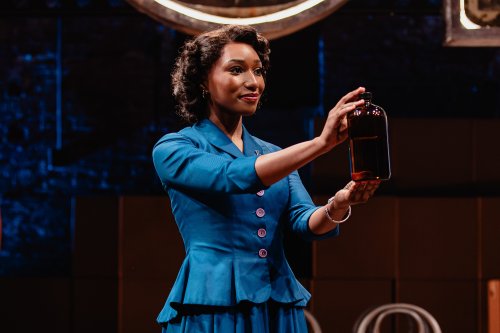
Cassia Thompson in a scene from Thornton Wilder’s “The Emporium” at the Classic Stage Company (Photo credit: Marc J. Franklin)
Melrose directs with remarkable confidence, refusing either to over-explain the play’s mysteries or to iron out its structural eccentricities. Wilder’s drama constantly ruptures conventional narrative: audience members are recruited to provide sound effects, phone lights become stars in the night sky, and three spectators—played with exquisite deadpan wit by Mahira Kakkar, Eva Kaminsky, and Patrick Kerr—gradually emerge as something like a Greek chorus, guardian spirits, or cosmic observers wandering in from another dimension. The production accepts all of this not as whimsy for whimsy’s sake, but as part of Wilder’s lifelong attempt to dissolve the barrier between stage and audience, performer and witness, life and art.
The design team contributes immeasurably to the evening’s strange enchantment. Walt Spangler’s split-level thrust set, dominated by a looming illuminated Emporium sign that seems at once glamorous and decaying, evokes both a vanished department-store palace and a mythic gateway. Cate Tate Starmer’s lighting transforms the open stage with cinematic fluidity, conjuring intimacy, vastness, nostalgia, and cosmic terror often within the same scene. Alejo Vietti’s richly expressive costumes capture postwar America without ever becoming museum pieces, while Darron L. West’s sound design and Anya Kutner’s lovingly detailed props lend the production an atmosphere of perpetual theatrical invention.
What becomes increasingly moving across the evening is the extent to which Wilder appears to be wrestling with the purpose of art itself. The Emporium—coveted, elusive, spiritually dangerous—gradually reveals itself as a metaphor for artistic life: glorious, unstable, irrational, economically disastrous, yet impossible for certain souls to resist. Opposed to it stands Craigie’s, the rival store promising order, predictability, and security. Wilder’s conflict is not merely between art and commerce, but between mystery and safety, risk and numbness. The play asks, with startling directness, what remains of a human life once wonder has been surrendered.
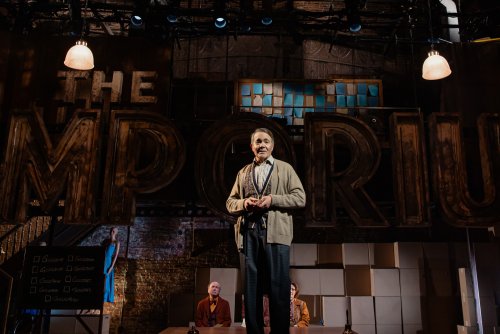
Derek Smith in a scene from Thornton Wilder’s “The Emporium” at the Classic Stage Company (Photo credit: Marc J. Franklin)
At intermission, in one of the production’s most inspired gestures, the audience votes on whether to see a scene Lynn constructed from Wilder’s unpublished notes explaining the play’s central metaphor. The device could have felt precious; instead, it becomes profoundly Wilderian, transforming spectators into collaborators in the playwright’s unfinished search for meaning. Even the play’s incompleteness becomes part of its emotional texture. One senses Wilder circling these ideas for years precisely because no single explanation could ever satisfy him.
And yet the evening’s achievement lies in transcending literary curiosity. This is not merely a fascinating footnote for Wilder scholars, nor a dutiful reconstruction of an abandoned manuscript. Against considerable odds, The Emporium emerges as a living, breathing piece of theater—funny, strange, touching, intellectually adventurous, and finally quite overwhelming in its generosity of spirit. The play may remain unresolved, but perhaps that irresolution is the point. Wilder understood, as few dramatists have, that human beings survive not through certainty but through repetition: through beginning again after each challenge.
“Nine tough goodbyes is generally thought to add up to a full life. It’s as much as most people can handle.” So declares one of the Emporium’s worldly gatekeepers early in the evening, and the production proceeds to tally those farewells on a chalkboard like stations in an existential pilgrimage. Each goodbye marks another shedding of innocence, ambition, certainty, or love, until the accumulating departures begin to resemble the rhythm of life itself. The structure, at once playful and mournful, reveals the play’s deeply circular design: Wilder’s characters do not advance toward resolution so much as spiral repeatedly through longing, disappointment, renewal, and return.
In the end, The Emporium feels less like an unfinished masterpiece than a masterpiece about unfinishedness itself. Wilder’s great subject was always humanity’s fragile persistence against cosmic indifference, and here, in this haunting theatrical palimpsest assembled decades after his death, that vision glows with startling force. Leaving the theater, one experiences the rare sensation not merely of having seen a play, but of having communed with an artist still thinking aloud across time.
Thornton Wilder’s The Emporium (through June 7, 2026)
Lynn F. Angelson Theater at the Classic Stage Company, 136 East 13th Street, in Manhattan
For tickets, visit www.classicstage.org
Running time: two hours and 15 minutes including one intermission


Leave a comment