
Canciones
An immersive play with music takes us into a gathering of a Mexican family in Brooklyn, one where we don't just visit, we immediately belong.
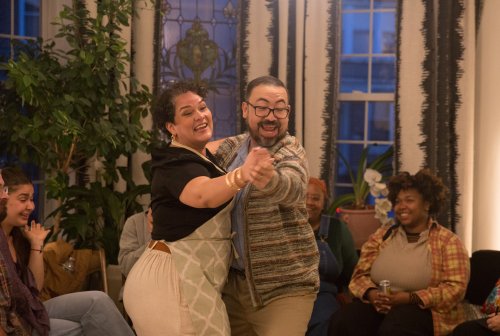
Cristina Contreras and Chino Ramos in a scene from “Canciones” (Photo credit: Jody Christopherson)
In an era when immersive theater often mistakes coercion for intimacy and novelty for depth, Canciones achieves something far rarer and more difficult: it dissolves the boundary between audience and story so completely that one forgets, within minutes, the architecture of performance altogether. The evening begins not in a black box or warehouse but on a quiet residential street in Flatbush, where audience members double-check addresses beneath rows of family homes before spotting a tent draped in papel picado outside a modest Brooklyn house. That small uncertainty—the feeling of arriving at a stranger’s gathering as someone’s tentative plus-one—becomes the production’s first brilliant stroke. Before anyone has crossed the threshold, the play has already begun disarming its audience.
Under the tent serving as a makeshift box office, guests receive shoe covers and pins indicating their comfort level with actor interaction, though the production’s remarkable achievement is how swiftly such anxieties evaporate. A nervous woman named Kati, played with extraordinary emotional immediacy by Sara Ornelas, approaches audience members before they even enter the home, asking advice about an email she has drafted regarding the sale of a treasured family charro suit to a museum. It is an elegant piece of dramaturgical sleight of hand: exposition disguised as casual conversation. By the time the audience ascends the narrow staircase into the crowded home, they have already been implicated in the family’s conflict.
Inside, Canciones unfolds less like a play than like an actual family gathering one has somehow wandered into midway through the evening. The house hums with side conversations, overlapping instructions, beer coolers on the patio, guitars in the basement, cousins teasing one another from room to room. Guests are separated organically into shifting clusters and ushered through the home not with theatrical rigidity but with the casual hospitality of relatives making space at a crowded party. Downstairs, primo Ricky, played with irresistible warmth and improvisatory ease by Sammy Rivas, and sister-in-law Jenn, wife to brother Tommy who has a history of not making an appearance at family gatherings, played by the welcoming EJ Zimmerman, invite audience members into a basement jam session lined with wood paneling, family photographs, storage bins, and the cluttered archaeology of real domestic life. He hands out instruments from a basket on the floor, riffs on guitars, jokes about getting high with cousins, and casually points to photographs of the family’s prized mariachi heirloom hanging nearby. Jenn joins on fiddle. The realism is so granular, so socially exact, that one stops observing and simply begins participating.
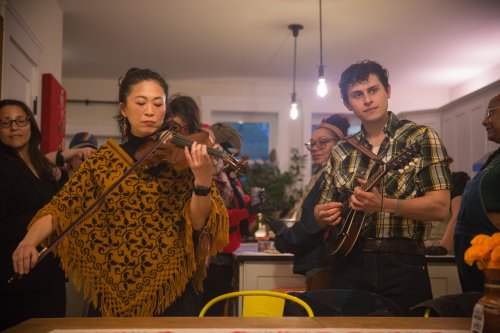
EJ Zimmerman and Sammy Rivas in a scene from “Canciones” (Photo credit: Jody Christopherson)
What distinguishes Canciones from lesser immersive productions is its astonishing command of social chemistry. So much immersive theater depends upon audience compliance; this production earns audience trust instead. The actors listen with genuine attentiveness, responding to guests not with mechanical improvisation but with the textured responsiveness of actual relatives. Conversations about grief, migration, memory, and obligation unfold with startling naturalism. Cristina Contreras, as Ely, the older sister desperately trying to preserve both the family home and its traditions, emerges as the evening’s emotional anchor. Contreras performs the exhausting labor of familial caretaking with devastating specificity: hosting while unraveling, listening while monitoring every room, smiling while silently calculating decades of sacrifice. Her arguments with Kati accrue not through melodramatic eruptions but through the microscopic humiliations familiar to every family gathering—loaded glances, interruptions, historical revisions, accusations disguised as jokes. The rhythms of resentment feel painfully lived-in.
The production’s most inspired choice may be its incorporation of food not as prop but as communal ritual. Midway through the evening, audience members are recruited into the kitchen to help prepare actual tamales alongside the actors. Masa is spread. Corn husks are folded. Salsa is passed around while conversations spill from room to room. Eventually, the tamales themselves are served and eaten communally as arguments continue unfolding nearby. There is something profoundly moving about this gesture—not merely immersive but sacramental. The act of cooking together collapses the distinction between witness and participant. Strangers begin speaking to one another like cousins. Audience members swap family stories and share fragments of information gleaned from different rooms. The production transforms spectatorship into collective memory-making.
And then there is the music, which arrives not as ornamental interlude but as the family’s emotional bloodstream. The house periodically erupts into mariachi songs performed with breathtaking immediacy by the ensemble, their harmonies reverberating through the living room and kitchen with such force that the walls themselves seem to vibrate. Chino Ramos as Julio, Ely’s husband, is on guitar most of the evening while Mayelah Barrera as Nina, Julio’s and Ely’s daughter, sings beautifully conjuring memories of the celebrated legend Selena. Hearing these voices from mere feet away—unamplified, unguarded, live within a domestic space—fundamentally alters the emotional experience of musical performance. The songs do not feel polished into theatrical sheen; they feel inherited. They carry grief, pride, longing, and history inside them. Ornelas, especially, commands the room with vocals of astonishing emotional power, her singing so full-bodied and aching that entire conversations cease mid-sentence. In Canciones, music is not entertainment. It is lineage.

Cristina Contreras in a scene from “Canciones” (Photo credit: Jody Christopherson)
The play’s central conflict—the proposed sale of the family’s charro suit to a new Latinx museum—serves less as plot engine than as vessel for larger questions about cultural inheritance, assimilation, sacrifice, and preservation. Yet Canciones wisely resists simplifying its tensions into moral binaries. Kati’s desire to honor the family legacy through institutional recognition feels understandable; Ely’s resistance to commodifying memory feels equally urgent. Around them orbit smaller but equally resonant conflicts: a daughter considering leaving home for California, an aging matriarch, Maestra, played by the emotionally centered Johanna Carlisle-Zepeda, resisting her children’s attempts to soften her vitality, and siblings tallying old wounds with forensic precision. Like any real family, everyone believes themselves to be both victim and caretaker simultaneously.
So relaxed and organically convivial are the surroundings of Canciones that one can occasionally lose sight of the fact that this gathering—this warm, noisy, emotionally volatile house party pulsing with music and overlapping conversations—is, in fact, an intricately calibrated piece of theater. That illusion of effortlessness is itself the production’s supreme accomplishment. The piece has been collaboratively created by director Rebecca Martínez, music director and arranger Julián Mesri, writer Beto O’Byrne, actor Sara Ornelas, and dramaturg Meropi Peponides, and what they have fashioned together feels astonishingly free of visible scaffolding. One senses an immense amount of rigor hidden beneath the evening’s casual hospitality.
Martínez’s direction is especially remarkable for its restraint. Many immersive productions overdirect their environments, pushing audiences toward revelation with the desperation of a theme park attraction. Martínez instead trusts atmosphere, rhythm, and human behavior. Her touch is felt in the subtle generosity that permeates the evening: the instinctive warmth with which guests are greeted, the fluidity with which conversations overlap, the graceful orchestration of movement through the house. Nothing feels forced. Nothing announces itself as theatrical craft. The production simply unfolds around its audience with the persuasive messiness of lived experience.

Johanna Carlisle-Zepeda in a scene from “Canciones” (Photo credit: Jody Christopherson)
Although the production takes place inside a donated private home, scenic and production designer Raul Abrego ensures the environment never feels fetishized or curated into artificial quaintness. This is not a precious museum exhibit of domesticity; it is a convincingly inhabited family home. Storage bins remain tucked into corners. Papers clutter surfaces. Plants spill into shared spaces. The kitchen bears the marks of actual use. Every room carries the accumulated texture of generations living on top of one another. The audience is not observing realism; they are temporarily absorbed into it.
The costumes by Christopher Vergara are equally attentive to character and social specificity. The clothing never strains for theatrical symbolism; instead, it locates each family member precisely within the gathering’s emotional ecosystem. One immediately understands personalities, generational tensions, and differing relationships to tradition through what these people wear to this particular evening. Most striking of all is the breathtaking appearance late in the production of Nina in the family’s charro suit. The image lands with nearly mythic force. After hearing so much discussion about the garment—its history, its emotional weight, its contested future—the charro emerges not merely as costume but as inheritance made visible.
Lighting designer María-Cristina Fusté performs the delicate task of preserving the illusion of ordinary domestic space while quietly sculpting emotional focus. The house remains warmly illuminated throughout, maintaining the natural conviviality of a real family gathering, yet subtle shifts in light gently isolate moments of grief, confrontation, or musical transcendence without ever rupturing the evening’s realism. Similarly, sound designer Tye Hunt Fitzgerald achieves a nearly invisible precision. The production understands the razor-thin distinction between intimacy and chaos, between a theatrical environment and an actual crowded house party. Fitzgerald calibrates that balance perfectly: conversations overlap without becoming muddy, music fills the house without overwhelming it, and every room retains its own emotional acoustics. The result is not simply immersive theater but immersive listening—a production in which audiences become attuned not only to dialogue and song but to the fragile emotional frequencies of family life itself.
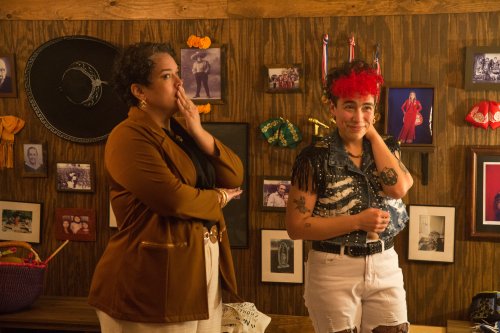
Cristina Contreras and Sara Ornelas in a scene from “Canciones” (Photo credit: Jody Christopherson)
What lingers after Canciones is not merely admiration for its technical accomplishment, though its orchestration of simultaneous conversations, improvisational responsiveness, and environmental storytelling is extraordinarily sophisticated. What lingers is the startling emotional aftereffect of having spent several hours inside a space that feels genuinely communal. By the evening’s conclusion, audience members are handed lyrics and invited to sing alongside the family as the entire house joins together in music. The effect is unexpectedly overwhelming. One leaves not with the sensation of exiting a performance but of departing an actual gathering reluctantly, lingering on the sidewalk as though saying goodbye to relatives after a holiday party.
There is something deeply restorative about Canciones—particularly now, in a cultural moment so saturated with isolation, irony, and digital remove. The production understands that immersion is not achieved through spectacle or gimmickry but through care: through hospitality, attentiveness, food, music, shared space, and the fragile social miracle of making strangers feel temporarily necessary to one another. By the time the audience steps back out onto the quiet Brooklyn street, the night air feels strangely thinner than the crowded warmth they have left behind. One carries the sensation of the house outward: the laughter spilling between rooms, the smell of tamales, the guitars humming downstairs, the unresolved arguments, the songs still echoing through the walls. Canciones does not simply invite audiences into a family’s home. It allows them, for a few fleeting hours, to belong there.
Canciones (through May 24, 2026)
Radical Evolution, Latinx Playwrights Circle, The Sol Project and Boundless Theatre Company
A private house, in Brooklyn
For tickets, visit http://www.radicalevolution.org
Running time: one hour and 40 minutes without an intermission


Leave a comment