
73 Seconds
A multimedia-theater virtuoso goes analog—through cassette tapes, VHS, and memory—to excavate the hidden galaxies of his relationship to his mother.
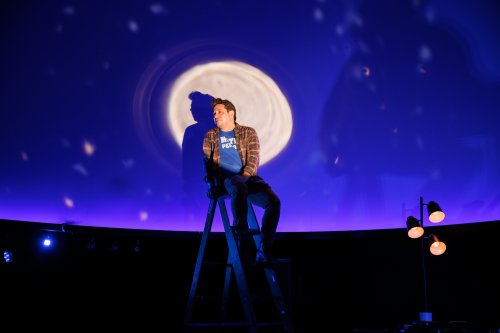
Jared Mezzocchi in a scene from his “73 Seconds” at Lower East Side Girls Club Planetarium (Photo credit: Maria Baranova)
In 73 Seconds, memory is not presented as narrative so much as atmosphere—a drifting accumulation of half-buried truths, vanished possibilities, and emotional aftershocks suspended in the air like cosmic dust. The play does not merely recount a life; it listens for the echoes left behind by all that was never fully spoken. In this hauntingly beautiful and structurally daring solo work, creator, writer and performer Jared Mezzocchi transforms autobiography into a form of celestial archaeology, sifting through memory, grief, and family myth with the meticulous wonder of someone charting an unfamiliar galaxy. Staged inside the intimate planetarium of the Lower Eastside Girls Club, the production surrounds its audience with stars while asking devastatingly earthly questions: How well can we ever know our parents? What survives when memory fails? And how does one mourn a person who is still alive?
Under the exquisitely calibrated direction of Aya Ogawa, the evening unfolds with the hypnotic inevitability of a constellation slowly revealing its shape. Co-developing here, Ogawa whose own work has long explored the unstable terrain of family and identity, proves an ideal collaborator for Mezzocchi’s material. Her staging possesses both intimacy and cosmic scale, allowing the production to drift fluidly between documentary realism and metaphysical meditation. She understands that the play’s emotional power lies not in sentimentality but in the tension between revelation and restraint, between what a mother chooses to say and what remains suspended forever in silence.
The first of the work’s three autobiographical movements begins at a rustic steakhouse after Mezzocchi’s high-school graduation. Beneath a framed photograph of astronauts, his mother, Rosemary, casually reveals that she once worked for NASA and had even been vetted for the Teacher in Space program that ultimately sent Christa McAuliffe aboard the doomed Challenger mission. Rosemary withdrew from consideration after becoming pregnant with Jared, a revelation that transforms her in her son’s imagination from beloved small-town math teacher into a figure who once brushed against history itself. “I’m looking at my mom as if she’s morphing into this real-life superhero,” Mezzocchi recalls, and the line captures the production’s central astonishment: the realization that our parents possessed entire identities, ambitions, and unrealized futures long before we entered the frame.
The title refers to the catastrophic 73 seconds between the Challenger’s launch and explosion, and Mezzocchi turns those seconds into the play’s governing existential paradox. Had Rosemary not become pregnant, might she have boarded that shuttle instead? The playwright comes to see himself simultaneously as the force that prevented his mother’s cosmic aspirations and the accidental reason she survived. Few memoir plays confront the absurd intimacy between guilt and gratitude with such honesty. The production recognizes how families construct themselves around contingencies so enormous they become nearly impossible to contemplate directly. Mezzocchi’s very existence becomes entangled with one of the most traumatic public tragedies of the 20th century.
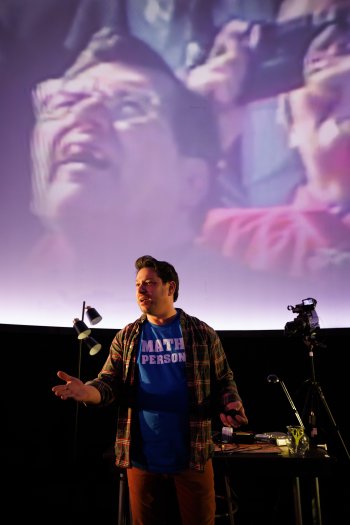
Jared Mezzocchi in a scene from his “73 Seconds” at Lower East Side Girls Club Planetarium (Photo credit: Maria Baranova)
The second movement descends from the speculative grandeur of space travel into the blunt immediacy of mortality. While attending college in Connecticut, Mezzocchi learns that his father has suffered a brain aneurysm. Yet even in crisis Rosemary cannot speak plainly. Over the phone she repeatedly insists only that his father is “in the same condition,” a phrase whose evasiveness becomes agonizing as he races through a New England snowstorm toward the hospital in New Hampshire. The production’s emotional architecture reaches its full sophistication here, revealing a family dynamic shaped less by confrontation than by omission. Rosemary’s instinct is not deception so much as emotional self-containment; she absorbs catastrophe inwardly, shielding others from pain, even a fatality, when silence itself becomes painful.
In the transitions one begins to appreciate fully the astonishing cohesion of the production’s design, which functions less as theatrical decoration than as an extension of memory itself. The production design and scenography by Calvin Anderson create an environment in which the analog textures of the late 20th century become vessels for emotional excavation. Lighting and video consultant work by Jeanette Oi-Suk Yew suffuses the dome with celestial vastness while preserving the fragile intimacy of family recollection. Technology lead Vinny Mraz integrates live-feed cameras, archival NASA footage, VHS imagery, overhead projectors, cassette tapes, and fading family photographs into a seamless multimedia language that feels simultaneously cutting-edge and deeply nostalgic. Meanwhile, the sound design by Ryan Gamblin layers the evening with the clicks, hums, rewinds, and ghostly reverberations of obsolete machinery, turning memory itself into an audible landscape.
The production’s final movement is among the most devastating theatrical depictions of Alzheimer’s disease in recent memory. Rosemary, now remarried and increasingly unmoored by dementia, suffers a spiraling meltdown during a simple card game while her exhausted husband struggles helplessly nearby. Watching the scene unfold, Mezzocchi confronts the unbearable contradiction of loving someone who is physically present yet psychologically receding beyond reach. “What am I doing, memorializing someone who’s still alive?” he asks at one point, and the line lands with almost unbearable force. The play understands dementia not merely as illness but as a gradual cosmological disappearance—the slow extinguishing of a once-brilliant star whose light still reaches us even after the source itself has begun to vanish.
What elevates 73 Seconds beyond the crowded field of autobiographical theater is Mezzocchi’s extraordinary command of theatrical form. Long celebrated for his multimedia work on productions such as Vietgone and Russian Troll Farm, he here turns his technical virtuosity inward, using old technologies not as gimmicks but as emotional instruments. Overhead transparencies, answering machines, cassette tapes, and grainy archival projections become sacred relics through which the past flickers uncertainly back to life. The analog aesthetic is not merely period detail; it evokes the imperfect mechanics of remembering itself, the distortions and erasures through which family histories survive.
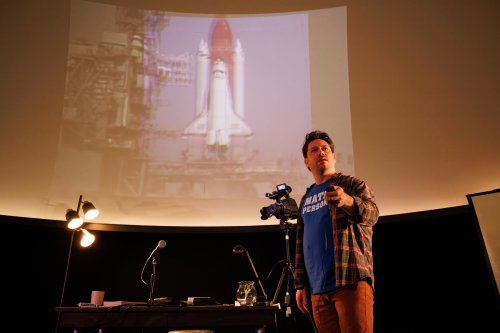
Jared Mezzocchi in a scene from his “73 Seconds” at Lower East Side Girls Club Planetarium (Photo credit: Maria Baranova)
The planetarium setting, realized through the site-specific vision of En Garde Arts, proves essential to the work’s grandeur. Reclining beneath a simulated Milky Way while listening to Mezzocchi reconstruct his family history, spectators experience the simultaneous immensity and fragility of human life. The production repeatedly juxtaposes the infinite scale of the cosmos against the tiny domestic rituals that define existence: a mother coaching MathCounts students, a son sneaking onto a barn roof to stargaze, the whir of a rewinding cassette tape, the awkward shuffle of cards at a kitchen table. Space becomes not merely subject matter but metaphor—the immeasurable emotional distances separating parents from children, memory from fact, love from comprehension.
As a performer, Mezzocchi possesses the trembling openness of someone genuinely excavating unresolved grief in real time. His performance never seeks polished catharsis. Instead, he allows confusion, regret, wonder, and frustration to coexist without resolution. Rosemary emerges not as saint, martyr, or mystery to be solved, but as something far more complicated and moving: a fully dimensional person whose inner life remains partly inaccessible even to the son who adores her. That unknowability becomes the play’s deepest truth. We spend our lives constructing narratives about our parents, only to discover too late that entire continents of their experience existed beyond our sight.
By the end of 73 Seconds, the audience sits suspended beneath a sky full of dead and living light, contemplating the unbearable brevity contained within the title itself. Seventy-three seconds: enough time for a shuttle to rise and explode; enough time for a life to veer irrevocably toward another destiny; enough time for memory to become history. In transforming his mother’s hidden past and fading present into an act of theatrical remembrance, Mezzocchi has created something extraordinary—a memoir play of uncommon formal beauty and emotional magnitude, one that gazes directly into oblivion and answers it, stubbornly and magnificently, with love.
73 Seconds (through May 18, 2026)
En Garde Arts
Lower East Side Girls Club Planetarium, 402 East 8th Street, in Manhattan
For tickets, visit http://www.engardearts.org
Running time: 70 minutes without an intermission


Leave a comment