
The Door Slams, A Glass Trembles
With a nod to Thomas Mann's “The Magic Mountain,” Paul Zimet and Talking Band give us an elliptical meditation on time, both elusive and unequivocal.
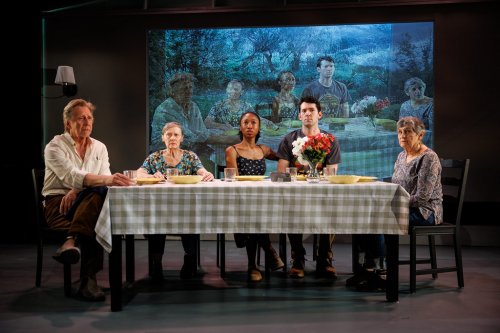
Jack Wetherall, Tina Shepard, Amara Granderson, Patrick Dunning and Ellen Maddow in Paul Zimet’s “The Door Slams, A Glass Trembles” at La Mama’s Downstairs Theatre (Photo credit: Maria Baranova)
There are productions that flirt with time, and then there are productions that seize it by the lapels, shake it, stretch it, fracture it, and, in doing so, reveal its strange elasticity. Paul Zimet’s The Door Slams, A Glass Trembles belongs emphatically to the latter category: a work of such formal daring and emotional intelligence that one leaves the theater not quite certain whether two hours or two lifetimes have passed. Zimet—co-founder and artistic director of the venerable Talking Band, as well as director of this production—has created something at once intimate and cosmological, a chamber piece that reverberates with the scale of history.
Inspired in part by The Magic Mountain, Thomas Mann’s 1924 meditation on illness and temporality, Zimet’s play borrows not its plot but its sensibility: the peculiar dilation and contraction of time as it is lived, remembered, and imagined. Like Mann’s sanatorium-bound protagonist, Zimet’s characters find themselves suspended in a liminal zone where past, present, and future bleed into one another with disorienting grace. The result is not mere homage but a vivid reanimation of Mann’s central insight—that time, far from being fixed, is a profoundly subjective medium.
Set and video designer Anna Kiraly’s stage picture is deceptively simple: a dining table before a window that looks out onto a mutable landscape. Yet within this modest frame, entire worlds unfold. Norm and Jenny, played with tender immediacy by Patrick Dunning and Amara Granderson, set the table alongside Norm’s parents, Marc (the superb Jack Wetherall) and Clara (the luminous Ellen Maddow). It is a domestic ritual recognizable in its outlines, but under Zimet’s direction it becomes something closer to choreography—a sequence of gestures that loop, pause, and repeat as if caught in a temporal eddy. The effect is mesmerizing: the audience begins to sense time not as a line but as a series of overlapping circles.
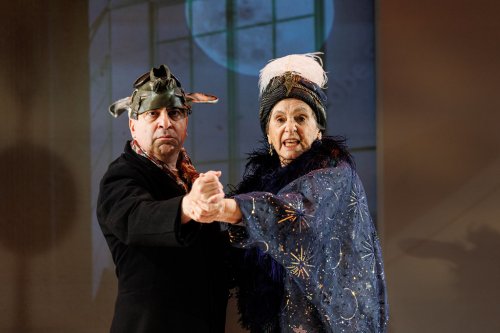
Stephen Rattazzi and Tina Shepard in Paul Zimet’s “The Door Slams, A Glass Trembles” at La Mama’s Downstairs Theatre (Photo credit: Maria Baranova)
Yet these quietly observed, almost liturgical scenes of domestic life are gently—and sometimes startlingly—interrupted by incursions from Marc’s past. The play opens fissures in the present tense, allowing us to slip with him into memory: an Atlantic crossing aboard a freighter, that evocative nowhere between origins and destinations, and, within it, the figure of Anne (Delaney Feener, appearing in delicately integrated video), a former lover who seems to exist as much in atmosphere as in narrative. These sequences do not announce themselves so much as seep in, like a change in weather one only gradually registers.
It is Clara, attuned to the subtlest calibrations of her husband’s inner life, who most often detects these departures. She recognizes, with a mixture of patience and quiet authority, when Marc has drifted into reverie—when his attention has loosened its grip on the present moment. Marc himself, with disarming frankness, confesses that he has “difficulty thinking beyond the present,” a line that resonates less as limitation than as paradox. For even as he claims this confinement, the play reveals a mind persistently—and perhaps involuntarily—haunted by what lies outside it: memory as both escape and undertow.
The silent opening passages—executed with a precision that borders on the musical—give way to language that feels newly minted, as though speech itself were being rediscovered. When the characters begin to talk, they do so with an acute awareness of time’s passage: a baby’s future, a childhood memory, the subtle recalibration of perception. Jenny’s recollection of looking through crib slats and realizing she could alter reality “just by moving my eyes” becomes, in retrospect, the play’s governing metaphor. Vision, like time, is mutable; what we see depends entirely on how—and when—we choose to look.

Amara Granderson, Patrick dunning and Tina Shepard in Paul Zimet’s “The Door Slams, A Glass Trembles” at La Mama’s Downstairs Theatre (Photo credit: Maria Baranova)
Zimet’s ensemble is nothing short of extraordinary, navigating the play’s tonal and temporal shifts with a collective sensitivity that feels almost telepathic. Tina Shepard’s Oona arrives like a wry chorus, while Lizzie Olesker and Steven Rattazzi, as Rita and Rick, introduce a generational counterpoint that deepens the play’s inquiry into aging, activism, and the uneasy inheritance of the future. Their conversations—by turns playful, rueful, and politically charged—anchor the work in a recognizably contemporary anxiety, even as the form itself resists linear progression.
What distinguishes this production, however, is its seamless integration of music by Ellen Maddow and choreography by Flannery Gregg as both structure and soul, which together achieve a near-metronomic precision. What matters here, what lingers, is not so much the content as the sensation: the act of experiencing the piece as one might experience a piece of music or a shifting landscape—something felt in the body before it is parsed by the mind. Narrative recedes; perception takes precedence. Ellen Maddow’s score—at once austere and enveloping—does not merely accompany the action; it constitutes it. Music here becomes a parallel language, one that measures time not in minutes but in pulses, repetitions, and resonances. As gestures slow to a near-freeze or accelerate into stylized movement, one becomes acutely aware of the body as an instrument marking duration. It is a reminder that time is not something we observe but something we inhabit.
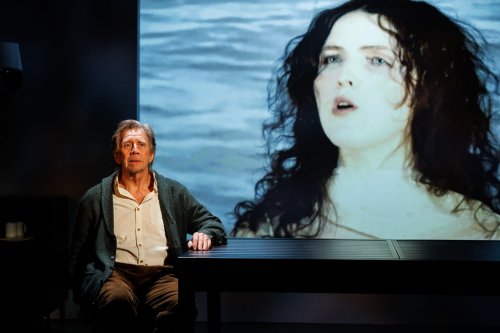
Jack Wetherall and Delaney Feener in Paul Zimet’s “The Door Slams, A Glass Trembles” at La Mama’s Downstairs Theatre (Photo credit: Maria Baranova)
Perhaps the most transporting sequences occur when Marc’s memories bleed into the present, conjuring scenes from Mann’s sanatorium. These episodes, in which the actors double roles with uncanny fluidity, are staged with a dreamlike clarity that collapses temporal distance. Mary Ellen Stebbins’ eerily sensitive lighting and Olivera Gajic’s exquisite costumes subtly delineate these shifts, while the performers inhabit their mirrored identities with an eerie familiarity. The past does not feel past; it feels concurrent, as though memory were another room in the house through which one might wander at will.
Yet Zimet resists the temptation to render time as purely cyclical or nostalgic. The world beyond the window—its forests subject to the slow violence of logging—introduces a harsher temporality, one marked by erosion and irrevocable change. The image of tree rings, silently recording years within their cellular architecture, becomes an unspoken counterpoint to the human dramas at the table. Time, the play suggests, is both intimate and geological, personal and planetary.
In its closing moments, The Door Slams, A Glass Trembles achieves something rare: it transforms abstraction into lived experience. Marc and Clara, poised at the threshold of a late-life decision, confront not merely the past they have accumulated but the future they might yet claim. The invocation—borrowed, via Mann, from Ezra Pound—to “Make It New!” lands not as a slogan but as a quiet imperative. Renewal, Zimet seems to argue, is not the province of youth alone; it is an ongoing act of perception.
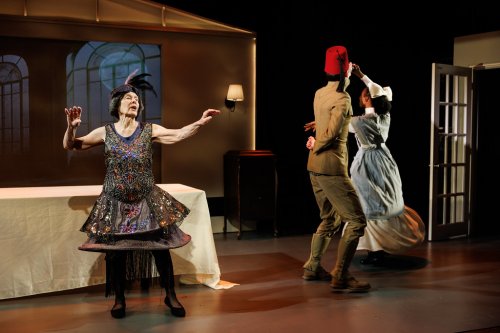
Tina Shepard, Patrick Dunning and Amara Granderson in Paul Zimet’s “The Door Slams, A Glass Trembles” at La Mama’s Downstairs Theatre (Photo credit: Maria Baranova)
To call this production engrossing would be accurate but insufficient. It is, more precisely, a work that recalibrates one’s sense of duration, leaving the audience suspended in its wake, attuned to the subtle rhythms of existence. In an era that so often mistakes speed for vitality, Zimet and his collaborators offer a counterproposal: that to truly experience time, one must be willing to let it tremble, to let it break, and, occasionally, to let it begin again.
The Door Slams, A Glass Trembles (through May 10, 2026)
La MaMa Experimental Theatre Club in association with Talking Band
La MaMa Experimental Theatre Club, Downstairs Theatre, 66 East 4th Street, in Manhattan
For tickets, visit www.lamama.org
Running time: 65 minutes without an intermission


Leave a comment