
Proof
David Auburn's Pulitzer Prize-winning play gets a fascinating new interpretation with "The Bear"'s Ayo Edebiri and film star Don Cheadle.
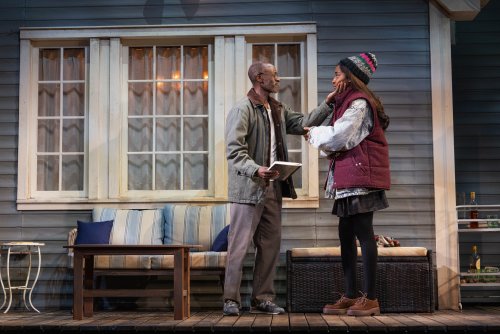
Don Cheadle and Ayo Edebiri in a scene from David Auburn’s “Proof” at the Booth Theatre (Photo credit: Matthew Murphy)
You might not have thought that a play about mathematics and mathematicians could be riveting – that is unless you had seen David Auburn’s Pulitzer Prize and Tony Award winning play Proof when it was last on Broadway 25 years ago. The play is so well written that although it seems to be what used to be called the “well-made play,” it breaks the form. A kind of mystery/thriller, Proof is compelling on many levels from its themes of societal and family expectations, to gender, identity, and ultimately, unexpressed but implicit in this production, race.
Thomas Kail’s elegant and polished production now at the Booth Theatre (probably the best Broadway venue for dramas) has recast the family as African American and it works just as well – if not better – than the original production in which the family was white. Two stars from the world of film and television – Ayo Edebiri (Chef Sydney on The Bear) and Don Cheadle (Devil in a Blue Dress, Crash, Hotel Rwanda, Traffic) – make their Broadway debuts and take to it like a duck to water. In addition, the remarkable Kara Young, nominated for the Tony Award the last four years and winning two in the last two years in a row, plays the supporting role of the sister with the assurance we have seen in her previously.
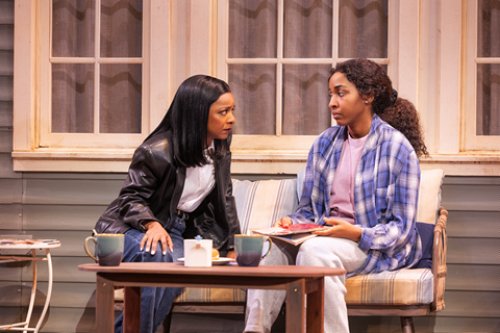
Kara Young and Ayo Edebiri in a scene from David Auburn’s “Proof” at the Booth Theatre (Photo credit: Matthew Murphy)
Twenty-five-year-old Catherine has just lost her famous mathematical genius father Robert, a professor at the University of Chicago. In the past five years he has been suffering from schizophrenia and she has had to give up her college studies in math to be his caretaker, as her mother has passed away and her sister Claire, a currency analyst, lives in New York. However, when Claire arrives to tend to the funeral, she finds Catherine uncommunicative and not wanting to get out of bed. This is on top of the fact that Catherine seems to be having conversations with their dead father, though Claire is unaware of this state of affairs. Is Catherine exhibiting her father’s illness or just grief?
And then there is Hal, a former student of Robert, now a teacher in his own right, who has asked to go through Robert’s notebooks to see if the last years of his life he had stumbled on any new work. When a truly brilliant mathematical proof turns up in his office, the question is whose it is: could he have had the lucidity to have written it in his last years or it is someone else’s, namely Catherine, a woman who has not finished college or done any previous important work. While Claire worries whether Catherine needs medical help, Hal considers how the brilliant proof can forward his career: at 28, he is three years past the age expected for mathematicians to do remarkable new work. This discovery could jumpstart his moribund career.
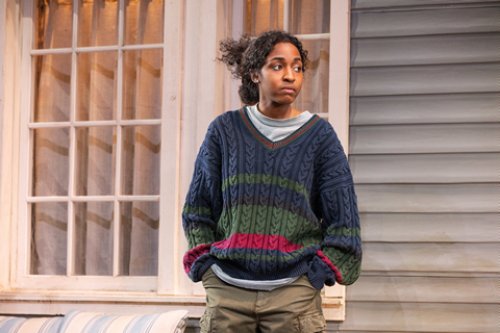
Ayo Edebiri in a scene from David Auburn’s “Proof” at the Booth Theatre (Photo credit: Matthew Murphy)
Both Edebiri and Cheadle handle their roles with great sensitivity so that we never know if their characters are unstable or entirely in control of their feelings and intellect. As Catherine, Edebiri is in the first act traumatized by her father’s death and her future. In the second act which includes several flashbacks, we see who she used to be. Her interactions with Hal in the present seem to take her out of herself and certainly her fights with her sister tend to wake her up. Cheadle is charming as the math professor who never knows when his illness is taking over or when he is entirely lucid, playing on a knife’s edge.
As Claire, the uncanny Young is efficient, sensitive, sophisticated and bossy: wanting the best for Catherine, but at the same time trying to push her into decisions that Claire’s making for her – like moving to New York or going into therapy. Jin Ha’s Hal is awkward like most math nerds but driven by his ambition. We are never certain if his beginning an affair with Catherine is to forward his career or if he is truly smitten with her. Under Kail’s perceptive and precise direction, these four performers interact in various combinations as the mystery of whose proof has turned up and what to do about it plays out.
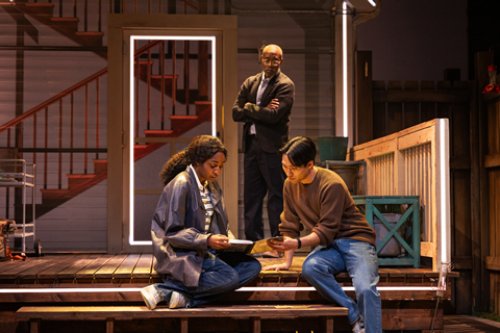
Ayo Edebiri, Don Cheadle and Jin Ha in a scene from David Auburn’s “Proof” at the Booth Theatre (Photo credit: Matthew Murphy)
Theresa L. Williams’ clever set design shows us the back porch but hints at stairways and rooms in the house. The subtle lighting by Amanda Zieve shifts moods for the various times of day but also highlights the windows with neon bars at the beginning of each scene, sort of like a three-dimensional proof or an equation being built before our eyes. Dede Ayite uses costuming to tell us a good deal about the characters, those who don’t care how they look and those who take trouble with their appearance to the rest of the world. Mia Neal’s wig design does the same thing making Claire look the picture of the New York executive while Catherine usually looks like she just got out of bed, nor does she care what other people think.
Playwright David Auburn pulls us instantly into this unfamiliar world of college mathematicians and makes us care about these people from the beginning. The sisters dealing with their father’s death is, of course, more familiar and easier to relate to. Hal’s problems as the nerd trying to build a career when he may be past his prime is also very relatable. The unexpressed topic of race is always there as Catherine isn’t taken seriously both as a woman and an African American which adds yet another layer to this fascinating play.
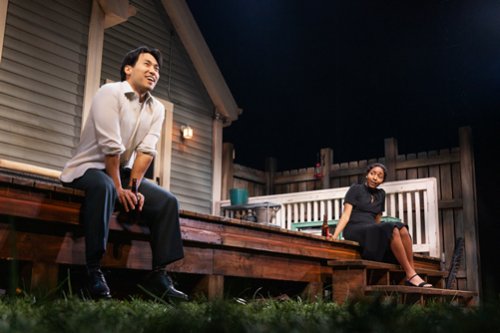
Jin Ha and Ayo Edebiri in a scene from David Auburn’s “Proof” at the Booth Theatre (Photo credit: Matthew Murphy)
Proof (through July 19, 2026)
Booth Theatre, 222 W. 45th Street, in Manhattan
For tickets, call 212-239-6200 or visit http://www.proofbroadway.com/tickets
Running time: two hours and 25 minutes including one intermission


Leave a comment