
Constance: A Confession
Four composers, four librettists, four stellar singers: a wickedly funny operatic experiment turns a startling subject into theatrical gold.
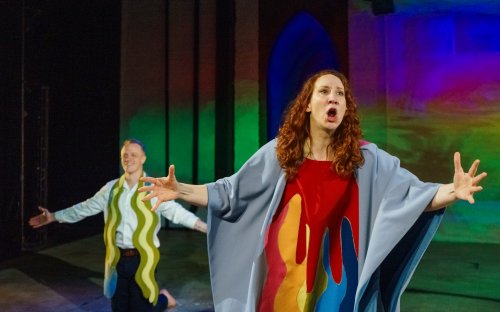
Nathaniel Sullivan and Sydney E. Anderson in a scene from Experiments in Opera’s production of “Constance: A Confession” at HERE Arts Center (Photo credit: Silin Chen)
There is something especially unnerving about the contemporary confidence artist: unlike the snake-oil salesmen of old, today’s grifters arrive swaddled in pastel gradients, armed with wellness jargon, and illuminated by the forgiving glow of ring lights. In Constance: A Confession, now at HERE Arts Center, the mischievously inventive collective Experiments in Opera transforms this peculiarly modern pathology into a sharp, strange, and savagely entertaining chamber opera about manipulation, self-delusion, and the frightening ease with which charisma can masquerade as enlightenment. The piece, devised collaboratively by the company’s Writers Room, skewers influencer spirituality with the precision of a poisoned crystal wand. Director Shannon Sindelar and Music Director Dmitriy Glivinskiy shepherd the work of the evening’s eight collaborators with an impressively light but unmistakably intelligent hand, maintaining tonal coherence across the stylistic whiplash of the four episodes while never sanding down their eccentricities. What could easily have dissolved into a self-conscious anthology instead acquires the momentum of a single manic vision. Most crucially, the staging grants the four singers ample room to blaze at the center of the enterprise, allowing each performer not merely to interpret the material but to seize it, reshape it, and hurl it outward with the kind of fearless theatricality that makes even the production’s wildest satirical detours feel emotionally inhabited.
The evening unfolds in four jaggedly comic installments, each one pairing a different librettist with a composer in the manner of an exquisite corpse assembled by downtown opera’s most delightfully unhinged pranksters. “Episode 1: The Fickle Finger of Fate” marries Ed Valentine’s gleefully acidic libretto to the music of Mattie Levy, whose score skitters and swoons with the nervous energy of a cabaret band trapped inside a moral panic. In “Part 2: Psychodrama,” Sam Norman’s text finds an ideal conspirator in composer Elizabeth Gartman, whose music seems to curl itself around the characters’ neuroses like cigarette smoke in a black-box theater lobby at midnight, a perfect palette for the morphing of Constance into Lady Constantina of the Rainbow.
“Part 3: Rainbow Warrior” introduces librettist Lisa Clair alongside the composer Roger A. Martinez. Their collaboration detonates with the reckless confidence of a punk zine staged as chamber opera, ridiculing sanctimony even as it courts it, with Lady Constantina becoming Connie C. Constance ‘The Con Artist’: Corporate Wellness Guru + influencer and “soulpreneur.” By the time the production arrives at “Episode 4: Baptism,” Susan Bywater’s libretto, set to Jasmine Galante’s hauntingly mercurial score, shifts the tone into something stranger and more searching: a mock-sacramental fever dream in which sincerity and satire become nearly impossible to disentangle. Connie C. Constance reverts back to Constance, but in name only. And yes, the woman on display in the vitrine is dead…very dead.
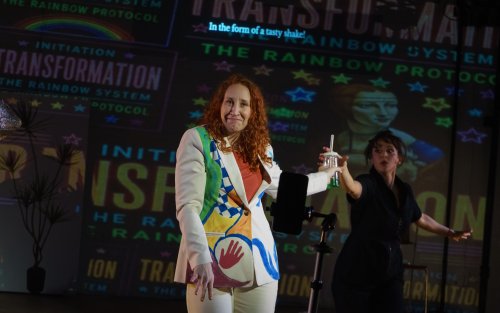
Sydney E. Anderson and Sishel Claverie in a scene from Experiments in Opera’s production of “Constance: A Confession” at HERE Arts Center (Photo credit: Silin Chen)
The titular Constance, played with hypnotic assurance by Sydney Anderson, begins as a grasping and vaguely ridiculous M.F.A. student (her final project is her classmate’s middle finger that she asked him to cut off with a bandsaw) before failing spectacularly upward into the role of tarot-reading lifestyle prophetess and eventually wellness-cult impresario. Her flock—the absurdly named Rainbow Warriors—consume not merely her aggressively colorful smoothies but also the increasingly dangerous mythology she spins around herself. The opera’s great joke, and eventually its great terror, is that Constance herself seems only intermittently aware of where performance ends and pathology begins. Like so many modern influencers, she appears to have monetized her own confusion.
The evening’s pleasures derive less from narrative surprise than from tonal dexterity. Sindelar knows exactly how ridiculous this world is, but resists the temptation to become smug about it. The libretto and score gleefully catalogue the linguistic debris of internet spirituality—“divine feminine,” trauma jargon, gut-health evangelism, pseudo-mystical affirmations—yet the satire lands because it is rooted in recognizable human hunger. These characters are not fools so much as spiritually malnourished people searching for coherence in a culture that increasingly offers branding in place of meaning.
Musically, the production possesses an appealing volatility. The score slides effortlessly between styles, charting Constance’s psychological ascent with increasingly flamboyant textures. Early passages evoke the bright perkiness of collegiate musical theatre; later, as ambition metastasizes into delusion, the music blooms into unruly jazz, funk, and expressionistic frenzy. The collaborative authorship gives the opera a patchwork energy that feels appropriate to its subject: this is a world assembled from borrowed aesthetics, algorithmic identities, and secondhand revelations. Yet the work never feels structurally chaotic. Instead, its restless stylistic shifts become the sonic equivalent of doomscrolling through a spiritually diseased internet.
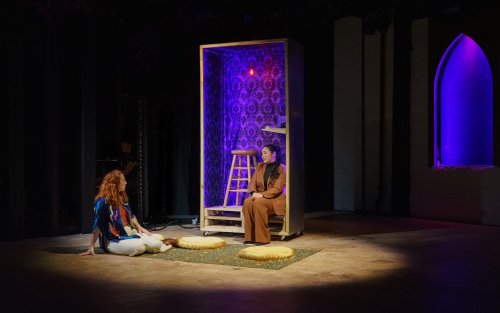
Sydney E. Anderson and Zen Wu in a scene from Experiments in Opera’s production of “Constance: A Confession” at HERE Arts Center (Photo credit: Silin Chen)
Anderson is the production’s blazing center of gravity. If the script occasionally undersells Constance’s magnetism, the performer compensates magnificently. Possessing a rich lyric soprano of warmth and tensile control, Anderson makes Constance simultaneously absurd and seductive; one understands, against better judgment, why vulnerable people might follow her into the abyss. Her face—open, expressive, perpetually flickering between sincerity and calculation—becomes its own running commentary on the instability of identity in influencer culture. It is an astonishingly poised performance, balancing comedy, narcissism, desperation, and flashes of genuine pain without collapsing into caricature.
The supporting cast proves equally deft. Nathaniel Sullivan delivers sly comic work as the variously named Marks—the indispensable marks in every confidence scheme—his warm baritone lending humanity to figures who might otherwise function merely as punchlines. Sishel Claverie is excellent as the indispensable enabler, while Zen Wu supplies the wary skepticism the opera cleverly withholds from the audience. Visually, the production weaponizes cheerfulness. Krista Intranuovo Pineman clothes the cast in an explosion of Rainbow Brite hues so aggressively whimsical that the opera’s eventual revelations of psychological, sexual, and physical violence arrive with genuine shock. A deliriously funny Instagram Live sequence captures the derangement of digital self-performance with almost anthropological accuracy.
Silin Chen’s scenic design and Mary Ellen Stebbins’ lighting operate with a rigorously minimalist vocabulary that paradoxically makes every gesture, every facial twitch, every eruption of feeling appear magnified before us. The stage is stripped of distraction, forcing the eye toward the performers with almost merciless concentration; a subtle shift in illumination or the introduction of a single object acquires startling dramatic weight. This economy of means proves especially effective because the production understands precisely where its true spectacle lies: in the singers themselves and, more unexpectedly, in the painfully believable story unfolding beneath the satire. For all the evening’s absurdist flourishes and operatic excess, there remains at its center something recognizably human and quietly tragic, a vulnerability the spare visual design refuses to let us evade.
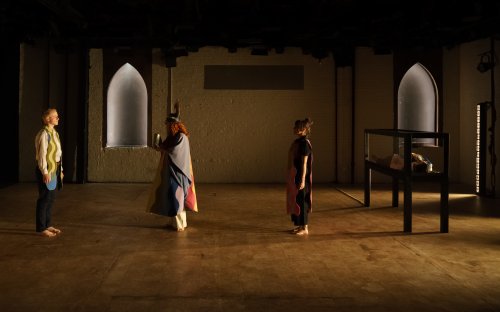
Nathaniel Sullivan, Sydney E. Anderson, Sishel Claverie and Zen Wu in a scene from Experiments in Opera’s production of “Constance: A Confession” at HERE Arts Center (Photo credit: Silin Chen)
What lingers after Constance: A Confession is not merely its topical cleverness but its unnerving emotional recognition. The opera understands that modern grifters flourish because they offer narrative clarity to frightened people drowning in informational chaos. Constance refracts contemporary life through comedy dark enough to become diagnostic, exposing how easily aspiration curdles into exploitation and how willingly loneliness submits itself to charismatic authority. Yet the production never scolds its audience or reduces its characters to moral illustrations. Instead, it achieves the far rarer feat of making our collective susceptibility feel tragic, funny, and painfully human all at once.
Constance: A Confession (through May 22, 2026)
Experiments in Opera
HERE Arts Center, 145 6th Avenue, in Manhattan
For tickets, visit www.here.org
Running time: 90 minutes without an intermission


Leave a comment