
Blackout Songs
New British play depicts the turbulent ten-year relationship of a couple who need each other as much as they need the bottle.
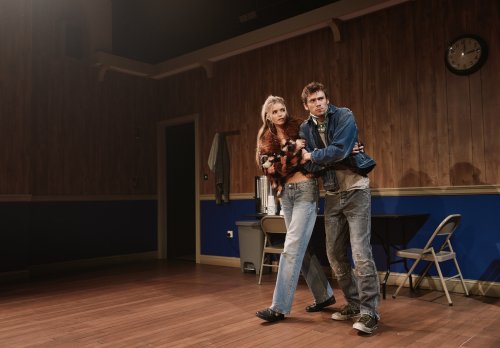
Abbey Lee and Owen Teague in Joe White’s “Blackout Songs” at The Susan & Ronald Frankel Theater at the Robert W. Wilson MCC Theater Space (Photo credit: Emilio Madrid)
The U.S. premiere of Joe White’s Olivier Award-nominated Blackout Songs is a tour de force for two actors. It is also a challenge for the audience both because its single topic is addiction and as intentionally written by the author we never know what is real and what is imagined. Rising film stars American actor Owen Teague (Unspeakable: The Murder of JonBenet Ramsey, the remake of Stephen King’s The Stand) and Australian actress Abbey Lee (Mad Max: Fury Road, Black Rabbit) both making their New York stage debuts give bravura performances, though Lee’s English accent is often difficult to understand as is the British slang that they often toss off. However, director Rory McGregor’s use of a single set to present a turbulent relationship over ten years and many locales is quite remarkable.
Until the final scene the characters are simply “Him” and “Her.” They meet at the coffee table at an Alcoholics Anonymous meeting in a church basement that both say is their first time (though we don’t entirely believe them.) He is wearing a neck brace and is shaking, but can’t remember why he needs the brace. She says she was dropped off by a man who is waiting for her in the pub across the street. We then follow their on again, off again relationship in various places. The time does not seem to be chronological as they often repeat things, have things happen that seem to have happened before, or do not remember events that we have witnessed. According to the script, the moments between the scenes are intended as blackouts in memory.
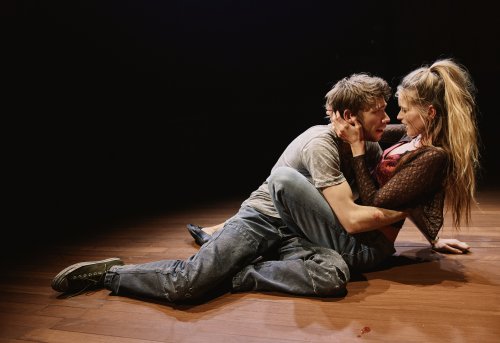
Owen Teague and Abbey Lee in Joe White’s “Blackout Songs” at The Susan & Ronald Frankel Theater at the Robert W. Wilson MCC Theater Space (Photo credit: Emilio Madrid)
Little by little we piece together information about them but gaps remain. He may be an American art student studying in London who admires Francis Bacon and is sharing a squat. He speaks of having had jaundice which turned his skin yellow: is this a warning that he has a bad liver? Dressed in a fur when we meet her, she may come from money as she does not seem to work. Early on she speaks of a husband but then says she is kidding. After they have been separated for a long time, when they meet again, he speaks of his girlfriend who is waiting for him. We never really see them sober, but except for one scene where he has delirium tremens, alcohol does not seem to affect them – though we may be seeing them only as they see themselves.
We see them at various places in Scott Pask’s minimal set: a coffee bar, an art gallery, breaking into a church to steal communion wine, at her apartment, later at an apartment they are sharing, his art college, her father’s funeral, a hospital, and finally another AA meeting. They make violent love soon after they meet, they dance, they sing, they break into buildings, he has hospital stays where she visits him. McGregor cleverly moves them around the space so that every scene is set somewhere else. Lighting designer Stacey DeRosier’s subtle lighting plot guides our eyes to these various spots on the stage. The set has furniture and props around the walls that are used to create the many environments: the church coffee machine, a restaurant table and two chairs, a two-story picture window, a podium, just enough to let us know we are somewhere else.
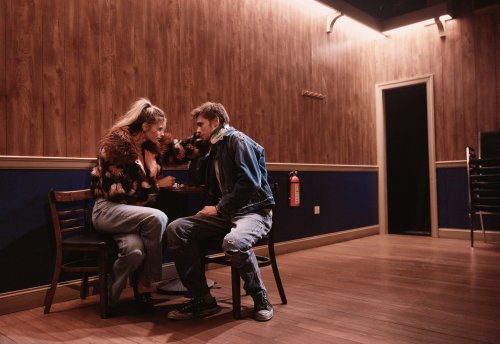
Abbey Lee and Owen Teague in Joe White’s “Blackout Songs” at The Susan & Ronald Frankel Theater at the Robert W. Wilson MCC Theater Space (Photo credit: Emilio Madrid)
As played by Lee and Teague, they are each other’s codependents, though they can’t live with each other or without each other. Events recur: his neck brace returns (is this a flashback?), she finds a tooth in her jacket pocket twice (is it the same tooth?), he works on a painting and finishes a commission (is it the same painting or another?) They refer to alcohol as “medicine” as if it has the power to cure when in their case it has the opposite effect. It may seem like one long drunken night to some theatergoers, but time passes as they break up and come together again. The ultimate tragic ending is inevitable – you can’t drink daily and not ruin your constitution. They are almost never on the wagon but always having one last drink.
As these co-dependents, Lee and Teague give bravura performances which remain high-powered throughout. While Teague is continually a dark brooding presence, he is manic at all times. Lee is more of a comic and ironic presence. While she seems to be a deterrent to his poor choices, she always seems to go along with them eventually. Both give off such intensity over the course of the play that the audience probably goes home tired just from watching them. It is remarkable that they never get lost in the play as they often deny scenes that have just taken place and react more than twice like they are meeting for the first time. They often seem to replay different versions of previous scenes as though they have very unreliable memories.
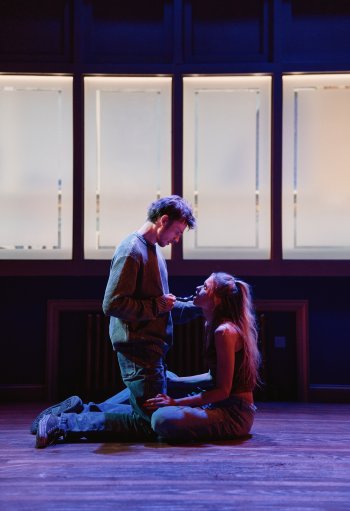
Owen Teague and Abbey Lee in Joe White’s “Blackout Songs” at The Susan & Ronald Frankel Theater at the Robert W. Wilson MCC Theater Space (Photo credit: Emilio Madrid)
Joe White’s Blackout Songs is remarkable in that he is able to keep the dialogue confined to one couple and their addiction throughout. While much is left untold, the characters are fully drawn and very real. The fact that the play almost never lets us see them drunk (though we know they almost never stop drinking) is also remarkable. It will be interesting to see all of the people involved with Blackout Songs in their next work which will be the real test of their success here.
Blackout Songs (through February 28, 2026)
The Susan & Ronald Frankel Theater at the Robert W. Wilson MCC Theater Space, 511 W. 52nd Street, in Manhattan
For tickets, visit http://www.blackoutsongs.com
Running time: 100 minutes without an intermission


Leave a comment