Victor Gluck was a drama critic and arts journalist with Back Stage from 1980 – 2006. He started reviewing for TheaterScene.net in 2006, where he was also Associate Editor from 2011-2013, and has been Editor-in-Chief since 2014. He is a voting member of The Drama Desk, the Outer Critics Circle, the American Theatre Critics Association, and the Dramatists Guild of America. His plays have been performed at the Quaigh Theatre, Ryan Repertory Company, St. Clements Church, Nuyorican Poets Café and The Gene Frankel Playwrights/Directors Lab.
When the play begins those who know the original will recognize that Ali has edited the text: the first two scenes have been flipped which makes perfect sense letting us know that Viola, the heroine, has been shipwrecked off the coast of Illyria, and that she has lost her twin brother Sebastian. (She decides to dress in male clothing in order to see the lay of the land as a single woman in a foreign country.) Unfortunately some of the other edits, including the most famous scene in the play in which the unloved puritan Malvolio reads out loud the forged letter he has received with the famous lines “Some are born great, some achieve greatness, and some have greatness thrust upon ‘em,” are mistakes. Much of the edited material makes the play dark so the intent may have been to soften the play’s somber side, though it does eliminate much of the characters’ best material. [more]
British illusionist Jamie Allan has brought his aptly named magic show "Amaze" to New World Stages and it is truly awesome. His act is so low key that one doesn’t at first realize how remarkable his tricks are taking many familiar and famous magic acts one step further – like the card trick with a deck of blank cards. He also uses his show to build the theory that children are more susceptible to magic and illusion and that we all need to return to our childhood memories and imaginations. [more]
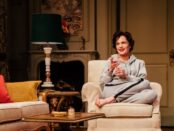
American actress Elizabeth McGovern is best known today for her role as Lady Cora, Countess of Grantham, in the long-running "Downton Abbey" series. However, she is also an Academy-Award winning nominee for her performance in the film of "Ragtime" as chorus girl and actress Evelyn Nesbitt. Since the early 1990s when she moved to London, she has often appeared on the West End stage. Now she has come to our shores as Hollywood icon Ava Gardner in a play of her own devising: "Ava: The Secret Conversations," adapted from the 2013 book of the same name by celebrity journalist Peter Evans and Gardner herself.
Although not the first name that comes to mind when one thinks of actresses to impersonate sex symbol Gardner, McGovern is charming and surprising, profane and coy, an independent woman who knows her own mind and has a great deal to say. She gives off flashes of fireworks along with the witty dialogue taken from Gardner’s own words. She is not only convincing but sympathetic as she recounts the mistakes and tragedies in her life. On stage throughout is Aaron Costa Ganis as British journalist Evans who we don’t learn as much about but makes an interesting foil for the flamboyant Gardner, even in these later years after her screen fame. [more]
Part of the problem with the play is that it attempts to cover too many topics in the form of a domestic tragedy: pollution, industrial waste, climate change, toxic chemicals, poverty, red-lining, foreclosures, destruction of animals, etc. It also cannot make up its mind whether its style is realism, surrealism, expressionism, symbolism or even magic realism. Many of the elements seem extraneous, tangential or not fully unified to the plot such as the talking animals. There is an interesting play hiding in this material but the playwright does not seem to know how to shape his ideas and wants to cover everything in this one play. [more]
Kevin Zak’s 'Ginger Twinsies" now at the Orpheum Theatre is an outrageous, campy gay stage parody of the 1998 Lindsay Lohan (a true redhead) remake of "The Parent Trap" in which she played fraternal twins, directed by rom-com specialist Nancy Meyers. Much of the humor is based on name dropping of pop culture, film, stage and television lore with “appearances” by Vanessa Redgrave, Demi Moore, Shirley MacLaine, Julianne Moore and Jessica Lee Curtis as well as Ms. Meyers herself. A great many gags come from the Harry Potter movies as well as Curtis in "Freaky Friday" and a plug for her new "Freakier Friday" opening on August 1. You don’t have to know "The Parent Trap" to enjoy the jokes as much of the humor is visual but it helps set up the premise. The laughs come once a minute but not all of them land as successfully as they are meant to. [more]
Under Lorin Latarro’s direction, there is little or no character development in Davenport’s book, with all of the characters remaining the same throughout, and the only thing that propels the show are the surprising events that happen. Joy’s family remains negative and dismissive about her inventing career (while eventually helping out in the marketing) until almost the very end. Davenport fudges the last scene by not telling us how the biased Texas judge ends up ruling in Joy’s favor so that the ending leaves us hanging. When the judge demeans Joy as a one-time inventor, we know that she has one of her clever inventions in her pocket (a reflective dog flea collar) but she never takes it out in her own defense. The songs are more like window dressing than adding much to the show and Milazzo’s generic lyrics tend to be very repetitious and give away their message in their titles. The show might have been more powerful as a straight play without the musical score. [more]
As directed by Avra-Fox Lerner and written by Curtis Fox, the production has many problems, the first being its leisurely slow pace which makes the play seem longer and less dramatic than it is. Written in 19 scenes and taking place on the same Soho loft set throughout, the play is more of a teleplay than a stage play, minus the camera angles and the set changes. Each scene only reveals one new piece of information, a dramaturgically dull way to tell a stage story. In spite of all this, the play might have worked if the acting was passionate and intense but the cool, unemotional style undercuts much of the tension. [more]
Andy Fickman’s polished production with its highly effective choreography by Gary Lloyd (additional choreography by Stephanie Klemons) is a Broadway-style production in a smaller house. If "Heathers the Musical" seemed too cynical in 2014 when it also played at New World Stages, time or events have caught up with it and it now seems a reflection of the life we live. With Broadway stars Lorna Courtney and Casey Likes leading the high-powered cast, "Heathers the Musical" should be a hit of the summer and beyond – and not just for teens and twenty-somethings who were in full evidence at the performance under review. [more]
How far would you go to be famous on social media? Julia Randall’s "Dilaria" is a stunning exposé of Gen Z 20-year olds, brought up on and addicted to TikTok and Instagram, who spend all their free time on their smart phones trolling the Internet. Making their Off Broadway debuts, rising stars Ella Stiller, Chiara Aurelia and Christopher Briney play very superficial college grads relocated to New York, but Randall gets a tremendous amount of satire from their interactions. The language is raw and sexy, not for senior citizens, but there is much humor in the way these twenty-somethings use words, particularly the latest urban slang. [more]
John Krasinski, best known for his role as the charming and amiable Jim Halpert on NBC’s sitcom The Office, is inspired casting for Penelope Skinner’s Angry Alan, a perfect showcase for his talents now the opening show at Studio Seaview, the renovated Tony Kiser Theater. In Skinner’s monologue co-created with actor Donald Sage Mackay who first played the part at the 2018 Edinburgh Fringe Festival, Krasinski is Roger, a three-years divorced man, who also lost his executive position job at AT&T and now works as the dairy manager at his local Kroger, a job he hates. Surfing the net, he finds a website called “Angry Alan” which seems to explain his midlife crisis: it is all the result of the “Gynocracy: a female dominated political regime which took over decades ago.” Roger who addresses us directly is still smarting from the fact that his live-in girlfriend Courtney has recently discovered feminism from a community college life class she is attending. [more]
"Machinal" makes use of all of these Expressionistic techniques. However, the current production has added tap dancing, practical foley and heightened movement created by choreographer Hilligoss in all of the scenes which both drowns out much of the dialogue and becomes very distracting. Obviously it is meant to emphasize the mechanical aspects of modern life but it also works as a sledge hammer repeatedly hitting the audience over the head with what is perfectly clear in the text itself. It is as though the director and choreographer do not trust the audience to get the message of the play. [more]
"Lowcountry" by Abby Rosebrock, author of 'Blue Ridge" seen at Atlantic Theater Company in 2019, has a great deal going for it: a fine cast, a play told in real time, scenic design in keeping with the milieu and the plot, and characters quirky enough to keep us interested. However, this talky play doesn’t get where it is going until the last ten minutes and has a great many unanswered questions that perplex as one watches the play. While Jo Bonney’s production is strong on the characterizations, it is weak on pace so the plot seems to go on longer than it needs to and lacks tension until the very end. Ultimately, except for those last surprising minutes, the play eventually becomes tedious and in need of a few cuts – or new devices. [more]
'Duke & Roya" is an engrossing rom-com with a geo-political background, the sort of story that Hollywood specialized in during World War II. Charles Randolph-Wright’s new play makes use of the war in Afghanistan in 2017 before the American pull out in 2020. The cast is led by television stars Jay Ellis (James in "Insecure") and Stephanie Nur (Aalyiyah in "Lioness") who prove to be engaging company. The cast is filled out by veteran stage performers Dariush Kashani ("The Kite Runner," "The Band’s Visit," "Oslo") and Noma Dumezweni who created the part of Hermione in both the London and Broadway versions of "Harry Potter and the Cursed Child," winning the Olivier Award for Best Supporting Actress. [more]
"Mike and Mindy’s Wild Weekend Jam," the musical returning Off Broadway in a bigger version than before, has a sophisticated score and unsophisticated book. The title is a bit of a misnomer as there is nothing “wild” about it and the “jam” part leads to unfilled expectations. However, the cast makes the most of the impressive musical portions of the show from Bucky Heard and Timothy D. Lee of the Righteous Brothers, salvaging Mark Corallo and Eileen Nelson’s book which resembles those Afterschool Specials of the past. [more]
Already seen at 200 venues across North America, "Bear Grease," the all Indigenous musical, arrives in New York for a three-month residency. While its subtitle declares that it is a “reimagining of the musical Grease by Jim Jacobs and Warren Carey told through an Indigenous lens,” it is more of a variety show with songs, dances, and video while including iconc scenes and songs from "Grease" paying tribute to Native American culture. Written and created by LightningCloud (Crystle Lightning and Henry Cloud Andrade,) the exuberant cast made up of members of the Enoch Cree Nation, Beaver First Nation, Big Stone Cree Nation, Frog Lake, Muskeg Lake, Gift Lake, Mvskoke and Navajo Nation makes this an entertaining evening in the theater. [more]
"Beau The Musical" is not only absorbing as a story, the songs help to move the story along, something few musicals accomplish these days. The multi-talented cast is splendid, while the story hits on a great many hot button topics: bullying, intolerance, self-identity, single parenting, finding one’s identity. Best of all Beau The Musical is extremely satisfying, sending you out pleased by what you have seen. [more]
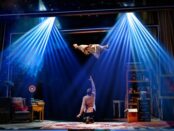
Montréal’s physical theater troupe The 7 Fingers has made their third visit to New York with Passengers and the wait has been worth it. Using circus events, music, dance and monologues, "Passengers" follows nine travelers who perform as their train travels across the country. Like Cirque du Soleil, the varied acts are all unified by a theme, but The 7 Fingers is more intimate in scale and eschews clowns, giving the nine acrobats, gymnasts and circus artistes more and more daring acts to do. As the journey continues, the performances become more breathtaking and demonstrate the versatility of the cast. [more]
"Prosperous Fools" is like those 1960s and 70s East Village happenings where one never knew what was coming next. Taylor Mac’s tremendous imagination could use some reining in but his satire is pungent and on target. Like happenings, this is a show that must be experienced to feel the import of the event. And one admires Theatre for a New Audience for risking their funding to offer to stage it. Moliere would be pleased that his 18th century comedy gave rise to this 21st century free-for-all. [more]
A farming couple who have been married 50 years go out into their western Kentucky field to watch a lunar eclipse. Nothing much happens but, on the other hand, they review their entire lives. There is little we don’t know about them by the end of the eclipse. Under the direction of Kate Whoriskey, Pulitzer Prize-winner Donald Margulies’ latest play, "Lunar Eclipse," with veteran actors Reed Birney and Lisa Emery is extremely poetic and sensitive about people and their feelings. If you are looking for action, this will not be for you. However, if you think plays should reveal the human condition, then you will be caught up in this very human story of lives lived with regrets but always to the best of their abilities. [more]
Conducted expertly by Tiffany Chang in a new chamber orchestration by Roland Freisitzer, this three-character opera is inspired by the lush romantic sound of Richard Wagner and Richard Strauss. As the libretto is based on a German prose translation of the Wilde play by Max Meyerfeld, there are no arias per se but the leading character Simone, a Florentine fabric merchant, has many long passages. Artistic director Philip Shneidman who staged the evening has chosen to set it in turn-of-the-last-century Vienna, home to Zemlinsky, rather than Florence in the 16th century as Oscar Wilde’s play is set. This takes a bit of getting used to considering the plot and the subject matter. However, Kylee Loera’s projection design of historical photographs of Vienna city streets and then an art nouveau wallpapered room sets the proper mood for pre-W.W. I Vienna. [more]
Creating his third outstanding and needed adaptation in conjunction with director Jesse Berger ("The Government Inspector," 2017; "The Alchemist," 2021), Jeffrey Hatcher has salvaged yet another comedy from the classic world theater which has been sorely neglected in the United States. All of these are large cast plays with lengthy speeches that have long needed pruning and updating for contemporary audiences. With Berger’s light touch and swift-paced production, this Molière is not only a delicious treat but a timely satire. [more]
Although Cobb makes references to Iago, Othello’s, second-in-command, and Barbary, the maid to Desdemona’s late mother who brought her up, Nine Moons does not tell us anything we don’t already know from Shakespeare’s play. Since the one thing we are waiting for is Othello’s wooing of Desdemona which will result in their elopement, this does not begin until one hour and five minutes into this 115 minute play. What transpires before that is chit chat about the state of Venice and Cyprus, Othello’s unease in this new city, and Cassio’s army ambitions at odds with his drinking problem, all of which is covered in Shakespeare’s later tragedy. [more]
In the title role, Amber Iman makes a sensational return to Off Broadway after her Tony Award and Drama League-nominated performance in "Lempicka" last season. This beautiful statuesque actress brings poise and elegance to the role of the goddess who comes down to earth in human form. Her magnificent singing brings the audience to its feet for her final solo. Austin Scott is a stalwart Omari both in his singing and saxophone playing which also impresses. As the excitable Rashida and Ahmed, Arica Jackson and Nick Rashad Burroughs make a terrific team playing off of each other. [more]
And what does it all mean? The new musical takes on pop fandom, celebrity, the Internet, MTV, pop culture, influencers, Gen Z and everything in between. "The Last Bimbo of the Apocalypse" is not only cutting edge but it may presage the dawning of the next kind of musical – which may not be to all tastes. It may also take you by surprise as to how much it pulls you into to its story and investigation of a period a little less than two decades old. [more]
Unfortunately, The Fire Weeds’ production directed by Jaclyn Bethany (who appears in both plays) is very uneven. An attempt at expressionism handled differently in each does not work for these Tennessee Williams’ plays. While “The Pretty Trap” eschews props for pantomiming, in “Interior: Panic” lighting designer Zoe Griffith has taken the stage direction “the light is normal” and literally bathed the stage in pink-red light periodically to suggest Blanche’s hallucinations. However, this is both distracting and intrusive. Of course, theatergoers are likely to know the longer more famous versions which are more fleshed out and have pertinent information not in the one act versions. [more]
The show at The Players Theatre is not exactly the same show that played in London's West End with book by Shaun McKenna and Steven Dexter which like the original novel was set in San Francisco. Now the show has been reset in New York’s East Village. Unfortunately, this also means Finney’s tribute to silent film stars is entirely missing which is one of the original novel’s strong suits. Additionally, the authors do not make use of the new setting except for a scene under the Queensboro Bridge. [more]
Not only is the show authentically written with Spanish sprinkled throughout, (much of it perfectly obvious as to its meaning,) but Sergio Trujillo’s superb production which he has both directed and choreographed, has been cast with an almost entirely Hispanic cast who are utterly engaging. Best is Justina Machado, a Broadway veteran of "In the Heights" and "A Free Man of Color," as the indomitable Carmen who can only imagine one path – though she herself left everything behind in Mexico to come to the United States. Following a close second are Broadway debuting Tatianna Córboda as the feisty Ana who has learned how to run rings around her elders and also debuting Florencia Cuenca as her weary sister Estela who has the weight of everyone’s aspirations on her shoulders. [more]
Not seen on Broadway since 1982 but racking up 26 productions up to that time since its New York premiere in 1879, the Roundabout Theatre Company’s new version of the Gilbert and Sullivan classic operetta, "The Pirates of Penzance," has been given a delightful facelift: retitled "Pirates! The Penzance Musical" is has now been Americanized and reset in a jazzy 1880 New Orleans by the team of director Scott Ellis, adapter Rupert Holmes, choreographer Warren Carlyle and music director and co-orchestrator Joseph Joubert. The energetic cast is led by Ramin Karimloo as the Pirate King, Jinkx Monsoon as Ruth and two-time Tony Award-winner David Hyde Pierce as Major-General Stanley, backed by a lusty crew of singers and dancers. [more]
At this vantage point 55 years after its premiere, like the Wilson plays which intentionally cover the previous 100 years, "Ceremonies in Dark Old Men" feels like an historical play wedded to its own time period. Its story and characters are a combination of a Black version of "Death of a Salesman" and a Harlem version of "A Raisin the Sun." Like the story of Willy Loman and his hapless family, the tale of Russell Parker and his two wastrel sons could only have a tragic ending, as their values are so hollow. And like "A Raisin the Sun," the Parker family is so desperate to succeed as Black people in Pre-Civil Rights Era America that they put their hopes in a man that even a child would not have trusted. [more]
Unfortunately, while the carnival atmosphere in the field above the cave increases, the musical is mostly a waiting game: if and when Floyd Collins will be brought up from the deteriorating cave. The emotions that you would expect as time begins to run out as passageways become either waterlogged or impassible are not in evidence except for Floyd’s father who is more concerned with finances that his son’s life. Floyd himself is often depicted as delirious or depressed so that we don’t get much of an arc of his emotions. [more]
At times the show directed by Stroman seems to be a satire or a parody, while the choreography by Bergasse mostly looks like ersatz Bob Fosse which seems inappropriate for the Marilyn Monroe story. As star Ivy Lynn playing Marilyn, Hurder seems to be doing a Megan Hilty impersonation from the TV series, rather than bringing anything new to the role. (Of course, Hilty is appearing around the corner in Death Becomes Her.) Bowman’s Karen is fine as far as she is allowed to go but the role seems underwritten. Nielsen ass The Actors Studio coach, (compared to Margaret Hamilton as the Wicked Witch of the West) is so unpleasant that you wonder why her character isn’t fired long before it happens in the story line. [more]
The cumulative effect of the four plays is greater than the sum of its parts. The quartet of plays seems to demonstrate Caryl Churchill in a new mode. While the plots are slight, the themes are of major importance and suggest new ways of thinking about them. James Macdonald’s production and the acting of his cast are quite assured even though the plays are mainly non-realistic and require their own kind of suspension of disbelief. [more]
While Belflower’s play is clever and insightful, it is also contrived and manipulative attempting to shoehorn almost every feminist hot button topic into one story overlaying "The Crucible": date rape, sexual abuse, sexual harassment on the job, toxic masculinity, patriarch dominance. It makes all of the male characters look like idiots and all of the women victims which is not exactly a reflection of real life. It also overloads the deck while at the same time copping out in the end. While New York teens are probably much more liberated than those in rural Georgia, the language of the play is incredibly devoid of swear or curse words which usually pepper the speech of adolescents. Finally, it borrows from Ivo van Hove’s 2016 staging of "The Crucible" in which a modern classroom also turns into a telling of Miller’s play. [more]
However, it is not just the remarkable video design which uses sometimes up to six screens to convey the action of the story plus live action, but we get inside of the head of protagonist Dorian Gray in ways not possible before. Also seeing or hearing Snook as all the characters in different voices is quite a remarkable feat. Andrew Scott only plays eight in his Vanya one-man show, but here Snook also changes costumes repeatedly before our eyes and emerges as someone else. Beginning as the narrator, she slowly becomes Dorian Gray who eventually takes over completely. We also see her as Lord Henry Wotton, painter Basil Hallward, actress Sibyl Vane and later her brother James, the Duchess of Harley, and former friend and Oxford classmate Alan Campbell. [more]
The Steppenwolf Theatre Company production of Branden Jacobs-Jenkins’ "Purpose" follows on the heels of their magnificently staged "August: Osage County," but unlike that dysfunctional family drama, this play has a great deal to say as well as major themes. Like the title of the author’s "Appropriate," "Purpose" has many meaning all used here at the same time. And never forget how much fun it is to have a private look in at the private lives of a rich and famous (but fictional) family when they are on their worst behavior. Do not be surprised if this play wins this year’s Tony Award followed by next year’s Pulitzer Prize. You can say you heard it here first. While the play is quite long, it is tremendously rewarding as great plays should be. [more]
Except for a couple of main characters, the people in his life seem to come and go making it a little bit difficult to follow. While the opening of each act is in the form of a Technicolor musical, the limited budget and the staged reading format does not allow for this. Actor Michael Halling is tall enough to represent the 6’4” Hughes but he does not portray his undoubted charisma to have taken the world by storm. There are also many anachronisms as well as at least one scene which is out of order and facts that are inaccurate. [more]
If only film star George Clooney and his co-script writer Grant Heslov had hired an actual playwright to adapt their acclaimed screenplay for the 2005 film "Good Night, and Good Luck." for the Broadway stage. What worked in close up in the film does not have the same effect on the huge stage of the Winter Garden Theatre. And while David Strathairn as Edward R Murrow in the film, the role now played by Clooney on Broadway, also seemed wooden and unemotional, his every flicker of emotion on his face was telegraphed through the extreme close ups of every frame. With its cast of 22 on a huge CBS studio set, most of the characters are undefined or unidentified. At times it is difficult to know who is talking or where their voices are coming from on the multileveled setting. [more]
Eric Bogosian’s "Humpty Dumpty" was first written 25 years ago and premiered at the McCarter Theatre Center, Princeton, in 2002. At that time the idea of quarantining due to a local or national disaster seemed a fantasy. However, since then, we have all lived through the Covid Pandemic and what was inconceivable became our daily existence. Not only does Bogosian’s play seem tame now, it also seems predictable and dated. Director Ella Jane New does not help the script much by allowing the vapid characters to all seem one dimensional. Possibly with a satiric approach or powerhouse performances, the play might have something new to say to us as its entitled people show their true colors. [more]
While most of the audience will probably not have graduated in the last ten years (though you never know), the play speaks to all of us about the closeness and personal relationships of our college years. Playwright Natalie Margolin knows how to create tension from hints casually dropped and director Jaki Bradley has created a cohesive cast who could have been together the last four years. "All Nighter" is one of the few plays set at a college that seems to come from the author’s own firsthand experiences. [more]
The new musical attempts to out Monty Python "Monty Python" by creating a full-length show and story in their style, although its origins also go back to British Music Hall where there is also much cross-dressing (i.e. men playing women and women playing men). Those who love Monty Python will have a great time; those who don’t may find the two hour and 30 minute show heavy going. The show is also Very British and a great many of the jokes and gags don’t land for American audiences. However, the hard working cast is impressive playing many roles each and Robert Hastie’s fast paced direction doesn’t give a lot of time to think about the antics on stage. [more]
The second in the York Theatre’s Spring New2NY series is "Who Is Jimmy Pants?," an entertaining spoof of bio-jukebox musical, a genre that could use some taking down. Presented concert-style with book-in-hand, as were the York’s Mufti Series, the high-powered cast of nine directed by Stephen Nachamie (Ken Ludwig’s "Dear Jack, Dear Louise") make the rather clichéd material seem better than it is. [more]
In fact, the play Harmon has written is mainly about the conflict between the grandmother and the mother. While we are never really certain why Ellen and Susan refuse to be in the same room, we come to know all the details of the relationship between Renée and Ellen from three sides. The most entertaining parts of this long one-act delineate the relationship between Joshua and his Auntie Mame-like grandmother who did not believe in age-appropriate events: taking him at age seven to see "Dances With Wolves," attending a Mapplethorpe exhibit (which he did not understand) at age nine, seeing Diana Rigg in "Medea" when he was ten, and a three-movie marathon during a snow day off from school: "Secrets and Lies," "Sling Blade" and "The English Patient." Joshua credits his grandmother with changing his life making him want to be a playwright after seeing "Medea." [more]
The new version by Irish playwright Mark O’Rowe uses contemporary and spare language but has made several events more literal as if not trusting modern audiences. The director has made the same mistake starting the play as a rehearsal in which we see the opening scene three times ranging from devoid of emotion to accomplished, which is both ineffective and pointless as it does not help us into the world of the play. The thrust stage by set designer John Lee Beatty (a room in unpainted wood, a single dining room table and mismatched chairs and a wall of French doors into a conservatory) is as stripped down and as spare as the language, a fitting place for a drama of tragic proportions, but does not offset the one- dimensional acting. The bland costumes mainly in black or white by Jess Goldstein straddle both the 19th and 21st centuries, seeming to want to have it both ways, but suggesting neither. [more]
Who knew that a biographical play could be so witty, entertaining and charming? The latest EST/Sloan Project science play, Michael Walek’s "Have You Met Jane Goodall and Her Mother?" is one of the most enjoyable and enlightening comedies of the season. Using the actual facts of Goodall’s first trip to Tanganyika’s Gombe Stream Reserve in 1960 to observe chimpanzees in the wild, Walek creates a play that sticks close to the well documented facts but fills in the missing information with often amusing supposition. The title refers to the fact that the Tanganyika government (then ruled by the British) only allowed Jane to study in their game park as a woman alone if she had a chaperone – so she brought along her mother. Jane Goodall’s trip was arranging by famed palaeoanthropologist Louis Leakey for her to find the missing link between humans and chimps which she finally does just before the end of her four month first trip. [more]
The play moves by unexpected twists and turns which are both amusing and engrossing. We never do find out for certain if Dina is a spy or not. However, she does tell Boubs that she was stationed at the embassy in Dar Es Salaam when al-Quada terrorists blew up both the Kenya and Tanzanian American embassies killing 200 and wounding 4,000. As she lost all of her friends and colleagues, she has vowed to hunt down and bring to justice those responsible. [more]
Anna Capunay has attempted to write a family drama in order to influence people to try alternatives to chemo and radiation. Unfortunately, in using her own family story, she has not thought out how to make this a convincing and persuasive play for others. Incidentally, the title comes from the song that singer Carlos Vives made famous in 1993 which literally refers to the weather, and not illness, though it may used metaphorically here as a cold front causing bad weather. [more]
While the characters do not change much, they roll through the years dealing with the various crises with various levels of success. However, the play is peppered with one liners and zingers that make this one of the most entertaining plays this season. Under the polished direction of Noah Himmelstein, Aaron and Doyle get a great deal of mileage from these jokes, not all of them new, but all of them hilarious. [more]
The author complicates the issue by bringing in autism (Margot) and Alzheimer’s (the unseen father of Adam 2 and Eve 2.) When asked if she would want her autism cured, Margot answers: “I might. Plenty of people would. I’m fine with who I am, but it’s also undeniable that the world only became truly accessible to me when I entered a specific tax bracket.” Ridding the world of Alzheimer’s wouldn’t help Adam and Eve’s father who is too far gone but might help the next generation. However, Adam feels betrayed by his sister’s research that would “give transphobic parents the option to prevent their kid from being trans before they are born.” He feels he is being elimin [more]
Arthur Miller has always been our major playwright of moral ambiguity, never more so than in his 1968 drama "The Price," now receiving its first Off Broadway revival. The metaphoric title refers both to the value of an attic of old furniture to be sold as well as the price paid by the choices that the characters have made. The fifth New York revival and the first production by the newly formed Village Theater Group directed by Noelle McGrath is both uneven at times and weakly cast, but Miller’s ultimately powerful play still makes its point. [more]
While Dickson’s production is elegant and pitch-perfect for its 1914 era, the characterizations are partly satiric and off base. While Daniel Marconi is fine as the designing, unprincipled and power-hungry Peter, he seems to be playing him as a comic character with a wink in his eye though there is no evidence in the play that Brighouse intended this. Madeline Seidman’s Margaret is rather bland, failing to show us what Peter first saw in her. As his mother, Amelia White is almost as ambitious and designing a social climber as her son. The most problematic characterizations are those of the aristocrats who are all played too broadly, rather than true to the period. As Lady Mottram, Melissa Maxwell is almost a gorgon out of Oscar Wilde rather than simply a high class snobbish member of the gentry. Sara Haider’s Gladys fails to give off the kind of signals that would tell Peter she is interested in him, while Avery Whitted as her brother Freddie is practically one of the those silly-ass men of leisure out of P.G. Wodehouse. [more]
Bess Wohl’s latest play is the ambitious and engrossing "Liberation," her attempt to investigate the roots of the Women’s Liberation Movement back in the 1970s from a decidedly contemporary point of view. Calling it a “memory play,” she uses a narrator “Lizzie,” who tries to recreate the consciousness raising group her mother started back in 1970 in Ohio where she lived at the time. Complicating things for the viewer, Lizzie also plays her own mother (who also seems to be named “Lizzie”) in the flashbacks, showing us seven meeting from the many the group had in their weekly encounters back in the seventies. She also interviews the survivors now in the present about what they recall of those days as her mother has recently passed away and she is sorry she didn’t ask her more questions. [more]
Conceived, written and directed by Elizabeth Hess, "No Reservation" is a celebration of "the lost feminine to give voice to all who have been discarded, silenced and overlooked.” The performances by members of The Hess Collective are very intense and the language rises to the level of poetry. At a brief 60 minutes, the play does not overstay its welcome or become agitprop. While "No Reservation" has no solution or answer to the question of the female power overtaken by the patriarchy, it remains a tribute to women over the centuries. [more]
The play is not very consistent with life in 1949. It is unlikely that middle class married women cursed, smoked marijuana, quoted Simone de Beauvoir or engaged in affairs with other women. While the program notes by the playwright describe "Mrs. Loman" as a “feminist critique” of the Arthur Miller play and reveals that the author feels that the original “does not provide for a full female character,” Linda’s studying philosophy at Brooklyn College does not make for a feminist statement. In fact, Beauvoir’s "The Second Sex" which Linda quotes from was not published in English until 1953 which means Linda could not have been studying it in an American class in 1949. [more]
When the audience enters the theater, they are asked to fill out a slip of paper with one word that has been on their mind. Part of the show is made up of audience participation and these slips of paper come into play. Another part of the show written by DePonto and Josh Koenigsberg recounts DePonto’s life with mentalism, his childhood, his memories, his studies and his discoveries about the mind. He begins by discussing the “memory palace,” the way in which the mind catalogs our memories. The remarkable set by Sibyl Wickersheimer which is revealed when a curtain is opened is a wall of 146 lockers which resemble the way the mind works. DePonto opens some of these and removes items while some of the lockers seem to have a mind of their own and open without his doing anything. [more]
Not only are the paintings massive but they also cover all sorts of modern periods of art without Kissajukian having known their work (abstract work by Picasso, Matisse, Joan Miró, Jackson Pollock, Franz Kline, Basquiat, etc.) After the show the audience is invited to experience his recent art work on display in four galleries in the theater while he remains available to answer questions. Not only are the paintings a kind of therapy for him, he also titles them with witty names and explanations, often having little to do with actual images. [more]