
Articles by Victor Gluck, Editor-in-Chief
"Hurricane Season" is the sort of vanity production in which one assumes that the author thinks he or she has invented the next step in the avant-garde. Unfortunately, Estes’ production will give most theatergoers a headache attempting to follow his play as well as the unnecessary flashing video. Whatever the play wants to say about “erotic desire and national anxiety,” it is lost in the proceedings on stage. Incidentally in the cause of transparency, Hurricane Season is not the least bit erotic though there is a certain amount of simulated sex. [more]
Once Upon a Mattress
Foster is a joy as the princess from the swamps who can swim, lift weights, dance all night, commit multiple contortions as she tries to get a good night sleep, and field any disaster that comes her way including the queen’s disdain. She is quick on her feet and in her tongue. She also stops the show with her rendition of the score’s most famous song “Shy” (used as the title to Mary Rodgers’ memoir published in 2022) but she is also memorable singing “The Swamps of Home” and “Happily Ever After,” with their witty lyrics by Barer, who often collaborated with Mary Rodgers. Is there anything she can’t do and anything she can’t make funny? [more]
Someone Spectacular
Doménica Feraud who has also written "Rinse, Release" has made a career of writing about very human psychological problems. While "Someone Spectacular" is rather untheatrical in its presentation as there are no fireworks which you might have expected in the situation, the characters become more absorbing as we get to know them, their stories and their problems. Not only is it all very real but it is easy to identify with one or the other as we all have gone through some loss in our lives. Tatiana Pandiani’s direction is smooth and fluid if a bit too serene. Some may also find the play comforting if they are going through the same thing or have suffered a loss recently. For the record, that title is explained near the end when Thom states “I lost someone spectacular” which how all the characters feel about their losses. [more]
Cats:”The Jellicle Ball”
The dynamic and exciting dances include the five elements of voguing: catwalk, duckwalk, hand performances, floor performances and spins and dips in various combinations. The competitions which include almost every song are taken from real ballroom events and the names are appear on the rear wall over the glitter curtain in Brittany Bland’s projection design. These include Virgin Vogue, Pretty Boy, Realness, Body, Bizarre, Opulence, New Way Vs. Old Way, Labels, Women’s, and All American. One razzle dazzle competition is the Tag Team Performance to the song “Mungojerrie & Rumpleteaser” which pitted “knockabout clowns” Jonathan Burke and Dava Havuesca in matching costumes with ballerina Baby as Victoria and gymnastic Bryce Farris subbing for Primo as Tumblebrutus. [more]
The Meeting: The Interpreter
Seemingly not trusting the material, director Brian Mertes has used all kinds of stage gimmicks including having the two actors photographed live by a team of three videographers whose equipment runs on a track around one side of the stage while a huge screen covers the second half on which we see the actions of Wood and Curran blown up to one story high. (Aside from the distraction, those who sit in the audience on stage left may find this blocks part of their view.) The meeting at Trump Tower which precipitates the ostensible action is played by the two actors and six miniature (nude!) puppets by famed designer Julian Crouch. At various points the two actors enter a booth in the back of the stage for no explained reason, as if in a session at the United Nations. There is also unexplained dancing and singing that seems to have little to do with the events at hand. [more]
The Sabbath Girl: A New Musical
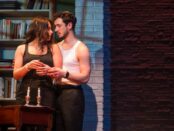
When was the last time you saw a new play in which you cared about the characters and wanted them to end up together? "The Sabbath Girl: A New Musical" is that kind of show. A delightful and charming rom-com adapted by Cary Gitter from his 2020 play of the same name, "The Sabbath Girl" brings together two unlikely people from very different worlds, both at crossroads in their lives. With sensitive performances by Marilyn Caserta and Max Wolkowitz, lovely music by Neil Berg, graceful and emotional lyrics by Berg and Gittter, and a poignant story, The Sabbath Girl is a must-see this summer. [more]
Bringer of Doom
The play doesn’t tell us enough about any of the characters which gives the actors little to work from. What does Lotte do for a living or is she a trust fund kid? As Lena Drake plays her, she seems totally adrift besides her hatred of her mother. While David Z. Lanson’s Demetrius is described as a professional (albeit failed) comedian, he has nothing to say that is very funny. The jokes tend to fall flat. Asking for drink, Demetrious says, “Anything you’d use on a medieval axe wound is fine.” As the entitled Esme, Laura Botsacos is self-absorbed, egotistical and unsympathetic. However, the author makes us think that she is the wisest one of all as she is usually right. It is she who says “At what point in life do we stop blaming mom?” - a statement the audience must be thinking as well. While James Andrew Fraser’s Clancy at first appears very dense, he does have a large vocabulary and catches many nuances, so he is not as dumb as he comes across on a first impression. [more]
Inspired by True Events
Actor Ryan Spahn’s first play "Inspired by True Events" at the new Theatre 145 (formerly the Ohio Space) is a professional, skillful production. Unfortunately, as a backstage thriller it leaves something to be desired. The first shock does not occur until two-thirds of the way through, making most of the play a simple waiting game for something to happen. What the playwright needs is to study classic stage thrillers like Emlyn Williams’ "Night Must Fall" and Frederick Knott’s "Wait Until Dark" to learn how suspense is built into this genre. [more]
La Viuda (The Widow)
María Irene Fornés’ rediscovered "La Viuda" is a valuable addition to her better known canon. It is a challenging play in that it is basically an 80-minute monologue with other characters in flashback occasionally interrupting Angela’s narration. Director Olga Sanchez Saltveit makes a fine case for this play with a spirited and lively production but she has not solved all of the play’s inherent problems. Performed in repertory with Sam Collier’s "A Hundred Circling Camps," "La Viuda' is a worthy part of Dogteam Theatre Project’s inaugural season. [more]
Empire
In "Empire," Caroline Sherman and Robert Hull attempt to tell a very big story but are unable to bring this unwieldy tale into suitable shape. The time traveling framework is both unnecessary and obtrusive. Both the historic characters and the fictional ones are underwritten and there are too many names to keep straight. While the music is catchy, the lyrics are often too unsophisticated and repetitious to make their mark. The cluttered setting and the busy staging don’t help to tell the story. "Empire" is an ambitious but unsuccessful musical which is defeated by its very form. [more]
N/A
Correa who for many years worked for Congresswoman Constance A. Morella knows his way around government and his characters are very convincing. The casting of Diane Paulus’ production is superb and Taylor and Villafañe make excellent sparring partners. The encounters which take place mainly in N’s congressional office that of first Minority Leader and then later Speaker of the House (the same set by Myung Hee Cho) include fast-paced repartee, quips, retorts and wordplay, all worth listening to. You are required to listen intently as the dialogue is fast paced and rapid fire. When we meet them A has just won her first primary in the Bronx and Queens, defeating the Democratic Party candidate that N has supported. In the course of the five scenes of the play, we next meet them when N needs A’s vote to regain the Speakership, while the last scene takes place four years later when the Republicans have regained the House and N is packing up her office, having stepped down from her position as party leader. [more]
Ella the Ungovernable
David McDonald has discovered onto an obscure and interesting story: 15-year-old Ella Fitzgerald’s incarceration in the New York Training School for Girls in Hudson, New York, after her mother was killed crossing the street, and her miraculous escape from it. While little is known of her life during this period, McDonald calls his play "Ella the Ungovernable" “speculative fiction.” As co-directed by actress Michele Baldwin (who plays Ella’s mother Tempie, short for Temperance) and the playwright, the play feels a bit long without an intermission. [more]
The Welkin
It is the first year that Haley’s comet has been predicted. Sally Poppy, trapped in a loveless marriage at age 21, has committed a murder with her lover of a child from a rich family she has worked for. She has been sentenced to death by hanging and then to be anatomized (you really don’t want to know). However, she has declared she is with child. If it is true, she will be deported to America after the child is born. But is it true? Twelve local matrons have convened in an unheated upper room of the courthouse to decide on the truth of her statement, from women who know her to be a liar, to those who pity her hard life, from older women with many children, to young ones about to have their first child, from a gentlewoman down to a simple farmer’s wife. The central character is Elizabeth Luke (played by film and television star Sandra Oh), the local midwife who does not wish to see injustice occur. She has brought Sally into the world but though she doesn’t know her since, she feels that the all-male court has not given her a fair chance. On the opposite side is Mrs. Charlotte Cary, a colonel’s widow who is convinced from private knowledge that Sally is a bad one and could be guilty of any crime. [more]
Tomorrow We Love
The play is framed, movie style, by a trial of the leading character, so that the bulk of the play becomes a flashback to what led up to it. However, the show which is occasionally amusing is too dependent on name dropping and 1950’s references: "Leave It To Beaver," "Dragnet," Sputnik, Charles Atlas, Jack LaLanne, Flannery O’Connor, James Bond, Geritol, Jane Wyman, Henny Youngman, "Valley of the Dolls," Jack Kerouac, and quotes from "Damn Yankees," "South Pacific" and "A Star is Born." While the sound design by Morry Campbell is often witty with snatches of the themes from "Written the Wind," "A Summer Place," "West Side Story" and Alfred Hitchcock thrillers, much of the exaggeration is too farfetched without being remotely believable: Farley refers to his ex-wife Lena Horne and claims to have been brought up at The White House by President Calvin Coolidge and his wife. [more]
David, A New Musical
"David" now at the AMT Theater is an ambitious Off Broadway musical dramatizing the story of the youth of the hero David, later second king of Israel. It has a bouncy contemporary score by Albert Tapper and a large talented cast. Somewhat indebted to Andrew Lloyd Webber’s Biblical musicals, it is narrated by the older King David on his deathbed to the Prophet Nathan. Most of David’s adventurous exploits take place off stage, while the dramatized scenes are mainly political and dramatic. [more]
Lyrics & Lyricists Series: “Wonder of Wonders: Celebrating Sheldon Harnick”
While most of the songs presented were standards, there were some oddities and curiosities like five cuts songs, one song from a Ford Motor Company industrial show by Bock and Harnick, and two songs Harnick wrote with others, one to his own lyrics. Sperling himself sang three of the five cuts song, starting with Amalia’s song of anxiety before her date with “Dear Friend” pen pal for the unashamedly romantic "She Love Me," “Tell Me I Look Nice,” replaced by the more powerful “Will He Like Me?” (created by Barbara Cook, and sung here by Zavelson). [more]
Breaking the Story
The dialogue is smart and sophisticated. The author’s unfocused theme seems to be the conflict between Marina and Nikki as to journalistic ethics. Marina believes in reporting the story whatever it is and let the audience decide. Nikki only reports on people and stories she can champion not wanting to give an outlet to evil-minded people. (There is something to be said for both points of view.) However, Scheer doesn’t take this argument very far and drops it quickly each time the two reporters clash without a resolution. The playwright also flirts with the idea that the danger of her work is adrenaline for Marina who couldn’t live without it, rather than just obtaining and breaking the story. Aside from the obvious meaning of the title, Nikki wants to name her podcast on Marina “Breaking the Story: The Life of Marina Reyes.” [more]
The Opposite of Love
Ashley Griffin’s "The Opposite of Love" is not afraid to tackle questions of sex, intimacy, abuse and suicide. It does so with great sensitivity and delicacy. It is as though the author does not want to frighten off those who have similar problems. However, it is this very timidity that makes the play feel so tame, as though not only are the actors awkward around each other but the author is too coy with her material. However, the actors and the direction always hold our attention even when the subtext is left to the audience. [more]

All of Me
Laura Winters’ "All of Me" is a lively rom-com of rich boy meets poor girl much on the lines of 1930’s film comedies. However, the new wrinkle here is that Lucy is disabled using a motorized scooter and a text-to-speech Augmentative and Alternative Communication device to speak, while Alfonso uses a motorized wheelchair and also uses an AAC device to speak as well. Both are independent people though Lucy needs a great deal of help while Alfonso’s wealth gives him staff to take care of his needs. They would seem a perfect fit for each other except that their mothers don’t think so. Ashley Brooke Monroe’s production is spirited and animated. What she cannot overcome in the smart and nimble dialogue is the delay in the response time using AAC devices so that there is an unavoidable pause between the responses in the repartee. Another problem is that though the main characters are played engagingly by Madison Ferris and Danny J. Gomez, the rest of Lucy’s dysfunctional family seems clichéd and familiar. [more]
A Groundbreaking Achievement of Outrageous Importance That People Scroll By, Barely Impacted
Playwright Jake Shore has something serious on his mind but his scatter-shot take on Artificial Intelligence does not make the case. The repetitious dialogue and events only undercut the intended satire. The attempts at humor like “You just make sure to tell the cell phone you’re dating that I’m excited to meet her,” “Love is like … a charcuterie board. All different types of pretzels and cheeses … and crackers,” and “I think I want to triple major in English, Math and Non-human Biologics” are neither funny nor absurd enough to count as satire. The acting and directing style fail to elevate all this to a level of farce or lampoonery. There is a very important play to be written about the dangers of Artificial Intelligence but this isn’t it. [more]
Just Another Day
Dan Lauria’s "Just Another Day" is quite leisurely in its delivery but Lauria and McCormack inhabit their roles. While the play could use some pruning, it is a charming portrait of two elderly people drifting into an age when they cannot count on their memories but know that there is something important they wish to recall. Their hidden backstories and their changing recollections at times make this play like a mystery as well as a comedy. "Just Another Day" is a tribute to those people old enough to know that their pasts are slipping away unless they can pin them down. [more]
The Actors
Ronnie Larsen, Allen Lewis Rickman and Jeni Hacker in a scene from Larsen’s “The Actors” at [more]
The Wiz
The eye-filling sets by Hannah Beachler and video and projection design by Daniel Brodie include subtle tributes to Black Culture that not all theatergoers may notice on a first look. When Dorothy first lands in Oz, the landscape and houses are reminiscent of Tremé, the Black neighborhood in New Orleans decimated by Hurricane Katrina. The overhead set piece is inspired by the arch in New Orleans’ Louis Armstrong Park as well as incorporating patterns found in quilts on the Underground Railroad. African symbols are carved into the bark of the trees along Dorothy’s path on the Yellow Brick Road as well as depicted on the sides of the theater proscenium arch. When Glinda enters, she comes out of house at the address 1804, commemorating the year of Haiti’s independence. The red and black sets and costumes (by Sharon Davis) for the sequence in the Castle of Evilene are a tribute to West African culture. [more]

Cabaret at the Kit Kat Club
The lead of the show is film star Eddie Redmayne, who won the Olivier Award for his performance as the Emcee in the London production and is also Tony nominated for this show. Director Rebecca Frecknall’s staging (with her British production team) is imaginative and innovative, quite unlike any Cabaret you have seen before. The new Sally Bowles is Scottish American actress Gayle Rankin who appeared as Fraulein Kost on Broadway in Sam Mendes’ 2014 Broadway revival of "Cabaret" which appeared at Studio 54. Frecknall’s interpretation is more dissolute and dissipated than most versions so that when American writer Clifford Bradshaw arrives in Berlin to get material for a novel the city is already deep in the throes of degradation and degeneracy when he meets second-rate singer Sally Bowles as the party girl par excellence and lead female singer of the Kit Kat Club. [more]
Jordans
In fact, the play which ought to be hilarious is almost devoid of jokes as the premise which is politically incorrect will make many white playgoers uncomfortable – unless this is the point of the play. As the setting is an event space/rental studio/production facility, we see a trendy photo shoot of a high fashion model, a taping of a motivational speaker, and a business meeting to plan a new advertising campaign for a rapper’s new product line, a pop star whose street cred is that he is on trial for aggravated assault and has been to jail a few times for drugs and theft. All of this is pushed to the limit which undercuts its humorous possibilities. Of course, there are the obvious jokes about Michael Jordan and wearing Jordan jeans. [more]

I Ought to Be In Pictures
Director Nicholas Viselli has done well with the characterizations but is unable to resolve the thinness of the backstories which are not fleshed out by the script. The shallow set which has most of its furniture and appliances lined up across the stage makes some of the blocking awkward and repetitious. Making her Off Broadway debut as Libby in the role that won Dinah Manhoff the Tony Award, Makenzie Morgan Gomez is spunky and quick with the retort. She has a breezy, wise stage presence. Her use of a wheelchair and a cane is no problem to the character but when she says that she has hiked and hitched her way across half of America one wonders if this is realistic. And today in 2024 do 19-year-old women risk hitching alone that distance? [more]
La Musica Deuxième
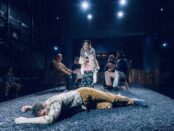
Jessica Burr’s Blessed Unrest production of Marguerite Duras’ "La Musica Deuxième" in the 1992 translation by Barbara Bray is like a violent Jean Paul Sartre short story directed in the cool style of filmmaker Éric Rohmer. Whether this is best for the material, you will have to decide for yourself. Aside from the 2023 film of Duras’ play Suzanna Andler, this is the first New York presentation of one of her plays since Savannah Bay at the Classic Stage Company in 2003. [more]

Hell’s Kitchen on Broadway
The new musical "Hell’s Kitchen" has made a successful transition to Broadway from The Public Theater and the new version seems to have corrected some of the flaws from before. This juke-box musical with a score by singer/songwriter Alicia Keys and a book by playwright Kristoffer Diaz (The Elaborate Entrance of Chad Deity), is a big ambitious show, a love letter to New York, and inspired by the coming of age story of Keys’ 17th year. It is no longer over-miked by sound designer Gareth Owen, characters seemed to have deepened, the plot seems to have gelled into a distinct coming of age story, and the redesigned set by Robert Brill has moved much of the action closer to the audience. It is a crowd pleaser with the iconic Keys’ songs “Girl on Fire,” “Fallin’” and “Empire State of Mind.” Excitingly performed by its cast made up of a handful of characters and a large ensemble of 15 singer/dancers, its most famous leads Shoshana Bean and Brandon Victor Dixon as Ali’s parents are given less to do as this is the daughter’s story. In the leading role of 17-year-old Ali, making their professional Broadway debut, is Maleah Joi Moon who proves to be an exciting musical personality who can hold a show such as this together. [more]

Uncle Vanya
Things are not helped by Mini Lien’s bland setting that looks more like a furniture showroom than the family manse held for decades and passed down to the present inhabitants. The new adaptation reduces the plot to one more dysfunctional family story while Chekhov is always more than that. Even more damaging is that the direction by Lila Neugebauer (best known for new plays by Sarah DeLappe, Zoe Kazan, Kenneth Lonergan, Brandon Jacobs Jenkins, Tracy Letts and Annie Baker) has staged the play so that it is in isolated conversations, one that should be called Scenes from the Life of Uncle Vanya. The lighting design by Lap Chi Chu and Elizabeth Harper highlights this by isolating various characters with light changes. Kay Voyce's costumes, except for the surprising brightly caftans of the grandmother, are characterless and monochromatic. [more]

Sally & Tom
In the very first scene it becomes apparent that we are watching "The Pursuit of Happiness," a new play from the Good Company, an indie theater group that has been known for radical and experimental work that no one came to see but now wants to reach a wider audience and find a producer who will foot the bill. African American playwright Luce is in an unmarried relationship with her director and costar Mike, similar to that of Sally and Tom whom they are playing, and just like Sally Hemings who bore Jefferson six children, Luce discovers that she is pregnant. The play alternates between scenes backstage among the actors in their dressing rooms and onstage as they rehearse the play with opening night only two days away, making changes as they go along. [more]

Scarlett Dreams
A good deal of fun is had by Brian Pacelli’s projection design which is shown on the modern and chic living room/dining room set by Christopher and Justin Swader. It takes us to the virtual reality world inhabited by Scarlett and later Kevin: forests, deserts, jungles, icescapes which change at the drop of a hat. It also lets us keep track of Kevin’s progress with fitness data and the success of the RealFit apps as to the number of new users. Emily Rebholz has created an attractive collection of clothes in monochromatic colors for these fitness-oriented people. The lighting by Jamie Roderick enhances the set and projections by changing the mood each time we find we are projected somewhere else. [more]
Macbeth (an undoing)
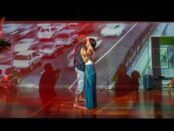
In attempting to make a feminist statement out of Shakespeare’s "Macbeth", Harris has made Lady Macbeth into the same murderous monster that her husband became in the original. This does not seem to further the feminist cause that if women were in power they would do things differently. Lady Macbeth’s treatment of Lady Macduff (kidnapping her back from her home, attempting to take her child away, etc.) makes her almost worse than Shakespeare’s protagonist. Having eliminated most of the scenes outside of the Macbeth Castle, the second half seems both long and repetitious as things get worse and worse for the new queen. The famous “Tomorrow and tomorrow” soliloquy is rather chopped up so that it does not make her sympathetic as it did Macbeth when hearing about his wife’s suicide. [more]
Lempicka
In telling the life story of Tamara de Lempicka, the show begins with a fascinating premise. Unfortunately, neither the score nor the book lives up to her high standards. Unlike "Sunday in the Park with George" which showed us the workings of the artistic process, "Lempicka" is more interested in the social aspects of the 1920’s and 1930’s Paris than in Tamara’s revolutionary paintings. The cast works hard to put over the new musical but they are defeated by commonplace situations, banal song lyrics, and over-used pronouncements. The musical of Tamara de Lempicka’s life still has to be told. [more]
Las Borinqueñas
Nelson Diaz-Marcano’s "Las Borinqueñas," the latest play in the Ensemble Studio Theatre/Alfred P. Sloan Foundation’s Science and Technology Project, has a fascinating, little known story to tell: the preliminary trials that led to the creation of the birth control pill which took place in Puerto Rico in the 1950’s up until 1960 when it was approved by the Food and Drug Administration. However, the play has too many characters each with a different story and too many themes that are not fully explored. Another problem for English speakers is that much of the play is in untranslated Spanish, all of the jokes and a good deal of the back and forth between the women. One assumes that this is for authenticity but it makes the play challenging for theatergoers who don’t know Spanish. Director Rebecca Aparicio keeps the play’s events swiftly moving along but does not compensate for the script’s deficiencies or confusing attempt to convey too much information. [more]
The Reef (opera workshop)
On April 10, 2024, Merkin Hall at Kaufman Music Center presented a tantalizing teaser of a musical evening with the world premiere workshop of only the first act of 2020 Pulitzer Prize-winning composer Anthony Davis’ new opera, "The Reef." With a libretto adapted by Joan Ross Sorkin, from the 1912 novel by Edith Wharton, this was the first time that the work has been adapted for the stage, though it has been filmed as Passion’s Way. The workshop was sponsored by the Berkshire Opera Festival using a cast of emerging artists all of whom were vocally capable of singing the work. [more]
Fish
Aside from its attempt to cover too much at one time (drug addiction, pregnancy, incarceration, high school dropouts, gun violence, lack of health care, underfunded ghetto schools), "Fish" does not tell us anything we don’t already know. It will come as no surprise that public schools teach to the test, truancy is a big problem and students fall asleep in class after working jobs at night to help pay the rent, or that charter schools are better funded than public schools. Nor does it have any answers other than that teachers should be more understanding of students’ home situations and help to do something about inadequate facilities and supplies – other than pay for missing supplies themselves. [more]
Water for Elephants
Playwright/bookwriter Rick Elice has written the greatest jukebox musical (so far) in his 2005 Jersey Boys. In his adaptation of Sara Gruen’s bestselling novel Water for Elephants, he may just have written the best stage musical about circuses by making the animals as real as the human characters. The indie folk band Pigpen Theatre Co. has written a varied collection of songs, ingeniously orchestrated, that are always exciting as they both forward the story and reveal the emotions of the people who sing them. However, it is director Jessica Stone assisted with circus design by Shana Carroll who has done the most inventive and original work. [more]
The Notebook: The Musical
While the characters age, the use of diversity here has them switch races, so that while one couple has a Black Allie and a white Noah, another has a white Allie and a Black Noah, as well as Allie’s parents being played by an interracial couple. Although it is easy to follow, it is somewhat distracting until one gets used to it. The setting has also been updated from the 1940’s to the 1960’s so that Noah fights in Vietnam now rather than World War II. Brunstetter’s book is faithful to both the novel and the movie, except that while the earlier two versions were recounted by the older Noah reading to his increasingly distracted wife from the notebook that she wrote in chronological order, here there are flashbacks within flashbacks, backtracking some of the events. Brunstetter has also made the ending more explicit than either the book or the film, as well as keeping much of the original sentimentality at bay. [more]
An Enemy of the People
The concept of alternate facts was not created under the Trump Administration. In 1882 Henrik Ibsen wrote "An Enemy of the People" in which a medical report that a town’s new spa is polluted by toxic bacteria which will cause an epidemic is contradicted by financial and political interests which will be brought down by the revelation. Amy Herzog’s new American adaptation could not be timelier after the pandemic which we just underwent. This forceful and vigorous production led by television stars Jeremy Strong ("Succession"; "Masters of Sex") and Michael Imperioli ("The Sopranos"; "The White Lotus") is robustly staged by Herzog’s own husband, controversial director Sam Gold. This is a play that has been staged when needed at various times in our history such as Arthur Miller’s adaptation during the McCarthy Era. [more]
Eddie Izzard: Hamlet
In this tour de force, Izzard has come up with a different voice and stance for each character: King Claudius is a baritone, Lord Polonius has a limp, Lady Ophelia has a somewhat breathy speech pattern while Queen Gertrude is very emotional. The gravediggers are given two different lower class accents and the humor in the scene is still very vivid. The courtier Osric, who is usually played as somewhat fey, waves his hands around a great deal. The duel scene between Hamlet and Laertes in the last act is mostly successful but eventually it becomes difficult to figure out who is winning and who is losing. [more]
Corruption
Playwright J.T. Rogers ("Oslo", 2017 Tony Award for Best Play) specializes in dramatizing the backstories to true scandals of which the real details behind the facts never made the news. His latest play, "Corruption" at the Mitzi E. Newhouse Theater, is based on the book Dial M for Murdoch: News Corporation and the Corruption of Britain by Tom Watson and Martin Hickman, the story of the widespread hacking scandal by the News of the World in Britain by two of the main characters in his play. While "Corruption" is fascinating in its evil details and frightening in its all-inclusiveness (no one was exempt neither government ministers, the metropolitan police, the royal family, celebrities or the general public), it is also extremely dense in its characters, has too many scenes, and is very difficult to wrap your head around all of the facts. Bartlett Sher’s production keeps the 46 characters played by 13 actors distinct but his staging is somewhat hampered by the Newhouse’s round configuration and Michael Yeargan’s unit set which has to stand in for a great many places in and around London. [more]
Illinoise
While "Illinoise" does not seem bigger than its individual parts nor transcend them, it is both satisfying and moving. Peck’s inventive and derivative choreography at the same time seems to pay homage to his teachers and sources but also is in his own style. Some will find "Illinoise" an emotional experience; others will be impressed by the vigor and high spirits of the dancers and singers. Several of the dancers should be come much better known through their roles in this work. Last but not least, Sufjan Stevens’ 2005 score is remarkable in its continued vitality after all these years. [more]
The Effect
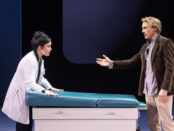
Soutra Gilmour’s setting is a sort of empty runway with the audience sitting on either side. The other props are two black chairs at either end for the two doctors. Scenes are created entirely by Jon Clark’s impressive lighting which turns a portion of the stage into a white square, the rest being kept in darkness. Since Connie and Tristan meet in various dorm rooms, doctor’s offices, examination rooms, etc., there is no sense of place. The problem is that each scene looks the same as the previous one and the many scenes covering the four weeks tend to become tiresome without an intermission to break the mood. Gilmour’s costumes which put the doctors in all black and the patients in all white are equally monotonous. [more]
Bedlam’s The Assassination of Julius Caesar as Told by William Shakespeare and George Bernard Shaw
The play is treated like a rehearsal (a conceit also used by Bedlam in their incomprehensible and lame "Henry IV" workshop in Brooklyn in 2023) with the director (Andrew Rothenberg who also plays Shaw’s Caesar) stopping the action periodically and breaking the mood. The costumes (production designed by director/adapter Eric Tucker, wardrobe supervisor Damarius Kennedy) are contemporary; whether this is supposed to be rehearsal clothes or a modern dress version is never made clear. (It is obviously cheaper than having to create period correct Egyptian and Roman costumes.) In terms of continuity, there are two Caesars: Rajesh Bose as Shakespeare’s Caesar and Rothenberg as Shaw’s which destroys any transition from one play to another. In fact, the segues from one text to the other are non-existent with one scene following another from the other play without any transition. [more]
The Ally
Itamar Moses’ 'The Ally" is a play of ideas not only torn from today’s headlines but tomorrow’s as well. Ostensibly dealing with the Israeli-Palestinian question on college campuses today, it also deals with censorship, anti-Semitism, racism, capitalism, colonialism, patriarchy and white supremacy. The play protagonist, a Jewish liberal teacher on a college campus, is asked to sign a social justice manifesto and finds that it challenges his political, marital, academic, American and Jewish beliefs. This is a good deal for one play to take on, possibly too much, but Lila Neugebauer’s production for The Public Theater almost gets all of it right for this provocative and heady play, with one caveat. [more]
Brooklyn Laundry
John Patrick Shanley has become our poet of lonely, desperate working class people trying to make a connection despite their inadequacies and hang-ups in such plays as "Danny and the Deep Blue Sea," "Savage in Limbo," "the dreamer examines his pillow," "The Big Funk" and "Outside Mullinger" and, of course, in his Academy Award-winning script for "Moonstruck." In all of these works, the pair makes an unlikely couple who fight against their very attachment as outside of the realm of possibility. In his latest play, the bittersweet "Brooklyn Laundry," he creates another lovely story of an unlikely couple Fran and Owen who find each other just when they need someone most. [more]
The Script in the Closet
Playwright Joyce Griffen’s idea of farce in her new play "The Script in the Closet" is a series of 48, mostly very short scenes in which to keep the plot going she continually introduces new characters both onstage and offstage as well as new events. Some of the scenes are less than a minute. A good deal of the play happens over the telephone with characters we never meet. The plot is made more and more complicated by new contrivances that have less and less to do with the original premise. Farces usually trigger laughter and have much physical comedy, none of which is present here. [more]
The Seven Year Disappear
While "The Seven Year Disappear" may challenge and confuse many theatergoers, people used to performance art may get the in-jokes. Jordan Seavey whose play "Homos, or Everyone in America" was seen in 2016 in the Labyrinth Theater Company at the Bank Street Theater is a sophisticated, seasoned playwright and he and director Scott Elliott make no concessions to their audience. "The Seven Year Disappear" may be most appreciated by devotees of experimental theater but it does make one hungry for Seavey’s next play. [more]
Deadly Stages
While we could use a good murder mystery stage play, "Deadly Stages" is too derivative to suit the bill. The cast work hard mostly playing multiple roles, but the play seems to have attempted to outdo Charles Busch’s output without having the wit or the cleverness to bring it off. Although "Deadly Stages" has amusing moments, it is a tired retread of better and more subtle works in this genre. [more]
Five, The Parody Musical
When she arrives dressed in a white pant suit, Labeija steals the stage with Hillary’s number “Miss Me Now” which trumps them all with a series of Broadway parodies paying tribute to Clinton’s love of the theater, with recognizable quotes from "The Sound of Music," "Company," "Gypsy," "Chicago," "Evita," "Thoroughly Modern Millie" and "Dreamgirls." However, while all of this is clever, at times the show becomes “can you identify this parody.” A “Six Mixalot” for the company takes the same place as “The Megasix” in "Six." Lena Gabrielle does fine work with the four-person all-female band but the sound design by Bailey Trierweiler, Kevin Heard and Uptown Works is often too loud for this small Off Broadway theater. [more]
Between Two Knees
At the performance under review, part of the audience found the show hilariously funny, while others proverbially sat on their hands. The show makes use of history, parody, satire, burlesque, musical comedy and tragicomedy, never being consistent to any one genre. At two and a half hours this kind of parody seems a bit too long. "Between Two Knees" is a noble effort to tell the story of one hundred years of Native American suffering through the Lakota tribe, but it seems to want to cover too much in too parodistic a style. [more]
Warrior Sisters of Wu
Inspired by 20th century film and video games based on the classic Chinese novel of the 15th century, 'Romance of the Three Kingdoms," Damon Chua’s delightful and engrossing "Warrior Sisters of Wu" takes two minor female characters and puts them center stage. Using the framework of Jane Austin’s "Pride and Prejudice" with the two best characters, male and female, taking an instant dislike to each other but eventually coming to see each other’s good traits, Warrior Sisters of Wu takes place at the end of the Chinese Han Dynasty in 200 A.D. when war is certain and society is changing. Stylishly directed by Jeff Liu for the Pan-Asian Repertory Theatre with top-notch fight choreography by Michael g. Chin, the play is both exciting and romantic including both vigorous swordfights and tender love scenes. Like Mr. Bennett in Austin’s novel, Lord Qiao has a problem: having only daughters, his estate is entailed to his next male heir, the indolent Cousin Xie who comes to visit in order to see about marrying either sister Wan or Qing, who are accomplished swordswomen. However, like Mr. Collins in Pride and Prejudice, Xie is an obnoxious social climber and does not interest either sister, Wan who is engaged to General Zhou Yu in a love match, nor Qing who has not found anyone who is her equal. [more]
The Apiary
Unfortunately, at 70 minutes the play seems skimpy. Structured in a great many short scenes, only one thing happens in each, so that there is a sameness to it all. Basically a two character play with two lab assistants Zora (April Matthis) and Pilar (Carmen M. Herlihy) attempting to come up with new solutions to the problem and spoken in the level-headed tone of scientific investigation, the play does not offer climaxes or high points but moves on the same plane. The four actors playing seven characters remain on the same level without developing or changing. Kate Whoriskey’s direction appears to have eschewed raising tension to make the play more interesting or more dramatic, something it sorely needs. [more]
Munich Medea: Happy Family
Like its unwieldy title, Corinne Jaber’s "Munich Medea: Happy Family" takes its time getting where it is going but is ultimately powerful and revealing in its almost unspeakable tale. It deals with difficult material but finds a way to tell its shocking story that eventually involves many people. Under Lee Sunday Evans’ direction, Crystal Finn, Kurt Rhoads and especially Heather Raffo impress through their characterizations and the baring of their souls. The play never talks down to us but confides in us as though we were complicit in not putting a stop to these long ago horrifying events. This attempt at a modern Greek tragedy is quite successful in a genre rarely seen these days. [more]
Russian Troll Farm: A Workplace Comedy
Sarah Gancher’s "Russian Troll Farm: A Workplace Comedy" is seemingly torn from the headlines - if this were the lead-up to the 2016 U.S. presidential election which pitted Hillary Clinton against Donald Trump. In 2024, it seems rather past its due date. Although it calls itself a comedy, it is not very funny but rather outrageous in its depicting of Russian misinformation intended for the American internet to influence the voters to cast their ballot for Trump rather than Clinton. What Gancher has written cannot make up its mind whether it is a comedy, satire, parody, drama or tragedy or a combination of all the above, which is problematic. Under Darko Tresnjak’s direction, don’t blame the hard working cast led by film and stage star Christine Lahti, all of whom throw themselves into their offbeat roles with abandon. [more]
The Following Evening
Although written and directed by Abigail Browde and Michael Silverstone of 600 Highwaymen, "The Following Evening" is a tribute and a summing up of the 50 year career and marriage of experimental theater legends Ellen Maddow and Paul Zimet, co-founding members of the Talking Band. In the past they were usually seen at La MaMa ETC, but the new show is part of the inaugural season at the Perelman Performing Arts Center (PAC NYC) in the black box theater known as Theater C. The space is perfectly suitable to the minimalist performance piece which includes all four actors. [more]
Jonah
The play is best at its mysteries which are only slowly revealed. However, audience members may be confused part of the time as to the sequence of events and the relationships. A great deal is never resolved. The scene transitions are accompanied by blaring sound and flashing lights (sound by Kate Marvin; lighting by Amith Chandrashaker) which at times suggest that at least one or more scenes may be fantasies. The costumes by Kaye Voyce remain basically the same but Gabby Beans as Ana seems to grow in poise and maturity though very subtly from teenager to maturity. Although set at first 20 years ago, the male characters often talk of permission for intimacy, something that was not common parlance that long ago. [more]
The Greatest Hits Down Route 66
The title of Michael Aguirre’s "The Greatest Hits Down Route 66," the story of the Franco family’s road trip during the summer of 1999, refers to Carl Sandburg’s 1927 "The American Songbag,' a best-selling collection of early folksongs. Aguirre tells us that “the goal is to use music as a memory, an imprint, incidental. It should carry emotional weight but don’t depend on it to move the plot forward.” And that is the problem with the show: the songs are extraneous to the plot and have little impact as most of the 13 songs sung are so familiar, in the musical arrangements of Grace Yukich and Jennifer C. Dauphinais. There are no surprises in the music played by a three piece band and a lead vocalist, Hannah-Kathryn “HK” Wall. Occasionally, the narrator played by Joél Acosta joins in or sings a song himself. [more]
Our Class
Tadeusz Slobodzianek’s "Our Class" is epic in its storytelling and shocking in its specifics. At three hours, the play is never long or boring as every line of dialogue offers new details to be digested as ten lives are laid out for us. While rather busy Igor Golyak’s production is always illuminating, always compelling. The cast of ten mostly young actors, many unfamiliar to New York audiences, are always riveting as they tell their individual and intertwining stories. What may be most shocking is that in Jan Gross’ prose account in his 2001 book "Neighbors: The Destruction of the Jewish Community in Jedwadne, Poland" he reveals was that this is not the only Polish town in which these atrocities against the Jews took place. One realizes why the world premiere of "Our Class" took place in Great Britain and not Poland. [more]
Pride House
While “Pride” has come to stand for Gay Liberation in contemporary times, Beatrice has named her house after Jane Austen’s novel as it is made clear when she names her new guesthouse “Prejudice” at the end of the play. The play’s cast of characters includes mostly real people under their own names: John Mosher, film critic for The New Yorker Magazine; Arthur Brill, decorator and furniture designer; Natalia Danesi Murray, a Broadway actress and later journalist and editor; and Edwin Marshall, an African American dancer in the Ziegfeld Follies. Unfortunately, neither the play nor the program makes it clear that these were all real people or that they were well known in their time. The play also does a certain amount of name dropping (Eva Le Gallienne, Gypsy Rose Lee, Janet Flanner) that may go over the heads of many of the younger theatergoers today. [more]