Articles by Victor Gluck, Editor-in-Chief
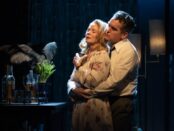
Sean Hayes, up till now best known for his Emmy Award-winning performance as Jack McFarland on "Will and Grace," gives a titanic performance as humorist, raconteur and pianist Oscar Levant once called the wittiest man in America, in Doug Wright’s new play "Good Night, Oscar." Although Levant is not much remembered today, you can enjoy this character study and depiction of early late night television even if you have never heard of him before. While "Will and Grace" has made evident Hayes’ way with one-liners, "Good Night, Oscar" demonstrates that Hayes is able to dig deep in a character portrayal as well. Credit must go to director Lisa Peterson for inspiring this memorable performance. [more]
The Knight of the Burning Pestle
Directors Noah Brody and Emily Young, both of the Fiasco Theater, have neatly trimmed the dialogue and some of the minor characters so that the play comes in at two hours and 15 minutes. However, they have made some choices that work much less well. Except for a rolling doorway to designate Merrythought’s home, Christopher Swader & Justin Swader’s scenic design does not differentiate one scene from another due to its lack of design elements. Other than the musical interludes, the productions lacks atmosphere in all its scenes. They have also used doubling and tripling to the point where it is difficult to keep straight who most of the actors are when they appear on stage in this play that has probably never been seen by most members of the audience. Most distracting is actress Royer Bockus playing three male roles – Merrythough’s son Michael, Little George, and a Servant as well as a horse named George. The role of Venturewell has had a change of gender but as Tina Chilip is still called “Merchant” but does not suggest one in her 17th century matron costume, this remains a little disconcerting. Characters who play major roles in one scene return to play minor roles in others which is more than a little confusing. [more]
The Thanksgiving Play
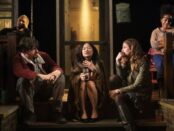
Larissa Fasthorse’s "The Thanksgiving Play" gives a good tweaking to those who are so hung up on political correctness that they dare not make a decision. On the other hand, the play reminds us how difficult it is to be fair to all sides of the historical spectrum. The erasure of the Native American point of view is made clear by their very absence from the play, while the problem of educators knowing how to walk the fine line between inclusion and suitability is given a rare airing in this delightful parody. The use of in jokes, theatrical, historical and educational notwithstanding, "The Thanksgiving Play" is a satire that entertains while it makes some very real and needed points about political correctness when dealing with unpleasant American history. [more]

Plays for the Plague Year
While the playlets seem too slight to have much dramatic weight as they are mainly about one minute long, they do have a cumulative effect summing up a year that was like no other in recent memory. Often the scenes feel like they want to go and continue, but Parks keeps them short. Periodically, we have a one sentence scene telling us how many people have died from Covid as of that date. Beginning on March 13, 2020, the first full day of the shutdown, the playlets continue until April 13, 2021, a year and a month from when Parks started. An electronic sign above the stage states the date of each scene and its name which include such titles as “Home,” “Broadway Is Closed,” “The City at 7 PM,” “Who’s Gonna Pay For This?,” and “Hiatus 4 Months: Holding It Together Together.” [more]
On the Right Track
The latest collaboration by composer lyricist Albert M. Tapper and bookwriter Tony Sportiello, "On the Right Track," proves to be a charming chamber musical for three performers playing seven roles. The show combines realism with magic and the supernatural as it tells three stories which take place on a New Jersey Transit train. The Conductor, the narrator, also is a mystical figure who is able to give the characters second chances in life and lea them to a better place than when they came on board. Owing some inspiration to such classics as Sir James M. Barrie’s "Dear Brutus", Sutton Vane’s "Outward Bound" and Frank Capra’s "It’s a Wonderful Life," "On the Right Track" avoids being preachy at the same time that it offers suggestions about how to live one’s life. [more]

Camelot
Unfortunately, though Sorkin may have made this "Camelot" more politically correct, scientifically accurate and less supernatural, it is much less entertaining and magical than earlier productions and certainly much darker as well as less funny. Whereas the original 1960 Broadway production billed itself as “the most beautiful show in the world,” Bartlett Sher’s revival has an almost empty grey stage most of the time (designed by Michael Yeargan) and drab costumes from Jennifer Moeller. Although the cast has 25 performers, the court scenes always look underpopulated as though not enough courtiers have shown up and there is almost no pageantry which one expects for a royal court of the Dark Ages or the Middle Ages. [more]

Emilie: La Marquise du Châtelet Defends Her Life Tonight
Gunderson uses two actors to play Emilie and writer Voltaire who was her mentor, companion and lover, and then three actors to play everyone else, from Emilie’s mother, husband and daughter, to servants and mathematician Sir Isaac Newton and poet Jean-Francois de Saint-Lambert. As they do not change their costumes, we are never entirely certain who they are when they reappear. Throughout the play Emilie is working on the physics formula F=mv2 (known as force vive) which she attributes to German mathematician and thinker Gottfried Wilhelm Leibniz. Unfortunately, this math will be foreign to most theatergoers who have not studied physics. Emilie narrates and addresses the audience, then turns back and interacts with the other characters on stage. She also keeps score in chalk on the walls as whether Love or Philosophy is in the ascendance. The play, cast as a flashback, has very short scenes so that a great deal passes in a short time. While the first act seems to be bits and pieces, the second act settles down into a more dramatic confrontation between Emilie and Voltaire and becomes more involving. MacGowan never finds the right tone to accomplish all of this. [more]

Smart
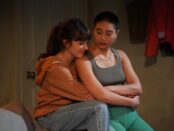
Mary Elizabeth Hamilton’s Smart has an interesting premise but does not carry out its goal turning quickly into a domestic drama and later a bittersweet love story. The two acts seem to be two different plays while the sketchy characters do not give the fine three actresses much to work from. Even the production values get in the way of understanding the play. Hamilton has a good ear for dialogue but needs to work on plotting and characterization in order to make this a satisfying theatrical experience. [more]

Life of Pi
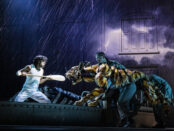
"Life of Pi" is a unique theatrical experience with its animal puppetry, depiction of days on the ocean, and bringing to life an Indian city, circa 1977. It tells a fantastical story with brio and flair making use of all of the theatrical arts. With a cast led by Olivier Award winner Hiran Abeysekera, you could not imagine anyone else in these roles. However, the playwriting and the production do have their flaws which are eventually overcome by its theatricality and storytelling. Kudos to director Max Webster for orchestrating the production so well. [more]
Vanities – The Musical
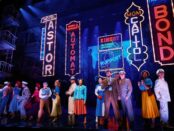
Although the women grow up and change over the 26 years we see them, Heifner’s book tends to stay away from politics and the women’s movement other than mentioning markers like Kennedy, Nixon and Bob Dylan. However, the dialogue is bright and lively. The show is definitely a period piece ending as it does in 1990 but there are probably women who still live these lives. While in no way taking a feminist point of view, the characters do evolve and change over the years. [more]
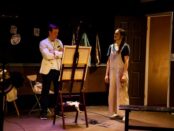
The Harder They Come
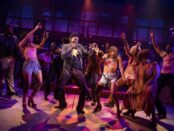
Celebrating the 50th anniversary of its original film release, Pulitzer Prize-winning playwright Suzan-Lori Parks has turned "The Harder They Come," the cult Jamaican film that starred later reggae legend Jimmy Cliff, into an exuberant stage musical now at The Public Theater. Led by British stage star Natey Jones and American Caribbean actress Meecah, the large cast does full justice to the new score which includes the ten songs used in the movie plus 26 other Jamaican and traditional songs, additionally interpolated ones by Cliff and others, and some with additional lyrics by Parks. There are also three original songs by Parks herself who when she is not involved with one of her plays fronts her own rock band. [more]
Bad Cinderella
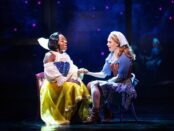
The book of "Bad Cinderella" plays like a series of unfunny "Saturday Night Live" sketches. Laurence Connor (who also directed the earlier London production) has given the show no particular style and each scene seems to be in another genre. The show can’t decide if it is taking place now - with its references to rock band Guns N’ Roses (parodied in the song “Buns ‘n’ Roses”),its use of both diversity and inclusion, a female Vicar, its erotic baker, reference to a “spare” prince, and its shirtless muscle hunks seen in the palace gym – or the Middle Ages. [more]
The Good John Proctor
Unfortunately, Monohon’s play which takes its cues from Miller’s drama, assumes a thorough knowledge of "The Crucible" and leaves out a great deal of information that would make it easier to follow. For example, John Proctor’s name is never uttered by the girls even after Abigail goes to work for him and his wife in the play. Caitlin Sullivan’s direction is too tame by far so that the play is not very dramatic. The most exciting event, the trial itself, is left as an afterthought and narrated years later by one of the girls after her death. [more]
Arden of Faversham
The problem with this production is that although the characters’ behavior is utterly outrageous on the verge of satire, Berger has directed in so flat and bland a style, that shocking lines that should get embarrassed laughter fail to make any impression. Has Berger directed the play absolutely straight knowing that his audience is unlikely to be familiar with it? It would be more fun and rewarding if was as over-the-top as the murderers’ plotting. [more]
The Hunting Gun
Not for everyone, this minimalistic theatrical event is performed entirely in Japanese with English language supertitles above the stage so that for non-Japanese speakers it requires reading of the text throughout. More’s the pity as Nakatani is a very expressive actress (having won six Japanese Academy Awards) and one doesn’t want to miss a moment of her performance. [more]
A Doll’s House
Like Ivo van Hove’s pared-down revival of Arthur Miller’s "A View from the Bridge," Jamie Lloyd’s new Broadway production of Henrik Ibsen’s 1879 "A Doll’s House" uses no sets or props and all black costumes for the entire cast. Going even further than van Hove, he has the heroine Nora Helmer played by film star Jessica Chastain seated almost for the entire length of this intermission-less three-act play. Using a new version by Amy Herzog recast in spare modern vernacular, this Doll’s House proves to be riveting and intense, even if you know the play very well, focusing our attention on the dialogue, the acting and emotion, rather than the décor and the historical trappings of 19th century Norway as we usually do. [more]
The Rewards of Being Frank
While playwright Scovell has a facility for language, she does not have the wit to mimic Wilde’s classic one-liners. Instead, she borrows expressions from the play and attempts to imitate the format of his humor. Lines like “It is imperative to be an attentive hostess, but never forgot that you are your most important guest” and “I’m glad to hear that your fervor for the truth is tempered by your humanity” pass for witticisms. Much time is spent on whether a wedding was “elegantly extravagant” or “extravagantly elegant.” The opening scene of the first act (and the end of the second act) is devoted to a discussion of cucumber sandwiches, which Wilde did justice to in his play and as such this comes as no surprise to an audience versed in the earlier work. [more]
Crumbs from the Table of Joy
While this first New York revival of the 1995 "Crumbs from the Table of Joy" does not reach the heights of Nottage’s later Pulitzer Prize-winning plays, "Ruined" and "Sweat," it proves to be a very charming and competent look at growing up Black in Brooklyn during the McCarthy Era. Under the direction of Colette Robert, the fine cast holds our interest with this domestic comedy drama. Always engrossing, the play demonstrates Nottage’s ability to write about race, social change and economic deprivation in an engaging manner. Nottage proves to have been a very accomplished playwright from the outset of her career. [more]
1+1
Eric Bogosian’s latest play to reach New York is his 2008 "1+1" which feels like a made for television movie written without taking into consideration the #MeToo movement that has occurred since then. While its Hollywood milieu of pornography, drugs, and easy money exists, this seems like a rather simplistic view of it all. Director Matt Okin, founder of The Black Box theater company of Englewood, N.J. which has coproduced the play now at the SoHo Playhouse, has done the actors no service allowing for a kind of soap opera acting. The minimalist production values undercut the discussion of the perks and glitz of the film world. [more]
Public Obscenities
Shayok Misha Chowdhury’s "Public Obscenities" having its world premiere at the Soho Rep is an immersive story into Bengali culture in Kolkata, formerly known as Calcutta. Directed by the author in 12 episodes which are given chapter names, this two hour and 50 minute play is as much like a television mini-series as it is a family saga. The realistic production resembles a film as much as it is possible on a stage with our attention being guided to various alcoves as though they were film cuts on the remarkable setting by the collective dots. The play is challenging as the first long extended scene is mainly in Bangla, the language of Kolkata, without supertitles. While the rest of the play is translated when it is bilingual, the dialogue is studded with Bangla words which are left up to the audience to figure out. [more]
The Sign in Sidney Brustein’s Window
Unfortunately, the latest revival now at the BAM Harvey Theater cannot be counted as having reversed the play’s fortunes. It still seems vastly overwritten and verbose as it attempts to cover too many topics (political corruption, anti-Semitism, racism, artistic fulfillment, prostitution, drug addiction, marriage, homosexuality, etc.) Almost no social issue of the day except foreign politics has been left out. At a current running time of three hours and five minutes with one intermission, the play seems long and lugubrious though it has a great deal to say that is admirable and prescient. The script being used could see a judicious edit and a pruning of topics covered. [more]
LOVE
Alexander Zeldin’s "LOVE" seems much longer than it actually is due to much silence and the reenactment of everyday tasks usually skipped onstage in plays. There is little dialogue and what there is tends to be rather ordinary talk about daily living. The play mainly works as a sort of experiment in the way that the Federal Theatre Project dramatized burning issues in the 1930’s. However, the play is a valuable record of life in a shelter using a documentary approach so real that it makes us feel like voyeurs. While the title remains unexplained, by the end each of the adult characters get to say it as a reminder that they have the backs of the others. [more]
The Seagull/Woodstock, NY
Aside from the problem of which translation from the Russian to use, the thorny problem with American productions of the plays of playwright Anton Chekhov is how to deal with the fact the author himself called them comedies but everyone from his early director Konstantin Stanislavski on has seen them as tragedies. Playwright Thomas Bradshaw has neatly solved both problems: in his new adaptation renamed "The Seagull/Woodstock, NY" which recasts the play as an updated modern comedy, he also made the play a very funny satire of today’s culture vultures, thespians and the literati. His version in which all of the names have been Anglicized makes Chekhov’s turn-of-the-last century play very accessible to contemporary audiences which is not often the case with Chekhov adaptations - without making drastic changes. In doing so, it makes whatever parody there was in the original of theater and literary icons of Chekhov’s time now understandable to today’s audiences due to updated references they can recognize. [more]
Becomes a Woman
Originally entitled "Francie Nolan," the same as the title character of her later "A Tree Grows in Brooklyn," but unrelated to that story except for sharing its Brooklyn setting, the play does incorporate anecdotes and scenes that would later appear in Smith’s novels. "Becomes a Woman" is uneven in tone, with a first act that is comedic, a second that is melodramatic, and a final act that is dramatic. On the one hand, the play is now a period piece depicting strict mores and values that have loosened up a great deal; on the other hand, much of its cavalier treatment of women is still unfortunately true today. While the first two acts resemble a great many films and plays of the 1930’s concerning fallen women, it is the third act which is progressive and ahead of its time, so much so that it may have scared off the all-male producing fraternity of those days. While the women are beautifully written, the male characters are undeveloped and not believable. As a result, the acting is the same with the best performances by the actresses and some unreal work by the men. [more]
A Bright New Boise
The second play of Samuel D. Hunter’s residency at Signature Theatre is the first New York revival of his 2011 Obie Award winning 'A Bright New Boise," not seen by too many people in its short schedule run at The Wild Project in the fall of 2010. Oliver Butler’s production is a taut drama with rising tensions throughout until the climax. At first appearing to be a workplace drama set in big box store breakroom, the play turns out to be a meditation on faith, relationships and expectations. The ensemble cast is excellent and makes this a riveting piece of theater. The title is ironic in that all of the characters are going through crises and do not see the promise of a new world, in fact, they are mostly pessimistic about the future. [more]
Cornelia Street
Although British playwright Simon Stephens has written three musicals with composer/lyricist Mark Eitzel, formerly of the indie rock band American Music Club, Cornelia Street, set on a quiet back street in the West Village, is the first to arrive in New York where it is having its world premiere courtesy of Atlantic Theatre – Stage 2. Led by two-time Tony Award winner Norbert Leo Butz who is on stage almost throughout the show, "Cornelia Street," an elegy for a bygone age of unique Village restaurants and coffee houses, does not give its cast enough to do. The songs do not forward the plot but tell us what we already know, and the plot such as it is does not get going until the second half. An interesting attempt to create a place and its regular denizens on stage, "Cornelia Street" in this form does not make a satisfying statement. [more]
The Wanderers
The latest play to reach New York by Anna Ziegler, author of 'Photography 51," "Boy," "The Last Match" and "Actually," has a complicated structure she appears to have invented. "The Wanderers," her fascinating study of faith, love and fulfillment, parallels two Jewish couples a generation apart who appear to have been each other’s destiny (the Jewish concept of “bashert”) but who do not seem to be able to live together successfully. The play also has an email correspondence between a celebrated and controversial novelist and a Hollywood film star played by Katie Holmes, who really is a Hollywood film star. Barry Edelstein who also directed the play’s world premiere at The Old Globe theatre in San Diego keeps the separate parts bubbling along but without achieving the depth of character that the play implies. [more]
She’s Got Harlem on Her Mind: 3 Plays by Eulalie Spence
The problem with rediscovering lost plays from the past is that works that are 100 years old may have gotten dated or express views no longer held. Back in the 1920’s, Harlem Renaissance author Eulalie Spence wrote a great many prize-winning one acts for which she could not get full productions. Metropolitan Playhouse is correcting that oversight by offering an evening of three of these entitled "She's Got Harlem on Her Mind." Unfortunately, they play like short stories rather than fully formed plays. As the characters are mainly grifters and con-artists, they do not show African-American life in the 1920’s in a very good light. A great deal of care and thought has gone into Timothy Johnson’s production which is set in 1927 including period songs between the plays and before and after, but his direction is often too slow and much of the acting is too studied to be naturalistic. [more]
Twelfth Night (The Classical Theatre of Harlem)
When the Countess Olivia played by glamorous Christina Sajous declares “How wonderful!” in the final scene of The Classical Theatre of Harlem’s return engagement of its production of William Shakespeare's "Twelfth Night," she most likely has the whole audience in agreement. Director Carl Cofield has created a colorful, imaginative and humorous staging of a romantic comedy classic that usually has two melancholy leading characters and is not very funny. Add music and dance to the talented cast led by the dynamic Kara Young as well as visual stage pictures which are very cinematic and you have a top-notch revival for audiences of all ages. [more]
Lady in the Dark
Unfortunately, this is musical comedy and does not need operatic voices, Lawrence being famously a singer with a very small range, while Kaye came from cabaret and night club. With all of the leads double cast, Sunday matinee’s singers seemed either miscast or poorly directed by Eric Lamp and Benjamin Spierman. Matthew Imhoff’s sets which are carried on and off by the singers took an inordinately long time and there were moments of dead time during office scenes which also seemed underpopulated. While conductor and artistic director Michael Spierman gave a creditable performance of the complete score, it did not seem to hang together but felt like individual numbers, unlike many other Weill scores which feel integrated and whole. [more]
Asi Wind’s Inner Circle
"Ari Wind’s Inner Circle" is so incredible that it defies the imagination. Can these be called sleights of hand when we see everything that happens at all times? It is the sort of show that you just have to see for yourself and experience firsthand to believe. Not even magicians have been able to explain many - or all - of the tricks. It would be unfair to describe the tricks more completely – though how they are handled will completely amaze and dazzle you. [more]
F*ck7thGrade
Singer/songwriter Jill Sobule’s life story is on display in the charming cabaret musical "F*ck7thGrade" – with a difference. Sobule, the original “I Kissed a Girl” composer/lyricist, plays herself in this one-woman musical which features a band of three voicing other roles. The score is made up of her greatest hits plus four new songs. Since so many of her songs are autobiographical, they segue beautifully into the story of an unhappy childhood and later success as a performer and writer. Liza Birkenmeier’s book is based on months of interviews with some of the names changed while others are left intact. [more]
Colin Quinn: Small Talk
"Small Talk," like its title suggests, is less unified than Quinn’s earlier shows. He also uses its format to wander from topic to topic, seemingly randomly without much structure. It allows him to focus on his pet peeves which seem to be the real topic of the show. While some of his earlier shows were big on humor, this one is more interested in provoking thoughts than laughs. [more]
Memorial
Not only is Livian Yeh’s "Memorial" revealing in its historic depiction of a recent piece of American history, it is additionally a very satisfying dramatic work. It is also very pertinent now with its depiction of racism against Asians shown to have been just as prevalent 40 years ago, as well as how deeply ingrained our unexpressed prejudices go. Jeff Liu’s direction mines all of the play’s nuances, twists and turns. The superb design adds greatly to bringing the play to life, suggesting more than is actually on the stage. With this world premiere, the Pan Asian Repertory Theatre has a current winner as well as a play that should travel well to other theaters around the country. [more]
Not About Me
Eduardo Machado’s 11th play to premiere at Theater for the New City is called "Not About Me" which is a complete misnomer as it is about his life for the last 40 years with his alter ego at its center. Marketed as a “memory play that takes audiences on a haunting journey through the mind of a playwright during Covid-19 lockdown,” in fact, it is about his friends who died during the last pandemic, the mysterious “gay disease” that came to be called AIDS. Other than as a tribute to those lost friends, it is difficult to see the message of the play as it depicts a great deal of risky behavior. [more]
The Dog Show
Ivan Faute’s "The Dog Show" is ambitious in trying to tell a story by holding back on the details. Unfortunately, the method has grave, unresolved problems. For most of the first act we have no idea why it has been given this title. Neither the direction nor the script allows the performers to develop their characters who remain at the end the same as at the beginning. There is a play buried in this material but as of now it has not surfaced. [more]
The Collaboration
While Bettany and Pope are each very convincing as Warhol and Basquiat since they are made up to look exactly like they did in life, they seem to be in two different plays, using different acting styles. The other problem with "The Collaboration" is that it feels very superficial, like a laundry list of items for them to discuss, while at least several of the dramatic devices are taken out of context or are relocated in chronology. It is certainly a fascinating premise: an older famous and fabulously successful artist whose star is fading and a younger rising star who has taken the art world by storm and seems to be unstoppable, brought together by their shared dealer. [more]
H.M.S. Pinafore (NYGASP)
While Albert Bergeret’s old-fashioned production does not sparkle, it is a solid, steady ship that satisfies with all its jokes intact plus a few new ones like the hilarious drunken scene between the captain and the First Lord of the Admiralty. Associate conductor Joseph Rubin kept the orchestra in close harmony and gave an excellent account of Sullivan’s lilting score. Albère’s attractively realistic scenery looked brand new and created interesting stage pictures. The lovely late Victorian costumes by Gail Wofford helped complete the stage picture. Benjamin Weill’s lighting design bathed the stage in sunlight for the daytime scenes in the first act, and used blues and purples for the evening scenes of the second act. [more]
Truth’s a Dog Must to Kennel
Under the direction of Karl Janes and Andy Smith, Tim Crouch is a very commanding performer, using his resonant baritone to paint pictures with words, holding our attention at all times. Narrating alone he makes us see all he describes from the theater, to the audience, to the landscape on stage and the other unseen actors. However, the play is not for all theatergoers simply because the format is complex and hard to follow and knowledge of the plot of "King Lear" is mandatory. On the other hand, for those who are into experimental theater, this is an exemplary model of the genre boldly pushing the envelope to what is possible. [more]
Ohio State Murders
McDonald is mesmerizing as she speaks Kennedy’s strong, clear, poetic and evocative prose. We never forget that McDonald’s Suzanne Alexander is giving a lecture but she changes ages in an instant as she becomes the wide-eyed and innocent college student in love with learning and new ideas, and then return to being the mature author with a shocking story to tell. McDonald shifts beautifully between idyllic scenes of college life, the ugly face of racism in the dorm and on campus, and the off-stage violence that defines the murders. While the play is not told in strict chronological order there is no problem in following the story of these few years in the early 1950’s that shape Suzanne Alexander’s life. [more]
Des Moines
Michael Shannon, Hari Nef, Heather Alicia Simms, Arliss Howard and Johanna Day in a scene from [more]
Becky Nurse of Salem
In any event, Ruhl has not written a play set in 1692 or a sequel to "The Crucible" but a comedy about free-spirited Becky Nurse, a descendant of the accused witch Rebecca Nurse, a pious 71-year-old woman who had nine children and was hard of hearing, who wishes to set the record straight. Although a fascinating premise, the problem with play is that it throws in everything except the kitchen sink – but, in fact, it makes use of metal freestanding toilet. The play attempts to cover multiple themes and topics: revisionist history, the opioid crisis, the generation gap, teenage suicide, the Salem Witch Trial, unemployment, medical care, the supernatural, adultery, and office harassment. Conceived and written between 2016 - 2019, the play also tries to connect Trump Rallies in which the crowds shouted “Lock her up” and Trump’s repeated use of the words “witch hunt” and his attempt to appear the victim to the hysteria of the Salem Witch Trial in 1692. All of this is too much weight for any one play. Director Rebecca Taichman’s uneven production does not help, though much of that is the fault of the shift in tone in the writing. [more]
The Weak and the Strong
Erik Ehn’s title "The Weak and the Strong" taken from St. Paul may refer to the bad choices that some people make that others avoid, but it seems to only reinforce the clichés of most western films. The storytelling and production are mostly so obscure that the play becomes tedious as it is so difficult to follow. With a 70-minute first act, the play seems extremely long and overwritten. It is to be hoped that the play finds an audience that can follow its circuitous path to its conclusion and in its poetic speech and metaphors. [more]
Ain’t No Mo’
Jordan E. Cooper’s scathing new racial comedy, "Ain’t No Mo’" has made the successful transition to Broadway with five of the six original actors from the previous Public Theater staging in 2019 and a more elaborate physical production from an almost entirely different design team. Delving into Black life and attitudes now, the play is hilarious, but not laugh-out-loud funny, rather it's impressive because of its cleverness, but its satire does not trigger laughter. However, its outrageous form of satire may not appeal to all theatergoers. [more]
Underneath the Skin
Famed performance artist John Kelly has brought his latest show, "Underneath the Skin" to La MaMa, subtitled “A Penetrative Portrayal of a Queer Giant Based on the life and work of Samuel Steward 1909-1993.” Steward had a remarkable life in the first three-quarters of the 20th century as a college professor, a tattoo artist, a pornographer, an unofficial collaborator at the Kinsey Institute and a sexual renegade. He was also a friend of Gertrude Stein and Alice B. Toklas, Thomas Mann, André Gide, had trysts with Rudolph Valentino and Lord Alfred Douglas, and became the lover of Thornton Wilder. Underneath the Skin is a fascinating and engrossing blend of theater, dance, video, erotic art and a gay history of the 20th century. [more]
& Juliet
The cast is a combination of New York stage favorites (Stark Sands, "Kinky Boots," and Betsy Wolfe, "Waitress," "Falsettos" and "The Mystery of Edwin Drood"), new faces (Lorna Courtney, Ben Jackson Walker, Justin David Sullivan) and older veterans (opera baritone Paolo Szot and London stage star Melanie La Barrie making her Broadway debut.) The clever book is by writer David West Read previously seen in New York with "The Performers" and "The Dream of the Burning Boy" as well as the long running television series Schitt’s Creek. The show seems to have been influenced by "Something Rotten"(parody of Elizabethan times), "Six "(its updated 16th century costumes by Paloma Young), "Head Over Heels" (reboot of a classic tale wedded to a pop-rock score) and "Moulin Rouge" (the over-the-top staging by director Luke Sheppard and choreographer Jennifer Weber) – but is actually more fun than all of those shows. At times it resembles "Saturday Night Live" skits but knows enough to keep them short and not let any of them go on too long before introducing the next complication. [more]
A Christmas Carol (Jefferson Mays)
Visually the show pulls out all of the stops continually making stage magic. Every scene offers new scenic effects and things that appear impossible but are right there on stage before you, and disappear in a twinkling of an eye to be replaced by new wonders. Beginning with Marley’s hearse in a flashback to seven years ago, Laffrey’s designs include Scrooge’s gloomy office, Scrooge’s staircase which somehow deposits him in his even darker bedroom on the second floor, the depressing all-boys school that Scrooge attended as a youth, Fezziwig’s warehouse (Scrooge’s first real job,) a colorful Christmas panorama filled with food and presents, the poor kitchen of the Cratchit family, the lavish dining room of his nephew Fred, and a brightly lit snow-filled cemetery. Using streaming video projection, a revolving stage and seemingly magic acts, as well as fog and snow effects, the production attempts all things that are possible on a stage. [more]
Sandra
Cale’s story uses many film noir devices from the 1940’s: exotic locale, strange encounters, searching down unknown streets, disappearing characters, a sexy stranger, danger signals avoided, clues that don’t add up, information that turns out to be fallacious, a damsel in distress, stolen objects, moments of high passion, etc. Yet all seem to be used as if for the first time. The elements are time tested, but the story is new. Cale is an excellent storyteller pulling us in with enough hints and clues to keep us interested until the very end. There are moments that sag but he always pulls out us into something new and unexpected. [more]
Evanston Salt Costs Climbing
Will Arbery’s Evanston "Salt Costs Climbing" (set in the city in which the author received his Master of Fine Arts Degree in 2015) is a perplexing experience as it shifts from realism to absurdism to surrealism. Its worthy topics of ecology and climate change notwithstanding, the play’s repetitiousness and unprepared-for events are frustrating as well as the missing backstories. While it begins interestingly enough , it very quickly turns tedious and inexplicable. A noble experiment, "Evanston Salt Costs Climbing" is either for the select few or needs a rewrite or second draft. [more]
Camp Siegfried
"Camp Siegfried" is a new departure for the author of "Small Mouth Sounds," "Continuity," "Make Believe" and "Grand Horizons." Depicting an important piece of history in an age when hate speech is on the rise, the play seems to be attempting something it doesn’t quite achieve. However, it is certainly a worthy effort and an engrossing piece in the theater though it leaves us hungry for more. [more]
The Rat Trap
Noel Coward’s "The Rat Trap" is not only entertaining but seems to have been ahead of its time. Discounted by critics and the author alike when it had its only production until now in 1926, the play turns out to be a cogent exploration of a creative woman’s search for her place in society, one which has no niche for her talents once she is a married woman. The Mint Theater Company does the play justice, restoring its reputation as an Edwardian period piece on the topic of the New Woman who is also a gifted artist. In Sarin Monae West and Elisabeth Gray we see the work of talented performers who we want to see more of in the future. [more]
Where We Belong
Writer/ director/actress Madeline Sayet is an engaging performer. Directed by Mei Ann Teo, her one-woman show “Where We Belong” is an autobiographical tale of her Mohegan roots and her seeking her place in the world as she travels to London to pursue a PhD in Shakespeare. While much of the play contains information and stories that will come as a revelation to most New Yorkers, the play often feels like a lecture with an agenda. The most interesting parts are her own discoveries about her roots and her encounters with other people in which she plays both characters. [more]
Almost Famous
What Crowe has done in writing his own book for the new show is recreate almost exactly every scene in the movie starting from the time when 15-year-old hero William Miller meets rock critic Lester Bangs, including the bus and plane sequences. The best lines in the stage version are recognizable from the film and nothing of equal stature has been added to the version now on stage at the Bernard J. Jacobs Theatre. The new songs credited to composer Tom Kitt with lyrics by Crowe and Kitt add little to the work as they do not forward the story. A good many of the iconic songs from the film make their appearance but as staged by director Jeremy Herrin and choreographer Sarah O’Gleby they are the least effective numbers in the show. [more]
My Broken Language
Hudes has directed her own play in a delightful vaudeville/musical comedy style with dancing between the scenes to choreography by Ebony Williams to live music played by pianist Ariacne Trujillo-Durand, supervised by Alex Lacamoire. Of the five actresses who perform each in their own inimitable style, three of them have appeared in Hudes’ plays before: Daphne Rubin-Vega and Zabryna Guevara (who play the Author twice each) have appeared in two New York productions and Marilyn Torres has appeared regionally in the Pulitzer Prize-winning, "Water by the Spoonful" at The Old Globe, San Diego. By the end of the evening we feel we have met all of the Perez women as well as know what makes the Author tick. [more]
A Delicate Balance
The first Off Broadway revival of Edward Albee’s " A elicate Balance," his first Pulitzer Prize-winning play (of three), is also the first to feature an all Asian American cast as well as being the first New York production of an Albee play to be performed by a non-white cast. A coproduction of Transport Group and the National Asian American Theatre Company (NAATCO), it is has been directed by Jack Cummings III, Transport Group’s artistic director. The production is elegant and polished, if a bit leisurely. However, at two hours and 45 minutes the running time is the same length as the 2014 Broadway revival. The six character cast is led by Mia Katigbak, actor-manager and co-founder of NAATCO. [more]
Topdog/Underdog
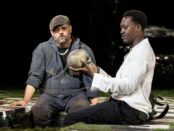
The 20th anniversary revival of Suzan-Lori Parks’ Pulitzer Prize-winning play, "Topdog/Underdog," is just as powerful and absorbing as before with its story of two African American brothers Booth and Lincoln who are searching for the American Dream in opposite ways. Under the astute but leisurely direction of Kenny Leon (Tony Award Best Revivals of "A Soldier’s Play," "A Raisin in the Sun" and "Fences"), rising stars Corey Hawkins (Tony nominated for "Six Degrees of Separation," and appearances in the film versions of "In the Heights" and "The Tragedy of Macbeth") and Yahya Abdul-Mateen II (Emmy Award winner for HBO’s "Watchmen" as well as ensemble awards for the cast of "The Trial of the Chicago 7") give riveted performances in this two-hander. [more]
Straight Line Crazy
Ralph Fiennes’ towering performance as a megalomaniac who changes the face of New York as we know it is worth the price of admission. With his puffed out chest and nose in the air remaking himself physically, he creates a biographical portrait which will go down in the theater annals. Co-directors Nicholas Hytner and Jamie Armitage keep all the data and speechifying fascinating despite what could be the dryness of the material. And let’s not forget David Hare’s achievement to place the 30 year career of builder Robert Moses front and center on stage without overwhelming us with facts and figures but creating drama out of real life confrontations. "Straight Line Crazy" may just prove to be the dramatic high point of this theater season. [more]
What Passes for Comedy
G.D. Kimble’s "What Passes for Comedy" depicts the fascinating era of early live television talk shows and the racism and anti-Semitism which was acceptable in those days. However, it also hints at hilarious comic interludes which it does not deliver. A much better play is hiding in this material and a rewrite could make it a much more successful evening. Its lack of focus camouflages its real intentions which are quite admirable. The play is also hampered by its conventional structure which requires a good many unnecessary exchanges. Nevertheless, this is an admirable attempt at something a little different from the usual run of historical plays on the stage, an absorbing evening even when it is not clear exactly where it is going. [more]
A Raisin in the Sun
Mandi Masden, Tonya Pinkins and Toussaint Battiste in a scene from Robert O’Hara’s production [more]
Montag
While director Dustin Wills has given 'Montag" a superb production, the meaning and message of Kate Tarker’s play remains obscure. Demonstrating female empowerment alone is not enough if the details remain murky and confusing. If the play has any geopolitical message about American-German-Turkish relations, it is entirely lost in the proceedings. The fact that both women are now single parents is not given much significance in the play. One gets the feeling that much of the play has a private meaning for the author who grew up in Germany on the outskirts of a U.S. military community. For those who do not know German, “Montag” is the word for Monday, the day when Clifford Andrews went missing and the women barricaded themselves in the apartment. [more]